SUBERT Sculptures
to
8
1
4
1
3
1
3
2
1
3
3
1
4
2
2
2
1
9
9
7
1
Height
to
Width
to
9
9
9
2
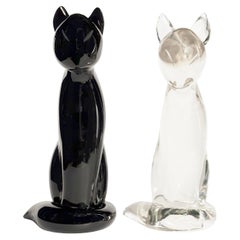
Pair of glass sculptures, Cats, Archimede Seguso, Murano, circa 1960-1970
By Archimede Seguso
Located in Milano, IT
Pair of glass sculptures Cats
Archimede Seguso (attr.)
Seguso Vetri d’arte
Murano, circa 1960-1970
Dimensions:
achrome cat: height 9.45 in x 4.49 in x 5.24 (24 cm x 11.4 x 13.3); ...
Category
Vintage 1960s Italian Other Animal Sculptures
Materials
Murano Glass
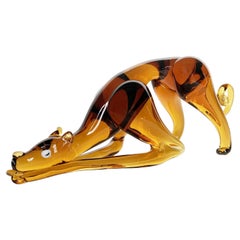
Greyhound - Shaped Glass Sculpture, Flavio Poli, I.V.A.M. Murano, Circa 1930
By Flavio Poli
Located in Milano, IT
Greyhound - shaped glass sculpture
Flavio Poli
I.V.A.M. Murano, circa 1930
It measures 4.72 in in height x 12.59 x 3.74 (12 cm x 32 x 9.5)
It weighs 2.42 lb (1.1 kg)
State of conse...
Category
21st Century and Contemporary Italian Modern Animal Sculptures
Materials
Murano Glass
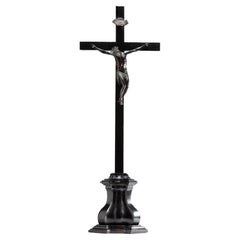
Crucifix, Bronze, iron, and wood, Lombardy, mid-17th century
Located in Milano, IT
Crucifix
Lombardy, mid-17th century
Bronze, iron, and wood
Sculpture: 33 cm height x 35 cm width x 10 cm depth at the knees;
Cross: 42.12 in height x 19.68 in width (107 cm x 50);
Ba...
Category
Antique Mid-17th Century Italian Baroque Figurative Sculptures
Materials
Bronze, Iron
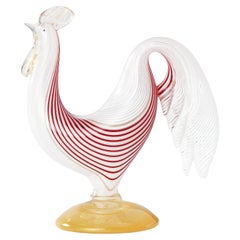
Murano Glass Rooster-Shaped Sculpture, Dino Martens, Venice Aureliano Toso, 1954
By Dino Martens
Located in Milano, IT
Rooster- shaped sculpture Galletto
Dino Martens (1894 - 1970)
Vetreria Artistica Rag. Aureliano Toso, 1954
It measures 9.25 inches in height x 8.18 in x 4.4 in (23.5 cm x 20.8 cm x 11.4 cm)
It weighs 2.57 lb (1.169 g)
State of conservation: intact.
The small glass sculpture...
Category
Vintage 1950s Italian Modern Animal Sculptures
Materials
Glass
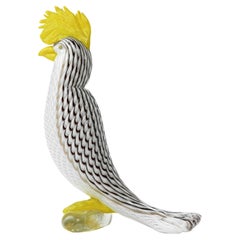
Glass Parrot-Shaped Sculpture, Dino Martens, Venice, Aureliano Toso, 1953-1956
By Dino Martens
Located in Milano, IT
Parrot-shaped sculpture Psitaccus
Dino Martens (1894 - 1970)
Vetreria Artistica Rag. Aureliano Toso, 1953-1956
It measures 9.055 inches in height x 4.13 in x 5.90 in (23 cm, 10.5 cm x 15 cm)
It weighs 1.997 lb (906 g)
State of conservation: intact.
The small glass sculpture...
Category
Vintage 1950s Italian Modern Glass
Materials
Blown Glass
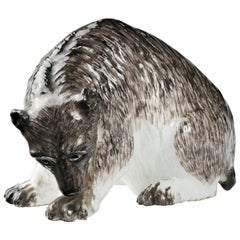
Meissen Porcelain Bear, Johann Gottlieb Kirchner, Johan Joachim Kaendler, 1735
By J.J. Kaendler
Located in Milano, IT
Hard porcelain bear modeled and painted in gray-brown and black
Manufacture of Meissen, by Johann Gottlieb Kirchner and Johan Joachim Kaendler, 1735
It...
Category
Antique 1730s German Baroque Porcelain
Materials
Porcelain
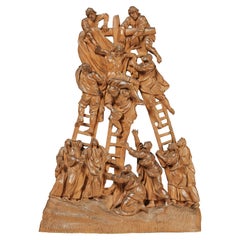
Ancient Boxwood Micro Carving Deposition, First Half of the 18th Century
Located in Milano, IT
Boxwood micro carving
Deposition
Central Europe, first half of the 18th century
It measures: the sculpture 7.40 x 5.31 x 0.6 in (18.8 x 13.5 x 1.6 cm); w...
Category
Antique 1740s European Baroque Figurative Sculptures
Materials
Boxwood
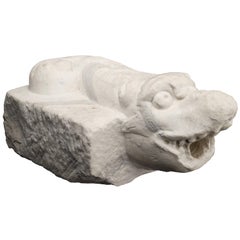
Italian Ancient Marble Sculpture Fountain, Late 16th Century
Located in Milano, IT
Sea monster
Carrara marble mouth fountain
Italy, late 16th century
It measures 13.8 x 31.5 x 18.9 in (35 x 80 x 48 cm)
State of conservation: some small evident gaps and widespread signs of wear due to outdoor exposure. The gray marks crossing it do not come from restoration, but are rather the natural veins of the marble.
This work has some morphological characteristics typically associated with the iconography of the sea monster: an elongated muzzle, sharp teeth, protruding eyes, elongated ears, and a coiled serpent's tail.
An in-depth series of studies on artistic depictions of the sea monster attempted to verify how this symbol evolved in antiquity in the European and Mediterranean contexts and how it gradually changed its image and function over time. The iconography itself is mutable and imaginative and its history is rich with cultural and artistic exchange, as well as the overlapping of ideas. This occurred so much that it is difficult to accurately pinpoint the "types" that satisfactorily represent its various developments.
However, we can try to summarize the main figures, starting from the biblical Leviathan and the marine creature that swallowed Jonah (in the Christian version, this figure was to become a whale or a "big fish", the “ketos mega”, translation of the Hebrew “dag gadol”). Other specimens ranged from the dragons mentioned in the Iliad (which were winged and had legs) to "ketos” (also from Greek mythology), the terrifying being from whose Latinized name (“cetus”) derives the word "cetacean". See J. Boardman, “Very Like a Whale” - Classical Sea Monsters, in Monsters and Demons in the Ancient and Medieval Worlds, in Papers presented in Honor of Edith Porada, Mainz am Rhein 1987, pp. 73-84).
In Italy the monster underwent yet further variations: it can be found in Etruscan art on the front of some sarcophagi representing the companion of souls, while among the Romans we find the “Pistrice” (cited by Plinio in Naturalis Historia PLIN., Nat., II 9, 8 and by Virgilio in Eneide: VERG., Aen., III, 427), which appeared in the shape of a stylized hippocampus or a very large monstrous cetacean and evolved into a hideous being with a dragon's head and long webbed fins.
During the Middle Ages, the sea monster was the object of new transformations: at this time, it is often winged, the head is stretched like a crocodile, the front legs are often very sharp fins - sometimes real paws - until the image merges with dragons, the typical figures of medieval visionary spirituality widely found throughout Europe (on this topic and much more, see: Baltrušaitis, J., Il Medioevo fantastico. Antichità ed esotismi nell’arte gotica, Gli Adelphi 1997).
In Italy during the 15th and 16th centuries, the revival of classicism - representative of the humanistic and Renaissance periods - led to a different reading of these "creatures". Indeed, the sea monster was also to find widespread use as an isolated decorative motif, especially in numerous fountains and sculptures where dolphins or sea monsters were used as a characterizing element linked to water (on this theme see: Chet Van Duzer, Sea Monsters on Medieval and Renaissance Maps, London, The British library, 2013).
From the morphological point of view, the "sea monsters" of this period are mostly depicted as hybrid figures, in which the body of a mythological or real being (a hippocampus, a sea snake, a dolphin), is joined to a head with a rather indistinct appearance. It was usually characterized by large upright ears, an elongated snout, sharp teeth and globular, protruding eyes; a complex and indefinite figure, both from the symbolic point of view and from that of its genesis.
The work we are examining is placed as a cross between the medieval sea serpent and the Renaissance dolphin, with stylistic features which recall the snake as often used in heraldry (such as the "snake" depicted in the coat of arms of the Visconti - the lords and then dukes of Milan between 1277 and 1447 - and which, for some, may be derived from the representations of the “Pistrice” that swallowed Jonah).
In the search for sources, Renaissance cartography and in particular woodcuts should not be neglected. See for example the monsters of Olaus Magnus, from the editions of the “Historia de gentibus septentrionalibus” (“History of the peoples of the north”) and the natural histories of Conrad Gesner, Ulisse...
Category
Antique 16th Century Italian Renaissance Animal Sculptures
Materials
Carrara Marble
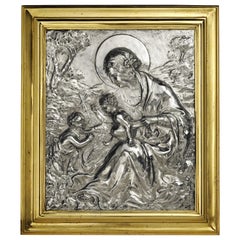
19th Century Italian Sterling Silver Madonna, circa 1830
Located in Milano, IT
Embossed and engraved silver plaque
La Madonna del lago (The Madonna of the Lake)
Probably Milan, post 1824
Brass frame
It measures 16.14 in x 13.85 in (41 x 35.2 cm) and it weighs 10.357 pounds (4.698 g): silver 1.31 pounds (598 g) + brass 9.03 pounds (4.100 g)
State of conservation: some abrasions on the bottom. The frame is old, but not original.
The plaque is made up of a sheet of embossed and engraved silver, and held in a solid brass frame. It depicts the “Madonna del lago” – “Madonna of the Lake” - (the Madonna with Child and San Giovannino) by Marco d'Oggiono (Oggiono, 1474 circa - Milan, 1524 circa), while changing only the background landscape. Almost certainly the subject reproduced in the plaque was taken from a famous engraving by Giuseppe Longhi (Monza, 1766 - Milan, 1831), one of the greatest engravers of his era.
The silver is unmarked, probably because originally the Madonna was due to be exposed in a church: sometimes precious metals destined for worship and liturgical use would be exempted from payment and were, therefore, not marked.
It is very likely that the plaque was made in Milan because in this city in 1824 the engraving by Giuseppe Longhi was made and printed. In addition, in Milan, the alleged lost painting by Leonardo da Vinci in his Milanese period (1482-1500) would be produced; this is the painting from which Marco d'Oggiono took his version.
The painting
Marco d?Oggiono was one of Leonardo da Vinci's most brilliant students and collaborators (D. Sedini, Marco d’Oggiono, tradizione e rinnovamento in Lombardia tra Quattrocento e Cinquecento, Roma 1989, pp. 151-153, n. 56; p. 225, n. 124, with previous bibliography). His style reflects in every way that of the Tuscan Maestro, so much so that he was the one who executed some copies of da Vinci's paintings. The execution of the “Madonna del Lago” probably draws inspiration from a lost painting by the Maestro, created while he was living in Milan (1482-1500). There are many similarities with other works by Leonardo such as the “Vergine delle rocce” or the “Vergine con il Bambino e San Giovannino, Sant’Anna e l’Agnello”.
The painting, from which the drawing and then the famous engraving were taken, is found today at the M&G Museum of Bob Jones University in Greenville, South Carolina, where it came to rest after the sale of the Harrington Collection in London in 1917.
The work appears in the inventories of the collection of Napoleon and Joséphine Bonaparte at the castle of Malmaison, before 1809.
The Malmaison building was born and developed in the 17th and 18th centuries. In the 18th century it belonged to Jacques-Jean Le Coulteux du Molay, a wealthy banker. Later, during the Directory, Joséphine Bonaparte de Beauharnais bought it on April 21st, 1799, but settled at the castle definitively only after her husband separated from her in 1809. She remained there until 1814, the year of her death. When Joséphine died, the estate passed to her son Eugène de Beauharnais, who moved to Munich with his whole family in 1815, bringing with him the collection of paintings he inherited from his mother. Eugène died in 1824 and his wife Augusta of Bavaria (von Bayern), unable to keep it, in 1828 sold the Malmaison to the Swedish banker Jonas-Philip Hagerman.
It is likely that in this period Augusta also sold part of the paintings inherited from her husband, including the “Madonna del Lago”. This painting then came into the possession of Leicester Stanhope, fifth Earl of Harrington (1784 - 1862) and then was passed down to his descendants.
In 1917, at the death of Charles, eighth Earl of Harrington, his brother Dudley inherited the title and properties and he put up a part of his collections for sale. Among these, precisely, the painting by Marco d'Oggiono was to be found.
On the occasion of that auction the painting was presented as a work by Cesare da Sesto, by virtue of a handwritten note by the Countess of Harrington on the back of the table. However, already in 1857, the German critic Gustav Waagen had identified Marco d'Oggiono as the author of the painting, then exhibited in the dining room of Harrington House in London (Treasures of Art in Great Britain, in 4 volumes, London, 1854 and 1857).
The engraving
Giuseppe Longhi was one of the most renowned engravers in Italy between the end of the 18th century and the first quarter of the 19th century.
In 1824 Giuseppe Longhi, based on a design by Paolo Caronni, made a famous engraving of the painting of Marco d?Oggiono. The activity of Longhi was then at the peak of his notoriety, enough to earn him very substantial commissions; it is not risky to suppose that some of his successful engravings were also reproduced using other means: in our case in silver. (A. Crespi, a cura di, Giuseppe Longhi 1766–1831 e Raffaello Morghen...
Category
Antique 1820s Italian Neoclassical Sterling Silver
Materials
Sterling Silver, Brass
Related Items
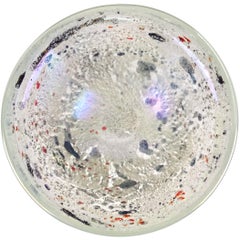
Murano Dino Martens Aureliano Toso Iridescent White Grey Italian Art Glass Bowl
By Aureliano Toso, Dino Martens
Located in Kissimmee, FL
Rare and beautiful, vintage Murano hand blown grayish white, black and red colored pigments Italian art glass decorative bowl. Attributed to designer Dino Martens for the Aureliano T...
Category
Mid-20th Century Italian Mid-Century Modern Decorative Bowls
Materials
Glass, Art Glass, Blown Glass, Murano Glass, Sommerso

$1,200
H 2.5 in Dm 7 in
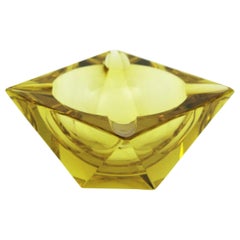
Flavio Poli Murano Yellow Faceted Glass Ashtray
By Flavio Poli
Located in Barcelona, ES
Beautiful faceted Murano glass ashtray in yellow color attributed to Flavio Poli, circa 1950s.
The color changes depending on the light. Neon yellow under white ligth and more orang...
Category
Mid-20th Century Italian Mid-Century Modern Decorative Bowls
Materials
Murano Glass, Glass, Art Glass
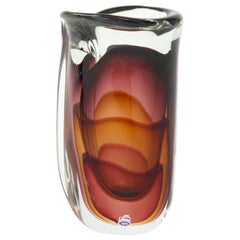
Flavio Poli, Cenedese Murano Glass Vase
By Flavio Poli, Cenedese
Located in New York, NY
Midcentury Murano glass vase with internal smokey colors of amber, violet, rose with an ombre effect encased in thick clear glass. Flavio Poli for Cendese, labeled.
Category
20th Century Italian Mid-Century Modern Vases
Materials
Murano Glass
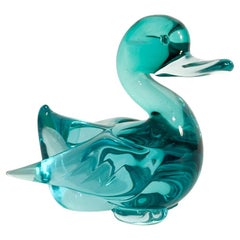
Green Murano Glass Duck Sculpture by Archimede Seguso 1950s
By Archimede Seguso
Located in Milano, MI
Green Murano glass duck sculpture, made by Archimede Seguso in the 1950s
Ø cm 10.5 Ø cm 5 h cm 9
Archimedes Seguso was a renowned Italian entrepreneur and master glassmaker, consid...
Category
Vintage 1950s Italian Mid-Century Modern Animal Sculptures
Materials
Murano Glass
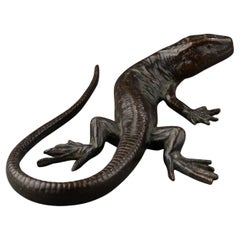
Bronze salamander - 17th century
Located in Bruxelles, BE
Bronze salamander
Italy, 17th century
Patinated bronze
4 x 17 x 10 cm
This finely cast bronze salamander exemplifies the 17th-century fascination with naturalistic forms and animal ...
Category
Antique 17th Century Italian Renaissance Animal Sculptures
Materials
Bronze
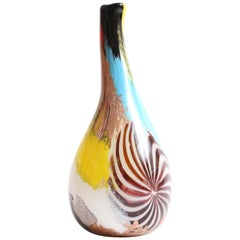
Dino Martens "Olaf" Model 3122
By Dino Martens
Located in West Palm Beach, FL
Dino Martens Olaf vase in the Oriente Technique.
This series was first presented at the Biennial of 1952.
Category
Vintage 1950s Italian Glass
Materials
Art Glass
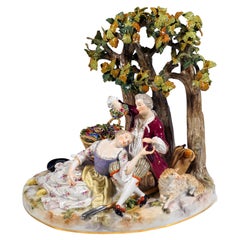
Meissen Rococo Group, Shpherd Couple Under Trees, by J.J. Kaendler, Ca 1860
By Meissen Porcelain, Johann Joachim Kaendler
Located in Vienna, AT
Excellent and rare Meissen porcelain genre group:
Elegantly dressed Rococo couple in the shade of a group of trees: a young lady sitting at the feet of her beau, leaning back against...
Category
Antique 1860s German Rococo Porcelain
Materials
Porcelain
$4,329
H 9.85 in W 9.85 in D 7.49 in
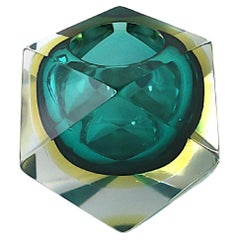
Flavio Poli Murano Art Glass Vessel
By Flavio Poli, Seguso Vetri d
Arte
Located in New York, NY
A beautiful emerald-green and yellow Italian Murano art glass vessel, by Flavio Poli, for glassmaking company Seguso Vetri d’Arte, Italian midcentury modern design period, circa mid-...
Category
Mid-20th Century Italian Mid-Century Modern Vases
Materials
Murano Glass
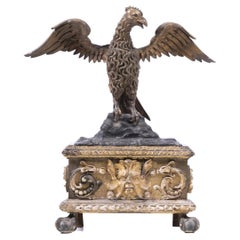
IMPORTANT ITALIAN IMPERIAL EAGLE 17th Century
Located in Madrid, ES
IMPERIAL EAGLE
Italian,
17th Century
sculpture in carved and gilded wood, based on a base decorated with plant motifs and masks with two claw and ball-...
Category
Antique Late 17th Century Italian Baroque Animal Sculptures
Materials
Wood
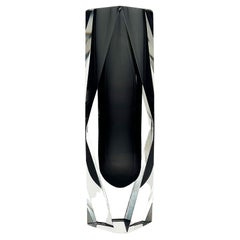
Flavio Poli Alessandro Mandruzzato Sommerso Murano Glass Vase circa 1960s
By Flavio Poli, Alessandro Mandruzzato
Located in Miami, FL
Flavio Poli Alessandro Mandruzzato Sommerso Murano Glass Vase circa 1960s
Offered for sale is a Flavio Poli for Alessandro Mandruzzato so...
Category
Mid-20th Century Italian Vases
Materials
Murano Glass
$550 Sale Price
20% Off
H 9.88 in W 4 in D 4 in
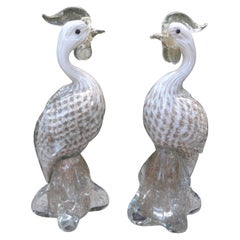
Pair of Murano Glass Birds Attributed to Archimede Seguso
By Seguso, Archimede Seguso
Located in Houston, TX
Pair of Murano glass birds attributed to Archimede Seguso. This beautiful pair of 1970s era blown glass birds from Murano are attributed to ...
Category
Vintage 1970s Italian Hollywood Regency Animal Sculptures
Materials
Glass, Blown Glass, Murano Glass
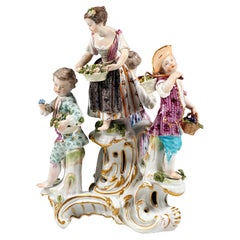
Early Meissen Round Group of Gardener Children, by J.J. Kaendler, 1763-1774
By Meissen Porcelain, Johann Joachim Kaendler
Located in Vienna, AT
Meissen porcelain group from the time of origin:
Four children in festive, rural rococo clothing on a three-part rocaille base: on the central raised pedestal a girl with a basket o...
Category
Antique 1760s German Rococo Porcelain
Materials
Porcelain
$6,976
H 8.67 in Dm 6.7 in