Sulis Fine Art Interior Prints
to
2
5
4
Overall Width
to
Overall Height
to
1
3
7
2
1
6
5
10
7
4
3
2
2
2
1
1
1
1
1
1
1
1
1
1
1
1
1
9
2
2
5
11
Graham Clarke (b.1941) - 20th Century Etching, Excelsior
Located in Corsham, GB
Graham Clarke (b.1941) Original etching in colour. 'Excelsior'. Pencil signed below plate lines. Editioned 249/300. On paper.
Category
20th Century Interior Prints
Materials
Etching
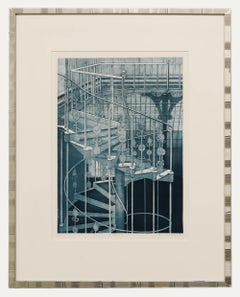
Pat Schaverien - Framed 20th Century Aquatint, Conservatory
Located in Corsham, GB
Limited edition aquatint. Signed, titled and dated (1984) to the lower margin. Editioned 35/40. Presented in a wide card mount and silver gilt frame. On paper.
Category
20th Century Interior Prints
Materials
Aquatint
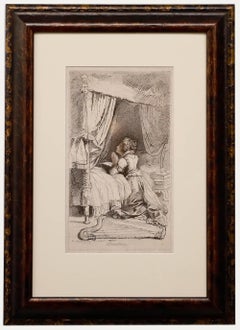
Richard Cosway RA - Framed Early 19th Century Stipple Engraving, Devotion
Located in Corsham, GB
Original stipple engraving on laid. Presented behind glass in a contemporary wooden frame with a Sebastian D'orsai label on the verso.
Category
Early 19th Century Interior Prints
Materials
Engraving
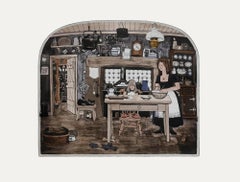
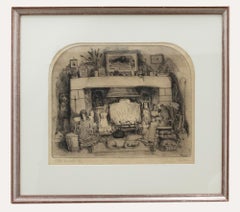
Graham Clarke (b.1941) - Framed 20th Century Etching, The Hearth
Located in Corsham, GB
A characterful etching with plate tone by the notable British printmaker, Graham Clarke. The naive scene depicts the heart of the home- the hearth- roaring on a cold winter's evening. A couple can be seen sitting comfortably in his and her chairs...
Category
20th Century Interior Prints
Materials
Etching
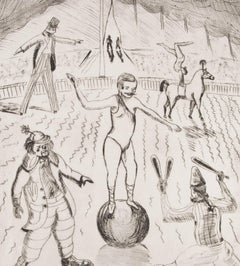
Terry Buchanan (b.1938) - 1997 Drypoint, Cirque II
Located in Corsham, GB
Drypoint 3/3. Signature, date and title inscribed below plate lines. On watermarked wove.
Category
1990s Interior Prints
Materials
Etching
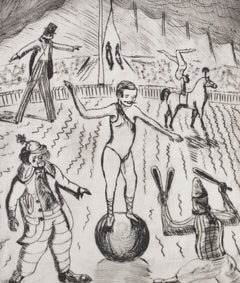
Terry Buchanan (b.1938) - 1997 Drypoint, Cirque
Located in Corsham, GB
Drypoint 1/3. Signature, date and title inscribed below plate lines. On wove.
Category
1990s Interior Prints
Materials
Etching
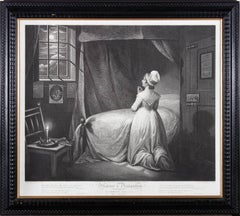
T. Gaugain after James Northcote - 1796 Engraving, Modest Girl In Her Chamber
Located in Corsham, GB
A fine 18th Century engraving showing a pious young woman kneeling in prayer at the edge of her bed. The scene comes from a series of engravings published to she the differences between the lives of "wanton" girls and "good" girls. There is an illuminated inscription at the lower edge with various Bible...
Category
18th Century Interior Prints
Materials
Engraving
John Hill after John Claude Nattes - Early 19th Century Aquatint, Pump Room
Located in Corsham, GB
A fine aquatint with hand colouring depicting the Pump Room, Bath by John Hill after John Claude Nattes (c.1765-1839). Published in 1804 by W. Miller...
Category
Early 19th Century Interior Prints
Materials
Aquatint
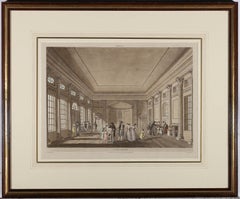
Peter Jaques - 1982 Etching, High St Circe
Located in Corsham, GB
A fun and charmingly naive acid etching showing a man, enchanted by a nude woman performing as Circe in a darkened interior. The artist has added hand colouring and signed, inscribed...
Category
20th Century Interior Prints
Materials
Etching
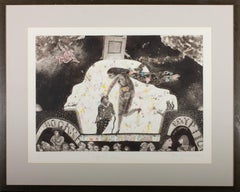
1975 Etching - Steppenwolf
Located in Corsham, GB
A truly striking acid bath etching showing an interior inspired by the house inhabited by the protagonist of Herman Hesse's novel, Steppenwolf. The interi...
Category
20th Century Interior Prints
Materials
Etching
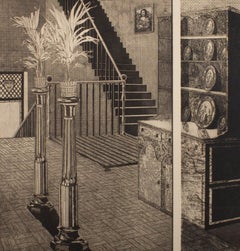
George Heywood Maunoir Sumner (1853-1940) - Signed 1880 Etching, The School Room
Located in Corsham, GB
Pupils relax in a magnificent schoolroom.
Sumner has achieved a magnitude of depth and detail through his expert etching technique.
The plate is inscribed 'Etched by Heywood Sumner...
Category
19th Century Interior Prints
Materials
Etching
Related Items
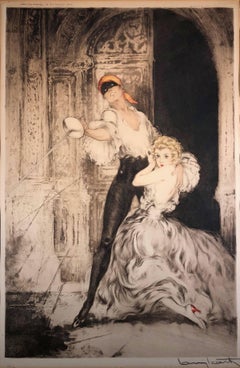
Don Juan
By Louis Icart
Located in Missouri, MO
Aquating Engraving
Image Size: approx. 20 1/4 x 13 3/8
Framed Size: 28 x 20.5 inches
Pencil Signed Lower Right
Louis Justin Laurent Icart was born in Toulouse in 1890 and died in Paris in 1950. He lived in New York City in the 1920s, where he became known for his Art-Deco color etchings of glamourous women.
He was first son of Jean and Elisabeth Icart and was officially named Louis Justin Laurent Icart. The use of his initials L.I. would be sufficient in this household. Therefore, from the moment of his birth he was dubbed 'Helli'. The Icart family lived modestly in a small brick home on rue Traversière-de-la-balance, in the culturally rich Southern French city of Toulouse, which was the home of many prominent writers and artists, the most famous being Henri de Toulouse-Lautrec.
Icart entered the l'Ecole Superieure de Commerce de Toulouse in order to continue his studies for a career in business, particularly banking (his father's profession). However, he soon discovered the play writings of Victor Hugo (1802-1885), which were to change the course of his life. Icart borrowed whatever books he could find by Hugo at the Toulouse library, devouring the tales, rich in both romantic imagery and the dilemmas of the human condition. It was through Icart's love of the theater that he developed a taste for all the arts, though the urge to paint was not as yet as strong for him as the urge to act.
It was not until his move to Paris in 1907 that Icart would concentrate on painting, drawing and the production of countless beautiful etchings, which have served (more than the other mediums) to indelibly preserve his name in twentieth century art history.
Art Deco, a term coined at the 1925 Paris Exposition des Arts Decoratifs, had taken its grip on the Paris of the 1920s. By the late 1920s Icart, working for both publications and major fashion and design studios, had become very successful, both artistically and financially. His etchings reached their height of brilliance in this era of Art Deco, and Icart had become the symbol of the epoch. Yet, although Icart has created for us a picture of Paris and New York life in the 1920s and 1930s, he worked in his own style, derived principally from the study of eighteenth-century French masters such as Jean Antoine Watteau, François Boucher and Jean Honoré Fragonard.
In Icart's drawings, one sees the Impressionists Degas...
Category
1920s Art Deco Figurative Prints
Materials
Engraving, Aquatint

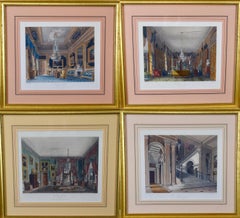
Four 19th Century Hand Colored Engravings Depicting English Royal Residences
By Charles Wild
Located in Alamo, CA
Four hand colored etchings and aquatints depicting interiors within English royal residences, including "The Blue Velvet Room at Carlton House", "The Queen's Library at Frogmore", "T...
Category
1810s Academic Interior Prints
Materials
Engraving
$1,560
H 15.5 in W 17.25 in D 0.88 in
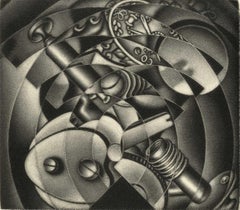
Sewing Circles
By Carol Wax
Located in New Orleans, LA
A play on words provides the title for this image -- a circle created out of the deconstructed parts of Singer IV This image is #37 from an edition of only 50, referenced as Firos 78...
Category
1990s American Modern Still-life Prints
Materials
Mezzotint
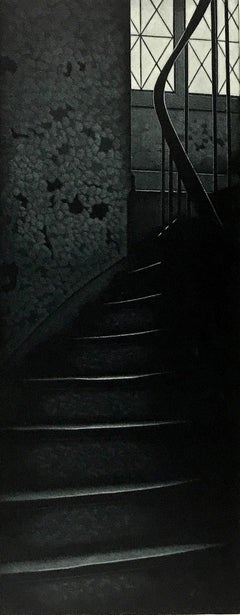
Before It Happened (A mysterious staircase offers no clues as to what happened)
By Jukka Vanttinen
Located in New Orleans, LA
This Finnish artist creates a mezzotint in black and white. This impression is #44 of 100 and is signed, dated and titled in pencil.
Jukka Vanttinen (Finn, b. 1954)
Jukka Vanttinen...
Category
Early 2000s Modern Interior Prints
Materials
Mezzotint
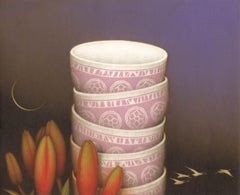
Lillies and Bowls (still life of flowers and colorful bowls)
Located in New Orleans, LA
The moon, bowls, lillies and birds are featured in this 2002 mezzotint. It is #17 from an edition of 75 and is signed, titled, dated and edition by hand by this Korean artist born i...
Category
Late 20th Century Contemporary Still-life Prints
Materials
Mezzotint
$200
H 11 in W 13.25 in
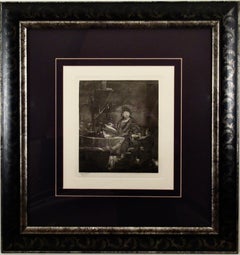
Jan Oytenbogaert
By Rembrandt van Rijn
Located in San Francisco, CA
This artwork titled Jan Uytenbogaert" 1639 is an etching on paper After Rembrandt Van Rijn, 1606-1669, plate engraved By French renown engraver Charles Armand Durand, 1831-1905. Sign...
Category
17th Century Realist Figurative Prints
Materials
Etching
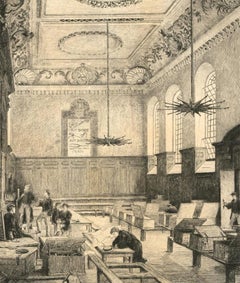
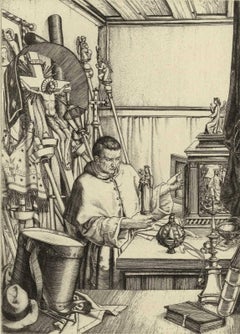
The Sacristan
By Harry Morley
Located in New Orleans, LA
This image shows a cleric seated in a church sacristy surrounded by religious statues, croziers, various saints, statues and chalices. It is an origina...
Category
Early 20th Century Modern Interior Prints
Materials
Engraving
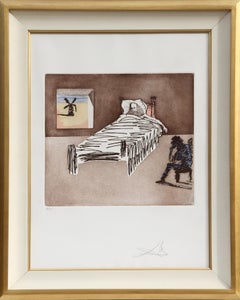
Le Legacy from Historia de Don Quichotte de la Mancha, Etching by Salvador Dali
By Salvador Dalí
Located in Long Island City, NY
Artist: Salvador Dali, Spanish (1904 - 1989)
Title: Le Legacy from Historia de Don Quichotte de la Mancha
Year: 1981
Medium: Etching on Arches, signed and numbered in pencil
Edition:...
Category
1980s Surrealist Figurative Prints
Materials
Etching
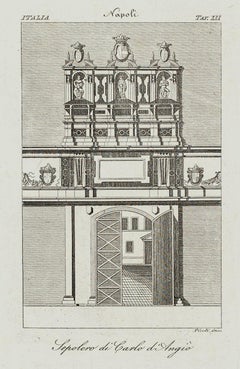
Sepulcher of Carlo di Angiò - Rome - Early 19th Century
Located in Roma, IT
Sepulcher of Carlo di Angiò is an original etching, realized by Piroli written below the image down in the XIX century, the table is XII is written at the top of the image on the rig...
Category
Early 19th Century Figurative Prints
Materials
Etching, Aquatint
$213
H 11.42 in W 8.67 in D 0.08 in
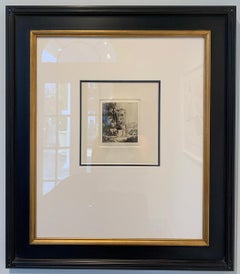
Jesus and the Woman at the Well,
by Amand-Durand, Engraving
By Armand Durand
Located in Oklahoma City, OK
This early 19th century framed 35" x 31" engraving by artist Amand-Durand depcits an etching of 'Jesus and the Woman at the Well,' after the Dutch master, Rembrandt van Rijn. This poignant Biblical story is depicted by Arman-Durand in Rembrandt style...
Category
Early 19th Century Old Masters Figurative Prints
Materials
Engraving
$1,200 Sale Price
20% Off
H 30.5 in W 26.5 in D 1.5 in
Architextures
By Carol Wax
Located in New Orleans, LA
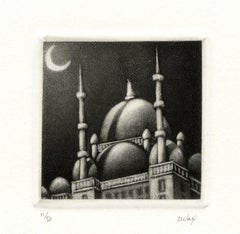
Architextures is a suite of 8 mezzotints in an edition of 50 created in 1984:
Mosque and Mosque Interior (5.1 cm x 5.1 cm)
Dome and Dome Interior (5.7cm x 3.8 cm)
Castle and Castle ...
Category
1980s American Modern Interior Prints
Materials
Mezzotint
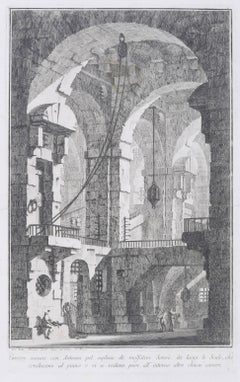
Carcere ascura
By Giovanni Battista Piranesi
Located in Fairlawn, OH
Carcere ascura
Etching, 1743
Signed in the plate bottom left corner
From: Prima Parte, 1743
Second edition: 1750-1778
Watermark: R 37-39
A lifetime impression printed during Piranesi’s life, before the plates are moved to Paris by his sons in the 1790’s
This image foretells Piranesi's famous set, Carceri (Prisons) which is his next creative effort.
Condition: Horizontal crease midway in the sheet associated with the manufacture of the paper.
Visible watermark verso
Small printer crease in the bottom right below the caption plate.
Image size: 14 1/2 x 9 1/2 inches
Reference: Robison 3 iii/VI
Piranesi In Rome: Prima Parte di Architetture e Prospettive
"Although Piranesi studied architecture in Venice, he never was able to find work in the field other than a few jobs involving remodeling in Rome. While Piranesi was struggling to support his architectural endeavors upon his arrival in Rome in 1740, he spent a short period of time in the studio of master painter Giovanni Battista Tiepolo (1696-1770) in addition to his apprenticeship with Giuseppe Vasi. The first production of Piranesi’s early years in Rome and a culmination of his training under Vasi, Tiepolo, and his uncle, was the Prima Parte di Architetture e Prospettive (1743). The Prima Parte was a collection of twelve etchings of imaginary temples, palaces, ruins, and a prison. During this time, Piranesi was still developing the unique style of etching he is known for today, and as such the Prima Parte differs significantly in technique compared to later works. In the Frontispiece of the Prima Parte, Piranesi’s lines are definite and exact with very little flow to them, designed in the form of traditional etching. The detail is immaculate, and yet perspective of the piece is oddly simple and familiar to the viewer. Piranesi’s technique employs miniscule markings and lines, intricately woven together to create a stippling effect. The Prima Parte, described as “rigid” by art historian Jonathan Scott, came to be seen as a stark contrast to his later sketches, which were much lighter and freer. Influenced by the style of Tiepolo, which epitomized the lightness and brightness of the Rococo period, Piranesi adopted some of the more painterly techniques of the masters he apprenticed under. Piranesi made the medium of etching appear as though it was a sketch or a painting, hence a “freer” and more fluid design in his later works. For example, the frontispiece of the Prima Parte read as an etching to Piranesi’s audience, but in his later vedute, the style of etching almost appears to be made of brushstrokes. Moreover, at the same time Piranesi was working on the Prima Parte, he aided the artist Giambattista Nolli. There is a small section of Nolli’s map...
Category
1740s Old Masters Interior Prints
Materials
Etching