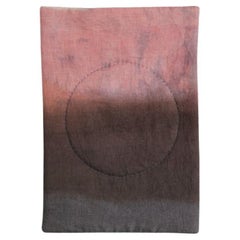
The Millen House Paintings and Screens
to
3
3
3
3
3
3
3
3
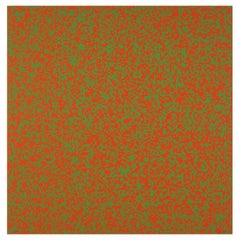
Screenprint of 50% Green
50% Orange Squares by François Morellet, 1971
By Francois Morellet
Located in AMSTERDAM, NL
François Morellet’s *Répartition aléatoire de 40000 carrés selon les chiffres pairs et impairs d’un annuaire de téléphone* (1971) is an 80 x 80 cm screenprint featuring a vibrant com...
Category
20th Century Paintings and Screens
Materials
Paper
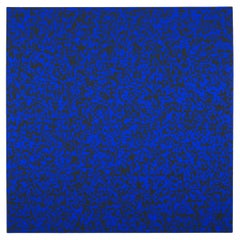
Screenprint of 50% Blue
50% Black Squares by François Morellet, 1971
By Francois Morellet
Located in AMSTERDAM, NL
François Morellet’s *Répartition aléatoire de 40000 carrés selon les chiffres pairs et impairs d’un annuaire de téléphone* (1971) is an 80 x 80 cm screenprint that masterfully combin...
Category
20th Century Paintings and Screens
Materials
Paper
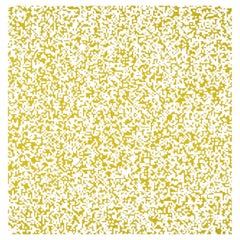
Screenprint of 50% Yellow
50% White Squares by François Morellet, 1971
By Francois Morellet
Located in AMSTERDAM, NL
François Morellet’s *Répartition aléatoire de 40000 carrés selon les chiffres pairs et impairs d’un annuaire de téléphone* (1971) is an 80 x 80 cm screenprint featuring a striking in...
Category
20th Century Paintings and Screens
Materials
Paper
Related Items
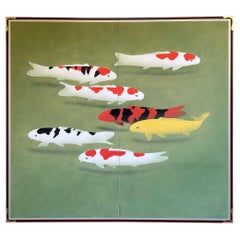
Group of Koi (Carp) screen ) by Nitten artist Tozaburo Ohno (大野藤三郎)
Located in Fukuoka, JP
Tozaburo Ohno (大野藤三郎)
A Japanese-style painter known for his refined depictions of koi carp and seasonal flowers. Born in 1917 in Osaka (though some sources cite Kyoto), he studied ...
Category
20th Century Japanese Showa Paintings and Screens
Materials
Wood, Paper

$5,260
H 67.72 in W 74.41 in D 1.58 in
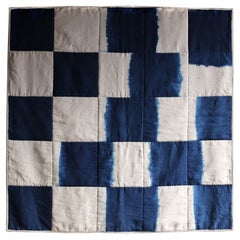
ICHIMATSU by Blue Tip atelier
Located in Sammu-shi, Chiba
Title : ICHIMATSU
Japan / 2020s
Size : W 1480 x H 1480 mm
Each part is dyed with indigo to express a checkered pattern that collapses. This quilt is made with Woven fresh linen. Hand-quilted with cotton thread. Hand dyed with indigo.
[Blue Tip atelier...
Category
2010s Japanese Modern Textiles
Materials
Linen
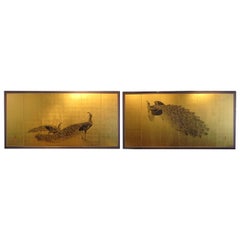
Pair of Japanese Screens: Ink paintings of peacocks on gold leaf by Imao Keinen
By Imao Keinen
Located in Prahran, Victoria
A pair of screens by Imao Keinen featuring peacocks painted in ink on gold leaf. Lacquered wood frame, brocade border, incised copper hardware.
Dimensions: H 175cm x W 352cm
Biogr...
Category
Antique Late 19th Century Japanese Meiji Paintings and Screens
Materials
Gold Leaf
$30,000 / set
H 69.3 in W 128.35 in D 7.88 in
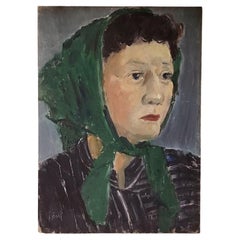
Portrait of a Lady Japanese Vintage Oil Painting by Yoshito Shibata
Located in Chiba, JP
Vintage oil painting on wooden plate, by a Japanese painter, Yoshito Shibata (1910-1995), circa 1960-70s, 24 x 33.3 x 0.5 cm (9.44 x 13.11 x 0.19in)
Category
Vintage 1960s Japanese Showa Paintings and Screens
Materials
Wood
$150
H 13.12 in W 9.45 in D 0.2 in
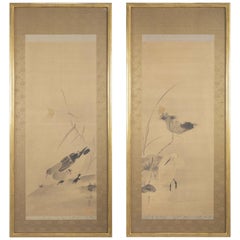
Pair of Japanese Framed Scrolls with Lotus, White Heron and Duck Decoration
Located in Stamford, CT
Pair of 19th century Japanese scrolls in frames with lotus, white heron circle of Kano Naonobu (Japan, 1607-1660) and duck beside a pond.
Category
Antique Mid-19th Century Japanese Paintings and Screens
Materials
Paper
$5,900
H 52.75 in W 23.25 in D 1 in
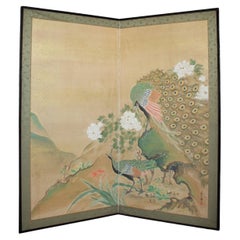
B50 Old Japanese Antiques a folding screen, Byobu 2panel, Peacock
Located in Niiza, JP
Unfolded size: 1700 x 1720 x 18 mm
Foldable: 855 x 1720 x 36 mm, 6kg
Estimated size after packaging (sandwiched between 9 mm plywood):
8 cm x 92 cm x 180 cm Weight 25KG
This paint...
Category
Antique 19th Century Japanese Paintings and Screens
Materials
Wood, Paper
$1,100
H 67.72 in W 66.93 in D 0.79 in
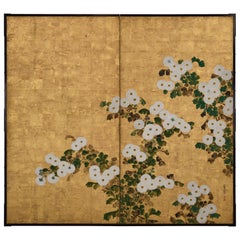
18th Century Japanese Rinpa Screen. White Chrysanthemums. School of Korin.
Located in Kyoto, JP
School of Ogata Korin
White Chrysanthemums
18th Century, Edo period.
A two-panel Japanese screen. Ink, color, gofun and gold leaf on paper.
Dimensions: H. 171 cm x W. 188 cm (67.5” x 74”)
On this two-panel Japanese screen we see blooming chrysanthemums, a flower which embodies the essence of autumn in Japan. Here the traditional floral theme has been simplified and stylized. The bright colors and asymmetrical composition against the delicate gold leaf create a luxurious and ornate work of art. Its background, a strikingly patinated grid of gold leaf, denies any sense of place or time and imbues everything with an ethereal glow. The leaves and stems of the plants are nothing more than pools of mottled color and ink without any outline whatsoever. These are typical Rinpa adaptations of traditional ink painting methods; tarashikomi, or diluted washes of color blended while very wet, and mokkotsu, or “bonelessness,” which creates forms without exterior outlines. The relief work of the rounded flower petals has been obtained by the moriage process (a mixture based on ground shells modeled on the surface of the paper).
On the lower right of the screen, the siganture “Hokyo Korin Jakumyo” and the “Hoshuku” seal can be read. Korin is Ogata Korin, famed for the Irises (Nezu Museum) and Red and White Plum Blossom (MOA Museum of Art) folding screens, both National Treasures. Korin worked in both Kyoto and Edo in the mid-Edo period. Korin was using the art name “Jakumyo” just after he received the Hokyo level, which was in 1701.
This particular screen was published in May of 1961 in the Japanese Sansai Fine Art Magazine*. An in depth article accompanies the photograph of the screen and and a photograph of the signature and seal. This article devotes much of its body to discussing the moriage technique, how it enlivens the chrysanthemum flowers and Korin’s specific skill in using the technique. The article goes on to discuss the most famous works of Korin, utilizing this technique, which were known at the time. Specifically a two-panel screen held in the Honolulu Museum which was discovered in the store-house of Takahashi Soan. A two-panel screen pair which the Nakano family own. A two-panel screen pair with chrysanthemums in moriage in fan designs owned by the Nomura family. Also a small folding screen featuring chrysanthemums held in the Yamato Bunkakan. The article goes on to say that this particular two-fold screen came from the Nijo family. Korin is known to have had a strong connection with the aristocratic Nijo family. The article explains that Korin received a lot of favors from the Nijo family and that this screen would have been gifted to them.
Since that time the Honolulu screen has been amended to ‘attributed to Ogata Korin’ and I do not know further details of the other 3 screens. Other Chrysanthemum screens...
Category
Antique 18th Century Japanese Edo Paintings and Screens
Materials
Gold Leaf
$32,000
H 67.5 in W 74 in D 0.75 in
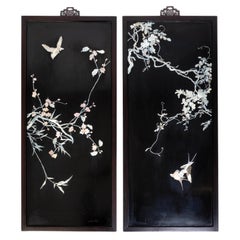
Pair of Large Framed Chinese Black Lacquer Mother Of Pearl Relief Hanging Panels
Located in London, GB
Pair of Large Framed Chinese Black Lacquer Mother Of Pearl Relief Hanging Panels
C.1920
Depicting birds amongst flowering branches.
In very good condition commensurate of age.
Plea...
Category
20th Century Chinese Chinoiserie Paintings and Screens
Materials
Lacquer
$5,439 / set
H 45.28 in W 18.51 in D 0.99 in
Morning of Gora Antique Japanese Oil Painting by Masuta Narahara
Located in Chiba, JP
Antique Japanese oil painting on wooden board, titled ‘Morning of Gora (Hakone, Japan)’, by Masuta Narahara (1888-1963). 27 x 21.5 x 0.5 cm (10.62 x 8.46 x 0.19in). Aged deteriorati...
Category
Early 20th Century Japanese Japonisme Paintings and Screens
Materials
Wood
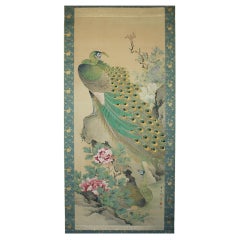
Japanese Antiques A hanging scroll of peacock painted by Kado for Tokonoma
Located in Niiza, JP
Color on silk, Scroll head: wood
Size: Image size: 680(W) x 1600(H) [mm]
Scroll mounting: 850(W) x 2300(H) [mm]
Box size: 100(W) x 100(H) x 940(D) [mm] 1.8kg
Estimate packing si...
Category
Antique Mid-19th Century Japanese Paintings and Screens
Materials
Silk
$2,140
H 90.56 in W 33.47 in D 1.19 in
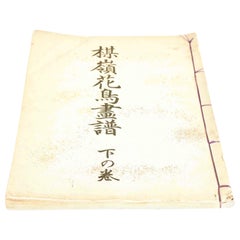
A Fine Collection of Prints and Paintings of Birds and Flowers by Kono Bairei
By Kono Bairei
Located in Prahran, Victoria
A volume of prints and paintings by Japanese artist Kono Bairei (1844-1895), well known practitioner of the Ukiyo e school during the Meiji period. He was born and lived in Kyoto, sp...
Category
Antique 19th Century Japanese Paintings and Screens
Materials
Paper
$1,250
H 14.57 in W 9.85 in D 0.4 in
The sky visible at Honmonji TempleⅣ by Blue Tip Atelier
Located in Sammu-shi, Chiba
Title : The sky visible at Honmonji TemplⅣ
Japan / 2024s
Size : W 275 H 395mm
A mini series of the sky as seen from Honmonji Temple.
Natural dyes used are Indian madder and oak g...
Category
2010s Japanese Modern Textiles
Materials
Linen