Thomas French Fine Art Interior Prints
to
10
1
4
Overall Width
to
Overall Height
to
7
1
1
6
2
1
1
1
7
1
6
1
2
1
1
1
1
7
10
5
7
5
4
3
2
2
1
1
1
11
3
2
1
1
15
The Art of Conversation (Three characters on...)
By Marcel Gromaire
Located in Fairlawn, OH
The Art of Conversation (Three characters on...)
Etching, 1958
Signed in pencil lower right: “Gromaire” (see photo)
Edition: 110 (18/110) see photo
Printed on RIVES paper
Publisher: ...
Category
1950s Cubist Interior Prints
Materials
Etching
The Woman and the Street
By Marc Chagall
Located in Fairlawn, OH
The Woman and the Street
Etching, 1927-1930
Signed in the plate lower right corner (see photo)
From: The Fables of La Fontaine, Plate 84
From the deluxe portfolio edition of 40 examp...
Category
1920s French School Prints and Multiples
Materials
Etching
The So-Called Tempio della Tosse, Near Tivoli. Interior Upright
By Giovanni Battista Piranesi
Located in Fairlawn, OH
The So-Called Tempio della Tosse, Near Tivoli. Interior Upright (Veduta interna del Tempio della Tosse)
"Temple of the Cough"
Etching, 1764
Signed in the plate
From: Vedute di Roma...
Category
1760s Old Masters Interior Prints
Materials
Etching
The So-Called Tempio della Tosse, Near Tivoli. Interior Upright
By Giovanni Battista Piranesi
Located in Fairlawn, OH
The So-Called Tempio della Tosse, Near Tivoli. Interior Upright (Veduta interna del Tempio della Tosse)
"Temple of the Cough"
Etching, 1764
Signed in the plate
From: Vedute di Roma...
Category
1760s Old Masters Interior Prints
Materials
Etching
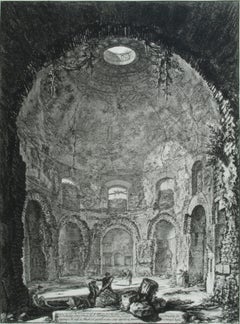
Ruine di Sepolcro antico
By Giovanni Battista Piranesi
Located in Fairlawn, OH
Ruine di Sepolcro antico
Etching, 1743
Signed in the plate bottomleft in the caaption plate
From: Prima Parte, 1743
Second edition: 1750-1778
Watermark: R 37-39
A lifetime impression printed during Piranesi’s life, before the plates are moved to Paris by his sons in the 1790’s
Coniditon: Excellent/Very good
Image size: 14 5/8 x 9 3/4 inches
Reference: Robison 17 iii/V
Piranesi In Rome: Prima Parte di Architetture e Prospettive
"Although Piranesi studied architecture in Venice, he never was able to find work in the field other than a few jobs involving remodeling in Rome. While Piranesi was struggling to support his architectural endeavors upon his arrival in Rome in 1740, he spent a short period of time in the studio of master painter Giovanni Battista Tiepolo (1696-1770) in addition to his apprenticeship with Giuseppe Vasi. The first production of Piranesi’s early years in Rome and a culmination of his training under Vasi, Tiepolo, and his uncle, was the Prima Parte di Architetture e Prospettive (1743). The Prima Parte was a collection of twelve etchings of imaginary temples, palaces, ruins, and a prison. During this time, Piranesi was still developing the unique style of etching he is known for today, and as such the Prima Parte differs significantly in technique compared to later works. In the Frontispiece of the Prima Parte, Piranesi’s lines are definite and exact with very little flow to them, designed in the form of traditional etching. The detail is immaculate, and yet perspective of the piece is oddly simple and familiar to the viewer. Piranesi’s technique employs miniscule markings and lines, intricately woven together to create a stippling effect. The Prima Parte, described as “rigid” by art historian Jonathan Scott, came to be seen as a stark contrast to his later sketches, which were much lighter and freer. Influenced by the style of Tiepolo, which epitomized the lightness and brightness of the Rococo period, Piranesi adopted some of the more painterly techniques of the masters he apprenticed under. Piranesi made the medium of etching appear as though it was a sketch or a painting, hence a “freer” and more fluid design in his later works. For example, the frontispiece of the Prima Parte read as an etching to Piranesi’s audience, but in his later vedute, the style of etching almost appears to be made of brushstrokes. Moreover, at the same time Piranesi was working on the Prima Parte, he aided the artist Giambattista Nolli. There is a small section of Nolli’s map...
Category
1740s Old Masters Interior Prints
Materials
Etching
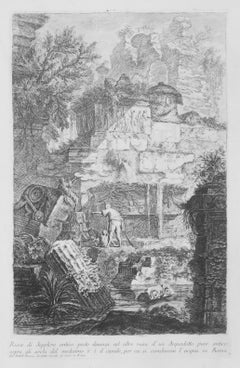
Carcere ascura
By Giovanni Battista Piranesi
Located in Fairlawn, OH
Carcere ascura
Etching, 1743
Signed in the plate bottom left corner
From: Prima Parte, 1743
Second edition: 1750-1778
Watermark: R 37-39
A lifetime impression printed during Piranesi’s life, before the plates are moved to Paris by his sons in the 1790’s
This image foretells Piranesi's famous set, Carceri (Prisons) which is his next creative effort.
Condition: Horizontal crease midway in the sheet associated with the manufacture of the paper.
Visible watermark verso
Small printer crease in the bottom right below the caption plate.
Image size: 14 1/2 x 9 1/2 inches
Reference: Robison 3 iii/VI
Piranesi In Rome: Prima Parte di Architetture e Prospettive
"Although Piranesi studied architecture in Venice, he never was able to find work in the field other than a few jobs involving remodeling in Rome. While Piranesi was struggling to support his architectural endeavors upon his arrival in Rome in 1740, he spent a short period of time in the studio of master painter Giovanni Battista Tiepolo (1696-1770) in addition to his apprenticeship with Giuseppe Vasi. The first production of Piranesi’s early years in Rome and a culmination of his training under Vasi, Tiepolo, and his uncle, was the Prima Parte di Architetture e Prospettive (1743). The Prima Parte was a collection of twelve etchings of imaginary temples, palaces, ruins, and a prison. During this time, Piranesi was still developing the unique style of etching he is known for today, and as such the Prima Parte differs significantly in technique compared to later works. In the Frontispiece of the Prima Parte, Piranesi’s lines are definite and exact with very little flow to them, designed in the form of traditional etching. The detail is immaculate, and yet perspective of the piece is oddly simple and familiar to the viewer. Piranesi’s technique employs miniscule markings and lines, intricately woven together to create a stippling effect. The Prima Parte, described as “rigid” by art historian Jonathan Scott, came to be seen as a stark contrast to his later sketches, which were much lighter and freer. Influenced by the style of Tiepolo, which epitomized the lightness and brightness of the Rococo period, Piranesi adopted some of the more painterly techniques of the masters he apprenticed under. Piranesi made the medium of etching appear as though it was a sketch or a painting, hence a “freer” and more fluid design in his later works. For example, the frontispiece of the Prima Parte read as an etching to Piranesi’s audience, but in his later vedute, the style of etching almost appears to be made of brushstrokes. Moreover, at the same time Piranesi was working on the Prima Parte, he aided the artist Giambattista Nolli. There is a small section of Nolli’s map...
Category
1740s Old Masters Interior Prints
Materials
Etching
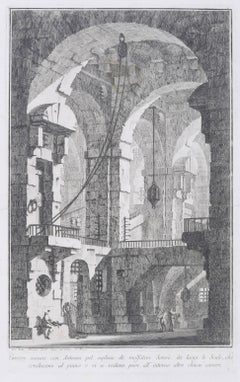
Camera sepolcrale
By Giovanni Battista Piranesi
Located in Fairlawn, OH
Camera sepolcrale
Etching 1743
Signed in the bottom left corner
From: Prima Parte, 1743
Second edition: 1750-1778
Watermark: R 37-39
A lifetime impression printed during Piranesi’s life, before the plates are moved to Paris by his sons in the 1790’s
Condition: Excellent
Image size: 14 5/8 x 9 3/4 inches
Reference: Robison 20 iii/V
Piranesi In Rome: Prima Parte di Architetture e Prospettive
"Although Piranesi studied architecture in Venice, he never was able to find work in the field other than a few jobs involving remodeling in Rome. While Piranesi was struggling to support his architectural endeavors upon his arrival in Rome in 1740, he spent a short period of time in the studio of master painter Giovanni Battista Tiepolo (1696-1770) in addition to his apprenticeship with Giuseppe Vasi. The first production of Piranesi’s early years in Rome and a culmination of his training under Vasi, Tiepolo, and his uncle, was the Prima Parte di Architetture e Prospettive (1743). The Prima Parte was a collection of twelve etchings of imaginary temples, palaces, ruins, and a prison. During this time, Piranesi was still developing the unique style of etching he is known for today, and as such the Prima Parte differs significantly in technique compared to later works. In the Frontispiece of the Prima Parte, Piranesi’s lines are definite and exact with very little flow to them, designed in the form of traditional etching. The detail is immaculate, and yet perspective of the piece is oddly simple and familiar to the viewer. Piranesi’s technique employs miniscule markings and lines, intricately woven together to create a stippling effect. The Prima Parte, described as “rigid” by art historian Jonathan Scott, came to be seen as a stark contrast to his later sketches, which were much lighter and freer. Influenced by the style of Tiepolo, which epitomized the lightness and brightness of the Rococo period, Piranesi adopted some of the more painterly techniques of the masters he apprenticed under. Piranesi made the medium of etching appear as though it was a sketch or a painting, hence a “freer” and more fluid design in his later works. For example, the frontispiece of the Prima Parte read as an etching to Piranesi’s audience, but in his later vedute, the style of etching almost appears to be made of brushstrokes. Moreover, at the same time Piranesi was working on the Prima Parte, he aided the artist Giambattista Nolli. There is a small section of Nolli’s map...
Category
1740s Old Masters Interior Prints
Materials
Etching
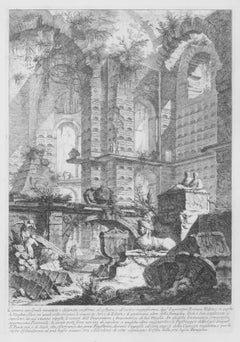
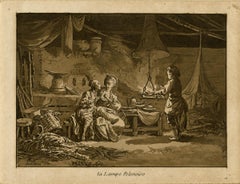
La Lampe Polonoise
By Jean Baptist Le Prince
Located in Fairlawn, OH
La Lampe Polonoise
Aquatint, 1771
Signed and dated in the plate lower left
Condition: Yellowing to the sheet
Image size: 6 1/8 x 8 1/8 inches
Reference: Hedou 147 ii/II
Provenance: C...
Category
1770s Old Masters Interior Prints
Materials
Aquatint
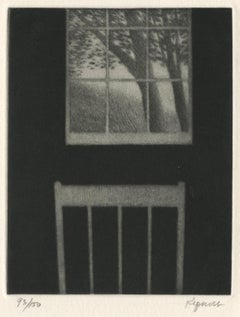
Landscape with Window and Chair
By Robert Kipniss
Located in Fairlawn, OH
Landscape with Window and Chair
Mezzotint on wove paper, 2000
Signed in pencil lower right (see photo)
Edition: 150 (93/150) (see photo)
Special Presentation Print for the Print Club...
Category
Early 2000s Contemporary Interior Prints
Materials
Mezzotint
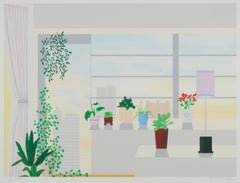
The 21st Floor-A View of the World Trade Center in the Skyline
Located in Fairlawn, OH
The 21st Floor-A View of the World Trade Center in the Skyline
Screen print, c. 1990
Signed: Joni Frankel lower left
Edition 200 (42/200)
Signed lower lef...
Category
1990s American Realist Interior Prints
Materials
Screen
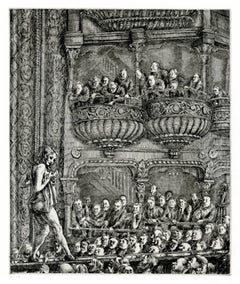
Gaiety Burlesk
By Reginald Marsh
Located in Fairlawn, OH
Gaiety Burlesque
Etching, 1930
Unsigned (as usual for the Whitney edition); Numbered in pencil lower left; Blind stamp of the Whitney Museum (WM) lower right
Edition: 114, regular ed...
Category
1930s American Modern Interior Prints
Materials
Etching
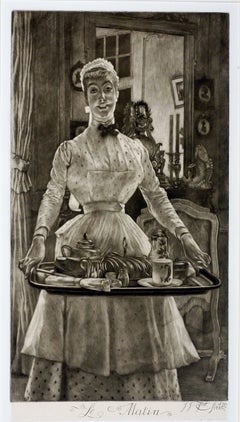
Le Matin (Morning)
By James Jacques Joseph Tissot
Located in Fairlawn, OH
Le Matin (Morning)
Mezzotint, 1886
Signed and dated in the plate (see photos)
Edition: at least 650 impressions in both states
Reference: Wentworth 82 ii/II
Provenance: Heirs of Edmu...
Category
1880s French School Interior Prints
Materials
Mezzotint
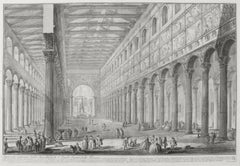
S. Paolo Fuori Le Mura (Vedute della Basilica di S. Paolo fuor della mura)
By Giovanni Battista Piranesi
Located in Fairlawn, OH
S. Paolo Fuori Le Mura (Vedute della Basilica di S. Paolo fuor della mura)
Etching, 1748
From: Vedute di Roma, Plate 8
An early Roman printing, published by Bouchard e Gravier
Watermark: Fleur de Lys in a double circle
Signed in the plate
Condition: Small margins as are common with Bouchard published impressions.
Centerfold (as usual)
Rich impression with good contrasts
Plate/Image size: 15 7/8 x 24 1/8 inches
Sheet size: 17 3/8 x 24 3/4 inches
Reference: Focillon 723
Wilton-Ely 138
Hind 6 ii/VI, Bouchard e Gravier printing, before the price and numbers in later states
This image is Piranesi’s second interior scene from the Vedute di Roma. The first interior is a less complex composition of the Interior of St. Peters which lacks the challenging perspective that the artist masters in this image.
The Papal Basilica of St. Paul Outside the Walls...
Category
1740s Old Masters Interior Prints
Materials
Etching
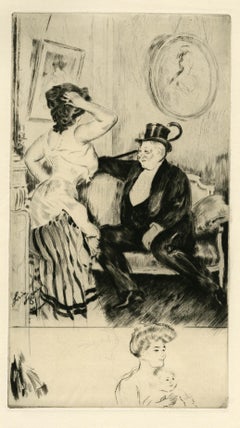
En passant (Passing by)
By Louis Legrand
Located in Fairlawn, OH
En passant (Passing by)
Drypoint, 1909
Unsigned (as issued in the deluxe portfolio)
From the album "Les Bars" (8 plates plus cover illustration)
Edition: 30, this state with remarque
Published by Gustav Pellet, Paris
A very rich impression wwith burr
Condition: Excellent
Image/Plate size: 9 7/8 x 6 3/8 inches
Reference: Arwas 391a (remarque)
Exteens 277 i/II
IFF 148 (portfolio)
Louis Auguste Mathieu Legrand (29 September 1863 – 1951) was a French artist, known especially for his aquatint engravings, which were sometimes erotic. He was awarded the Légion d'honneur for his work in 1906.
Life
Legrand was born in the city of Dijon in the east of France. He worked as a bank clerk before deciding to study art part-time at Dijon's Ecole des Beaux-Arts. He won the Devosge prize at the school in 1883.[2] In 1884 Legrand studied engraving under the Belgian printmaker Félicien Rops.
Legrand's artworks include etchings, graphic art and paintings. His paintings featured Parisian social life. Many were of prostitutes, dancers and bar scenes, which featured a sense of eroticism. According to the Hope Gallery, "Louis Legrand is simply one of France's finest early twentieth century masters of etching." His black and white etchings especially provide a sense of decadence; they have been compared to those of Henri de Toulouse-Lautrec, though his drawings of the Moulin Rouge, the can-can dance and the young women of Montmartre preceded Toulouse-Lautrec's paintings of similar scenes. He made over three hundred prints of the night life of Paris. They demonstrate "his remarkable powers of observation and are executed with great skill, delicacy, and an ironic sense of humor that pervades them all."
Two of his satirical artworks caused him to be tried for obscenity. The first, "Prostitution" was a symbolic drawing which depicted a naked girl being grasped by a dark monster which had the face of an old woman and claws on its hands; the second, "Naturalism", showed the French novelist Émile Zola minutely studying the thighs of a woman with a magnifying glass. Defended by his friend the lawyer Eugène Rodrigues-Henriques (1853–1928), he was found not guilty in the lower court, but was convicted in the appeal court and then given a short prison sentence for refusing to pay his fine.
Legrand was made famous by his colour illustrations for Gil Blas magazine's coverage of the can-can, with text by Rodrigues (who wrote under the pseudonym Erastene Ramiro). It was a tremendous success, with the exceptional quantity of 60,000 copies of the magazine being printed and instantly sold out in 1891.
In 1892, at the instigation of the publishing house Dentu, Legrand made a set of etchings of his Gil Blas illustrations. The etchings were published in a book, Le Cours de Danse Fin de Siecle (The End of the Century Dance Classes).
Legrand took a holiday in Brittany, which inspired him to engrave a set of fourteen lithographs of simple country life called Au Cap de la Chevre (On Goat Promontory). It was published by Gustave Pellet who became a close friend of Legrand's. Pellet eventually published a total of 300 etchings by Legrand, who was his first artist; he also published Toulouse-Lautrec and Félicien Rops among others.
He did not only work in graphics; he exhibited paintings at the Paris salon of the Société Nationale des Beaux-Arts starting in 1902. In 1906 he was made a chevalier of the Légion d'honneur.
Legrand died in obscurity in 1951. A retrospective exhibition was held at the Félicien Rops museum in Namur, Belgium in 2006 to celebrate his graphic art. The art collector Victor Arwas published a catalogue raisonné for the occasion.
Books illustrated
de Maupassant, Guy: Cinq Contes Parisiens, 1905.
Poe, Edgar Alan: Quinze Histoires d'Edgar Poe...
Category
Early 1900s Art Nouveau Interior Prints
Materials
Drypoint
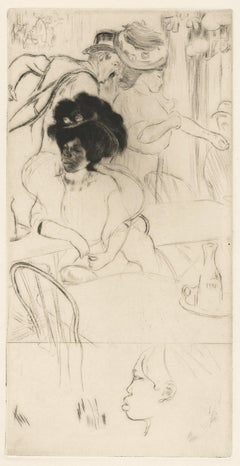
La Negresse (The Negress)
By Louis Legrand
Located in Fairlawn, OH
La Negresse (The Negress)
Etching & drypoint, 1909
Unsigned (as issued in the portfolio)
From the album "Les Bars" (8 plates plus cover illustration)
Editi...
Category
Early 1900s Art Nouveau Interior Prints
Materials
Etching
Related Items
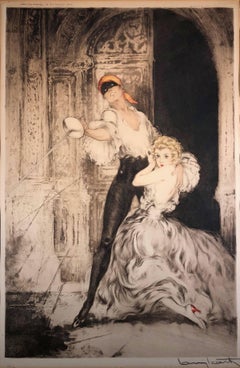
Don Juan
By Louis Icart
Located in Missouri, MO
Aquating Engraving
Image Size: approx. 20 1/4 x 13 3/8
Framed Size: 28 x 20.5 inches
Pencil Signed Lower Right
Louis Justin Laurent Icart was born in Toulouse in 1890 and died in Paris in 1950. He lived in New York City in the 1920s, where he became known for his Art-Deco color etchings of glamourous women.
He was first son of Jean and Elisabeth Icart and was officially named Louis Justin Laurent Icart. The use of his initials L.I. would be sufficient in this household. Therefore, from the moment of his birth he was dubbed 'Helli'. The Icart family lived modestly in a small brick home on rue Traversière-de-la-balance, in the culturally rich Southern French city of Toulouse, which was the home of many prominent writers and artists, the most famous being Henri de Toulouse-Lautrec.
Icart entered the l'Ecole Superieure de Commerce de Toulouse in order to continue his studies for a career in business, particularly banking (his father's profession). However, he soon discovered the play writings of Victor Hugo (1802-1885), which were to change the course of his life. Icart borrowed whatever books he could find by Hugo at the Toulouse library, devouring the tales, rich in both romantic imagery and the dilemmas of the human condition. It was through Icart's love of the theater that he developed a taste for all the arts, though the urge to paint was not as yet as strong for him as the urge to act.
It was not until his move to Paris in 1907 that Icart would concentrate on painting, drawing and the production of countless beautiful etchings, which have served (more than the other mediums) to indelibly preserve his name in twentieth century art history.
Art Deco, a term coined at the 1925 Paris Exposition des Arts Decoratifs, had taken its grip on the Paris of the 1920s. By the late 1920s Icart, working for both publications and major fashion and design studios, had become very successful, both artistically and financially. His etchings reached their height of brilliance in this era of Art Deco, and Icart had become the symbol of the epoch. Yet, although Icart has created for us a picture of Paris and New York life in the 1920s and 1930s, he worked in his own style, derived principally from the study of eighteenth-century French masters such as Jean Antoine Watteau, François Boucher and Jean Honoré Fragonard.
In Icart's drawings, one sees the Impressionists Degas...
Category
1920s Art Deco Figurative Prints
Materials
Engraving, Aquatint

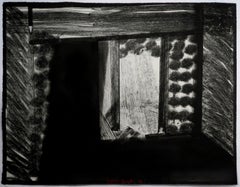
All Alone in the Museum of Modern Art Howard Hodgkin abstract black painting
By Howard Hodgkin
Located in New York, NY
Large scale black and white abstract interior scene with dots, lines, brushstrokes, paint daubs, fingerprints, squares and rectangles, and hand painting in grey. Hang in contemporary, modern and minimalist spaces. While British pop artists such as David Hockney and Patrick Caulfield numbered amongst Howard Hodgkin's circle of friends, Hodgkin's work is painterly, emotional, expressionist, and abstract.
Paper: 29.5 x 38.75 in. / 74.7 x 98.2 cm.
Soft-ground etching with hand coloring in black gouache on grey BFK Rives mould made paper. Signed by the artist, dated 79, and numbered 59/100 lower center in red crayon. Printed from the same plate as 'Thinking Aloud in the Museum of Modern Art', this print was previously titled "Not Quite Alone in the Museum of Modern Art," suggesting an erotic dalliance in the museum.
This print depicts an abstracted scene, perhaps a window and a door, in Hodgkin's signature painterly style. The expressive mark-making in this print is an example of the artist’s movement in the late 70s towards pronounced gestures. Beside bold black strokes, his fingerprints form areas of texture. Always seeking greater richness in his prints, Hodgkin layered ink and hand coloring in this print, rendering each print in the edition unique.
Howard Hodgkin was introduced to the etching technique used in 'All Alone in the Museum of Modern Art' at Petersburg Press, where this print was produced and where he would become a long-time collaborator. This technique allowed him to work fluidly and spontaneously, creating the moody interior scenes that mark Hodgkin’s work from the late 70s and early 80s.
Part of a series of four prints reflecting on a visit to the Museum...
Category
Late 20th Century Abstract Abstract Prints
Materials
Etching
$2,250
H 29.5 in W 38.75 in
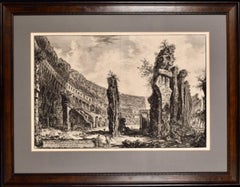
The Roman Colosseum: A Framed 18th Century Etching of the Interior by Piranesi
By Giovanni Battista Piranesi
Located in Alamo, CA
This large framed 18th century etching by Giovanni Battista Piranesi entitled "Veduta dell'interno dell'Anfiteatro Flavio detto il Colosseo" (View of the interior of the Flavian Amph...
Category
1760s Old Masters Figurative Prints
Materials
Etching
$5,875
H 28.88 in W 37.25 in D 1.25 in
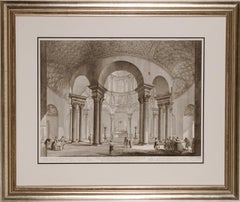
Church of St. Costanza, Rome: An 18th Century Piranesi Architectural Etching
By Giovanni Battista Piranesi
Located in Alamo, CA
This is a framed 18th century Giovanni Battista Piranesi etching entitled: "Veduta interna del Sepocro di Santa Costanza, fabbricat...
Category
1770s Old Masters Interior Prints
Materials
Etching
$3,775
H 27 in W 32 in D 1.5 in
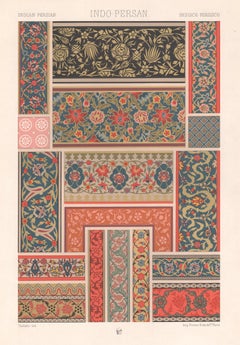
Indian-Persian, French antique 19th century Racinet art design lithograph print
Located in Melbourne, Victoria
'Indian-Persian - Indo-Persian - Indisch-Persisch'
Late 19th century interior design chromolithograph, from Racinet’s ‘L’Ornement Polychrome’, 1887. Published in Paris.
Albert Raci...
Category
Late 19th Century French School Interior Prints
Materials
Lithograph
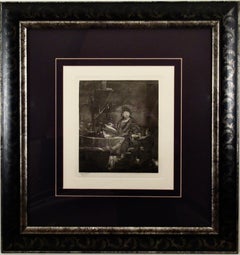
Jan Oytenbogaert
By Rembrandt van Rijn
Located in San Francisco, CA
This artwork titled Jan Uytenbogaert" 1639 is an etching on paper After Rembrandt Van Rijn, 1606-1669, plate engraved By French renown engraver Charles Armand Durand, 1831-1905. Sign...
Category
17th Century Realist Figurative Prints
Materials
Etching
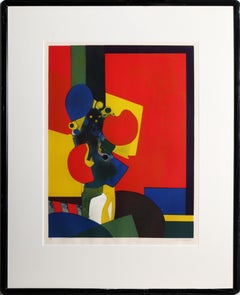
Still Life with Flowers, Framed Cubist Lithograph by Andre Minaux
By Andre Minaux
Located in Long Island City, NY
Andre Minaux, French (1923–1986)
Date: circa 1975
Lithograph, signed and numbered in pencil
Edition of EA
Image Size: 22.5 x 16.5 inches
Frame Size: 34 x 27 in...
Category
1970s Cubist Still-life Prints
Materials
Lithograph
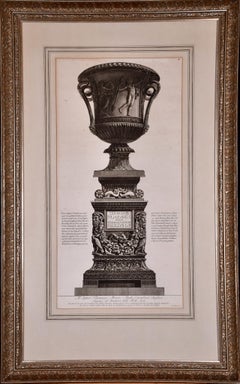
A Framed 18th C. Piranesi Etching of an Ancient Marble Vase from Hadrian
s Villa
By Giovanni Battista Piranesi
Located in Alamo, CA
This large framed 18th century etching by Giovanni Battista Piranesi is entitled "Vaso antico di Marmo adornato di eccellenti Sculture si nella parte anteriere che nell' opposta, le ...
Category
1770s Old Masters Figurative Prints
Materials
Etching
$3,975
H 42.25 in W 26.5 in D 1.5 in
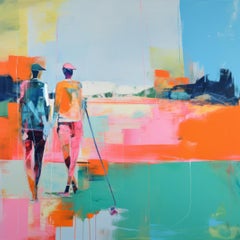
Golf Players Limited Edition Textured Canvas Print
By Irena Orlov
Located in Los Angeles, CA
Title: Golf Players - Limited Edition Textured Canvas Print
Immerse yourself in the world of golf with "Golf Players," a limited edition textured canvas print that celebrates the spirit of the sport. This captivating artwork captures the essence of golfing moments...
Category
2010s Cubist Figurative Paintings
Materials
Canvas, Paint, Cotton Canvas, Mixed Media, Acrylic, Digital, Inkjet, Giclée
$3,840 Sale Price
20% Off
H 52 in W 52 in D 2 in
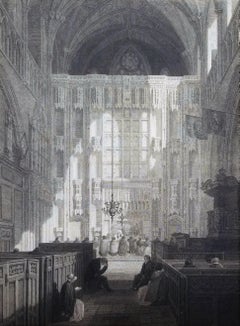
St. Alban
s Abbey Church, High Altar screen /// Robert Clutterbuck Hertford Art
Located in Saint Augustine, FL
Artist: Robert Clutterbuck (English, 1772-1831)
Title: "St. Alban's Abbey Church, High Altar screen"
Portfolio: The History and Antiquities of the County of Hertford
Year: 1815-1827 (First edition)
Medium: Original Engraving on wove paper
Limited edition: Unknown
Printer: Nichols, Son, and Bentley, London, UK
Publisher: Nichols, Son, and Bentley, London, UK
Reference: Brunet II, No. 112; Lowndes No. 483; BAL RIBA No. 666; Upcott I, page 623
Sheet size: 17.63" x 11.38"
Image size: 11.57" x 8.57"
Condition: Scattered foxing throughout sheet; it doesn't show much within the image. Creasing to upper left and right corners. Has been professionally stored away for decades. It is otherwise a strong impression in good condition
Notes:
Provenance: private collection - Aspen, CO. Engraved by English artist John Henry Le Keux (1812-1896) after a drawing by English artist Frederick Nash (1782-1856). Comes from Clutterbuck's three volume "The History and Antiquities of the County of Hertford", (1815-1827) (First edition), which consists of 54 engravings. Printed from one copper plate on one color: black. "Vol. I. p. 65" printed upper right in margin. "Proof" printed lower right in margin.
St Albans Cathedral, officially the Cathedral and Abbey Church of St Alban, also known as "the Abbey", is a Church of England cathedral...
Category
1810s Old Masters Interior Prints
Materials
Engraving, Intaglio
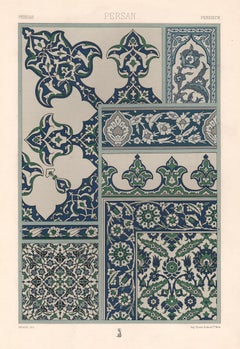
Persian, French antique 19th century Racinet art design lithograph print
Located in Melbourne, Victoria
'Persian - Persan - Persisch'
Late 19th century interior design chromolithograph, from Racinet’s ‘L’Ornement Polychrome’, 1887. Published in Paris.
Albert Racinet's 'L' Ornement Po...
Category
Late 19th Century French School Interior Prints
Materials
Lithograph
Celtic, French antique 19th century Racinet art design lithograph print
Located in Melbourne, Victoria
'Celtic - Celtique - Keltisch'
Late 19th century interior design chromolithograph, from Racinet’s ‘L’Ornement Polychrome’, 1887. Published in Paris.
Albert Racinet's 'L' Ornement P...
Category
Late 19th Century French School Interior Prints
Materials
Lithograph