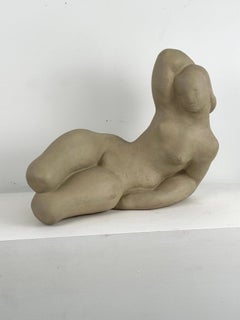
Thomas French Fine Art Figurative Sculptures
to
3
Overall Width
to
Overall Height
to
3
1
2
1
1
2
1
1
1
1
1
1
1
2
1
2
1
3
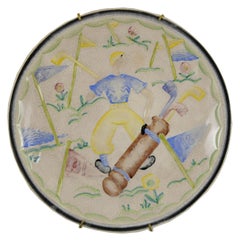
Golf (Wall Plaque)
By Viktor Schreckengost
Located in Fairlawn, OH
Golf (Wall Plaque)
Polychromed ceramic, c. 1930-1
Signed with the artist's initials: VS recto
Very rare, only a few produced prior to the closure of Cowan Pottery
Format: Round ceramic plate, 11 1/4 inches
Designed by the artist while working for Cowan Pottery in 1930. One of Cowan's clients, an interior designer, requested plates decorated with different outdoor activities. Others in the series included "Swimming," "Tennis," "Polo," and "The Hunt."
According to Henry Adams, the number of examples created was very limited due to the closing of Cowan Pottery in 1931. Very rare
Condition: Good, with the usual craquelure of the glazes used.
Note: Industrial design democratizes high style, and Mr. Schreckengost was widely considered among the most democratic industrial designers. He made, quite literally, the stuff of life — things found routinely in homes, backyards and garages in this country and around the world. He designed bicycles for Sears and everyday china for American Limoges...
Category
1930s Art Deco Figurative Sculptures
Materials
Ceramic
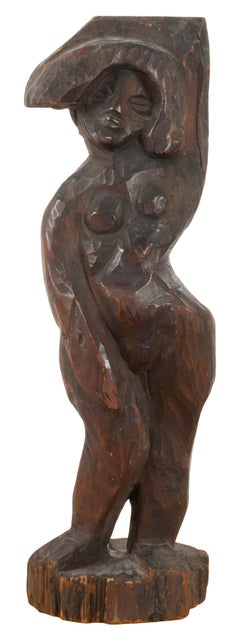
Standing Female Nude After Alexander Archipenko
By Walt Kuhn
Located in Fairlawn, OH
Illustrated: "Walt Kuhn, Painter, His Life and Work, by Phillip Rhys Adams, page 67, plate 27, Courtesy of Kennedy Galleries-Kuhn Estate (see photo)
Kuhn’s sculptures were collected...
Category
1910s Cubist Figurative Sculptures
Materials
Wood
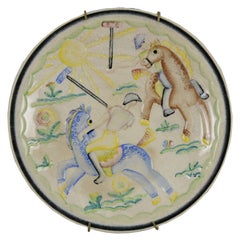
Polo (Wall Plaque)
By Viktor Schreckengost
Located in Fairlawn, OH
Polo (Wall Plaque)
Polychromed ceramic, c. 1930-1931
Signed with the artist's initials: VS recto
Cowan Pottery stamp verso
References And Exhibitions:
Designed by the artist while working for Cowan Pottery in 1930. One of Cowan's clients, an interior designer, requested plates decorated with different outdoor activities. Others in the series included "Swimming," "Tennis," "Golf," and "The Hunt."
Condition: with the usual craquelure
Size: 11 1/4 inches in diameter
Industrial design democratizes high style, and Mr. Schreckengost was widely considered among the most democratic industrial designers. He made, quite literally, the stuff of life — things found routinely in homes, backyards and garages in this country and around the world. He designed bicycles for Sears and everyday china for American Limoges. He designed children’s toys and pedal cars; flashlights, furniture and fans; lawn chairs, lawn mowers...
Category
1930s American Modern Figurative Sculptures
Materials
Ceramic
Related Items
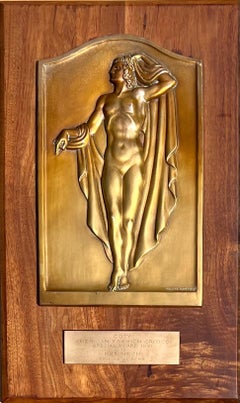
1961 Coty Award Plaque Kenneth Hairdresser Jacqueline Onassis Bronze Fashion
Located in New York, NY
1961 Coty Award Plaque Kenneth Hairdresser Jacqueline Onassis Bronze Fashion
Bronze on wood. The wood plaque measures 12 3/4" by 20 3/4 inches. The bronze plaque itself is 13 3/4 x 8 3/4 inches and the the bronze inscription, which reads "COTY, American Fashion Critics Special Award 1961 to KENNETH of LILY DACHE...
Category
1960s American Modern Figurative Sculptures
Materials
Bronze
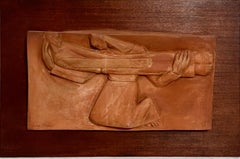
Large George Aarons Terracotta Sculpture Relief Art Deco Plaque WPA Artist
By George Aarons
Located in Surfside, FL
Two Figures (Mother and son)
9" x 17" terracotta sculpture, signed lower left mounted to wood panel, 15 1/2" x 23 1/2"
George Aarons (born Gregory Podubisky, in St. Petersburg, Russ...
Category
20th Century Art Deco Figurative Sculptures
Materials
Wood, Terracotta

$2,200
H 15.5 in W 23.5 in D 1 in
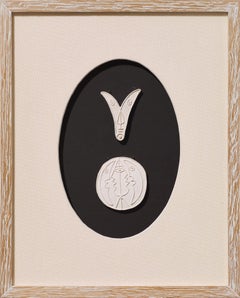
Original ceramic pendant " Vé et Astrology "
By Jean Cocteau
Located in CANNES, FR
Jean Cocteau ( 1889 - 1963 )
Vé and Astrology ceramic's pendant :
Vé : signed underneath White 1ere variant
( Terre blanche en relief ). page 212
Size: 7 x5.5 cm
catalogue rai...
Category
1950s Art Deco Figurative Sculptures
Materials
Ceramic
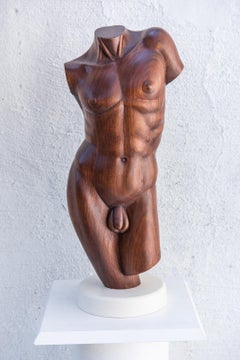
Male Classical Torso
By Larry Scaturro
Located in Brooklyn, NY
Male classical torso.
Category
2010s Contemporary Figurative Sculptures
Materials
Wood, Walnut
Deers, Art Deco figurine. Porcelain, hand painted. Riga Porcelain factory
Located in Riga, LV
Vintage Soviet period figurine from Riga of the 60's. Hand painted.
Category
1960s Art Deco Figurative Sculptures
Materials
Porcelain

$331
H 7.09 in W 6.89 in D 1.58 in
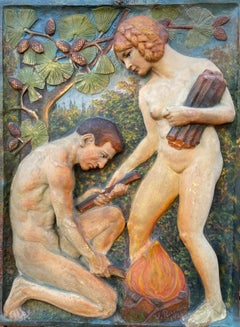
“Adam and Eve”
Located in Southampton, NY
Very rare Art Deco three dimensional terracotta sculpture of Adam and Eve by the Austrian artist, Virgil Rainer. Hand painted by the artist. Signed bott...
Category
1920s Art Deco Figurative Sculptures
Materials
Terracotta, Plaster
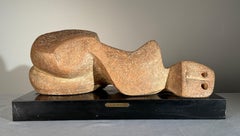
"Reclining Figure" Louise Nevelson, Modernist, Human Form, Abstracted Body
By Louise Nevelson
Located in New York, NY
Louise Nevelson
Reclining Figure, circa 1943
Tattistone
8 inches high x 21 inches wide x 9 inches deep
With base 10 inches high x 21 3/4 inches wide x 9 1/2 inches deep
Provenance
T...
Category
1940s American Modern Abstract Sculptures
Materials
Cast Stone
$30,000
H 8 in W 21 in D 8 in
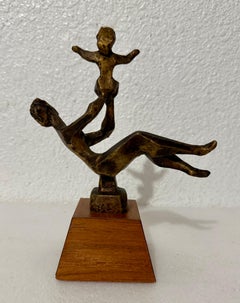
Chaim Gross Mid Century Mod Bronze Sculpture Mother and Baby Playing WPA Artist
By Chaim Gross
Located in Surfside, FL
Chaim Gross (American, 1904-1991)
Cast bronze sculpture
Caring (or Mother and Child)
signed
Mounted on wooden plinth
Featuring a mother raising her child up in superb high relied i...
Category
Mid-20th Century American Modern Figurative Sculptures
Materials
Bronze
$2,400
H 9 in W 7.5 in D 3.5 in
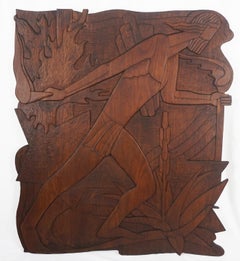
Large Mahogany Relief of Prometheus, The Giver of Fire in Style of Peterpaul Ott
Located in Soquel, CA
Large Scale Mahogany Wood Relief Sculpture of Prometheus, The Giver of Fire In the Style of WPA artist Peterpaul Ott
Wonderfully executed wood r...
Category
1950s Other Art Style Figurative Sculptures
Materials
Wood, Mahogany
$6,112 Sale Price
20% Off
H 50.5 in W 44 in D 2 in
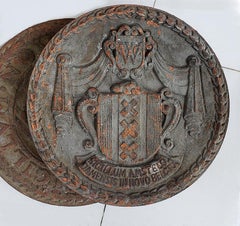
Westside Highway Cast Iron Roundel Art Deco - Rene Paul Chambellan
Located in Miami, FL
This sale is for one of them of the Cast Iron Roundels. However, we have 3 Cast Iron Roundels from the Old West Side Highway in Manhattan if you want to buy all three... reach out to us. . Each retains its original industrial paint. If the paint is removed, the clear shape of the iron cast will be removed. Each roundel has a different image and story. They were designed in 1928 by Rene Paul Chambellan...
Category
1920s Art Deco Abstract Sculptures
Materials
Iron
$2,000 Sale Price
20% Off
H 2 in W 17.75 in
Hollywood
By Philip Paval
Located in West Hollywood, CA
Philip Paval was a sculptor and silversmith who worked primarily in Los Angeles. He was known as a Hollywood Artist, as he affiliated with many of the Hol...
Category
1930s Art Deco Figurative Sculptures
Materials
Brass
Relining Nude (WG6)
By Waylande Gregory
Located in Wilton Manors, FL
Waylande Gregory (1905-1971).
Nude Reclining, ca. 1950's. Painted composite cast from original sculpted in 1930's. Casting sanctioned and approved by the artist during his lifetime in partnership with MPI, Museum Pieces Incorporated. Very few examples were produced and even fewer survive.
Waylande Gregory was considered a major American sculptor during the 1930's, although he worked in ceramics, rather than in the more traditional bronze or marble. Exhibiting his ceramic works at such significant American venues for sculpture as the Whitney Museum of American Art in New York City and at the venerable Pennsylvania Academy of the Fine Arts in Philadelphia, he also showed his ceramic sculptures at leading New York City galleries. Gregory was the first modern ceramist to create large scale ceramic sculptures, some measuring more than 70 inches in height. Similar to the technique developed by the ancient Etruscans, he fired his monumental ceramic sculptures only once.
Gregory was born in 1905 in Baxter Springs, Kansas and was something of a prodigy. Growing up on a ranch near a Cherokee reservation, Gregory first became interested in ceramics as a child during a native American burial that he had witnessed. He was also musically inclined. In fact, his mother had been a concert pianist and had given her son lessons. At eleven, he was enrolled as a student at the Kansas State Teacher's College, where he studied carpentry and crafts, including ceramics.
Gregory's early development as a sculptor was shaped by the encouragement and instruction of Lorado Taft, who was considered both a major American sculptor as well as a leading American sculpture instructor. In fact, Taft's earlier students included such significant sculptors as Bessie Potter Vonnoh and Janet Scudder. But, Taft and his students had primarily worked in bronze or stone, not in clay; and, Gregory's earliest sculptural works were also not in ceramics. In 1924, Gregory moved to Chicago where he caught the attention of Taft. Gregory was invited by Taft to study with him privately for 18 months and to live and work with him at his famed "Midway Studios." The elegant studio was a complex of 13 rooms that overlooked a courtyard. Taft may have been responsible for getting the young man interested in creating large scale sculpture. However, by the 1920's, Taft's brand of academic sculpture was no longer considered progressive. Instead, Gregory was attracted to the latest trends appearing in the United States and Europe. In 1928 he visited Europe with Taft and other students.
"Kid Gregory," as he was called, was soon hired by Guy Cowan, the founder of the Cowan Pottery in Cleveland, Ohio, to become the company's only full time employee. From 1928 to 1932, Gregory served as the chief designer and sculptor at the Cowan Pottery. Just as Gregory learned about the process of creating sculpture from Taft, he literally learned about ceramics from Cowan. Cowan was one of the first graduates of Alfred, the New York School of Clayworking and Ceramics. Alfred had one of the first programs in production pottery. Cowan may have known about pottery production, but he had limited sculptural skills, as he was lacking training in sculpture. The focus of the Cowan Pottery would be on limited edition, table top or mantle sculptures. Two of the most successful of these were Gregory's Nautch Dancer, and his Burlesque Dancer. He based both sculptures on the dancing of Gilda Gray, a Ziegfield Follies girl.
Gilda Gray was of Polish origin and came to the United States as a child. By 1922, she would become one of the most popular stars in the Follies. After losing her assets in the stock market crash of 1929, she accepted other bookings outside of New York, including Cleveland, which was where Gregory first saw her onstage. She allowed Gregory to make sketches of her performances from the wings of the theatre. She explained to Gregory, "I'm too restless to pose." Gray became noted for her nautch dance, an East Indian folk dance. A nautch is a tight, fitted dress that would curl at the bottom and act like a hoop. This sculpture does not focus on Gray's face at all, but is more of a portrait of her nautch dance. It is very curvilinear, really made of a series of arches that connect in a most feminine way.
Gregory created his Burlesque Dancer at about the same time as Nautch Dancer. As with the Nautch Dancer, he focused on the movements of the body rather than on a facial portrait of Gray. Although Gregory never revealed the identity of his model for Burlesque Dancer, a clue to her identity is revealed in the sculpture's earlier title, Shimmy Dance. The dancer who was credited for creating the shimmy dance was also Gilda Gray. According to dance legend, Gray introduced the shimmy when she sang the Star Spangled Banner and forgot some of the lyrics, so, in her embarrassment, started shaking her shoulders and hips but she did not move her legs. Such movement seems to relate to the Burlesque Dancer sculpture, where repeated triangular forms extend from the upper torso and hips. This rapid movement suggests the influence of Italian Futurism, as well as the planar motion of Alexander Archipenko, a sculptor whom Gregory much admired.
The Cowan Pottery was a victim of the great depression, and in 1932, Gregory changed careers as a sculptor in the ceramics industry to that of an instructor at the Cranbrook Academy in Bloomfield Hills, Michigan. Cranbrook was perhaps the most prestigious place to study modern design in America. Its faculty included the architect Eliel Saarinen and sculptor Carl Milles.
Although Gregory was only at Cranbrook for one and one half years, he created some of his finest works there, including his Kansas Madonna. But, after arriving at Cranbrook, the Gregory's had to face emerging financial pressures. Although Gregory and his wife were provided with complimentary lodgings, all other income had to stem from the sale of artworks and tuition from students that he, himself, had to solicit. Gregory had many people assisting him with production methods at the Cowan Pottery, but now worked largely by himself. And although he still used molds, especially in creating porcelain works, many of his major new sculptures would be unique and sculpted by hand, as is true of Kansas Madonna. The scale of Gregory's works were getting notably larger at Cranbrook than at Cowan.
Gregory left the surface of Kansas Madonna totally unglazed. Although some might object to using a religious title to depict a horse nursing its colt, it was considered one of Gregory's most successful works. In fact, it had a whole color page illustration in an article about ceramic sculpture titled, "The Art with the Inferiority Complex," Fortune Magazine, December, 1937. The article notes the sculpture was romantic and expressive and the sculpture was priced at $1,500.00; the most expensive sculpture...
Category
1950s Art Deco Figurative Sculptures
Materials
Plaster