Tobogan Antiques Cabinets
to
3
Height
to
Width
to
Depth
to
7
7
7
7
4
4
3
3
7
7
7
7
7
1
1
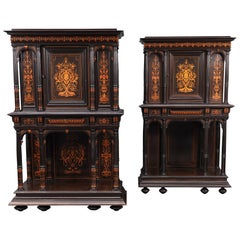
Rare Pair of Renaissance Revival Cabinet Attributed to F. Linke, France, c. 1880
By François Linke
Located in PARIS, FR
Cabinet 1 - Height : 152 cm (59,8 in.) ; Width : 96 cm (37,8 in.) ; Depth : 48 cm (18,9 in.)
Cabinet 2 - Height : 150 cm (59 in.) ; Width : 87,5 cm (34,4 in.) ; Depth : 42 cm (16,5 in.)
Rare near pair of French Renaissance style cabinets attributed to F. Linke. Composed of an architectured upper part, with inlaid panels alternated with Fine fluted columns, opening with a central door onto an exquisite filet framed veneered wood interior fitted with shelves. The decor of the panels is made of very Fine designed motifs such scrolls, grotesques and flowery vases, all characteristic of the Renaissance decorative repertoire. The lower section with three drawers above a three arched support ornated with columns, raised on a stepped base ; the back with similarly-inlaid decoration.
These neo-Renaissance style cabinets are very close to François Linke’s one presented in his private collection.
(photo attached, Reproduced and commented in François Linke (1855-1946), The Belle Époque of French Furnitures, Ch. Payne, pp.40-41).
If the style, characterizing François Linke, is mostly recognizable by its Rococo-Art Nouveau motifs, it occasionally appealed other historical ornaments, such from the French Renaissance. That reminds of the time, when the cabinet took the central place in the interior furnishings. This collector...
Category
Antique 1880s French Renaissance Revival Cabinets
Materials
Wood
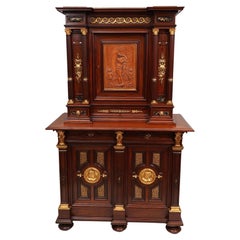
Neo-Renaissance Cabinet by P. Sormani and attr. to E. Lièvre, France, Circa 1870
By Edouard Lievre, Paul Sormani
Located in PARIS, FR
Signed twice on the lock P. SORMANI 10 rue Charlot Paris
Rare neo-Renaissance cabinet in carved wood and Portor marble, adorned with chiseled and gilded bronze.
The upper, part, surmounted by a frieze of posts and marble cabochons, consists of a central door decorated with a carved panel representing the birth of Venus, framed by two pairs of ringed and fluted columns with Corinthians capitals in gilded bronze revealing two doors with secret opening. Two drawers with lion’s head shaped handles and a central drawer decorated with tracery in gilded bronze complete the upper part of this cabinet.
In the lower part, two drawers on the belt with diamond...
Category
Antique 1870s French Renaissance Cabinets
Materials
Marble, Bronze

$58,131 Sale Price
44% Off
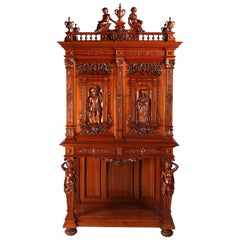
Renaissance Style Wooden Cabinet Attributed to H.A. Fourdinois, France, 1893
Located in PARIS, FR
A wooden cupboard, elaborately carved throughout, dated "1893" on the crest and attributed to H.A. Fourdinois. The upper section with a pair of cherubs at the center of a balustrade ornamented with two-handled urns, two architectonic doors below, carved with lady and gentleman in niches surrounded by extensive carving with classical motifs. The lower section with two drawers above a standing female caryatid support at each front corner. The all reposing on four gadronned round feet.
The Fourdinois company was founded in 1835 by Alexandre-Georges Fourdinois (1799-1871). The Universal Exhibition held in London in 1851 was undoubtedly their first great artistic and public success. Winning the Great medal for a neo-Renaissance buffet...
Category
Antique 1890s French Renaissance Cabinets
Materials
Wood
$16,214 Sale Price
38% Off
Renaissance Style "Four Seasons" Cabinet by M. Lerolle, France, Circa 1890
By Lerolle
Located in PARIS, FR
Signed " Meubles D’Art, M. Lerolle, Fabricant, 61, Rue des Sts-Peres. Paris "
Remarkable carved wood cabinet, richly sculpted in the Neo-Renaissance style, and inlaid with vert de m...
Category
Antique 1890s French Renaissance Revival Cabinets
Materials
Marble
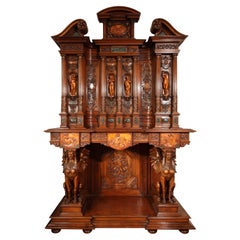
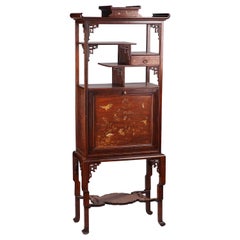
Japanese Style Cabinet-Secretary Attributed to G. Viardot, France, Circa 1880
By Gabriel Viardot
Located in PARIS, FR
A Japanese style carved wood cabinet attributed to G. Viardot. A painted decor imitating Japanese lacquer, ornamented with flowers, birds and butterflies. Opening onto two drawers an...
Category
Antique 1880s French Japonisme Cabinets
Materials
Wood, Paint
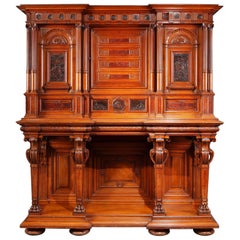
Neo-Renaissance Cabinet by G.F. Quignon, Universal Exhibition of Paris 1889
By Frederic Gustave Quignon
Located in PARIS, FR
Presented at the Universal Exhibition of Paris in 1889
Important sculpted and engraved natural wood, patinated bronze and Griotte de Campan red marble inlaid Neo-Renaissance style cabinet.
The upper part is composed of a frieze of bronze medallions separated by triglyphs and supported by ribbed columns with Corinthian capitals. There are eight of these columns paired at the front and two simple columns at the rear. The facade presents an alternation of bronzes in niches and cartouches, of marble slates in cartouches sometimes flanked by palmettes, and of engraved motives of laurel and foliage scrolls. The upper part opens with three leaves and three mobile compartments. The belt carved with acanthus leaves opens with two drawers. This cabinet is supported by four richly sculpted tapered feet ending with claws. Four fluted pilasters are inscribed in the moulded back as counterparts. The whole ensemble stands on a moulded plinth and eight rounded feet.
Neo Renaissance Cabinet...
Category
Antique 1880s French Renaissance Cabinets
Materials
Marble, Bronze
$102,090 Sale Price
37% Off
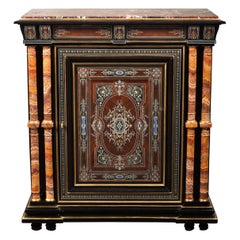
Exceptional Marquetry Cabinet Attributed to Susse Frères, France, Circa 1880
By Susse Freres
Located in PARIS, FR
Blackened wood side-cabinet attributed to Susse Frères, opening with a central cupboard door underlined with gilt bronze rods, flanked by two small onyx c...
Category
Antique 1880s French Cabinets
Materials
Lapis Lazuli, Onyx, Marble, Brass, Bronze
Related Items
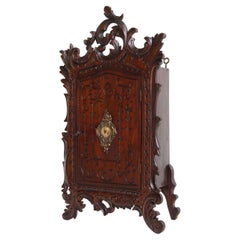
Antique French Renaissance Revival Richly Carved Wall Cabinet 19th Century Brass
Located in Ijzendijke, NL
Luxurious & romantic French Renaissance revival Wall cabinet / small cabinet , richly carved & decorated with brass.
Very nice craftsmanship with impressive carvings.
When opened...
Category
Antique 1880s French Renaissance Revival Shelves and Wall Cabinets
Materials
Brass
$1,555
H 22.45 in W 13 in D 6.3 in
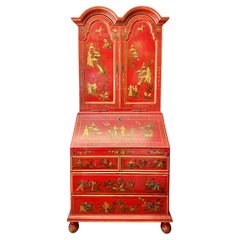
English Chinoiserie Georgian Style Japanned Scarlet Vermillion Cabinet Secretary
Located in New York, NY
Vintage bureau cabinet secretary in the English chinoiserie style with elements of Queen Anne and George I design, japanned finish in red vermillion/scarlet with hand-painted and gil...
Category
Mid-20th Century Italian Queen Anne Cabinets
Materials
Wood
$4,500
H 84 in W 38 in D 20 in
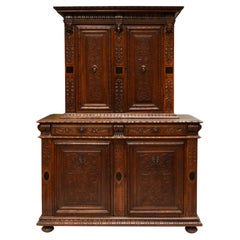
Renaissance Cabinet form Lyon
France
Located in Saint-Ouen, FR
Condition : Partly dating from the Renaissance. The backs and the drawer’s insides have been re-done.
Historical background
The 16th century is a prosperous period for Lyon...
Category
Antique 16th Century French Renaissance Cabinets
Materials
Walnut
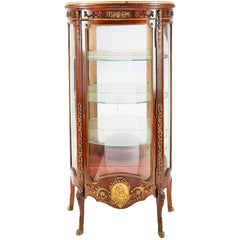
French Linke Style Display Cabinet, 19th Century
By François Linke
Located in Brighton, Sussex
A good quality late 19th century plum pudding mahogany Louis XVI style vitrine, having a marble top, gilded ormolu mounts, shaped glass panels to the door and sides, three glass shel...
Category
Antique Late 19th Century French Louis XVI Cabinets
Materials
Ormolu
$9,905 Sale Price
20% Off
H 64.57 in W 32.68 in D 13 in
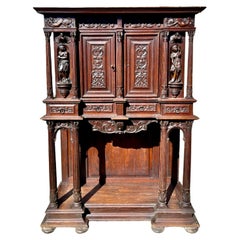
Renaissance Style Carved Cabinet in oak, XIXth century
Located in Beaune, FR
Cabinet, sideboard or splashback in solid oak in Renaissance style. Richly carved, this piece of furniture offers a very pretty architecture. The decorations are inspired by the Rena...
Category
Antique 19th Century French Renaissance Revival Cabinets
Materials
Oak
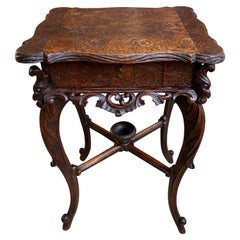
Antique French Carved Side Table Jewelry Cabinet Renaissance Louis XV c1890
Located in Shreveport, LA
~Direct from France~
Unique, highly carved antique French table with exquisite details throughout!~
~The overall silhouette is stunning, from the serpentine edge top to the figural side trim, elongated legs and center cross stretcher with decorative cup~
~Cabinet top is completely hand carved in a lovely floral motif, with the same carved design on all four sides of the body~
~Open carved French trim on all the apron sides with dimensional faces on the corners~
~Carved beveled ‘faux bois’ trim~
~Elegant long, French legs with detailed hand carved foliate motif~
~Perfect to “float” in any room, as all sides are finished, there is no ‘backside’~
~Fitted cubbyhole interior, implies this was probably a jewelry or collector’s box. The center front drawer slides forward and features it’s separate lift top lid!~
~Most probably a commissioned piece for a French aristocrat...
Category
Antique Late 19th Century French Renaissance Revival Side Tables
Materials
Oak
$2,465
H 31.5 in W 21.5 in D 18 in
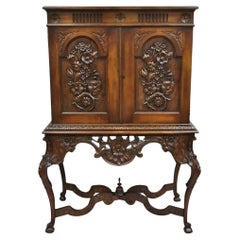
Antique French Renaissance Flower Carved Walnut China Cabinet Radio Bar Cabinet
Located in Philadelphia, PA
Antique French Renaissance Flower Carved Walnut China Cabinet Radio Bar Cabinet. Item features wonderful relief carved flowers throughout, shapely ca...
Category
Early 20th Century Unknown Renaissance Cabinets
Materials
Walnut
$1,500
H 61 in W 43 in D 22 in
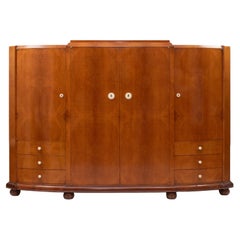
Fine Art Deco Mahogany Cabinet, attributed to Jules Leleu, circa 1925
By Jules Leleu
Located in Roma, IT
Important Art Déco cabinet, attributed to Jules Leleu, realized between 1925 and 1930.
Executed in mahogany veneer with subtle figuring and a warm, satin finish, the cabinet showcas...
Category
Vintage 1920s French Art Deco Cabinets
Materials
Mahogany, Ivory
$27,024
H 48.82 in W 72.05 in D 16.54 in
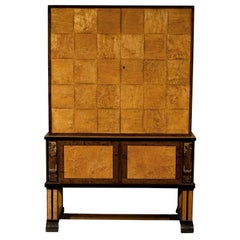
Art Deco Cabinet Attributed to Eliel Saarinen
By Eliel Saarinen
Located in Atlanta, GA
Rare dining cabinet attributed to Eliel Saarinen (father of Eero Saarinen) designed before his immigration to the United States. In a style that we now refer to as "Art Deco," this style was considered the "National Romantic Style" in Finland - essentially a twist on what became known worldwide as Art Deco - with its strong vertical lines and medieval references.
The workmanship of this cabinet and its materials is magnificent. Note the carefully matched panels of golden masurbjork (Burl Birch root), the intricate carvings of medieval knights (very similar to those guarding Saarinen's Helsinki Railway Station built in 1906) and the high contrast of golden and dark birch wood - seen again in Saarinen's furniture designed in the United States in the late 1920s.
While Saarinen's son Eero went on to become the more famous of the two, it was Eliel who could be considered the grandfather of Nordic Art Deco...
Category
Vintage 1920s Finnish Art Deco Cabinets
Materials
Birch, Burl
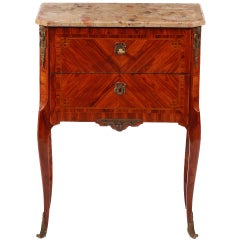
A French Ormulo-Mounted Petite Commode By PAUL SORMANI
By Paul Sormani
Located in Sheffield, MA
A FRENCH ORMOLU-MOUNTED INLAID
KINGWOOD
MARBLE-TOP PETIT COMMODE,
BY PAUL SORMANI, LAST QUARTER 19TH CENTURY
A rectangular marble top over two drawers with ormolu mounts ove...
Category
Antique 19th Century French Louis XV Commodes and Chests of Drawers
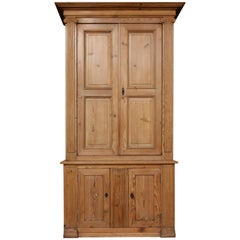
19th Century French Renaissance Revival Bookcase Cabinet Made of Pine
Located in Dusseldorf, DE
A 19th Century French bookcase in Renaissance style, made of solid pine.
Consists of an upper and a lower part with a total of 4 doors.
Facade-like front. Pilaster strips with flut...
Category
Antique 19th Century French Renaissance Revival Bookcases
Materials
Fir, Pine
$2,341
H 89.38 in W 55.91 in D 18.51 in
Important Renaissance Cabinet from Lyon
France
with a Decor of Perspectives
Located in Saint-Ouen, FR
As soon as 1540 France's second Renaissance is in the making, intimately linked to the rediscovery of the Antique world. The development of the printing and engraving industry allows the spread of artworks and models in many cities and countries. The Italian influence can be perceived in every artistic field. While the French king entrust the most talented Italian artists with major projects such as Il Rosso or Primaticcio in Fontainebleau, French artists also travel to Italy to form themselves to this new style. In Italy they get acquainted with the work of Leo Battista Alberti the first to theorize perspective (De Pictura, 1435-36) and architecture (De re oedificatoria, 1541). Those two publications would have a revolutionary impact on arts.
Furniture is marked by the work of the most famous Italian architects of the time as well as French architects. Indeed Philibert de l'Orme competes with Alberti and by the end of his life publishes several treaties including one devoted to a theory of architecture (1567). Unfortunately he would not live to complete the second volume. In this treaty he expresses his interest for mathematical norms applied to architecture, copied from the Antique. His journeys in Italy allowed him to accumulate the most sophisticated references. Jean Bullant, another architect of great talent also theorizes his practice. He establishes rules characterizing Greco-Roman art staying faithful to Vitruvius.
Following this new inspiration the structure of furniture evolves. From then on appear columns, capitals, cornices, friezes and architraves. The ornamentation uses this inspiration as well with egg-and-dart, palm leaf and rose adorning the most beautiful pieces.
In Lyon, crossroad where meet merchants from everywhere those new experiments are welcomed. Lyon florishing printing industry allows the spreading of models and treaties essential to the artist's work. Thus the first publication of Vitruvius' De Architectura in France would be printed in Lyon in 1532.
Artists from Lyon rediscover and familiarize themselves with the Antique knowledge very early. They adopt those new ideas and use them in their own creations. Lyon cabinet-makers re interpret Antique architecture and Italian Renaissance palaces to give their pieces a pure and harmonious architectural structure. Grooved pilasters are particularly favored. They are topped by capitals of diverse orders always respecting the sequencing with simpler ones for the lower levels and the richest ones on the higher levels. As for the ornamentation, one of the great distinctiveness of Lyon workshops remains the architectural perspective illusions, drawing inspiration from Tuscany.
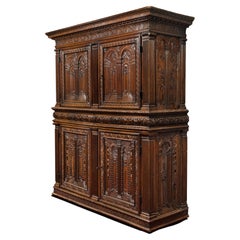
True masterpiece of the Second French Renaissance this important cabinet illustrates Lyon workshops' taste for fine Italian architecture inspired by Antiquity. An architectural perspective of great quality is treated in symmetry on each panel.
This two-bodied cabinet without recess stands on four rectangular feet. The base comprises a molding, a palm leaf frieze and is bordered by a braid.
The lower body is divided by three grooved pilasters with Tuscan capitals framing two door-leaves. The two panels are encircled by a moudled frame with palm leaves. They are finely carved with a decor of fantasized architecture depicting an Italian Renaissance palace erected symmetrically on each side of a grooved pilaster. On the ground floor a door opens through a stilted arch while the stories are opened with mullioned windows, dormers and occuli. Two large pegged-boss cladded pillars support the entablature enriched by a palm leaf frieze upon which stands an arch whose coffered intrados is centred by a rose. Behind this arch a pyramid appears, standing in front of a second facade with a window topped by a broken curvilinear pediment under a cul-de-four with a shell.
The checker flooring gives depth to the low-reliefs creating vanishing points structuring the panels and guiding the eye of the observer.
A thin laurel braid highlights the belt of the cabinet where are located two drawers. Their facades are adorned by palm leaves in hoops.
The upper body is encircled with palm leaves. The same ternary division as in the lower body appears. However, the pilasters are topped by Ionic capitals with volutes and egg-and-dart. The door-leaves are framed with flowers. On the panels the artist has designed another architectural decor. On the foreground open two arches on top of grooved pilasters with rectangular capitals adorned with palm leaves. The arches are enriched with braids and the coffered intrados bears a decor of roses. The spandrels also bear a flower decor. In the background another arcature hosts a fluted grooved column topped with double basket acanthus capital, characteristic of Corinthian order. The triangular pediment is interrupted by a choux bourguignon.
A large cornice crowns the cabinet. It stands on pilasters and forms an entablature comprising a palm leaf frieze and an egg-and-dart, triglyph and palm leaf cornice.
The cabinet's sides have also been carefully considered. The lower body's panels are enriched with an arch rising above a broken pediment portico hosting a twisted column. Flowers garnish the spandrels. An architectural facade completes the decor. The upper body's panels present two arches supported by a facade opened with dormers and mullioned windows as well as cartouches (one bears the inscription 1580 dating the cabinet) suggesting the interior of an Italian Renaissance palace, confirmed by the chandeliers. The flooring leads our gaze to a second arch with a broken curvilinear pediment where stands a flower vase. This arch opens onto a perspective of another facade along a road.
Inside the cabinet, on the lower body door-leaves appear two designs. On the right door is depicted a Crucifixion. Saint Mary and Saint John flank the Christ on the cross. In the bottom part is inscribed « Dure uiator abis nihil haec spectacula curas / Pendenti cum sis unica cura Deo. / Tota suo moriente dolet natura Magistro. / Nil qui solus eras caussa dolenda doles. ». The signature [Christoff Swartz Monachiensis pinx[it] / Ioa[nnes] Sadeler sculp[it]] tells us it was made by Johan Sadeler I (1550-1600) after Christoph Schwartz (1548-1592). This engraving belongs to an ensemble depicting the Passion of Christ Johan Sadeler executed in 1589 after an altar piece painted by Christoph Schwartz for the private chapel of Renée of Loraine, wife of Duke William V of Bavaria. This altar piece made of nine copper panels has been destroyed during the 19th century. The Crucifixion panel once in the centre of the altar piece is the only one that survived and is today kept in Munich's Alte Pinakothek.
On the left door appears Saint Francis receiving the stigmata. The inscription says : « Signastidomine Servum Tuum. Franciscum. Signis Redemptionis Nostrae ».
This Renaissance cabinet with an architectural decor appearing as much in the structure faithful to Antique rules...
Category
Antique 16th Century European Renaissance Cabinets
Materials
Walnut
$180,160
H 87.41 in W 74.81 in D 27.17 in