TRIBA Prints
to
6
6
3
1
5
2
3
2
3
6
6
6
5
1
6
6
6
3
1
1
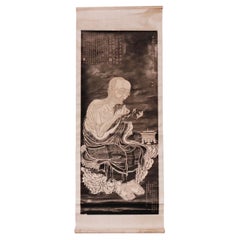
Antique Chinese Printed Ink Rubbing of Panthaka Arhat, (scroll mounted)
Located in Point Richmond, CA
Chinese ink rubbing printing depicting Panthaka Arhat, no.4 of the 16 arhat images immortalized in stone at the former stupa at Shengyin Temple. Depicted here sitting on a rock with a book in his left hand and snapping his fingers in his right hand, symbolic of the speed at which he obtained enlightenment, accompanied by a beggar’s bowl and an incense burner, complete with colophons and silk scroll mounting. The Emperor Qianlong ordered the stone stele to be carved in 1764 after the arhat designs painted by the famed artist Guanxiu (832-912). Even though the temple was destroyed in the Taiping rebellion, the steles remain and have been reinstalled at the Hangzhou Stele Forest. Condition: Creases from rolling, otherwise fine condition. Mounting: 58” x 22”. 19th Century. Ex Collection: Frank “Till” & Peggy Durdin, San Diego.
For other rubbings of this stele see:
Penn Museum, object number 2010-26-4
The Metropolitan Museum of Art AN#: 59.195.15
Fine Arts Library of Harvard University, record id: W280021_urn-3:FHCL:478850
For another example of this image rendered in jade and lacquer see: “Screen Paintings of Guanxiu’s Sixteen Arhats in the Collection of the Palace Museum” Luo Wehhua translated by Bruce Doar, Orientations, September 2010, p. 104. In this article the image is identified as the sixteenth arhat Abheda, It is explained in this article that Qianlong re-identified the arhats, thus the 16th Arhat attribution for this image. Also in this article the identical colophon by Qianlong above the image is translated as: “These accurate portraits of the Sixteen Arhats were created by the Tang Dynasty painter Guanxiu, as recorded in Xuanhe Huapu (Record of paintings in the Xuanhe Reign), and during the millennium from the Guangming reign period to the present day, the original works were to be found in Zhejiang, where they were housed in the collection of Shengyin Temple in Qiantang (Huangzhou). In spring of the dingchou year (1757) of his reign, the Qianlong emperor undertook a southern tour of inspection and stayed at an imperial lodge on the West Lake. He went to the temple to pay his respects and there he saw the arhats on display and wrote a description of these marvels. The sequence of the arhats and their names had been passed down since ancient times, but they did not correspond to their Sanskrit titles; the sequence of the arhat names conformed instead to the interpretation of the Sanskrit classics by the Zhangjia State Preceptor. The emperor penned the original names and positions in the sequence below each of the figures in accordance with the readings supplied in Tongwen Yuntong (Unified Rhymes), and below each he penned an encomium, which he signed. Then the images were returned to the collection, to be passed down as a perpetual treasure. Now, the fourth great arhat had long gone missing and we did not know where his painting was. But it was merely a trifling matter of matching the images with the names, and now surely we have found him! This I, the emperor, believe.”
All 16 of these rubbings can be found in the Rubel Chinese Rubbings Collection at the Fine Arts Library of Harvard University with the following descriptive historical note: “Rubbing from stele depicting No. 4 of 16 arhats (Lohans, Buddhist saints) -- Nan ti mi duo luo qing you, Panthaka Arhat. Original painting attributed to Guanxiu, 832-912. Inscriptions written by Hongli, Emperor Qianlong (Gaozong, 1711-1799) of Qing Dynasty. 7 seals of Qianlong follow the inscriptions. Script style: in xing shu. Shi liu zun zhe -- "The 16 noble ones" are 16 lohans. Lohans are also called "a-lo-han" based on the transliteration of the Sanskrit term "arhat." (Japanese: Rakan; Chinese: Lohan; Tibetan: Gnas-brtan). Arhats or Arahants are saints or sages said to have renounced nirvana (freedom from the cycle of suffering and rebirth), vowed to remain in the world to protect the Dharma and propagate the Law of the Buddha in order to devote themselves more effectively to the relief of human misery, like the Bodhisattvas. These 16 Arhats, personal disciples distinguished by the Buddha, formed part of the 500 claimed by tradition to have attended the First Council in Rajagrha. The names and abodes of these 16 arhats are given in a work entitled "Record on the Duration of the Law, spoken by the Great arhat Nadimitra," which was translated into Chinese by the famous pilgrim Xuanzang (596-664) in 654. 16 lohans are quite often represented, especially in China and Japan, in sculpture and painting, in poses and with attributes. Every lohan can be easily with special icongraphic characteristics. Guanxiu (Jiang Deyin or Deyuan, a Buddhist monk also named Master Chan Yue, 832-912) -- painter during late Tang to Five Dynasties, specialized in painting lohan figures. Legend has it that the first portraits of the 18 Lohans...
Category
Antique 19th Century Chinese Qing Prints
Materials
Paper
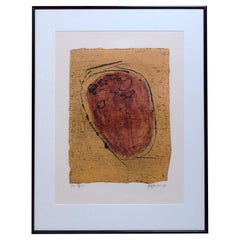
Japanese Collagraph Print by Tsuguo Yanai, "Broken Heart"
By Tsuguo Yanai
Located in Point Richmond, CA
Japanese Collagraph Print by Tsuguo Yanai (b. 1953, Hagi, Yamaguchi), titled “Broken Heart” in Japanese with the printing number 2/30 under the image on the left and pencil signatur...
Category
Vintage 1980s Japanese International Style Prints
Materials
Paper
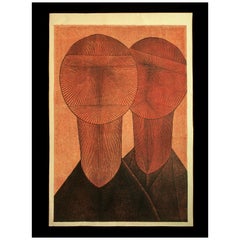
1960 Big Boys, Woodblock Print by Tomio Kinoshita, Japan
By Tomio Kinoshita
Located in Point Richmond, CA
Tomio Kinoshita (1923 – 2014)
Big Boys, 1960
Woodblock print
Image size: 32.75 high by 22 inches wide (83 by 56 cm)
Paper size: 35.5 high by 23.75 inches wide (90 by 60.3 cm)
Signed: in pencil lower right, Tomio Kinoshita
Titled: in pencil at lower left
Edition: 30/50
Condition: Very good
The woodblock for this large print was carved in 1958, just three years after Kinoshita’s began creating woodblocks. This print was signed and dated in 1960, but not numbered; prints were also pulled from this block in the 1970s, so it must have been one of more popular images.
One of his students has written, “As time progressed further, the postwar era saw improvements in nutrition, and children became taller and heavier than in the past, but their lack of physical exercise and severely inferior physical abilities became a social problem; this is ironically depicted in Big Boys.” In 1963, Kinoshita told him that he had just finished pulling a print of this image in response to a request from Unichi Hiratsuka...
Category
Vintage 1960s Japanese Mid-Century Modern Prints
Materials
Paper
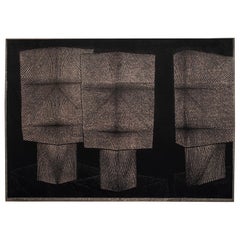
1981 Graphic Woodblock Print by Tomio Kinoshita, Japan
By Tomio Kinoshita
Located in Point Richmond, CA
Tomio Kinoshita (1923 - 2014)
Masks (No. 4), 1981
Woodblock print
Image Size: 22 high by 31 inches wide (56 by 79 cm)
Paper Size: 22.75 high by 31.5 inches wide (57.8 by 80 cm)
...
Category
Vintage 1980s Japanese Mid-Century Modern Prints
Materials
Paper
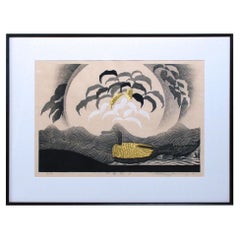
Reika Iwami, Contemporary Japanese woodblock print
By Reika Iwami
Located in Point Richmond, CA
Contemporary Japanese woodblock print (Sosaku hanga) by the female artist Reika Iwami (b. 1927, Tokyo) titled “Water Fantasy A”of a setting full moon on th...
Category
Vintage 1980s Japanese International Style Prints
Materials
Paper
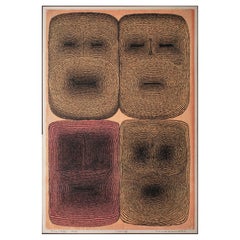
1969 Graphic Woodblock Print by Tomio Kinoshita, Japan
By Tomio Kinoshita
Located in Point Richmond, CA
Faces (4 Faces), 1969
Tomio Kinoshita (1923-2014), Japan
Woodblock print
Paper, pigment, sumi ink
Image: 27 high by 18.25 inches wide (68.5 by 46.4 cm)
Paper size: 28 high by 19...
Category
Vintage 1960s Japanese Mid-Century Modern Prints
Materials
Paper
Related Items
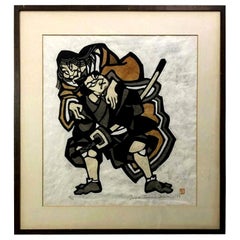
Yoshitoshi Mori Signed Limited Edition Japanese Woodblock Stencil Print, 1969
By Yoshitoshi Mori
Located in Studio City, CA
A large, earthly toned, dramatically composed print, with just the right touch of humor, is by Japanese master printmaker Yoshitoshi Mori who was famed ...
Category
Vintage 1960s Japanese Showa Prints
Materials
Paper

$1,795
H 29 in W 27 in D 0.75 in
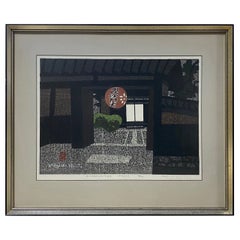
Kiyoshi Saito Signed Limited Edition Japanese Woodblock Print Bisyamonten, Kyoto
By Kiyoshi Saitō
Located in Studio City, CA
A beautifully designed and composed woodblock print by famed Japanese printmaker Kiyoshi Saito. Many consider Saito to be one of the most important, if not the most important, contem...
Category
Vintage 1960s Japanese Showa Prints
Materials
Paper
$1,695
H 24 in W 29.25 in D 1.25 in
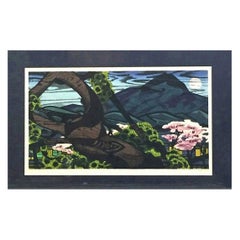
Clifton Karhu Signed Limited Edition Japanese Woodblock Print "Kamigano"
By Clifton Karhu
Located in Studio City, CA
A beautiful, large woodblock print by American master printmaker Clifton Karhu who lived in Japan for over 50 years. Karhu's work gained great e...
Category
20th Century Japanese Showa Prints
Materials
Paper
$2,495
H 21.25 in W 31.5 in D 1 in
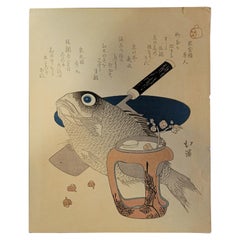
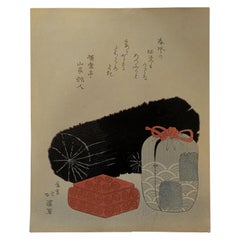
Japanese Woodblock Print by Totoya Hokkei 魚屋北溪
1780-1850
Located in Norton, MA
Original Japanese woodblock print by Totoya Hokkei ????(1780-1850)
About the artist
Totoya Hokkei (?? ??, 1780–1850) was a Japanese artist best kno...
Category
Antique Early 19th Century Japanese Prints
Materials
Paper
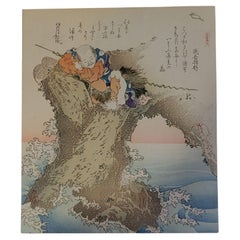
Japanese Woodblock Print (1823) by Yanagawa Shigenobu 柳川重信
Located in Norton, MA
Japanese Woodblock Print by Yanagawa Shigenobu 1787-1832, unframed.
ABOUT THE ARTIST
Born in Yanagawa in 1787, Shigenobu worked as a puppet ma...
Category
Antique Early 19th Century Japanese Prints
Materials
Paper
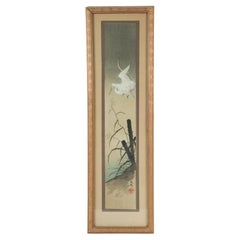
Antique Taisho Period Tanzaku Woodblock Print of Heron at Twilight by Seiko
By Seiko
Located in Philadelphia, PA
A fine antique Taisho period Japanese woodblock print.
Depicting a swooping heron above a riverbed with a thin sliver of a crescent moon in the background.
By Seikо̄. Seikо̄ is tho...
Category
Early 20th Century Japanese Taisho Paintings and Screens
Materials
Paper
$495
H 17.63 in W 5.25 in D 0.75 in
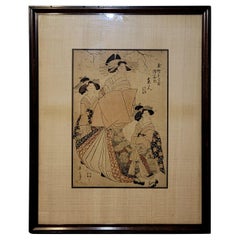
Japanese Woodblock Print " Three Geishas" Kikukawa Eizan (菊川英山) #1
Located in Norton, MA
Original woodblock work by " Three Geishas" Kikukawa Eizan (????) 1787-1867, depicting the traditional Japanese ladies with the traditional beautiful cu...
Category
Antique 19th Century Japanese Prints
Materials
Paper
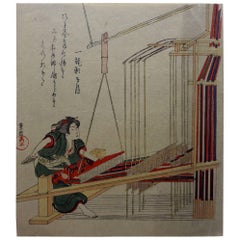
Japanese Woodblock Print by Yanagawa Shigenobu 柳川重信
1880 version 2"
Located in Norton, MA
Japanese woodblock print (1823) by Yanagawa Shigenobu 1880 version 2, unframed.
About the artist
Born in Yanagawa in 1787, Shigenobu worked as a puppet maker before a successful ca...
Category
Antique 1880s Japanese Prints
Materials
Paper
$1,450
H 8 in W 7.125 in D 0.15 in
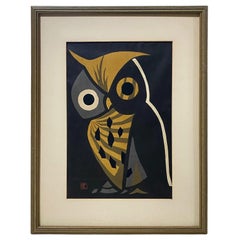
Kaoru Kawano Signed Lifetime Edition Japanese Woodblock Print The Big Owl
By Kaoru Kawano
Located in Studio City, CA
An engaging and quite coveted work by famed Japanese artist Kaoru Kawano who was known for his whimsical portrayals of women, children, and animals. Stylistically, he was one of the first Japanese artists to combine Western-style elements with the traditional methods of woodblock printmaking. This work is known as "The Big Owl" Kawano's owl images are some of his most popular works, this one in particular.
This print is hand signed in pencil and sealed (in red) by Kawano within the image.
This work is a quite rare self-printed lifetime print. Prints made and signed by Kawano are becoming harder to find.
A very beautiful and rich image. Would make for a great addition to any Japanese art and print collection or eye-catching stand-out accent work in about any setting.
Frame dimensions: 21.25" high, 16.25" wide, .5" deep
Viewable art: 14.5" x 9.5".
Please note that the work is framed but there is no glass covering...
Category
Vintage 1950s Japanese Mid-Century Modern Prints
Materials
Paper
$695
H 21.25 in W 16.25 in D 0.5 in
Japanese Woodblock Print by Totoya Hokkei 魚屋北溪
1780-1850
Located in Norton, MA
Original Japanese Woodblock print by Totoya Hokkei ????(1780-1850)
About the artist
Totoya Hokkei (?? ??, 1780–1850) was a Japanese artist best kno...
Category
Antique Early 19th Century Japanese Prints
Materials
Paper
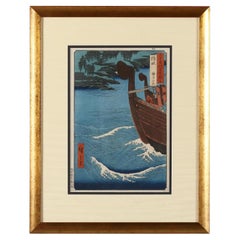
Japanese Woodblock Print Famous Views of the Sixty-Odd Provinces by Hiroshige
By Utagawa Hiroshige (Ando Hiroshige)
Located in Atlanta, GA
Artist: Utagawa Hiroshige (1797 - 1858)
Series: Pictures of Famous Places in the Sixty-odd Provinces
Number: 44 Oki Province: Takuhi Shrine
Medium: Woodblock Print
Date: 1853 (Kaei 6), 12th month
Number of Prints: 70/70 (inc. Title Page)
Format: Vertical Oban
Size (H x W): 14" x 9.25" print only.
Publisher: Koshimuraya Heisuke (Koshihei)
Blockcutter's mark: Hori Ko-Sen
Signature: Hiroshige hitsu
Additional marks: Censor's seals: aratame, Ox 12
Displayed with mat and gilt wood frame.
Reference: For an identical print, see the collection of MIA (Minneapolis Institute of Art) Accession Number P.75.51.398; MFA...
Category
Antique 1850s Japanese Edo Prints
Materials
Paper
$5,500
H 22 in W 17.5 in D 1 in
Japanese Woodblock Print by Sadanobu Hasegawa III
Located in Norton, MA
Japanese Woodblock print by Sadanobu Hasegawa III,(1881~1963), unframed.
About the artist
Born in Osaka, Sadanobu Hasegawa III combines traditi...
Category
Antique Late 19th Century Japanese Prints
Materials
Paper