Tschechisches Wohndesign Sculptures and Carvings
to
1
1
1
1
1
1
1
1
1
1
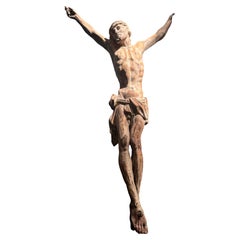
18th Century Bohemian Corpus of Christ
Located in Wien, AT
An expressive hand-carved wooden corpus of Christ from 18th century Bohemia, originally mounted on a wooden cross for devotional use.
Executed in the late Baroque style, the figure s...
Category
Antique 18th Century Czech Baroque Sculptures and Carvings
Materials
Wood
Related Items
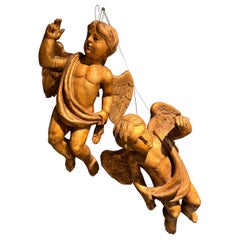
A pair of 18th century Austrian winged cherubs
Located in London, GB
A beautiful pair of 18th century Austrian carved gilt wood angel cherubs with their original hooks to the back .
Category
Antique Mid-18th Century Austrian Rococo Sculptures and Carvings
Materials
Giltwood

$2,091 Sale Price / set
20% Off
H 11.82 in W 6.7 in D 4.73 in
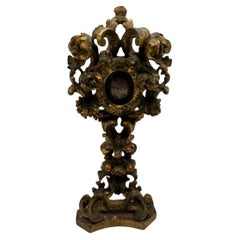
Opulent 18th Century Baroque Reliquary of Blood of Saint St. Francis
15th Cent
Located in North Miami, FL
Opulent 18th century Baroque carved giltwood reliquary (a container for relics) monstrance with curled scroll design. It houses a first-class relic of the blood of the15th Century sa...
Category
Antique 15th Century and Earlier Rococo Sculptures and Carvings
Materials
Wood, Giltwood
$4,950
H 11 in W 6 in D 2 in
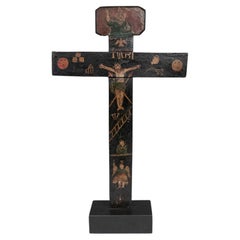
18th Century Wooden Cross, Guanajuato, Mexico
Located in Point Richmond, CA
Wooden cross
Guanajuato, Mexico
Wood, paint
22 x 13 inches, (56 cm x 33 cm)
18th century
A wonderful old wooden cross with a painted crucified Christ figure, an angel, possibly Mary Magdelene...
Category
Antique 18th Century Mexican Folk Art Mounted Objects
Materials
Wood, Paint
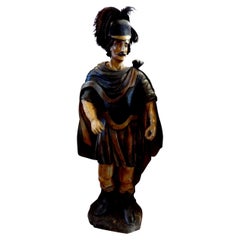
18th Century, Spanish Conquistador Carved Wood Figure
Located in Houston, TX
18th century Spanish Conquistador carved wood figure.
18th century Carved and painted wood Spanish Conquistador figure or sculpture. This beautif...
Category
Antique 18th Century Spanish Baroque Figurative Sculptures
Materials
Wood
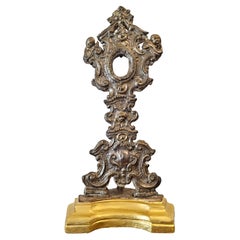
18th/19th Century Italian Baroque Silvered Metal Altar Monstrance Reliquary
Located in Forney, TX
A stunning antique Italian Baroque style silvered metal gilded wood monstrance reliquary. circa 1770-1820
Handmade in Italy in the late 18th / early 19th century, commissioned by the church to display an important religious relic, sculptural painted wood form, mounted with decorative silver repousse metal facing, open oval window where the philatory relic was once housed, rising on a gold gilt painted shaped plinth base.
Dimensions: (approx)
17" High, 8" Wide, 5" Deep, 1.25lbs
History:
Reliquaries (also referred to as a shrine or châsse in French), are containers used to protect and display relics. A portable reliquary may be called a fereter, and a chapel in which it is housed a feretory. A monstrance, also known as an ostensorium (or an ostensory), is a vessel used in Roman Catholic, Old Catholic, High Church Lutheran and Anglican churches for the display on an altar of some object of piety, such as the consecrated Eucharistic host during Eucharistic adoration or Benediction of the Blessed Sacrament. It is also used as reliquary for the public display of relics of some saints.
The use of reliquaries became an important part of Christian practices from at least the 4th century, initially in the Eastern Churches, which adopted the practice of moving and dividing the bodies of saints much earlier than the West, probably in part because the new capital of Constantinople, unlike Rome, lacked buried saints. Relics are venerated in the Oriental Orthodox, Eastern Orthodox, Roman Catholic and some Anglican Churches. Reliquaries provide a means of protecting and displaying relics. While frequently taking the form of caskets, they range in size from simple pendants or rings to very elaborate ossuaries.
The relics were enshrined in containers crafted of or covered with gold, silver, gems, and enamel. These objects constituted a important form of artistic production across Europe and Byzantium throughout the Middle Ages.
Many were designed with portability in mind, often being exhibited in public or carried in procession on the saint's feast day or on other holy days. Pilgrimages often centered on the veneration of relics. The faithful often venerate relics by bowing before the reliquary or kissing it; those churches which observe the veneration of relics distinguish between the honor given to the saints and the worship that is due to God alone.
Sixteenth-century reformers such as Martin Luther opposed the use of relics since many had no proof of historical authenticity and objected to a cult of saints. Many reliquaries, particularly in northern Europe, were destroyed by Calvinists or Calvinist sympathizers during the Reformation...
Category
Antique Early 19th Century Italian Baroque Sculptures and Carvings
Materials
Metal
$2,250
H 17 in W 8 in D 5 in
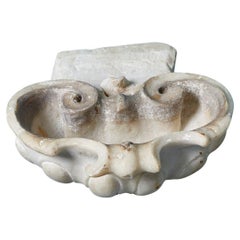
18th Century Italian Marble Holy Water Stoup
Located in Wormelow, Herefordshire
18th Century Italian Marble Holy Water Stoup. A wonderful shaped marble water stoup.
Category
Antique Mid-18th Century Sculptures and Carvings
Materials
Marble
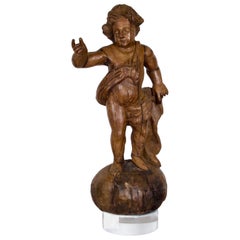
18th-19th Century Italian Wood Carved Angel
Located in San Francisco, CA
A lovely angel, his right hand extended as if to touch something or hold
something. He appears very calm and peaceful, clothed in a partial shroud
which is draped over his shoulder...
Category
Antique Late 18th Century Italian Baroque Figurative Sculptures
Materials
Wood
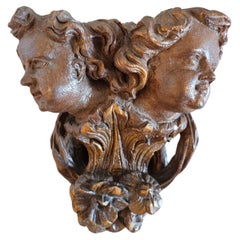
18th Century German Baroque Architectural Putti Bust Wall Shelf Carving
Located in Forney, TX
A finely carved Baroque period architectural element, now fashioned as a sculptural bracket shelf.
Hand-crafted by a master-artisan in the 18th century, originally part of a corbel, likely from a church around the Black Forest region of Southern Germany. Exquisitely hand carved solid walnut, exceptionally executed and intricately detailed, featuring two protruding busts of cherub children with fine facial details and sculpted wavy hair, over pierced foliate floral decoration. circa 1750
Provenance / Acquisition:
Property from the magnificent estate of the late T. Boone Pickens (1928 -2019). An American business magnate and financier.
Acquired from the highly reputable auction house J. Garrett Auctioneers, Dallas, Texas. September 2022 More of T. Boone Pickens Estate catalog
J. Garrett Auctioneers had the pleasure of presenting this item from the iconic Texas and Oklahoma oil...
Category
Antique 18th Century German Baroque Sculptures and Carvings
Materials
Walnut
$1,250
H 8 in W 7 in D 8.75 in
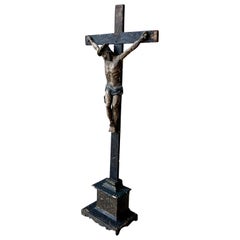
18th Century Carved And Painted Wooden Crucifix From France
Located in Haddonfield, NJ
An early 18th Century antique hand carved and polychromed hand painted table crucifix from France with its original patina preserved.
This crucifix could possible date back as early ...
Category
Antique Early 18th Century French Baroque Sculptures and Carvings
Materials
Fruitwood
$920 Sale Price
20% Off
H 26.38 in W 11.03 in D 4.34 in
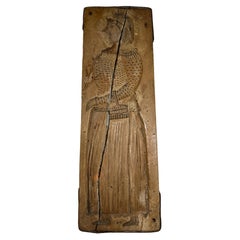
18th Century Noblewoman Man Wooden Gingerbread Cookie Speculaas Springerle Mold
Located in Nuernberg, DE
A Classic 118th century wooden double sided gingerbread cookie or speculaas springerle mold (Noblewoman and Nobleman). Made of hand carved wood. Found...
Category
Antique Late 18th Century Austrian Baroque Sculptures and Carvings
Materials
Wood
$280
H 15.38 in W 5.25 in D 0.63 in
18th Century Swedish Carved Mangle Board
Located in Forney, TX
A long hand carved wooden mangle board (clothing and bedding press) with beautiful patina.
Handmade in Sweden, circa 1744, this Scandinavian antique with...
Category
Antique 18th Century Swedish Primitive Sculptures and Carvings
Materials
Wood
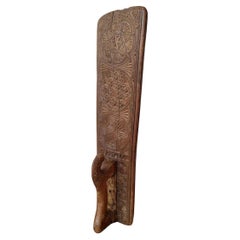
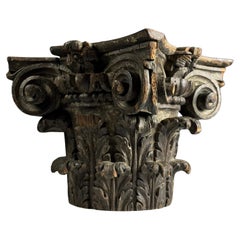
Hand-carved capital, 18th century
Located in MILL, NL
Hand-carved capital, 18th century
Hand-carved capital.
Carved from solid oak.
Originating from France, 18th century.
Was attached to a wall at an angle and is therefore less finely...
Category
Antique 18th Century French Sculptures and Carvings
Materials
Oak