WICK ANTIQUES LTD Maps
to
3
3
1
3
2
2
1
1
2
2
2
1
1
3
3
3
1
1
1
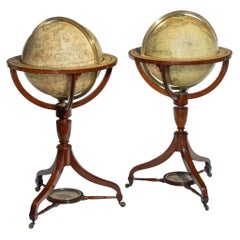
Fine Pair of Floor Globes by J
G Cary, Dated 1820 and 1833
By George
John Cary
Located in Lymington, Hampshire
A fine pair of 15 inch floor globes by J & G Cary, dated 1820 and 1833, each set into a mahogany stand with a vase shaped support and three legs centred on a compass, one with a labe...
Category
Antique Early 19th Century English Regency Globes
Materials
Mahogany
Large and Extremely Rare Terrestrial Globe by Newton
By Newton Globes - Planer
Newton
Located in Lymington, Hampshire
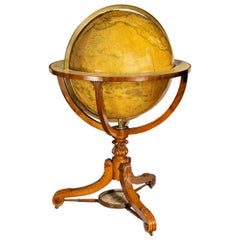
A large and extremely rare 24-inch terrestrial globe by Newton
Our most magnificent and rare globes were a pair of 24-inch Newton globes.
These too were updated in 1852 (terre...
Category
Antique Mid-19th Century English Globes
Materials
Mahogany
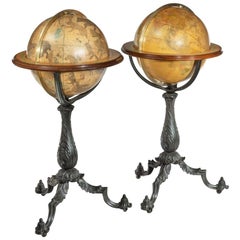
Pair of Floor Standing Globes by Gilman Joslin
By Gilman Joslin
Located in Lymington, Hampshire
A pair of 16-inch floor standing globes by Gilman Joslin, each set into a cast-iron tripod base with an acanthus-leaf baluster support on three b...
Category
Antique 19th Century American Maps
Materials
Iron

$67,129 / set
Related Items
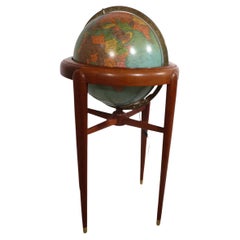
Replogle Terrestrial Floor Globe
By Replogle Globes
Located in Asbury Park, NJ
This floor globe by Replogle floats within a ring of walnut, supported by four 'turned' chrome stiles, which connect to a base of walnut. The ...
Category
Vintage 1960s American Mid-Century Modern Globes

Floor Model Light Up Globe by Replogle Ca. 1950/1960
s
By Replogle Globes
Located in New York, NY
Exceptional light up floor model globe, by Replogle Globes Inc. The globe is 16 in. in diameter, it features an interior light, and restrain a solid mahogany frame. This example is i...
Category
Mid-20th Century American Mid-Century Modern Globes
Materials
Glass, Mahogany, Paper
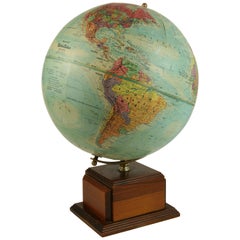
Vintage Reploge Terrestrial World Globe
Located in Douglas Manor, NY
2-309 vintage world globe with raised surfaces set on a custom walnut wood stepped base, circa 1960.
Category
Vintage 1960s Globes
Materials
Metal
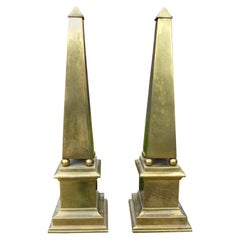
Pair of Hollywood Regency Neoclassical Style Brass Obelisks
Located in Houston, TX
Great pair of Hollywood Regency brass obelisks. These beautiful midcentury neoclassical style brass obelisks have a naturally occurring patina that could be polished if desired. Perf...
Category
Vintage 1970s Neoclassical Obelisks
Materials
Brass
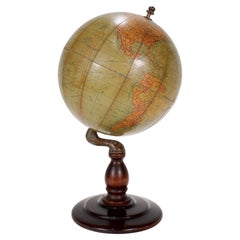
Antique Hammond
s 6-Inch Terrestrial Globe on Stand
By C.S. Hammond
Co.
Located in Philadelphia, PA
Offered here for your consideration is, A fine antique 6-inch terrestrial globe.
Additional Details:
By C.S. Hammond & Co.
The globe likely dates from 1927 to 1930 due to the ...
Category
20th Century Unknown Art Deco Globes
Materials
Wood, Paper
English Campaign Trunk of Brass-Bound Leather and Camphor Wood, circa 1820
Located in Austin, TX
A handsome medium-sized British officer's military Campaign camphor trunk or chest of brass-bound and studded leather over camphor wood, circa 1820.
Manufactured by the British East India...
Category
Antique Early 19th Century English Campaign Trunks and Luggage
Materials
Brass, Metal
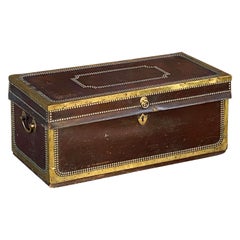
$3,495
H 13.13 in W 31.5 in D 16 in
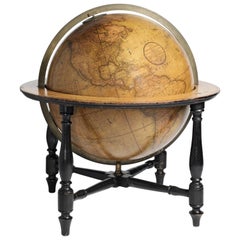
18-inch Globe, Cary
s, London, 1840
By Cary’s
Located in Milano, IT
John and William Cary
Updated by George and John Cary
Terrestrial Globe
London, 1840
lb 22 (kg 10)
Slight surface abrasions due to use. A small crack on the horizon circle.
The globe rests in its original Dutch style stand with four supporting turned wood columns.
It measures 26 in in height x 23.6 in in diameter with the diameter of the sphere measuring 18 in; 66 cm in height x 60 cm in diameter with the diameter of the sphere measuring 45.72 cm.
The 18 inch...
Category
Antique 1840s English Early Victorian Globes
Materials
Paper, Wood
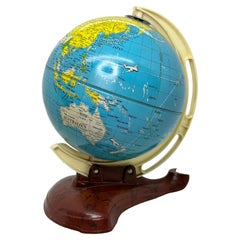
Vintage Bakelite, Sheet Metal / Tin Globe from the 1950s, West Germany
Located in Nuernberg, DE
Vintage Globe from the 1950s.
Specially made on the subject of aviation.
Depicted with all kinds of flying lines.
Made by the company M.S. Germany.
The globe is made of Tin and the stand is Bakelite.
Globe and stand...
Category
Vintage 1950s German Mid-Century Modern Globes
Materials
Metal
$120
H 9.25 in W 7.5 in D 5.5 in
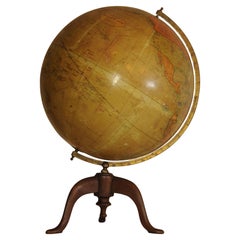
Antique World Globe From Fleet Street London 1923 on Wooden Stand
Located in Reading, Berkshire
Antique Terrestrial Geographia of Fleet Street London 12"inch World Globe on handcrafted Wooden Three Legged Base 1923
Made 55 Fleet Street, London
Beautiful desktop globe, showcas...
Category
Vintage 1920s British Art Deco Globes
Materials
Wood, Paper
English Pocket Globe, London, Circa 1775-1798
By Herman Moll
Located in Milano, IT
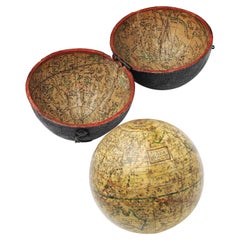
Pocket globe
London, between 1775 and 1798
Re-edition of the globe of Hermann Moll (1678-1732) dated 1719
The globe is contained in its original case, which itself is covered in shark skin.
There are slight gaps in the original paint on the sphere. The case no longer closes.
The sphere measures 2.7 in (7 cm) in diameter whereas the case measures 2.9 in (7.4 cm) in diameter.
lb 0.22 (kg 0.1)
The globe is made up of twelve printed paper gores aligned and glued to the sphere.
In the North Pacific Ocean there is a cartouche with the inscription:
A Correct
Globe
with the new
Discoveries.
The celestial globe is depicted on the inside of the box and is divided into two hemispheres with the cartouche:
A correct globe
with ye new cons
relations of Dr.
Halley & c.
It shows the ecliptic divided into the days of the zodiacal calendar and the constellations represented as animals and mythological figures.
On the globe are delineated the equinoctial line, divided by degrees and hours, the ecliptic and the meridian (passing west of Greenwich). The continents are shaded and outlined in pink, green and yellow. It shows: the Cook routes; a wind rose in the Southern Indian Ocean; Antarctica without land; Africa with Negroland (Hermann Moll is considered the first geographer to name the West African region in his 1727 map. (Encyclopaedia Britannica, ed. 1902, under "States of Central Africa"); Tartary in Central Asia; the Mogul kingdom in northern India; in North America only New England, Virginia, Carolina, Florida, Mississippi are identified; California is already a peninsula; the northwest coast of America is "unknown parts" (Alaska is not described and it is only partially delineated, it was to become part of the United States in 1867); Mexico is named "Spain"; Central South America "Amazone America". Australia (which was to be so named after 1829) is called New Holland. The route of Admiral Anson is traced (1740) and the trade winds are indicated by arrows. (See Van der Krogt, P., Old Globes in the Netherlands, Utrecht 1984, p. 146 and Van der Krogt, P. - Dekker, E., Globes from the Western World, London 1993, pp. 115.)
Elly Dekker, comparing Moll’s 1719 globe and his re-edition (of which the one described above is a sample), identifies the differences between them: the two editions are quite similar to each other, but in the "anonymous" globe, compared to the previous globe of 1719, California looks like a proper peninsula - the reports of the Spanish explorers of the region had given rise to uncertainty over whether it was connected to the mainland or not. The geographical nature of California was confirmed after the explorations of Juan Bautista de Anza (1774-1776). The routes of Dampier's journey were partially erased and the route of Captain James Cook's first voyage was superimposed on them, and the geography of Australasia was adapted accordingly, including the denomination of the Cook Strait. See Dekker, Elly, Globes at Greenwich, 1999.
An important ante quem element is represented by Tasmania: it is not separated from Australia by the Bass Strait...
Category
Antique Late 18th Century English George III Globes
Materials
Shagreen, Paper
Miniature Terrestrial Globe Newton
Son London, Post 1833, Ante 1858
By Newton and Son
Located in Milano, IT
Miniature Terrestrial Globe
Newton
Son
London, post 1833, ante 1858
Paper, papier-mâché, bronze and wood
It measures: sphere diameter 2.95 in (7.6 cm); diameter of the wooden base 6.02 in (15.3 cm); height 8.36 in (21.24 cm).
Weight: 2,067 lb.
State of conservation: the globe still bears its original paint, but has various small gaps, abrasions and stains on the surface.
The globe is hinged with two pins at the meridian circle, which is in turn inserted perpendicular to the horizon circle; this is supported by four semi-arches connected at the bottom by a small goblet-shaped foot, resting on a wooden bell-shaped base.
Apart from the wooden base, the entire support structure is made of bronze; on the foot there are the scale reproductions of a compass, a telescope and an open book.
The sphere is made of papier-mâché and is covered with twelve printed paper gores.
In the North Pacific Ocean the globe bears a cartouche with the inscription (about 30% of the writing is illegible, but the missing parts can be easily integrated based on the rest):
NEWTON’S
New
Improved
TERRESTRIAL
Globe
Published by Newton
Son
66 Chancery Lane
LONDON
On the globe, much of central Africa is empty and the great lakes Tanganyika and Victoria are not marked (Europeans would begin to explore the area after 1858). Canada is called "British Territory" and Alaska "Russian Territory" (it would become part of the United States in 1867). Australia already bears its modern name (until 1829 it had been called New Holland) and its coasts are completely designed; Tasmania is listed as an island (Matthew Flinders circumnavigated it in 1798). The routes of Cook's various voyages are plotted; both the route followed by Biscoe in 1831 and the "Land of Enderby" which he discovered on the coast of Antarctica, south of Africa, are marked.
Bibliography
P. Van der Krogt, Old Globes...
Category
Antique 1840s English Early Victorian Maps
Materials
Bronze
Antique Danish Terrestrial Globe, 1900s
Located in Asaa, DK
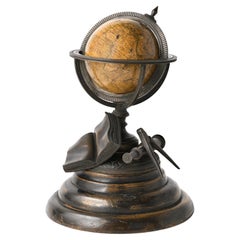
Antique Danish terrestrial globe, 1900s.
Rare Danish terrestrial globe from the late 1800s/early 1900s. Familie-Globus (Family globe) made by Vilhelm P...
Category
Antique Early 1900s Danish Art Nouveau Globes
Materials
Wood