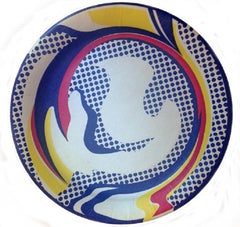
Roy Lichtenstein Art

American, 1923-1997

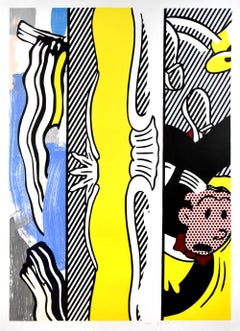
Roy Lichtenstein is one of the principal figures of the American Pop art movement, along with Andy Warhol, James Rosenquist, Claes Oldenburg and Robert Rauschenberg.

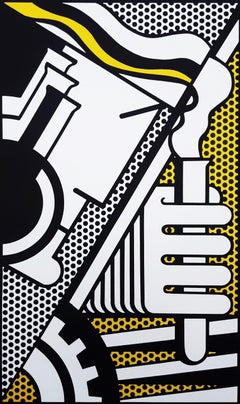
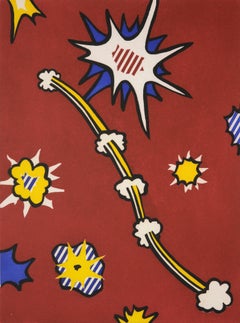
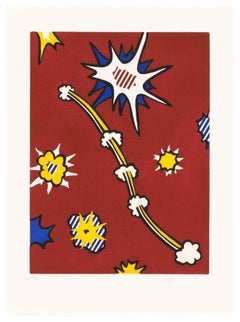
Drawing inspiration from comic strips, Lichtenstein appropriated techniques commercial printing in his paintings, introducing a vernacular sensibility to the visual landscape of contemporary art. He employed visual elements such as the halftone dots that comprise a printed image, and a comic-inspired use of primary colors gave his paintings their signature “Pop” palette.

Born and raised in New York City, Lichtenstein enjoyed Manhattan’s myriad cultural offerings and comic books in equal measure. He began painting seriously as a teenager, studying watercolor painting at the Parsons School of Design in the late 1930s, and later at the Art Students League, where he worked with American realist painter Reginald Marsh. He began his undergraduate education at Ohio State University in 1940, and after a three-year stint in the United States Army during World War II, he completed his bachelor’s degree and then his master’s in fine arts. The roots of Lichtenstein’s interest in the convergence of high art and popular culture are evident even in his early years in Cleveland, where in the late 1940s, he taught at Ohio State, designed window displays for a department store and painted his own pieces.

Working at the height of the Abstract Expressionist movement in the 1950s, Lichtenstein deliberately eschewed the sort of painting that was held in high esteem by the art world and chose instead to explore the visual world of print advertising and comics. This gesture of recontextualizing a lowbrow image by importing it into a fine-art context would become a trademark of Lichtenstein’s artistic style, as well as a vehicle for his critique of the concept of good taste. His 1963 painting Whaam! confronts the viewer with an impact scene from a 1962-era issue of DC Comics’ All American Men of War. Isolated from its larger context, this image combines the playful lettering and brightly colored illustration of the original comic with a darker message about military conflict at the height of the Cold War. Crying Girl from the same year featured another of Lichtenstein’s motifs — a woman in distress, depicted with a mixture of drama and deadpan humor. His work gained a wider audience by creating a comic-inspired mural for the New York State Pavilion of the 1964 World's Fair, he went on to be represented by legendary New York gallerist Leo Castelli for 30 years.

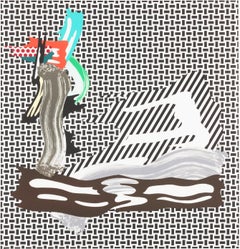
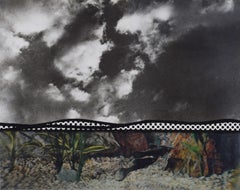
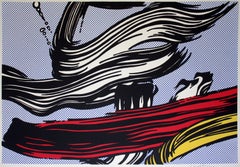
In the 1970s and ’80s, Lichtenstein experimented with abstraction and began exploring basic elements of painting, as in this 1989 work Brushstroke Contest. In addition to paintings in which the brushstroke itself became the central subject, in 1984 he created a large-scale sculpture called Brushstrokes in Flight for the Port Columbus International Airport in Ohio. Still Life with Windmill from 1974 and the triptych Cow Going Abstract from 1982 both demonstrate a break from his earlier works where the subjects were derived from existing imagery. Here, Lichtenstein paints subjects more in line with the norms of art history — a pastoral scene and a still life — but he has translated their compositions into his signature graphic style, in which visual elements of printed comics are still a defining feature.

Lichtenstein’s work is represented in the collections of the Metropolitan Museum of Art, the Museum of Modern Art, Tate Modern, and many others. He was awarded National Medal of Arts in 1995, two years before he passed away.

Find a collection of Roy Lichtenstein prints, drawings and more on 1stDibs.

to
8
15
17
21
13
26
Overall Width
to
Overall Height
to
3
88
1
1
3
24
15
18
9
69
13
5
2
43
39
4
19
9
7
5
5
4
4
4
3
3
3
3
3
2
2
2
2
2
2
2
50
36
20
14
9
111
9,980
2,753
1,376
1,373
46
15
76
14
Artist: Roy Lichtenstein
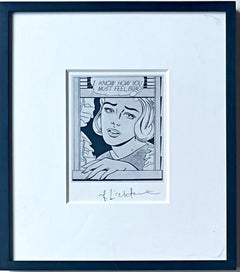
"I Know How You Made Me Feel, Brad!", VIP invitation to MoMA show, Hand Signed
By Roy Lichtenstein
Located in New York, NY
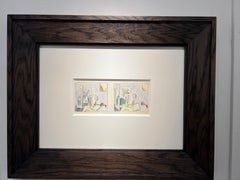
Roy Lichtenstein VIP Invitation to Museum of Modern Art black tie preview of the exhibition "The Drawings of Roy Lichtenstein" Offset lithograph on Coronado Opaque SST Cover paper Boldly signed in black marker on the front The front of the fold out invitation card depicts Roy Lichtenstein's 1963 pencil pochoir “I Know How You Must Feel Brad” This print was published by the Museum of Modern Art as an invitation to an exclusive VIP preview of the exhibition "The Drawings of Roy Lichtenstein." The artist signed the card in person at the event. This work has been elegantly framed in a museum quality wood frame under UV Plexiglass with a die cut window to reveal the text from inside the MoMA fold-out invitation card, which expressly states that the artist will be present at the VIP event. A true vintage collectors item when hand signed by Roy Lichtenstein, as the present work Measurements: Framed 13.5 inches vertical by 12 horizontal by 1.5 Artwork 6 inches by 4 inches Roy Lichtenstein Biography Roy Lichtenstein was one of the most influential and innovative artists of the second half of the twentieth century. He is preeminently identified with Pop Art, a movement he helped originate, and his first fully achieved paintings were based on imagery from comic strips and advertisements and rendered in a style mimicking the crude printing processes of newspaper reproduction. These paintings reinvigorated the American art scene and altered the history of modern art. Lichtenstein’s success was matched by his focus and energy, and after his initial triumph in the early 1960s, he went on to create an oeuvre of more than 5,000 paintings, prints, drawings, sculptures, murals and other objects celebrated for their wit and invention. Roy Fox Lichtenstein was born on October 27, 1923, in New York City, the first of two children born to Milton and Beatrice Werner Lichtenstein. Milton Lichtenstein (1893–1946) was a successful real estate broker, and Beatrice Lichtenstein (1896–1991), a homemaker, had trained as a pianist, and she exposed Roy and his sister Rénee to museums, concerts and other aspects of New York culture. Roy showed artistic and musical ability early on: he drew, painted and sculpted as a teenager, and spent many hours in the American Museum of Natural History and the Museum of Modern Art. He played piano and clarinet, and developed an enduring love of jazz, frequenting the nightspots in Midtown to hear it. Lichtenstein attended the Franklin School for Boys, a private junior high and high school, and was graduated in 1940. That summer he studied painting and drawing from the model at the Art Students League of New York with Reginald Marsh. In September he entered Ohio State University (OSU) in Columbus in the College of Education. His early artistic idols were Rembrandt, Daumier and Picasso, and he often said that Guernica (1937; Museo Reina Sofía, Madrid), then on long-term loan to the Museum of Modern Art, was his favorite painting. Even as an undergraduate, Lichtenstein objected to the notion that one set of lines (one person’s drawings) “was considered brilliant, and somebody’s else’s, that may have looked better to you, was considered nothing by almost everyone.”i Lichtenstein’s questioning of accepted canons of taste was encouraged by Hoyt L. Sherman, a teacher whom he maintained was the person who showed him how to see and whose perception-based approach to art shaped his own. In February 1943, Lichtenstein was drafted, and he was sent to Europe in 1945. As part of the infantry, he saw action in France, Belgium and Germany. He made sketches throughout his time in Europe and, after peace was declared there, he intended to study at the Sorbonne. Lichtenstein arrived in Paris in October 1945 and enrolled in classes in French language and civilization, but soon learned that his father was gravely ill. He returned to New York in January 1946, a few weeks before Milton Lichtenstein died. In the spring of that year, Lichtenstein went back to OSU to complete his BFA and in the fall he was invited to join the faculty as an instructor. In June 1949, he married Isabel Wilson Sarisky (1921–80), who worked in a cooperative art gallery in Cleveland where Lichtenstein had exhibited his work. While he was teaching, Lichtenstein worked on his master’s degree, which he received in 1949. During his second stint at OSU, Lichtenstein became closer to Sherman, and began teaching his method on how to organize and unify a composition. Lichtenstein remained appreciative of Sherman’s impact on him. He gave his first son the middle name of “Hoyt,” and in 1994 he donated funds to endow the Hoyt L. Sherman Studio Art Center at OSU. In the late 1940s and early 1950s, Lichtenstein began working in series and his iconography was drawn from printed images. His first sustained theme, intimate paintings and prints in the vein of Paul Klee that poked lyrical fun at medieval knights, castles and maidens, may well have been inspired by a book about the Bayeux Tapestry. Lichtenstein then took an ironic look at nineteenth-century American genre paintings he saw in history books, creating Cubist interpretations of cowboys and Indians spiked with a faux-primitive whimsy. As with his most celebrated Pop paintings of the 1960s, Lichtenstein gravitated toward what he would characterize as the “dumbest” or “worst” visual item he could find and then went on to alter or improve it. In the 1960s, commercial art was considered beneath contempt by the art world; in the early 1950s, with the rise of Abstract Expressionism, nineteenth-century American narrative and genre paintings were at the nadir of their reputation among critics and collectors. Paraphrasing, particularly the paraphrasing of despised images, became a paramount feature of Lichtenstein’s art. Well before finding his signature mode of expression in 1961, Lichtenstein called attention to the artifice of conventions and taste that permeated art and society. What others dismissed as trivial fascinated him as classic and idealized—in his words, “a purely American mythological subject matter.”ii Lichtenstein’s teaching contract at OSU was not renewed for the 1951–52 academic year, and in the autumn of 1951 he and Isabel moved to Cleveland. Isabel Lichtenstein became an interior decorator specializing in modern design, with a clientele drawn from wealthy Cleveland families. Whereas her career blossomed, Lichtenstein did not continue to teach at the university level. He had a series of part-time jobs, including industrial draftsman, furniture designer, window dresser and rendering mechanical dials for an electrical instrument company. In response to these experiences, he introduced quirkily rendered motors, valves and other mechanical elements into his paintings and prints. In 1954, the Lichtensteins’ first son, David, was born; two years later, their second child, Mitchell, followed. Despite the relative lack of interest in his work in Cleveland, Lichtenstein did place his work with New York dealers, which always mattered immensely to him. He had his first solo show at the Carlebach Gallery in New York in 1951, followed by representation with the John Heller Gallery from 1952 to 1957. To reclaim his academic career and get closer to New York, Lichtenstein accepted a position as an assistant professor at the State University of New York at Oswego, in the northern reaches of the state. He was hired to teach industrial design, beginning in September 1957. Oswego turned out to be more geographically and aesthetically isolated than Cleveland ever was, but the move was propitious, for both his art and his career. Lichtenstein broke away from representation to a fully abstract style, applying broad swaths of pigment to the canvas by dragging the paint across its surface with a rag wrapped around his arm. At the same time, Lichtenstein was embedding comic-book characters figures such as Mickey Mouse and Donald Duck in brushy, expressionistic backgrounds. None of the proto-cartoon paintings from this period survive, but several pencil and pastel studies from that time, which he kept, document his intentions. Finally, when he was in Oswego, Lichtenstein met Reginald Neal, the new head of the art department at Douglass College, the women’s college of Rutgers University, in New Brunswick, New Jersey. The school was strengthening and expanding its studio art program, and when Neal needed to add a faculty member to his department, Lichtenstein was invited to apply for the job. Lichtenstein was offered the position of assistant professor, and he began teaching at Douglass in September 1960. At Douglass, Lichtenstein was thrown into a maelstrom of artistic ferment. With New York museums and galleries an hour away, and colleagues Geoffrey Hendricks and Robert Watts at Douglass and Allan Kaprow and George Segal at Rutgers, the environment could not help but galvanize him. In June 1961, Lichtenstein returned to the idea he had fooled around with in Oswego, which was to combine cartoon characters from comic books with abstract backgrounds. But, as Lichtenstein said, “[I]t occurred to me to do it by mimicking the cartoon style without the paint texture, calligraphic line, modulation—all the things involved in expressionism.”iii Most famously, Lichtenstein appropriated the Benday dots, the minute mechanical patterning used in commercial engraving, to convey texture and gradations of color—a stylistic language synonymous with his subject matter. The dots became a trademark device forever identified with Lichtenstein and Pop Art. Lichtenstein may not have calibrated the depth of his breakthrough immediately but he did realize that the flat affect and deadpan presentation of the comic-strip panel blown up and reorganized in the Sherman-inflected way “was just so much more compelling”iv than the gestural abstraction he had been practicing. Among the first extant paintings in this new mode—based on comic strips and illustrations from advertisements—were Popeye and Look Mickey, which were swiftly followed by The Engagement Ring, Girl with Ball and Step-on Can with Leg. Kaprow recognized the energy and radicalism of these canvases and arranged for Lichtenstein to show them to Ivan Karp, director of the Leo Castelli Gallery. Castelli was New York’s leading dealer in contemporary art, and he had staged landmark exhibitions of Jasper Johns and Robert Rauschenberg in 1958 and Frank Stella in 1960. Karp was immediately attracted to Lichtenstein’s paintings, but Castelli was slower to make a decision, partly on account of the paintings’ plebeian roots in commercial art, but also because, unknown to Lichtenstein, two other artists had recently come to his attention—Andy Warhol and James Rosenquist—and Castelli was only ready for one of them. After some deliberation, Castelli chose to represent Lichtenstein, and the first exhibition of the comic-book paintings was held at the gallery from February 10 to March 3, 1962. The show sold out and made Lichtenstein notorious. By the time of Lichtenstein’s second solo exhibition at Castelli in September 1963, his work had been showcased in museums and galleries around the country. He was usually grouped with Johns, Rauschenberg, Warhol, Rosenquist, Segal, Jim Dine, Claes Oldenburg, Robert Indiana and Tom Wesselmann. Taken together, their work was viewed as a slap in the face to Abstract Expressionism and, indeed, the Pop artists shifted attention away from many members of the New York School. With the advent of critical and commercial success, Lichtenstein made significant changes in his life and continued to investigate new possibilities in his art. After separating from his wife, he moved from New Jersey to Manhattan in 1963; in 1964, he resigned from his teaching position at Douglass to concentrate exclusively on his work. The artist also ventured beyond comic book subjects, essaying paintings based on oils by Cézanne, Mondrian and Picasso, as well as still lifes and landscapes. Lichtenstein became a prolific printmaker and expanded into sculpture, which he had not attempted since the mid-1950s, and in both two- and three-dimensional pieces, he employed a host of industrial or “non-art” materials, and designed mass-produced editioned objects that were less expensive than traditional paintings and sculpture. Participating in one such project—the American Supermarket show in 1964 at the Paul Bianchini Gallery, for which he designed a shopping bag—Lichtenstein met Dorothy Herzka (b. 1939), a gallery employee, whom he married in 1968. The late 1960s also saw Lichtenstein’s first museum surveys: in 1967 the Pasadena Art Museum initiated a traveling retrospective, in 1968 the Stedelijk Musem in Amsterdam presented his first European retrospective, and in 1969 he had his first New York retrospective, at the Solomon R. Guggenheim Museum. Wanting to grow, Lichtenstein turned away from the comic book subjects that had brought him prominence. In the late 1960s his work became less narrative and more abstract, as he continued to meditate on the nature of the art enterprise itself. He began to explore and deconstruct the notion of brushstrokes—the building blocks of Western painting. Brushstrokes are conventionally conceived as vehicles of expression, but Lichtenstein made them into a subject. Modern artists have typically maintained that the subject of a painting is painting itself. Lichtenstein took this idea one imaginative step further: a compositional element could serve as the subject matter of a work and make that bromide ring true. The search for new forms and sources was even more emphatic after 1970, when Roy and Dorothy Lichtenstein bought property in Southampton, New York, and made it their primary residence. During the fertile decade of the 1970s, Lichtenstein probed an aspect of perception that had steadily preoccupied him: how easily the unreal is validated as the real because viewers have accepted so many visual conceptions that they don’t analyze what they see. In the Mirror series, he dealt with light and shadow upon glass, and in the Entablature series, he considered the same phenomena by abstracting such Beaux-Art architectural elements as cornices, dentils, capitals and columns. Similarly, Lichtenstein created pioneering painted bronze sculpture that subverted the medium’s conventional three-dimensionality and permanence. The bronze forms were as flat and thin as possible, more related to line than volume, and they portrayed the most fugitive sensations—curls of steam, rays of light and reflections on glass. The steam, the reflections and the shadow were signs for themselves that would immediately be recognized as such by any viewer. Another entire panoply of works produced during the 1970s were complex encounters with Cubism, Futurism, Purism, Surrealism and Expressionism. Lichtenstein expanded his palette beyond red, blue, yellow, black, white and green, and invented and combined forms. He was not merely isolating found images, but juxtaposing, overlapping, fragmenting and recomposing them. In the words of art historian Jack Cowart, Lichtenstein’s virtuosic compositions were “a rich dialogue of forms—all intuitively modified and released from their nominal sources.”v In the early 1980s, which coincided with re-establishing a studio in New York City, Lichtenstein was also at the apex of a busy mural career. In the 1960s and 1970s, he had completed four murals; between 1983 and 1990, he created five. He also completed major commissions for public sculptures in Miami Beach, Columbus, Minneapolis, Paris, Barcelona and Singapore. Lichtenstein created three major series in the 1990s, each emblematic of his ongoing interest in solving pictorial problems. The Interiors, mural-sized canvases inspired by a miniscule advertisement in an Italian telephone...
Category

1980s Pop Art Roy Lichtenstein Art

Materials

Lithograph, Offset

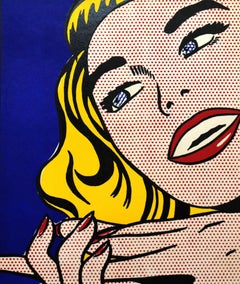
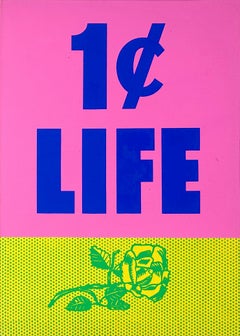
Roy Lichtenstein Girl from 1¢ Life
By Roy Lichtenstein
Located in Washington, DC
Artist: Roy Lichtenstein Title: Girl Portfolio: 1¢ Life Medium: Lithograph on white wove paper Date: 1964 Edition: 2000 Frame Size: 20 3/4" x 18 5/8" Sheet Size: 16 1/4" x 11 1/2" Im...
Category

1960s Pop Art Roy Lichtenstein Art

Materials

Lithograph

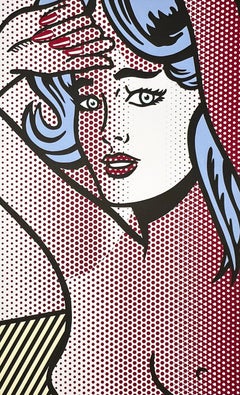
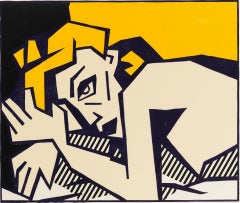
Nude With Blue Hair
By Roy Lichtenstein
Located in Washington, DC
Artist: Roy Lichtenstein Title: Nude With Blue Hair Medium: Relief print on Rives BFK mold-made paper Date: 1994 Edition: 28/40 Sheet Size: 57 7/8" x 37 5/8" Image Size: 51 5/16" x 3...
Category

1990s Pop Art Roy Lichtenstein Art

Materials

Woodcut

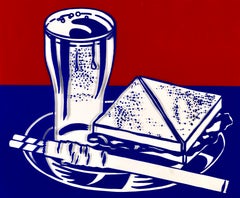
Roy Lichtenstein, Sandwich and Soda, from Ten Works by Ten Painters, 1964
By Roy Lichtenstein
Located in Southampton, NY
This exquisite silkscreen by Roy Lichtenstein (1923–1997), titled Sandwich and Soda, originates from the landmark 1964 folio X + X (Ten Works by Ten Painters). Published by the Wadsworth Atheneum Museum of Art, Hartford, and printed by Sirocco Screenprints, Inc., North Haven, in Sandwich and Soda, Lichtenstein translates his signature Pop Art vocabulary—bold outlines, flat commercial color, and Ben-Day dot structure—into a crisp, iconic composition that reimagines everyday consumer imagery with graphic intensity and conceptual clarity. Executed as a silkscreen on Mylar over Mohawk Superfine Bristol paper, this work measures 20 x 24 inches. Unsigned and unnumbered as issued. Printed by Sirocco Screenprints, Inc., North Haven, one of the most capable American screenprinting ateliers of the mid-20th century. Artwork Details: Artist: Roy Lichtenstein (1923–1997) Title: Sandwich and Soda, from X + X (Ten Works by Ten Painters), 1964 Medium: Silkscreen on Mylar over Mohawk Superfine Bristol paper Dimensions: 20 x 24 inches (50.8 x 60.96 cm) Inscription: Unsigned and unnumbered as issued Date: 1964 Publisher: Wadsworth Atheneum Museum of Art, Hartford Printer: Sirocco Screenprints, Inc., North Haven Edition: D Catalogue raisonne reference: Corlett, Mary Lee, and Roy Lichtenstein. The Prints of Roy Lichtenstein: A Catalogue Raisonne 1948–1997. 2nd rev. ed., Hudson Hills Press in association with the National Gallery of Art, Washington, D.C.; Distributed in the U.S. by National Book Network, 2002, No. 35. Condition: Well preserved, consistent with age and medium Provenance: From the 1964 folio X + X (Ten Works by Ten Painters), published by the Wadsworth Atheneum Museum of Art, Hartford Notes: Excerpted from the folio, This portfolio was commissioned and printed in an attempt to extend as much of the visual impact as possible of ten artists to paper and to make these prints available to collectors who might not otherwise have such a vivid slice of the artist. The dry surface of screening seemed to be most apt to translate the effect of their painting, both the flatness which is the unifying bond between the ten, and the insistance of paint on the surface of canvas so like the visible heft of ink on paper here. Samuel J. Wagstaff, Jr., Curator of Printings. About the Publication: X + X (Ten Works by Ten Painters), published in 1964 by the Wadsworth Atheneum Museum of Art in Hartford, stands as one of the most ambitious and influential printmaking endeavors of postwar American art. Conceived under the direction of curator Samuel J. Wagstaff, Jr., the project sought to capture and translate the defining visual languages of ten leading American painters of the era—Stuart Davis, Ellsworth Kelly, Robert Indiana, Adolph Gottlieb, George Ortman, Larry Poons, Richard Anuszkiewicz, Frank Stella, Andy Warhol, and Roy Lichtenstein—into original silkscreens. Each artwork was created as an autonomous work that embodied the formal, chromatic, and conceptual principles of its respective artist. The choice of silkscreen printing, executed by Sirocco Screenprints, Inc., was central to the portfolio’s purpose: its dry, matte surface and capacity for crisp, saturated color allowed for a faithful translation of the painters’ flatness, surface tension, optical effects, and graphic precision. Organized and published by a major American museum at a moment of seismic change in contemporary art, X + X marked a turning point in institutional engagement with editioned works, representing one of the first concerted efforts by a museum to commission an ensemble of original graphics from the leading figures of its time. The portfolio captured the pulse of 1960s American painting—from Hard-Edge abstraction to Pop, Op, and Color Field—offering both a curated snapshot of artistic innovation and an accessible format that expanded the audience for contemporary art. Today, X + X is widely regarded as a landmark in American printmaking, celebrated for its curatorial vision, technical accomplishment, and its role in defining the dialogue between museum patronage and the burgeoning print culture of the 1960s. About the Artist: Roy Lichtenstein (1923–1997) was an American painter, printmaker, and sculptor whose revolutionary elevation of comic-book graphics, Ben-Day dots, commercial illustration, and mass-media visual language into the realm of fine art made him one of the founding giants of Pop Art, drawing on the breakthroughs of Pablo Picasso, Alexander Calder, Alberto Giacometti, Salvador Dali, Joan Miro, Wassily Kandinsky, Marcel Duchamp, and Man Ray to synthesize Cubist fragmentation, Surrealist wit, Modernist experimentation, and Duchampian conceptualism into an unmistakable style defined by bold outlines, flat industrial color, graphic reduction, and the now-iconic Ben-Day dot technique; emerging in the 1960s alongside Andy Warhol, Claes Oldenburg, James Rosenquist, Jasper Johns, and Robert Rauschenberg, Lichtenstein shifted American art away from Abstract Expressionism toward a cool, analytical investigation of consumer culture, mass reproduction, advertising, and the manufactured image, creating paintings, prints, sculptures, and monumental public works that reimagined romance comics, war scenes, cartoons, brushstroke parodies, landscapes, and art-historical citations while offering a humorous yet incisive commentary on how images shape contemporary life; his influence is immense, shaping artists such as Jeff Koons, Takashi Murakami, Damien Hirst, Julian Opie, KAWS, Banksy, and numerous contemporary painters, designers, fashion houses, and digital creators, while his works are held in major institutions including the Museum of Modern Art, the Whitney Museum of American Art, the Solomon R. Guggenheim Museum, the Art Institute of Chicago, the National Gallery of Art, Tate, Centre Pompidou, SFMOMA, the Hirshhorn Museum and Sculpture Garden, and LACMA, with his highest auction record achieved when Nurse (1964) sold for 95,365,000 USD at Christie's New York on November 9, 2015. Roy Lichtenstein silkscreen...
Category

1960s Pop Art Roy Lichtenstein Art

Materials

Screen

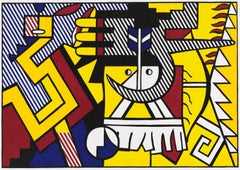
American Indian Theme VI
By Roy Lichtenstein
Located in Washington, DC
Artist: Roy Lichtenstein Title: American Indian Theme VI Medium: Woodcut on handmade Suzuki Paper Date: 1980 Edition: 24/50 Frame Size: 40" x 53" Sheet Size: 37 3/4" x 50 5/16" Image...
Category

1980s Pop Art Roy Lichtenstein Art

Materials

Woodcut

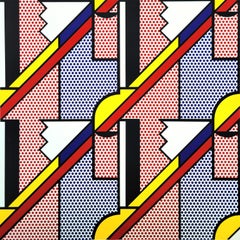
Modern Print /// Roy Lichtenstein Pop Art Abstract Geometric MoMA Gemini G.E.L.
By Roy Lichtenstein
Located in Saint Augustine, FL
Artist: Roy Lichtenstein (American, 1923-1997) Title: "Modern Print" *Numbered, signed, and dated by Lichtenstein in pencil lower right Year: 1971 Medium: Original Lithograph and Scr...
Category

1970s Pop Art Roy Lichtenstein Art

Materials

Lithograph, Screen

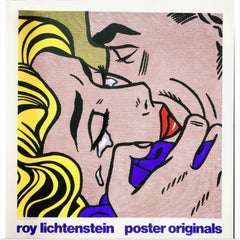
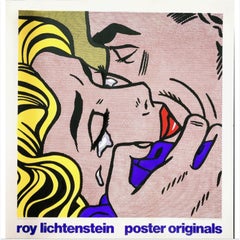
Kiss By Roy Lichtenstein
By Roy Lichtenstein
Located in Dubai, Dubai
Kiss By Roy Lichtenstein Roy Lichtenstein was a prominent American pop artist known for his bold, comic strip-inspired paintings. Emerging in the 1960s, his work featured bright co...
Category

1960s Contemporary Roy Lichtenstein Art

Materials

Paper, Screen

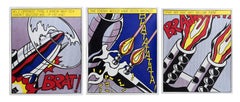
As I Opened Fire, Pop Art Three Offset Lithograph Posters by Roy Lichtenstein
By Roy Lichtenstein
Located in Long Island City, NY
Roy Lichtenstein, American (1923 - 1997) - As I Opened Fire. Year: 1964 Year Printed: 1997, Medium: Three Offset Lithograph Posters, Image Size: 24 x 19.5 inches, Size: 25 x 20.5 in...
Category

1990s Pop Art Roy Lichtenstein Art

Materials

Lithograph, Offset

Chem 1A /// Pop Art Roy Lichtenstein Science Chemistry Screenprint Portrait Face
By Roy Lichtenstein
Located in Saint Augustine, FL
Artist: Roy Lichtenstein (American, 1923-1997) Title: "Chem 1A" *Signed and dated by Lichtenstein in pencil lower right Year: 1970 Medium: Original Screenprint on Special Arjomari pa...
Category

1970s Pop Art Roy Lichtenstein Art

Materials

Screen

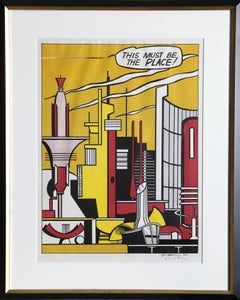
This Must Be the Place (C. III.20), Pop Art Lithograph by Roy Lichtenstein
By Roy Lichtenstein
Located in Long Island City, NY
Artist: Roy Lichtenstein, American (1923 - 1997) Title: This Must Be the Place (C. III.20) Year: 1965 Medium: Offset Lithograph, signed in the plate and in pencil l.r. Edition of unk...
Category

1960s Pop Art Roy Lichtenstein Art

Materials

Offset

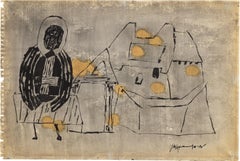
Early Roy Lichtenstein drawing (Roy Lichtenstein, St. Macarius Monastery) c.1951
By Roy Lichtenstein
Located in NEW YORK, NY
Roy Lichtenstein, ‘St. Macarius Before His Monastery,’ circa 1951: Included in the Roy Lichtenstein Foundation, Roy Lichtenstein: A Catalogue Raisonné - this unique, rare early sket...
Category

1950s Pop Art Roy Lichtenstein Art

Materials

India Ink, Watercolor

VIP Invitation to "The Drawings of Roy Lichtenstein" @ MoMA, Hand Signed, Framed
By Roy Lichtenstein
Located in New York, NY
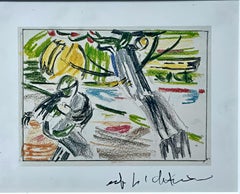
Roy Lichtenstein VIP Invitation to Museum of Modern Art black tie preview of the exhibition "The Drawings of Roy Lichtenstein" (Hand Signed), 1987 Offset lithograph on Coronado Opaque SST Cover paper (hand signed by Roy Lichtenstein) Offset lithograph on Coronado Opaque SST Cover paper Boldly signed in black marker on the front The front of the invitation depicts Roy Lichtenstein's print The Sower, from the suite "Landscape Sketches." This print was published by the Museum of Modern Art as an invitation to an exclusive VIP preview of the exhibition "The Drawings of Roy Lichtenstein." The artist signed the card in person at the event. This work has been elegantly framed in a museum quality wood frame under UV Plexiglass with a die cut window to reveal the text from inside the MoMA fold-out invitation card. A true vintage collectors item when hand signed by Roy Lichtenstein, as the present work Measurements: Framed 12 inches vertical by 13.25 horizontal by 1.5 Artwork 5 inches by 6.25 inches Roy Lichtenstein Biography Roy Lichtenstein was one of the most influential and innovative artists of the second half of the twentieth century. He is preeminently identified with Pop Art, a movement he helped originate, and his first fully achieved paintings were based on imagery from comic strips and advertisements and rendered in a style mimicking the crude printing processes of newspaper reproduction. These paintings reinvigorated the American art scene and altered the history of modern art. Lichtenstein’s success was matched by his focus and energy, and after his initial triumph in the early 1960s, he went on to create an oeuvre of more than 5,000 paintings, prints, drawings, sculptures, murals and other objects celebrated for their wit and invention. Roy Fox Lichtenstein was born on October 27, 1923, in New York City, the first of two children born to Milton and Beatrice Werner Lichtenstein. Milton Lichtenstein (1893–1946) was a successful real estate broker, and Beatrice Lichtenstein (1896–1991), a homemaker, had trained as a pianist, and she exposed Roy and his sister Rénee to museums, concerts and other aspects of New York culture. Roy showed artistic and musical ability early on: he drew, painted and sculpted as a teenager, and spent many hours in the American Museum of Natural History and the Museum of Modern Art. He played piano and clarinet, and developed an enduring love of jazz, frequenting the nightspots in Midtown to hear it. Lichtenstein attended the Franklin School for Boys, a private junior high and high school, and was graduated in 1940. That summer he studied painting and drawing from the model at the Art Students League of New York with Reginald Marsh. In September he entered Ohio State University (OSU) in Columbus in the College of Education. His early artistic idols were Rembrandt, Daumier and Picasso, and he often said that Guernica (1937; Museo Reina Sofía, Madrid), then on long-term loan to the Museum of Modern Art, was his favorite painting. Even as an undergraduate, Lichtenstein objected to the notion that one set of lines (one person’s drawings) “was considered brilliant, and somebody’s else’s, that may have looked better to you, was considered nothing by almost everyone.”i Lichtenstein’s questioning of accepted canons of taste was encouraged by Hoyt L. Sherman, a teacher whom he maintained was the person who showed him how to see and whose perception-based approach to art shaped his own. In February 1943, Lichtenstein was drafted, and he was sent to Europe in 1945. As part of the infantry, he saw action in France, Belgium and Germany. He made sketches throughout his time in Europe and, after peace was declared there, he intended to study at the Sorbonne. Lichtenstein arrived in Paris in October 1945 and enrolled in classes in French language and civilization, but soon learned that his father was gravely ill. He returned to New York in January 1946, a few weeks before Milton Lichtenstein died. In the spring of that year, Lichtenstein went back to OSU to complete his BFA and in the fall he was invited to join the faculty as an instructor. In June 1949, he married Isabel Wilson Sarisky (1921–80), who worked in a cooperative art gallery in Cleveland where Lichtenstein had exhibited his work. While he was teaching, Lichtenstein worked on his master’s degree, which he received in 1949. During his second stint at OSU, Lichtenstein became closer to Sherman, and began teaching his method on how to organize and unify a composition. Lichtenstein remained appreciative of Sherman’s impact on him. He gave his first son the middle name of “Hoyt,” and in 1994 he donated funds to endow the Hoyt L. Sherman Studio Art Center at OSU. In the late 1940s and early 1950s, Lichtenstein began working in series and his iconography was drawn from printed images. His first sustained theme, intimate paintings and prints in the vein of Paul Klee that poked lyrical fun at medieval knights, castles and maidens, may well have been inspired by a book about the Bayeux Tapestry. Lichtenstein then took an ironic look at nineteenth-century American genre paintings he saw in history books, creating Cubist interpretations of cowboys and Indians spiked with a faux-primitive whimsy. As with his most celebrated Pop paintings of the 1960s, Lichtenstein gravitated toward what he would characterize as the “dumbest” or “worst” visual item he could find and then went on to alter or improve it. In the 1960s, commercial art was considered beneath contempt by the art world; in the early 1950s, with the rise of Abstract Expressionism, nineteenth-century American narrative and genre paintings were at the nadir of their reputation among critics and collectors. Paraphrasing, particularly the paraphrasing of despised images, became a paramount feature of Lichtenstein’s art. Well before finding his signature mode of expression in 1961, Lichtenstein called attention to the artifice of conventions and taste that permeated art and society. What others dismissed as trivial fascinated him as classic and idealized—in his words, “a purely American mythological subject matter.”ii Lichtenstein’s teaching contract at OSU was not renewed for the 1951–52 academic year, and in the autumn of 1951 he and Isabel moved to Cleveland. Isabel Lichtenstein became an interior decorator specializing in modern design, with a clientele drawn from wealthy Cleveland families. Whereas her career blossomed, Lichtenstein did not continue to teach at the university level. He had a series of part-time jobs, including industrial draftsman, furniture designer, window dresser and rendering mechanical dials for an electrical instrument company. In response to these experiences, he introduced quirkily rendered motors, valves and other mechanical elements into his paintings and prints. In 1954, the Lichtensteins’ first son, David, was born; two years later, their second child, Mitchell, followed. Despite the relative lack of interest in his work in Cleveland, Lichtenstein did place his work with New York dealers, which always mattered immensely to him. He had his first solo show at the Carlebach Gallery in New York in 1951, followed by representation with the John Heller Gallery from 1952 to 1957. To reclaim his academic career and get closer to New York, Lichtenstein accepted a position as an assistant professor at the State University of New York at Oswego, in the northern reaches of the state. He was hired to teach industrial design, beginning in September 1957. Oswego turned out to be more geographically and aesthetically isolated than Cleveland ever was, but the move was propitious, for both his art and his career. Lichtenstein broke away from representation to a fully abstract style, applying broad swaths of pigment to the canvas by dragging the paint across its surface with a rag wrapped around his arm. At the same time, Lichtenstein was embedding comic-book characters figures such as Mickey Mouse and Donald Duck in brushy, expressionistic backgrounds. None of the proto-cartoon paintings from this period survive, but several pencil and pastel studies from that time, which he kept, document his intentions. Finally, when he was in Oswego, Lichtenstein met Reginald Neal, the new head of the art department at Douglass College, the women’s college of Rutgers University, in New Brunswick, New Jersey. The school was strengthening and expanding its studio art program, and when Neal needed to add a faculty member to his department, Lichtenstein was invited to apply for the job. Lichtenstein was offered the position of assistant professor, and he began teaching at Douglass in September 1960. At Douglass, Lichtenstein was thrown into a maelstrom of artistic ferment. With New York museums and galleries an hour away, and colleagues Geoffrey Hendricks and Robert Watts at Douglass and Allan Kaprow and George Segal at Rutgers, the environment could not help but galvanize him. In June 1961, Lichtenstein returned to the idea he had fooled around with in Oswego, which was to combine cartoon characters from comic books with abstract backgrounds. But, as Lichtenstein said, “[I]t occurred to me to do it by mimicking the cartoon style without the paint texture, calligraphic line, modulation—all the things involved in expressionism.”iii Most famously, Lichtenstein appropriated the Benday dots, the minute mechanical patterning used in commercial engraving, to convey texture and gradations of color—a stylistic language synonymous with his subject matter. The dots became a trademark device forever identified with Lichtenstein and Pop Art. Lichtenstein may not have calibrated the depth of his breakthrough immediately but he did realize that the flat affect and deadpan presentation of the comic-strip panel blown up and reorganized in the Sherman-inflected way “was just so much more compelling”iv than the gestural abstraction he had been practicing. Among the first extant paintings in this new mode—based on comic strips and illustrations from advertisements—were Popeye and Look Mickey, which were swiftly followed by The Engagement Ring, Girl with Ball and Step-on Can with Leg. Kaprow recognized the energy and radicalism of these canvases and arranged for Lichtenstein to show them to Ivan Karp, director of the Leo Castelli Gallery. Castelli was New York’s leading dealer in contemporary art, and he had staged landmark exhibitions of Jasper Johns and Robert Rauschenberg in 1958 and Frank Stella in 1960. Karp was immediately attracted to Lichtenstein’s paintings, but Castelli was slower to make a decision, partly on account of the paintings’ plebeian roots in commercial art, but also because, unknown to Lichtenstein, two other artists had recently come to his attention—Andy Warhol and James Rosenquist—and Castelli was only ready for one of them. After some deliberation, Castelli chose to represent Lichtenstein, and the first exhibition of the comic-book paintings was held at the gallery from February 10 to March 3, 1962. The show sold out and made Lichtenstein notorious. By the time of Lichtenstein’s second solo exhibition at Castelli in September 1963, his work had been showcased in museums and galleries around the country. He was usually grouped with Johns, Rauschenberg, Warhol, Rosenquist, Segal, Jim Dine, Claes Oldenburg, Robert Indiana and Tom Wesselmann. Taken together, their work was viewed as a slap in the face to Abstract Expressionism and, indeed, the Pop artists shifted attention away from many members of the New York School. With the advent of critical and commercial success, Lichtenstein made significant changes in his life and continued to investigate new possibilities in his art. After separating from his wife, he moved from New Jersey to Manhattan in 1963; in 1964, he resigned from his teaching position at Douglass to concentrate exclusively on his work. The artist also ventured beyond comic book subjects, essaying paintings based on oils by Cézanne, Mondrian and Picasso, as well as still lifes and landscapes. Lichtenstein became a prolific printmaker and expanded into sculpture, which he had not attempted since the mid-1950s, and in both two- and three-dimensional pieces, he employed a host of industrial or “non-art” materials, and designed mass-produced editioned objects that were less expensive than traditional paintings and sculpture. Participating in one such project—the American Supermarket show in 1964 at the Paul Bianchini Gallery, for which he designed a shopping bag—Lichtenstein met Dorothy Herzka (b. 1939), a gallery employee, whom he married in 1968. The late 1960s also saw Lichtenstein’s first museum surveys: in 1967 the Pasadena Art Museum initiated a traveling retrospective, in 1968 the Stedelijk Musem in Amsterdam presented his first European retrospective, and in 1969 he had his first New York retrospective, at the Solomon R. Guggenheim Museum. Wanting to grow, Lichtenstein turned away from the comic book subjects that had brought him prominence. In the late 1960s his work became less narrative and more abstract, as he continued to meditate on the nature of the art enterprise itself. He began to explore and deconstruct the notion of brushstrokes—the building blocks of Western painting. Brushstrokes are conventionally conceived as vehicles of expression, but Lichtenstein made them into a subject. Modern artists have typically maintained that the subject of a painting is painting itself. Lichtenstein took this idea one imaginative step further: a compositional element could serve as the subject matter of a work and make that bromide ring true. The search for new forms and sources was even more emphatic after 1970, when Roy and Dorothy Lichtenstein bought property in Southampton, New York, and made it their primary residence. During the fertile decade of the 1970s, Lichtenstein probed an aspect of perception that had steadily preoccupied him: how easily the unreal is validated as the real because viewers have accepted so many visual conceptions that they don’t analyze what they see. In the Mirror series, he dealt with light and shadow upon glass, and in the Entablature series, he considered the same phenomena by abstracting such Beaux-Art architectural elements as cornices, dentils, capitals and columns. Similarly, Lichtenstein created pioneering painted bronze sculpture that subverted the medium’s conventional three-dimensionality and permanence. The bronze forms were as flat and thin as possible, more related to line than volume, and they portrayed the most fugitive sensations—curls of steam, rays of light and reflections on glass. The steam, the reflections and the shadow were signs for themselves that would immediately be recognized as such by any viewer. Another entire panoply of works produced during the 1970s were complex encounters with Cubism, Futurism, Purism, Surrealism and Expressionism. Lichtenstein expanded his palette beyond red, blue, yellow, black, white and green, and invented and combined forms. He was not merely isolating found images, but juxtaposing, overlapping, fragmenting and recomposing them. In the words of art historian Jack Cowart, Lichtenstein’s virtuosic compositions were “a rich dialogue of forms—all intuitively modified and released from their nominal sources.”v In the early 1980s, which coincided with re-establishing a studio in New York City, Lichtenstein was also at the apex of a busy mural career. In the 1960s and 1970s, he had completed four murals; between 1983 and 1990, he created five. He also completed major commissions for public sculptures in Miami Beach, Columbus, Minneapolis, Paris, Barcelona and Singapore. Lichtenstein created three major series in the 1990s, each emblematic of his ongoing interest in solving pictorial problems. The Interiors, mural-sized canvases inspired by a miniscule advertisement in an Italian telephone...
Category

1980s Pop Art Roy Lichtenstein Art

Materials

Lithograph, Offset

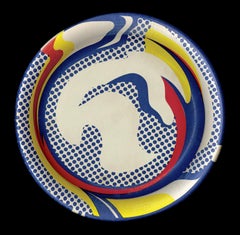
PLATE
By Roy Lichtenstein
Located in Aventura, FL
Screen print on waxed paper plate. Unsigned from an unknown edition. Published by Bert Stern, New York. Plate size 10 x 10 inches. Frame size approx 17 x 17 inches. Stamped "Ro...
Category

1970s Pop Art Roy Lichtenstein Art

Materials

Paper, Screen

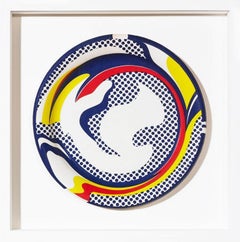
PLATE
PLATE
$1,400 Sale Price
20% Off
Lichtenstein Paper Plate — Pop Art Icon
By Roy Lichtenstein
Located in Myrtle Beach, SC
Roy Lichtenstein, 'Paper Plate', serigraph, 1969, edition unknown, Corlett III.45. Printed in dark blue ink verso, 'Roy Lichtenstein © On 1st Inc. 1969'. A fine impression, on white paperboard pressure formed into a 3-dimensional plate; age toning verso, otherwise in very good condition. Published by Bert Stern, New York. Image size 10 1/4 inch diameter, 1-inch depth. Archivally sleeved, unmounted, unframed. Carefully protected for shipping. Literature: John Russell. 'Art: Time for Old-Master Prints', New York Times (July 27, 1979), p. C16. Jan Howard. 'Reflections on 'The Prints of Roy Lichtenstein', Print Collector's Newsletter 26 (July–August 1995), p. 82. Mark M. Johnson. 'The Great American Pop Art Store: Multiples of the '60s', Art & Activities 123 (June–Summer 1998), ill. p. 37 (color). Mary Lee Corlett. 'The Prints of Roy Lichtenstein: A Catalogue Raisonné', New York, 2002, p. 286, no. III.45. Susan Dackerman, ed., 'Corita Kent and the Language of Pop', exhibition catalog, Harvard Art...
Category

1960s Pop Art Roy Lichtenstein Art

Materials

Screen

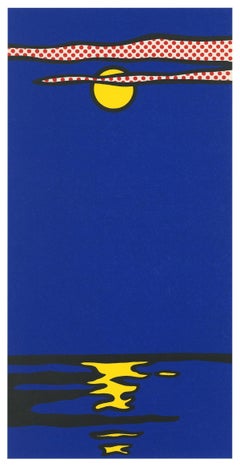
Moonscape
By Roy Lichtenstein
Located in New York, NY
Created after Roy Lichtenstein's iconic Moonscape Banner (1966), this folded screenprint on wove cardstock was published by Multiples, Inc. (New York) in 1969, and would later be use...
Category

20th Century Pop Art Roy Lichtenstein Art

Materials

Screen

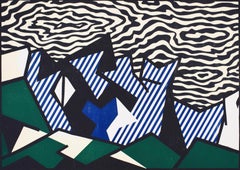
Morton A. Mort, from: Expressionist Woodcut Series - Pop Art Expressionism
By Roy Lichtenstein
Located in London, GB
This original woodcut in colours with embossing is hand signed in pencil "R. Lichtenstein" at the lower right margin. It is dated ‘80’ [1980] next to the signature. It is also number...
Category

1980s Pop Art Roy Lichtenstein Art

Materials

Woodcut

Red Lamp
By Roy Lichtenstein
Located in Boston, MA
Artist: Lichtenstein, Roy Title: Red Lamp Date: 1992 Medium: Original lithograph on Rives BFK paper Unframed Dimensions: 21.5" x 24" Framed Dimensions: 32" x 34.5" Signature:...
Category

1990s Pop Art Roy Lichtenstein Art

Materials

Lithograph

Untitled
By Roy Lichtenstein
Located in New York, NY
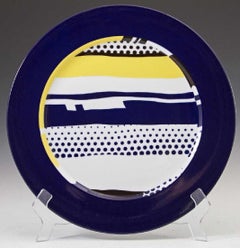
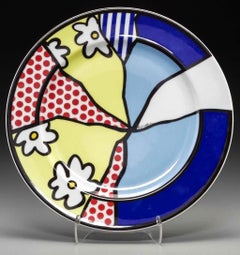
This Lichtenstein plate, commissioned by Rosenthal/Germany, is hand-colored porcelain, stamp signed and inscribed  “Kunstlerplatzteller" / "Rosentha...
Category

Late 20th Century Contemporary Roy Lichtenstein Art

Materials

Porcelain

Lichtenstein-Guggenheim Museum-Vintage Pop Art
By Roy Lichtenstein
Located in Brooklyn, NY
This original poster, designed by Roy Lichtenstein for his first solo exhibition at the Guggenheim Museum in New York (September 19–November 16, 1969), is a screen print on white glo...
Category

1960s Pop Art Roy Lichtenstein Art

Materials

Screen

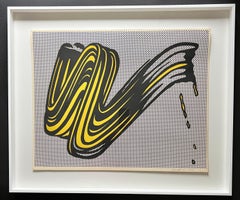
Brushstroke on Canvas - Pop Art American Brushstroke
By Roy Lichtenstein
Located in London, GB
This original lithograph in colours is hand signed in pencil "R. Lichtenstein" at the lower right margin. It is dated ‘89’ [1989] next to the signature. It is also numbered in penci...
Category

1980s Pop Art Roy Lichtenstein Art

Materials

Lithograph

Roy Lichtenstein - Shipboard Girl - hand-signed lithograph - 1965
By Roy Lichtenstein
Located in Varese, IT
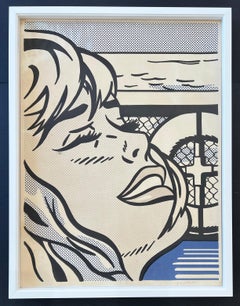
Offset lithograph on white wove paper, Edited in 1965 Limited edition , signed in pencil by artist in lower right corner paper size: 69 x 51.5 cm framed size: 72.5 x 55.5 cm good...
Category

1960s Pop Art Roy Lichtenstein Art

Materials

Paper

Water Lilies
By Roy Lichtenstein
Located in New York, NY
Published in 1990 by Rosenthal, Germany, Roy Lichtenstein’s, Water Lilies is an exquisite glazed porcelain charger, brilliantly colored, accompanied by signed certification. Stamp si...
Category

20th Century Pop Art Roy Lichtenstein Art

Materials

Porcelain, Screen

Roy Lichtenstein ( 1923 - 1997 ) – Brushstroke – hand-signed Screenprint – 1965
By Roy Lichtenstein
Located in Varese, IT
Screenprint on heavy, white wove paper , edited in 1965 Limited edition of 280 copies signed in pencil by artist in lower right corner and numbered 243/280 paper size: : 58,4 x 73,6 ...
Category

1960s Pop Art Roy Lichtenstein Art

Materials

Paper, Screen

The Red Horsemen (Equestrians) limited edition signed Olympic lithograph w/COA
By Roy Lichtenstein
Located in New York, NY
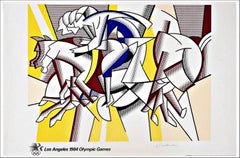
Roy Lichtenstein The Red Horsemen, aka The Equestrians (with COA from the 1984 Olympic Committee), 1982 Limited Edition Lithograph and offset Lithograph on Parsons Diploma Parchment...
Category

1980s Pop Art Roy Lichtenstein Art

Materials

Lithograph, Offset

Roy Lichtenstein De Denver au Montana, Départ 27 Mai Signed New Fall of America
By Roy Lichtenstein
Located in Philadelphia, PA
Roy Lichtenstein Illustration for ‘De Denver au Montana, Départ 27 Mai 1972” (I), From ‘La Nouvelle Chute de l’Amérique (The New Fall of America)” Etching and aquatint on 250-gram V...
Category

Late 20th Century Pop Art Roy Lichtenstein Art

Materials

Etching

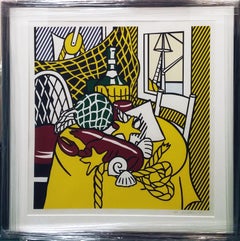
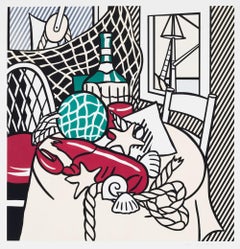
STILL LIFE WITH LOBSTER
By Roy Lichtenstein
Located in Aventura, FL
Hand signed, dated and numbered by the artist. From the Six Still Lifes Series. Lithograph and screenprint on rives BFK paper. Co-published by Multiples, Inc. and Castelli Graphics, ...
Category

1970s Pop Art Roy Lichtenstein Art

Materials

Paper, Lithograph, Screen

Rose, Cover from 1 Cent Life
By Roy Lichtenstein
Located in Austin, TX
Artist: Roy Lichtenstein Title: Rose, Cover from 1 Cent Life (Rose) Screenprint in green over yellow linen and (1 Cent Life) Screenprint in pink over blue lettering on board of unbound book Year: 1964 Medium: Silkscreen on linen on heavy board Size Edition : 2000 Dimensions: 16.31" x 25.32" (Full cover) Dimensions of Image: 16.31 x 11.88 References : Corlett # III.3 Provenance: Private Collection, Berlin Printed by Maurice Beaudet in Paris and published by E. W. Kornfeld, of Bern, Switzerland. Edition of 2000, unsigned as issued in the regular edition of Walasse Ting's '1¢ Life' portfolio of 1964. Superb impression with good strong colors. This iconic piece was executed by Lichtenstein and printed onto stiff paperboard to serve as the front cover of 1 Cent Life, published in 1964 by Kornfeld in an edition of 2000. The image is printed to the edge of the board, with the Lichtenstein silkscreen...
Category

1960s Pop Art Roy Lichtenstein Art

Materials

Linen, Screen

Apple, Lt Ed St. Louis Art museum print Signed dated by Roy Lichtenstein Frame
By Roy Lichtenstein
Located in New York, NY
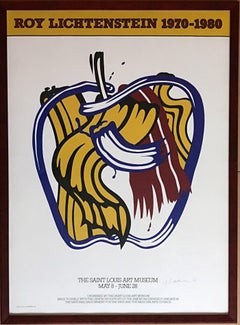
Roy Lichtenstein 1970-1980 (Hand Signed and dated by Roy Lichtenstein), 1981 Offset lithograph. Hand signed and dated in ink Hand-signed by artist, H...
Category

1980s Pop Art Roy Lichtenstein Art

Materials

Ink, Lithograph, Offset, Pencil, Graphite
Peace Through Chemistry I, 1970, C.97
By Roy Lichtenstein
Located in Palo Alto, CA
Roy Lichtenstein, Peace Through Chemistry I (1970), masterfully fuses the aesthetic of commercial illustration with a biting commentary on industrial modernity, science, and human a...
Category

1970s Roy Lichtenstein Art

Materials

Lithograph, Screen

The Solomon R. Guggenheim Museum – hand-signed Screenprint on Rives paper – 1969
By Roy Lichtenstein
Located in Varese, IT
Screenprint on Rives paper, Edited in 1969 Limited Edition of 250 copies Signed and dated in pencil by artist in lower rith corner , numbered as 88/250 in lower left corner Paper siz...
Category

1960s Pop Art Roy Lichtenstein Art

Materials

Paper, Screen

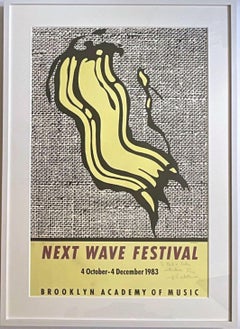
Roy Lichtenstein Rare Brooklyn Academy print Hand signed warmly inscribed, dated
By Roy Lichtenstein
Located in New York, NY
Roy Lichtenstein Next Wave Festival Poster (Hand signed, warmly inscribed and dated), 1983 Offset lithograph (hand signed, uniquely inscribed, and dated by Roy Lichtenstein) Signed, ...
Category

1980s Pop Art Roy Lichtenstein Art

Materials

Lithograph, Offset

Kiss By Roy Lichtenstein
By Roy Lichtenstein
Located in Dubai, Dubai
Kiss By Roy Lichtenstein Roy Lichtenstein was a prominent American pop artist known for his bold, comic strip-inspired paintings. Emerging in the 1960s, his work featured bright co...
Category

1960s Contemporary Roy Lichtenstein Art

Materials

Paper, Screen

Merton of The Movies-ORIGINAL POSTER
By Roy Lichtenstein
Located in Brooklyn, NY
This original poster, titled Merton of the Movies, was published by List Art Posters and printed by Fine Creations Inc. It was the first poster published by HKL, Ltd., a nonprofit or...
Category

20th Century Pop Art Roy Lichtenstein Art

Materials

Screen

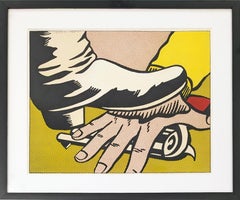
Foot and Hand, Corlett II. 4 (hand signed limited edition lithograph)
By Roy Lichtenstein
Located in Aventura, FL
Offset lithograph in colors on wove paper. Hand signed, dated and numbered by Roy Lichtenstein. Inscribed "HC." (there is also an edition of 300 signed and numbered copies plus an ...
Category

1970s Pop Art Roy Lichtenstein Art

Materials

Paper, Lithograph

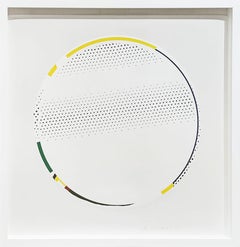
Roy Lichtenstein "Mirror #2"
By Roy Lichtenstein
Located in Boston, MA
Artist: lichtenstein, Roy Title: Mirror #2 Date: 1972 Medium: Linecut and screenprint with embossing on Arjomari paper Unframed Dimensions: 28" x 28" Framed Dimensions: 29.5" x...
Category

1970s Pop Art Roy Lichtenstein Art

Materials

Screen

Indian with Pipe
By Roy Lichtenstein
Located in New York, NY
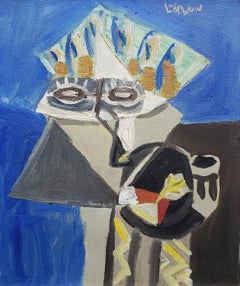
This exceptional oil on canvas by master Pop artist Roy Lichtenstein is an exceptional and unique example of his early pre-pop work. It is signed by the artist, upper right. After m...
Category

1950s Abstract Roy Lichtenstein Art

Materials

Canvas, Oil

Roy Lichtenstein GREEN FACE Lithograph Screenprint, 58.5"H
By Roy Lichtenstein
Located in Lake Worth Beach, FL
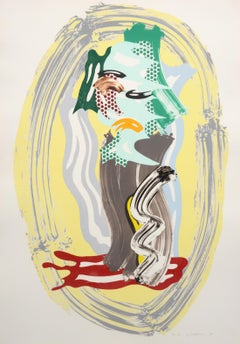
Artist/Designer; Manufacturer: Roy Lichtenstein (American, 1923-1997) Marking(s); notes: signed, blind stamp, marking(s); PP 1/2 aside from the edition of 60; 1989 Materials: lithogr...
Category

1980s Pop Art Roy Lichtenstein Art

Materials

Screen, Lithograph, Woodcut

Still Life with Windmill
By Roy Lichtenstein
Located in Beverly Hills, CA
Roy Lichtenstein Still Life with Windmill, 1973 Colored pencil on paper 5 x 8 ¾ inches (12.7 x 22.2 cm) NB: The work is included in the Roy Lichtenstein catalogue raisonné. Provena...
Category

1970s Pop Art Roy Lichtenstein Art

Materials

Paper, Color Pencil

Haystack #5
By Roy Lichtenstein
Located in Fairlawn, OH
Haystack #5 Color lithograph and screen print, 1969 Signed and dated in pencil (see photo) From: Haystack Series (seven plates) see photo of entire portfolio Signed and dated in pencil Edition: 100 (74/100) Publisher: Gemini G.E.L., Los Angeles, CA, with their blaindstamp Reference: Paul Bianchini No. 33e Corlett and Fine 69 Condition: Excellent Fresh colors Small paper imperfection in bottom margin near the edge of the sheet Image size: 13 1/4 x 23 3/8 inches Sheet size: 20 ¾ x 30 ¾ inches Frame size: 23 ½ x 33 ¾ inches This is one of the finest images in the portfolio, inspired by Claude Monet's famous series of Haystack paintings...
Category

1960s Pop Art Roy Lichtenstein Art

Materials

Screen

Pyramid (hand signed three dimensional screen print)
By Roy Lichtenstein
Located in Aventura, FL
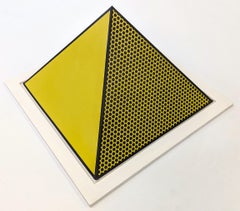
Screen print in colors on lightweight board folded into a three-dimensional pyramid. Hand signed and numbered on interior edge by Roy Lichtenstein Numbered 41/300 (only approximate...
Category

1960s Pop Art Roy Lichtenstein Art

Materials

Paper, Lithograph, Screen

BEDROOM
By Roy Lichtenstein
Located in Aventura, FL
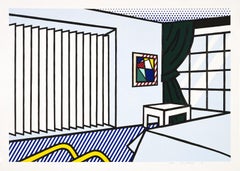
From Interior Series. Woodcut and screen print in colors on Museum Board. Hand signed, dated and numbered by Roy Lichtenstein. Published by Gemini G.E.L., Los Angeles.. Corlett 247...
Category

1990s Pop Art Roy Lichtenstein Art

Materials

Board, Lithograph, Screen, Woodcut

Roy Lichtenstein Haystack #4 Signed Lithograph and Screenprint 1969
By Roy Lichtenstein
Located in Miami, FL
ROY LICHTENSTEIN (1923-1997) Roy Lichtenstein's 'Haystack #4' is a lithograph and screenprint in colors on Arjomari paper. It is signed, dated, and numbered 73/100 in pencil in the ...
Category

1960s Contemporary Roy Lichtenstein Art

Materials

Screen, Lithograph

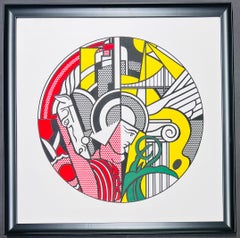
Reflections on Minerva
By Roy Lichtenstein
Located in Philadelphia, PA
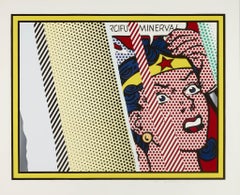
Roy Lichtenstein Reflections on Minerva 1990 Lithograph, screenprint, relief, and metalized PVC collage with embossing on mold-made Somerset paper Signed, numbered, and dated in pen...
Category

1990s Pop Art Roy Lichtenstein Art

Materials

Lithograph, Screen

RECLINING NUDE
By Roy Lichtenstein
Located in Aventura, FL
Reclining Nude, from Expressionist Woodcut Series (C. 172). Woodcut in colors with embossing, 1980, on Arches Cover. Hand signed, numbered and dated in ...
Category

1980s Pop Art Roy Lichtenstein Art

Materials

Woodcut

Roy Lichtenstein Still Life with Lobster Signed Lithograph and Silkscreen 1974
By Roy Lichtenstein
Located in Miami, FL
ROY LICHTENSTEIN (1923-1997) Roy Lichtenstein's 'Still Life with Lobster' is a 1974 color lithograph and silkscreen. This work is signed, dated 'Lichtenstein '74' and numbered 43/10...
Category

1670s Contemporary Roy Lichtenstein Art

Materials

Lithograph, Screen

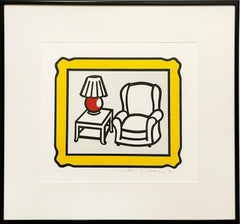
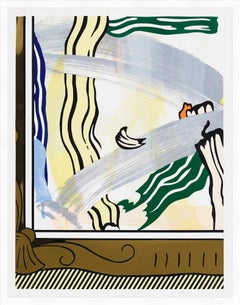
Painting in Gold Frame
By Roy Lichtenstein
Located in Aventura, FL
From the Paintings series. Woodcut, Lithograph, screen print and collage on Arches 88 paper. Hand signed, dated and numbered by Roy Lichtenst...
Category

1980s Pop Art Roy Lichtenstein Art

Materials

Lithograph, Screen, Woodcut, Paper

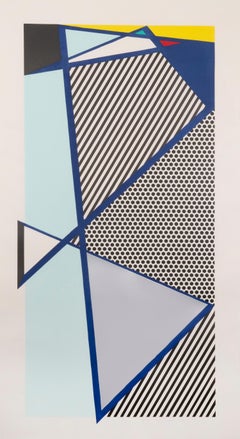
Imperfect Print for B.A.M.
By Roy Lichtenstein
Located in London, GB
Woodcut and screenprint in colours, 1987, on Arches wove paper, signed and dated in pencil from the edition of 75, published by Parasol Press, Ltd., New York, from The Brooklyn Acade...
Category

1980s Abstract Roy Lichtenstein Art

Materials

Color, Screen, Woodcut

Two Paintings: Dagwood
By Roy Lichtenstein
Located in Palo Alto, CA
Roy Lichtenstein Two Paintings: Dagwood, 1984 is a vivid, colorful piece that demonstrates the clever work of Lichtenstein’s varied oeuvre. The work is c...
Category

1980s Pop Art Roy Lichtenstein Art

Materials

Lithograph, Woodcut

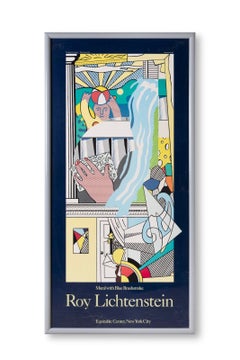
Photo of Mural with Blue Brushstroke Maquette by Roy Lichtenstein
By Roy Lichtenstein
Located in Dallas, TX
Early photo of 'Mural with Blue Brushstroke' maquette by Roy Lichtenstein. This is a large photo measuring over 5ft x 2ft from 1984. In 1984, Roy Lichtenstein was commissioned to cre...
Category

1980s Roy Lichtenstein Art

Materials

Photographic Paper

Roy Lichtenstein DE DENVER Aquatint
By Roy Lichtenstein
Located in Lake Worth Beach, FL
Artist/Designer; Manufacturer: Roy Lichtenstein (American, 1923-1997) Marking(s); notes: signed; ed. 37/80; 1992 Materials: aquatint Dimensions (H, W, D): 16.75"h, 13"w sight; 19"h, ...
Category

1990s Pop Art Roy Lichtenstein Art

Materials

Aquatint

To Battle
By Roy Lichtenstein
Located in New York, NY
Woodcut printed in blue on tan wove paper, 1950. Signed by the artist and dated in pencil, lower center margin. Numbered 4/11 in pencil, lower left margin. Printed and published ...
Category

1950s Abstract Expressionist Roy Lichtenstein Art

Materials

Woodcut

Illustration for "Hüm Bum!" from "La Nouvelle Chute de l Amérique" - Pop Art
By Roy Lichtenstein
Located in Köln, DE
This etching and aquatint in colours from 1992 was published in ‘La Nouvelle Chute de l'Amérique’ (The New Fall of America). The 115-page unbound book comprises 11 poems by Allen Gin...
Category

1990s Pop Art Roy Lichtenstein Art

Materials

Etching, Aquatint

Night Scene
By Roy Lichtenstein
Located in London, GB
Etching, aquatint and engraving in colours, 1980, on mould-made Lana paper, signed and dated in pencil, numbered from edition of 32 (there were also 12 artist's proofs), published by Tyler Graphics, Ltd., New York,with their blindstamp, 53 x 54.1 cm. (20 x 21 1/4 in.) Catalogue Raisonne: Corlett 170; Tyler, 1987, cat no. 354:RL22 ‘Night Scene’ is one of six intaglio prints Roy Lichtenstein...
Category

1980s Abstract Roy Lichtenstein Art

Materials

Engraving, Etching, Aquatint

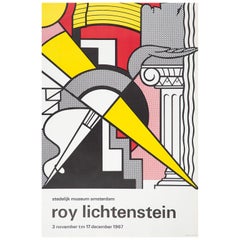
Stedelijk Museum Amsterdam
By Roy Lichtenstein
Located in Toronto, Ontario
Roy Lichtenstein (1923-1997) was one of the most successful and influential artists of the 20th century, helping pioneer and define Pop Art in the 1960s. Lichtenstein's signature st...
Category

1960s Pop Art Roy Lichtenstein Art

Materials

Lithograph, Offset

LANDSCAPE 8
By Roy Lichtenstein
Located in Aventura, FL
Hand signed, numbered and dated on verso. Landscape 8, from Ten Landscapes (C. 58). Iridescent silver Mylar collage on opaque black Rowlux and gray moire Rowlux. The full sheet, moun...
Category

1960s Pop Art Roy Lichtenstein Art

Materials

Mylar

Lichtenstein De Denver au Montana, Départ 27 Mai (II) Signed New Fall of America
By Roy Lichtenstein
Located in Philadelphia, PA
Roy Lichtenstein Illustration for ‘De Denver au Montana, Départ 27 Mai 1972” (II), From ‘La Nouvelle Chute de l’Amérique (The New Fall of America)” Etching and aquatint on 250-gram ...
Category

Late 20th Century Pop Art Roy Lichtenstein Art

Materials

Etching

Fish and Sky - American Pop Art
By Roy Lichtenstein
Located in London, GB
This work is hand signed in pencil "R. Lichtenstein" at the lower right margin on the mount board. It is also signed, verso. It is also hand numbered in pencil from the edition of 20...
Category

1960s Pop Art Roy Lichtenstein Art

Materials

Lithograph, Screen

Brushstrokes (C.45)
By Roy Lichtenstein
Located in New York, NY
Screenprint on off-white wove paper Signed and numbered in pencil: 44 from 300 plus an unknown number of AP (inscribed A/P).
Category

20th Century Pop Art Roy Lichtenstein Art

Materials

Screen

Roy Lichtenstein Modern Head #2 (Corlett 92) 1970
By Roy Lichtenstein
Located in Miami, FL
ROY LICHTENSTEIN (1923-1997) Lithograph and line-cut in colors with embossing, 1970, signed in pencil, dated and numbered 30/100 (total edition includes seven artist's proofs). This...
Category

1970s Contemporary Roy Lichtenstein Art

Materials

Lithograph

Roy Lichtenstein s famous Paper Plate, 1969
By Roy Lichtenstein
Located in New York, NY
Colorful swirls in red, blue, white, and yellow on a white plate with blue dots over the surface of the plate. "The Prints of Roy Lichtenstein" a catalogue raisonne page 286 #III.45 Notes: Roy Lichtenstein, Paper Plate, 1969 stamped on the back: Roy Lichtenstein © On 1st Inc. 1969 Dimensions: 10" diameter Artist or Maker: Roy Lichtenstein Medium: Serigraph Screenprint in yellow, red, and blue, on white paper plate. Publisher: Bert Stern, for On 1st, New York. Date: 1969 Description: "Paper Plate" by Roy Lichtenstein, 1969 Unsigned Serigraph. Paper size is 10 x 10 inches, with an image size of 10 x 10 inches. The Serigraph is from an edition size of 2000 and is not framed. Printer: Unknown, possibly Artmongers manufactory, New York. The plates were commercially printed and wrapped in clear cellophane in packages of 10 for sale at Bert Stern's On 1st store. Correspondence found in the artist's records indicates that the plates may have been fabricated at Artmongers manufactory, New York. Paper Plate is related to other designs the artist produced for dishware, such as the limited-edition place settings produced by Jackson China...
Category

1960s Pop Art Roy Lichtenstein Art

Materials

Paper, Screen

Roy Lichtenstein art for sale on 1stDibs.

Find a wide variety of authentic Roy Lichtenstein art available for sale on 1stDibs. If you’re browsing the collection of art to introduce a pop of color in a neutral corner of your living room or bedroom, you can find work that includes elements of orange, yellow, blue and other colors. You can also browse by medium to find art by Roy Lichtenstein in screen print, lithograph, offset print and more. Much of the original work by this artist or collective was created during the 20th century and is mostly associated with the Pop Art style. Not every interior allows for large Roy Lichtenstein art, so small editions measuring 3 inches across are available. Customers who are interested in this artist might also find the work of James Rosenquist, Jim Dine, and Ed Ruscha. Roy Lichtenstein art prices can differ depending upon medium, time period and other attributes. On 1stDibs, the price for these items starts at $250 and tops out at $1,500,000, while the average work can sell for $20,500.

Artists Similar to Roy Lichtenstein

Questions About Roy Lichtenstein Art
  • 1stDibs ExpertJune 6, 2024
    Roy Lichtenstein's art style was Pop art. In fact, he is one of the principal figures of the American Pop art movement, along with Andy Warhol, James Rosenquist, Claes Oldenburg and Robert Rauschenberg. Drawing inspiration from comic strips, Lichtenstein appropriated techniques of commercial printing in his paintings, introducing a vernacular sensibility to contemporary art. He employed visual elements such as the halftone dots that comprise a printed image and a comic-inspired use of primary colors to give his paintings their signature "Pop" palette. On 1stDibs, shop a selection of Roy Lichtenstein art.
  • 1stDibs ExpertMay 30, 2024
    To make his dots, Roy Lichtenstein developed a special process. He would hold an aluminum mesh template over the painting and then push oil paint through its openings using a small toothbrush. This innovative technique allowed the Pop artist to recreate the dotted look of comic book art with paint. On 1stDibs, shop a variety of Roy Lichtenstein art.

  • large oils are worth many millions of dollars. The value would depend on the size, composition and importance of the piece.
  • 1stDibs ExpertNovember 13, 2024
    The dots that Lichtenstein used in his art were called Ben-Day dots. He employed visual elements like these halftone dots to make his works reminiscent of comic books. Roy Lichtenstein was one of the principal figures of the American Pop art movement, along with Andy Warhol, James Rosenquist, Claes Oldenburg and Robert Rauschenberg. On 1stDibs, find a wide range of Roy Lichtenstein art.
  • 1stDibs ExpertMarch 22, 2022
    Roy Lichtenstein is an American artist who helped to shape the Pop art movement. He was born on October 27, 1923 in New York City, and he died there on September 29, 1997. Some of his most famous works include Whaam!, Drowning Girl and two different pieces titled Crying Girl. On 1stDibs, find a selection of Roy Lichtenstein art.
  • 1stDibs ExpertMarch 22, 2022
    Roy Lichtenstein is from New York City, New York. He was born in Manhattan on October 27, 1923, and he died in the city on September 29, 1997. Lichtenstein attended Ohio State University in Columbus, Ohio. On 1stDibs, find a range of Roy Lichtenstein art.
  • 1stDibs ExpertApril 5, 2022
    Roy Lichtenstein was famous for his remarkable work in pop art, perhaps most notably, his comic book-style paintings. His work is renowned for its sense of parody. Shop a collection of Roy Lichtenstein pieces and prints from top sellers around the world on 1stDibs.
  • 1stDibs ExpertMarch 22, 2022
    Roy Lichtenstein was important to the art world because he helped pioneer Pop art. This movement focused on incorporating images from pop culture and mass media into fine art. His work continues to influence contemporary artists like Richard Bell and Grégoire Guillemin to this day. Shop a collection of Roy Lichtenstein art on 1stDibs.
  • 1stDibs ExpertMarch 22, 2022
    Advertising and comic books inspired Roy Lichtenstein to create art. In fact, many of his pieces appropriated images from these sources, transforming them into commentaries on geopolitics and social issues. On 1stDibs, you can shop a collection of Roy Lichtenstein art.
  • 1stDibs ExpertApril 5, 2022
    To authenticate Roy Lichtenstein art, consult the help of a licensed art appraiser with experience identifying Pop art. Due to the number of high quality giclée prints available, it is very difficult to verify that an artwork is real and not a reproduction. Shop a collection of expertly vetted Roy Lichtenstein art on 1stDibs.
  • 1stDibs ExpertMarch 22, 2022
    To pronounce Roy Lichtenstein, say, "Roy LICK-ton-stine." The artist's last name is of German origin. He was a leader of the Pop art movement who lived from 1923 to 1997. On 1stDibs, you can shop a variety of Roy Lichtenstein art.
  • 1stDibs ExpertMarch 22, 2022
    Roy Lichtenstein influenced a number of contemporary artists, including Richard Bell, Grégoire Guillemin and Douglas Coupland. During his lifetime, he also inspired other Pop art artists like Andy Warhol, James Rosenquist and Claes Oldenburg. Shop a variety of Roy Lichtenstein art on 1stDibs.
  • 1stDibs ExpertFebruary 22, 2021
    No, Pop artist Roy Lichtenstein is not alive. He died at the age of 73 in 1997. You can find Roy Lichtenstein's art on 1stDibs.
  • 1stDibs ExpertApril 5, 2022
    Yes, Roy Lichtenstein did indeed use appropriation in his art. In this case, ‘appropriation’ in art is the use of existing objects or images with little or no transformation applied to them. One of Lichtenstein’s most famous pieces is ‘Look Mickey’ featuring Mickey Mouse and Donald Duck. Shop a selection of Roy Lichtenstein’s pieces from some of the world’s top art dealers on 1stDibs.
  • 1stDibs ExpertMarch 22, 2022
    Roy Lichtenstein has a large number of famous paintings. The most famous include Whaam!, Drowning Girl, Look Mickey, M-Maybe, In the Car, Masterpiece, Crak!, and two separate works titled Crying Girl. You'll find a selection of Roy Lichtenstein art on 1stDibs.
  • 1stDibs ExpertMarch 22, 2022
    Roy Lichtenstein used patterns of dots to give his Pop art paintings the look of mass-printed graphics. To create this effect, he placed a stencil covered with perforated dots and brushed paint over the back. On 1stDibs, shop a collection of Roy Lichtenstein art.
  • 1stDibs ExpertMarch 22, 2022
    Roy Lichtenstein studied art at Ohio State University. He received both Bachelor and Master of Fine Arts degrees from the university. For 10 years, he worked as an instructor at the institution. Find a range of Roy Lichtenstein art on 1stDibs.
  • 1stDibs ExpertApril 5, 2024
    Roy Lichtenstein made his art by using comic books and advertisements as sources. He took images from pop culture and then painted them using Magna acrylic paints that had a flat finish that mimicked the look of printing inks. The Pop artist worked mostly in primary colors and employed thick lines and Ben-Day dots to give his work a cartoon-like quality. Shop a selection of Roy Lichtenstein art on 1stDibs.
  • 1stDibs ExpertMarch 22, 2022
    No, Roy Lichtenstein did not paint Wonder Woman. However, other artists depicted the character in his style. Lichtenstein did use comic books for inspiration. For example, the 1962 issue of “All-American Men of War” from DC Comics was the source for his painting Whaam! Find a collection of Roy Lichtenstein art on 1stDibs.
  • 1stDibs ExpertMarch 22, 2022
    Roy Lichtenstein started producing Pop art in the 1950s. His work drew inspiration from advertisements and comic books. In the 1960s, his work became widely known, and today, historians credit him with greatly influencing the Pop art movement. On 1stDibs, find a collection of Roy Lichtenstein art.
  • 1stDibs ExpertMarch 22, 2022
    Roy Lichtenstein was a part of the Pop art movement. He and other pop artists like Andy Warhol and James Rosenquist elevated images from pop culture and mass media into fine art as a way of commenting on geopolitical and social issues. You'll find a variety of Roy Lichtenstein art on 1stDibs.
  • 1stDibs ExpertMarch 22, 2022
    Roy Lichtenstein painted Pop art to comment on geopolitical and social issues of his time. He patterned his work off of mass media like advertising and comic books to help convey his messages. On 1stDibs, shop a range of Roy Lichtenstein art.
  • 1stDibs ExpertApril 5, 2022
    Roy Lichtenstein painted The Crying Girl because he saw a similar image in the comic strip “Secret Hearts.” Throughout his career, Lichtenstein frequently drew inspiration from comic books, advertisements and other forms of mass media. Shop a variety of Roy Lichtenstein art on 1stDibs.
  • 1stDibs ExpertAugust 26, 2024
    The difference between Andy Warhol and Roy Lichtenstein is what inspired their art. While both artists were leading figures in the Pop art movement, they produced different types of work. Lichtenstein is famous for drawing inspiration from comic books and appropriating techniques of commercial printing in his paintings. Andy Warhol tended to produce paintings and prints depicting celebrities, such as Marilyn Monroe, and everyday objects like Campbell's soup cans. On 1stDibs, shop a variety of Pop art.

Recently Viewed

View All