Artículos similares a Impressionistic Portrait of the Equestrian Artist Baptista Schreiber - Drawing
¿Quieres más imágenes o vídeos?
Solicita imágenes o vídeos adicionales al vendedor
1 de 11
Gosta von HennigsImpressionistic Portrait of the Equestrian Artist Baptista Schreiber - Drawing1910-1920
1910-1920
650 €IVA incluido
Acerca del artículo
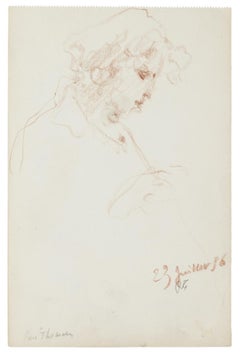
This expressive and atmospheric graphite drawing by Gösta von Hennigs (1866–1941) portrays the celebrated equestrian artist Baptista Schreiber within the charged setting of a circus manège. In the foreground, Schreiber is captured in an impressionistic moment of motion, her head turned toward her horse Menelik, which is only faintly suggested in the background. Behind her, her partner stands ready to lift her onto the horse, reinforcing the sense of immediacy and preparation before performance. On the reverse (a tergo), Schreiber is depicted riding her horse Menelik in the arena, wearing a striking feathered headdress. The audience appears schematically in the background, while to the right stands a male figure, possibly the circus director or presenter. The drawing is possibly a study for a painting, probably executed around 1905- 1915, and demonstrates von Hennigs’s assured command of line and movement, as well as his keen interest in performers and modern spectacle. The back panel has an old note describing the present drawing and attesting the artist, signed by Sven Petersohn, artexpert and one of the authors of the Swedish National Encyclopedia of Swedish artists. It is not signed.
Carl Gustaf Albert von Hennigs (1866-1941) was a Swedish painter whose career spans the transition from late 19th-century Impressionism to a highly personal engagement with modern urban and performative life.
Von Hennigs received his artistic training at the Artists’ Association School (Konstnärsförbundets skola) between 1891 and 1893, where he studied under Richard Bergh, Per Hasselberg, and Anders Zorn. During his early career, he painted street scenes, and focused on Stockholm motifs rendered in an impressionistic manner. He was an active member of the Artists’ Association (Konstnärsförbundet) and participated in many of its exhibitions until the organisation was dissolved in 1920.
From the early 1900s, von Hennigs gradually moved away from purely urban landscapes and developed a distinctive new subject matter. From around 1903 onwards, he increasingly drew inspiration from the world of the circus, the arena, and the manège, a thematic focus that earned him the epithet “the circus painter.” His works from this period depict acrobats, riders, jugglers, and clowns, executed in oil and watercolour. These compositions are marked by strong, vibrant colours and an impressionistic handling that emphasises movement, rhythm, and spectacle.
Stylistically, von Hennigs evolved from Impressionism toward a more decorative expression, influenced in part by Japanese colour woodcuts. His choice of viewpoints and compositional cropping often recalls Edgar Degas, particularly in the way figures are captured mid-motion and seen from unconventional angles. This approach allowed him to convey the fleeting, dynamic nature of performance with immediacy and visual intensity.
The Artists’ Association exhibition in Stockholm in 1912 marked a major breakthrough in his career. Prince Eugen purchased nine of his works at the exhibition, which were subsequently incorporated into the collection at Prins Eugens Waldemarsudde.
Von Hennigs’s reputation as an artist of movement and light was summarised in Svenska Dagbladets Yearbook in 1941, which noted his particular strength in capturing motion and the interplay of light and colour, while also observing a certain coolness in his work, arising from a strong focus on visual sensation despite the temperament of his motifs.
In addition to his artistic practice, von Hennigs played an important role in Swedish art education. He served as acting professor at the Royal University College of Fine Arts (Konsthögskolan) in Stockholm from 1928 to 1933. Today, Gösta von Hennigs is regarded as a key figure in Swedish early modern painting, especially celebrated for his vivid and innovative depictions of circus and performance life.
His works can be found in the Swedish National Museum, Modern museum of art, Prince Eugen Waldemarsudde and others.
Baptista Schreiber’s fame as an equestrian artist cannot be fully understood without placing her celebrated horse Menelik at the centre of her life and career. Schreiber, also known as Mijares-Schreiber, was the owner and trainer of Menelik, a white Arabian stallion who came to be regarded as the most famous circus horse in Sweden. Their partnership symbolized the height of artistic horsemanship in the early 20th century, when the bond between rider and horse was central to the show.
Menelik arrived in Schreiber’s life under extraordinary circumstances. In 1914, he was presented to her as a gift from Queen Alexandra of Great Britain and the British royal court, an exceptional gesture that reflects both Schreiber’s international reputation and the prestige surrounding her performances. The stallion was named after Emperor Menelik II of Ethiopia, a name that further enhanced the horse’s aura of strength, nobility, and exotic distinction.
Menelik’s death in 1931 caused widespread public attention and marked the end of an era. Together, their story has become part of Swedish cultural memory, illustrating how artistic performance, personal attachment, and public recognition could intersect in a way that elevated a circus horse to the level of a national icon.
- Creador:Gosta von Hennigs (1866 - 1941, Sueco)
- Año de creación:1910-1920
- Dimensiones:Altura: 39 cm (15,36 in)Anchura: 33 cm (13 in)Profundidad: 2 cm (0,79 in)
- Medio:
- Movimiento y estilo:
- Época:
- Estado:The drawing is in good condition. The paper has turned slightly brown. It has presently an acid free mounting.
- Ubicación de la galería:Stockholm, SE
- Número de referencia:1stDibs: LU2608217370262
Sobre el vendedor
5,0
Vendedor Oro
Vendedores premium que mantienen una calificación de +4,3 y tiempos de respuesta de 24 horas
Vendedor de 1stDibs desde 2023
33 ventas en 1stDibs
Tiempo de respuesta usual: <1 hora
- EnvíoRecuperando presupuesto…Envío desde: Stockholm, Suecia
- Política de devolución
Partes de esta página se han traducido automáticamente. 1stDibs no puede garantizar la exactitud de las traducciones. El inglés es el idioma predeterminado de este sitio web.
Más de este vendedor
Ver todoRetrato de mujer gitana - Dibujo del siglo XIX
Dibujo de retrato de perfil de una mujer, realizado en grafito sobre papel por Johannes Collin (1873-1951), firmado "Johannes Collin 98" y titulado "Zigenerska". Esta obra temprana e...
Categoría
Década de 1890, Otro estilo de arte, Dibujos y acuarelas de retratos
Materiales
Papel, Grafito
Oficial de caballería a caballo
Una acuarela sobre papel finamente trabajada representa a un oficial de caballería a caballo -de porte y traje formales- pintado con la delicada claridad por la que Egron Lundgren es...
Categoría
Mediados del siglo XIX, Otro estilo de arte, Dibujos y acuarelas de anim...
Materiales
Papel, Acuarela
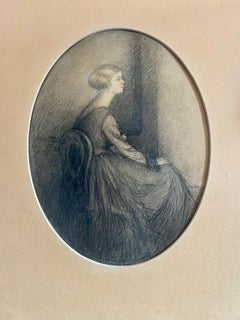
Retrato de perfil de una mujer sentada en una silla
Un dibujo oval finamente afinado de la artista finlandesa Ester Helenius que representa a una joven de perfil sentada en una silla. La habitación sólo está sugerida por un fondo difu...
Categoría
Década de 1910, Jugendstil, Dibujos y acuarelas de retratos
Materiales
Papel, Carbón, Gouache
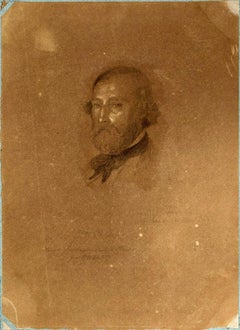
Retrato Gustav Wilhelm Palm - Siglo XIX Lápiz y pastel sobre papel
Retrato de Gustaf Wilhelm Palm (1810-1890) por Lorenz Frølich (1820-1908)
Firmado con monograma y fechado en mayo de 1849. Lápiz y pastel sobre papel. 29,5 × 21 cm.
Este retrato del ...
Categoría
Década de 1840, Naturalista, Dibujos y acuarelas de retratos
Materiales
Papel, Pastel, Lápiz de carbón
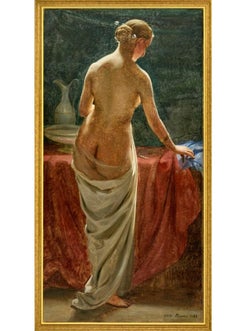
Psique - Siglo XIX Óleo sobre lienzo
Por Otto Bache
En este óleo neoclásico sobre lienzo firmado y fechado "Otto Bache 1864", el artista representa a Psique de pie, de espaldas al espectador, junto a una mesa drapeada de rojo. Lleva e...
Categoría
Década de 1860, Otro estilo de arte, Pinturas figurativas
Materiales
Óleo
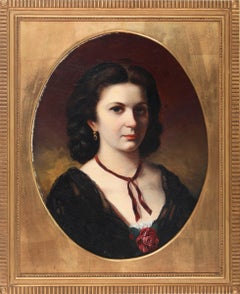
Princesa rusa Olga Gortschakoff - Retrato del siglo XIX, Óleo sobre lienzo
Retrato de la princesa Olga Gortschakoff, obra de la artista del siglo XIX Elise Hügel.
Retrato ovalado de la princesa Olga Gortschakoff (1838-1926), más tarde baronesa von Meyendor...
Categoría
Década de 1850, Otro estilo de arte, Pinturas de retratos
Materiales
Lienzo, Óleo
También te puede gustar
Retrato - Dibujo a lápiz sobre papel - Mediados del siglo XX
Retrato es un dibujo original a lápiz sobre papel, realizado por un artista anónimo a mediados del siglo XX. Con otro dibujo en la parte trasera.
Buenas condiciones.
Categoría
mediados del siglo XX, Moderno, Dibujos y acuarelas figurativos
Materiales
Lápiz
Retrato - Dibujo al carboncillo de Pierre Georges Jeanniot - Principios del siglo XX
Por Pierre Georges Jeanniot
Retrato es un Dibujo original sobre papel realizado por el pintor Pierre Georges Jeanniot (1848-1934).
Dibujar a lápiz.
Firmado a mano en la parte inferior.
Buen estado, salvo los...
Categoría
principios del siglo XX, Moderno, Dibujos y acuarelas de retratos
Materiales
Lápiz
Retrato de una dama - Dibujo de Hermann Paul - Años 1890
Retrato de dama es un dibujo a lápiz realizado por Hermann Paul.
Firmado a mano en la esquina inferior izquierda. Passpartout incluido cm 51x35
Buen estado.
René Georges Hermann-...
Categoría
Década de 1890, Moderno, Dibujos y acuarelas figurativos
Materiales
Papel, Lápiz
Retrato de mujer - Dibujo original al carboncillo - Principios del siglo XX
Retrato de Mujer es una obra de arte original realizada por un Artista Desconocido.
Dibujo a punta de gris y acuarela sin firmar, escrito detrás CH.L. Papel pegado sobre cartón. Di...
Categoría
principios del siglo XX, Moderno, Dibujos y acuarelas figurativos
Materiales
Papel, Lápiz
Estudio para un retrato - Dibujo original a lápiz - Siglo XX
"Estudio para un Retrato" es un dibujo original en temple sobre papel, realizado por un Artista Anónimo Francés del Siglo XX .
El estado de conservación de las obras de arte es muy ...
Categoría
siglo XX, Moderno, Dibujos y acuarelas figurativos
Materiales
Lápiz
Equestrienne", Salón de Otoño, Museo del Luxemburgo, Postimpresionismo francés
Por Henri Ottmann
Firmado abajo a la derecha: "Henri Ottmann" (francés, 1877-1927) y creado hacia 1915.
Elegante dibujo a lápiz y tinta que muestra a dos mujeres conversando, una sentada de lado a ca...
Categoría
Década de 1910, Pinturas figurativas
Materiales
Papel, Tinta china, Lápiz
