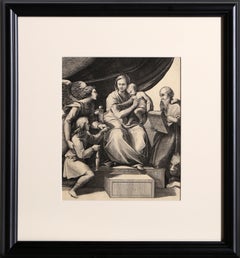
Artículos similares a Venere e Amore sui Delfini (Venus and Cupid on Dolphins) /// Old Masters Raphael
¿Quieres más imágenes o vídeos?
Solicita imágenes o vídeos adicionales al vendedor
1 de 22
Marco DenteVenere e Amore sui Delfini (Venus and Cupid on Dolphins) /// Old Masters Raphael1515-1520
1515-1520
4342,94 €
Acerca del artículo
Artist: Marco Dente da Ravenna (Italian, 1493-1527)
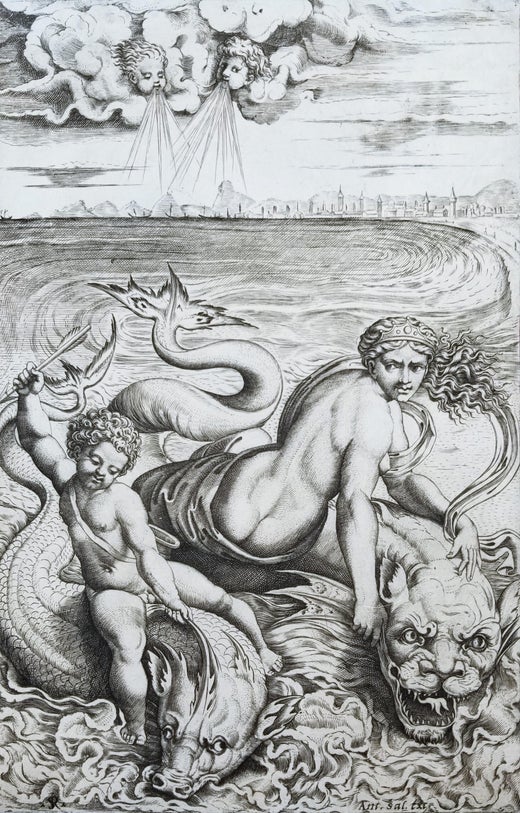
Title: "Venere e Amore sui Delfini (Venus and Cupid on Dolphins)"
*Monogram signed by Dente in the plate (printed signature) lower left
Circa: 1515-1520 (second state of three)
Medium: Original Engraving on laid paper
Limited edition: Unknown
Printer: Unknown
Publisher: Antonio Salamanca, Rome, Italy
Reference: Bartsch XIV, page 244, No. 324; Passavant VI, page 69, No. 32; Le Blanc, II, page 111, No. 16; Imolesi Pozzi pages 71-72, 113, No. 10
Framing: Recently beautifully framed, the sheet is museum mounted, floated over a 100% cotton rag mat in a modern gold moulding and Museum glass
Framed size: 16.88" x 13.07"
Sheet size: 10.63" x 6.94"
Condition: Thread margins. A strong impression in excellent condition
Very rare
Notes:
Provenance: private collection - Périgueux, France. This work is also sometimes referred to as "Venus and Cupid riding two sea monsters, Cupid raises an arrow in his right hand, two heads representing wind in the clouds above". The engraver's monogram "SR" lower left. Published by Antonio Salamanca (1478-1562) in Rome, Italy with his address printed lower right: "Ant. Sal. Exc.". No watermark found. This engraving is after a drawing by Italian artist Raphael aka Raffaello Sanzio da Urbino (1483-1520).
"This engraving by Marco Dente is after a design by Raphael, now lost, used by Giulio Romano for his fresco on the south wall of the Stufetta of cardinal Bibbiena - a small room in the Apostolic Palace, at the Vatican, that originally served as a washroom for the cardinal. The engraving differs from the fresco in some details, such as the cityscape in the background and the two winds above, which may indicate that these elements were present in Raphael's drawing. " - Christie's, London
Biography:
Marco Dente da Ravenna (1493–1527), usually just called Marco Dente, was an Italian engraver born in Ravenna in the latter part of the 15th Century. He was a prominent figure within the circle of printmakers around Marcantonio Raimondi in Rome, and is known for the imitative nature of the reproductive prints or close copies of other prints that were most of his output. His prints in specific cases are also of certain interest in that we can see the impact and design of sculptural restorations. Marco Dente was killed in the tumult of the Sack of Rome in 1527. He used the accompanying monogram, D-B; albeit sparingly. Marco Dente is not a well-known figure in the Renaissance. The reproductive nature of his works contributed to the subversion of his identity. There was much debate surrounding the attribution of artists within Marcantonio Raimondi's School, and their respective plates. Also contributing to the subversion of his identity was that every plate in Dente's studio was destroyed during the Sack of Rome. Marco Dente was killed in the same war; and very few of his plates were later reissued by publishers.
The artist was a member of a patrician family who grew up and lived in Ravenna for the majority of his life. He was an integral member of Marcantonio Raimondi's school of art, joining in 1516; Dente was likely an apprentice alongside Agostino di Musi, another Italian engraver. Dente and Agostino di Musi formed the first generation of Marcantonio's school. However, between the two artists, Dente was considered to have come closest to mastering the technique of engraving. The characteristic that defines Marco Dente's work is the reproductive nature of his works. The reproductive nature of Dente's work served three functions. The first was to replicate an event in history; the second was to advance financially; the third was to produce with an intent to distribute the print, and as an extension, the print's conceptual elements too. There was a growing demand for depictions of antique relief in the middle of the sixteenth century. The school's commercial function was facilitated by the markets within La Bottega del Cartolaio; this is largely where prints by Marcantonio and Marco Dente were able to be exchanged or acquired.
Raphael (Italian, 1483-1520) was a seminal Italian painter of the High Renaissance period. Admired for his ability to organize forms and color into clear and graceful compositions, Raphael portrayed scenes with delicate lines and subtle shading, evoking a Platonic ideal of serenity and beauty. In perhaps his best-known work, The Sistine Madonna (1513-1514), the artist conveyed an elaborate scene in which wistful cherubs gaze up at the Virgin Mary, two saints, and her son. Born Raffaello Sanzio on April 6, 1483 in Urbino, Italy, his father was the painter Giovanni Santi who became the young artist’s first instructor. By the age of 17, Raphael was already considered a precocious talent, producing paintings influenced by the work Piero della Francesca. Around the year 1500, he apprenticed with Pietro Perugino, helping the elder artist to produce an important fresco commission in Perugia, an experience that had a profound influence on the young Raphael. Moving to Florence in 1504, he was immersed in the milieu of the one the great epochs of art history, while in the city he studied the works of both Leonardo da Vinci and Michelangelo. Called by Pope Julius II to Rome in 1508, Rapahel was hired to complete a cycle of frescoes in the papal apartments inside the Vatican, he would live in the city the next 12 years. The artist died on his 37th birthday on April 6, 1520 in Rome, Italy. According to his biographer Giorgio Vasari, Raphael’s premature death was caused by a fever brought on by excessive lovemaking with his mistress Luti. Today, his works are held in the collections of the Alte Pinakothek in Munich, the Hermitage Museum in St. Petersburg, the Louvre Museum in Paris, the National Gallery in London, the Rijksmuseum in Amsterdam, and the Metropolitan Museum of Art in New York, among others.
- Creador:Marco Dente (1493 - 1527, Italiano)
- Año de creación:1515-1520
- Dimensiones:Altura: 42,88 cm (16,88 in)Anchura: 33,2 cm (13,07 in)
- Medio:
- Movimiento y estilo:
- Época:
- Estado:
- Ubicación de la galería:Saint Augustine, FL
- Número de referencia:1stDibs: LU121217369532
Marco Dente de Rávena (1493-1527), normalmente llamado Marco Dente, fue un grabador italiano nacido en Rávena a finales del siglo XV. Fue una figura destacada dentro del círculo de grabadores que rodeaban a Marcantonio Raimondi en Roma, y es conocido por la naturaleza imitativa de los grabados reproductivos o copias cercanas de otros grabados que constituyeron la mayor parte de su producción. Sus grabados en casos concretos también tienen cierto interés, ya que podemos ver el impacto y el diseño de las restauraciones escultóricas. Marco Dente fue asesinado en el tumulto del Saqueo de Roma en 1527. Utilizaba el monograma de acompañamiento, D-B; aunque con moderación. Marco Dente no es una figura muy conocida en el Renacimiento. El carácter reproductivo de sus obras contribuyó a la subversión de su identidad. Hubo mucho debate en torno a la atribución de los artistas de la Escuela de Marcantonio Raimondi y sus respectivas planchas. También contribuyó a la subversión de su identidad el hecho de que todas las planchas del estudio de Dente fueran destruidas durante el Saqueo de Roma. Marco Dente murió en la misma guerra, y muy pocas de sus láminas fueron reeditadas posteriormente por las editoriales. El artista era miembro de una familia patricia que creció y vivió en Rávena la mayor parte de su vida. Fue miembro integrante de la escuela de arte de Marcantonio Raimondi, a la que se incorporó en 1516; Dente fue probablemente aprendiz junto a Agostino di Musi, otro grabador italiano. Dente y Agostino di Musi formaron la primera generación de la escuela de Marcantonio. Sin embargo, entre los dos artistas, se consideraba que Dente era el que más se había acercado al dominio de la técnica del grabado. La característica que define el trabajo de Marco Dente es el carácter reproductivo de sus obras. El carácter reproductivo de la obra de Dente cumplía tres funciones. La primera era reproducir un acontecimiento de la historia; la segunda, avanzar económicamente; la tercera, producir con la intención de distribuir el grabado y, como extensión, también los elementos conceptuales del grabado. A mediados del siglo XVI creció la demanda de representaciones de relieves antiguos. La función comercial de la escuela se veía facilitada por los mercados de La Bottega del Cartolaio; allí es donde, en gran medida, se podían intercambiar o adquirir grabados de Marcantonio y Marco Dente.
Sobre el vendedor
5,0
Vendedor Platino
Vendedores premium con una calificación de +4,7 y tiempos de respuesta de 24 horas
Establecido en 1978
Vendedor de 1stDibs desde 2015
1363 ventas en 1stDibs
Tiempo de respuesta usual: <1 hora
- EnvíoRecuperando presupuesto…Envío desde: Saint Augustine, FL
- Política de devolución
Partes de esta página se han traducido automáticamente. 1stDibs no puede garantizar la exactitud de las traducciones. El inglés es el idioma predeterminado de este sitio web.
Más de este vendedor
Ver todoL
Amour Montrant Psyche Aux Graces /// Mitología del Renacimiento Raphael Clásicos
Por (after) Raphael (Raffaello Sanzio da Urbino)
Artista: (según) Rafael (italiano, 1483-1520)
Título: "L'Amour Montrant Psyche Aux Graces" (El amor sigue a Psique en las gracias)
Cartera: Gaceta de Bellas Artes
Año: 1883
Soporte: ...
Categoría
Década de 1880, Antiguos maestros, Impresiones de desnudos
Materiales
Grabado químico, Entalle
Aurora sive Tempus Matutinum; Der Wohl und Übel angewandte Morgen /// Viejo Maestro
Artista: (según) Johann Daniel Preissler (alemán, 1666-1737)
Título: "Aurora sive Tempus Matutinum; Der Wohl und Übel angewandte Morgen (Amanecer o Tiempo Matutino; La Mañana Utiliza...
Categoría
Década de 1720, Antiguos maestros, Impresiones figurativas
Materiales
Papel verjurado, Grabado, Grabado químico
El Nuevo Testamento /// Antiguos Maestros Grabado Religioso Bíblico Arte Angelical Holandés
Por Michael Burghers
Artista: Michael Burghers (holandés, c.1647/1648-1727)
Título: "El Nuevo Testamento"
Portafolio: Santa Biblia
*Firmado por Burghers en la plancha (firma impresa) abajo a la izquierd...
Categoría
Década de 1680, Antiguos maestros, Impresiones figurativas
Materiales
Acuarela, Papel verjurado, Grabado, Grabado químico, Entalle
La Femme Muse /// Simbolismo Alegórico Romanticismo Antiguos Maestros Dibujo Europeo
Artista: Desconocido (Probablemente francés, siglo XVIII)
Título: "La Femme Muse"
*No se ha encontrado ninguna firma
Circa: 1780
Medio: Dibujo original al pastel sobre papel verjurad...
Categoría
Década de 1780, Antiguos maestros, Dibujos y acuarelas figurativos
Materiales
Pastel, Papel verjurado
Vespera; Der Abend (La tarde; La noche) /// Johann Daniel Preissler Maestro antiguo
Artista: (según) Johann Daniel Preissler (alemán, 1666-1737)
Título: "Vespera; Der Abend (Vespera; La Tarde)"
Portafolio: Die Vier Tageszeiten (Los cuatro momentos del día)
Año: 1723...
Categoría
Década de 1720, Antiguos maestros, Impresiones figurativas
Materiales
Papel verjurado, Grabado, Grabado químico
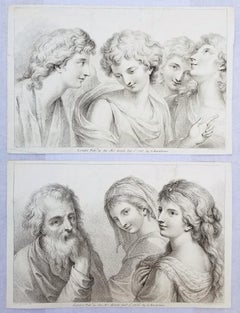
Conjunto de dos grabados según Cipriani "Cuatro musas" y "Padre y dos hijas"
Por Francesco Bartolozzi
Artista: Francesco Bartolozzi (italiano, 1727-1815)
Título: "Cuatro musas" y "Padre y dos hijas"
Portafolio: Rudimentos del dibujo
*Editado sin firmar, aunque ambos están firmados po...
Categoría
Década de 1780, Antiguos maestros, Impresiones figurativas
Materiales
Grabado, Grabado químico
También te puede gustar
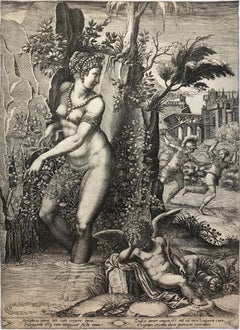
Venus y la Rosa (2º Estado)
Por Giorgio Mantovano Ghisi
Grabado según Luca Penni
Categoría
siglo XVI, Antiguos maestros, Impresiones y múltiplos
Materiales
Grabado
Venus l
Amour et Pallas, Heliograbado de Marco Dente
Marco Dente, Después de Amand Durand, Italiano (1493 - 1527) - Venus l'Amour et Pallas, Año: hacia 1878, Medio: Heliograbado, Tamaño: 9 x 5.5 in. (22.86 x 13,97 cm), Impresor: Ama...
Categoría
Década de 1870, Antiguos maestros, Impresiones y múltiplos
Materiales
Grabado químico
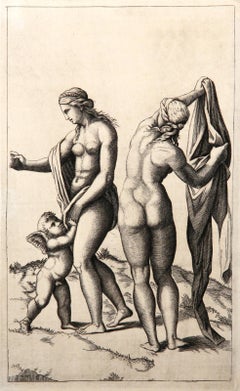
Venus Accroupie, Heliograbado de Marcantonio Raimondi
Por Marcantonio Raimondi
Marcantonio Raimondi, Después de Amand Durand, Italiano (1480 - 1534) - Venus Accroupie, Año: 1875, Medio: Heliograbado, Tamaño: 9.25 x 6 in. (23.5 x 15,24 cm), Impresor: Amand Du...
Categoría
Década de 1870, Antiguos maestros, Impresiones y múltiplos
Materiales
Grabado químico
HERCULES LUCHA CONTRA ADRAGÓN centro, ACELOO DESPLAZA A DEIANEIRA izquierda
Por Giulio Bonasone
GIULIO BONASONE (Italiano 1500/10-1574)
HERCULES FiGHTS ADRAGON centro, ACHELOUS CARRY OFF DEIANEIRA izquierda 1531-76 (Bartsch XV.157.178; Massari 1983, no.230)
Grabado. Rotul...
Categoría
siglo XVI, Antiguos maestros, Impresiones figurativas
Materiales
Grabado
Mars Venus et l
amour, Heliograbado de Marcantonio Raimondi
Por Marcantonio Raimondi
Marcantonio Raimondi, Después de Amand Durand, Italiano (1480 - 1534) - Mars Venus et l'amour, Año: 1875, Medio: Heliograbado, Tamaño: 12 x 8.5 in. (30.48 x 21,59 cm), Impresor: A...
Categoría
Década de 1870, Antiguos maestros, Impresiones y múltiplos
Materiales
Grabado químico
La Vierge au Poisson (d
apres Raphael), Heliograbado de Marco Dente
Marco Dente, Después de Amand Durand, Italiano (1493 - 1527) - La Vierge au Poisson (d'apres Raphael), Año: hacia 1878, Medio: Heliograbado, Tamaño de la imagen: 10 x 8,5 pulgadas, ...
Categoría
Década de 1870, Antiguos maestros, Impresiones figurativas
Materiales
Grabado químico