Artículos similares a Iris con rama de olivo
¿Quieres más imágenes o vídeos?
Solicita imágenes o vídeos adicionales al vendedor
1 de 8
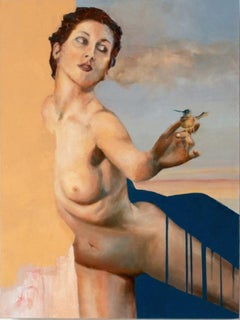
Jose Manuel CapulettiIris con rama de olivoCirca 1975
Circa 1975
3000 €
Acerca del artículo
JOSÉ MANUEL CAPULETTI
Spanish, 1925 - 1976
IRIS CON RAMA DE OLIVO
signed "Capuletti" (lower right)
oil on canvas
34-5/8 x 20-1/2 inches (88 x 52 cm.)
framed: 38 x 23-3/4 inches (96.5 x 60.5 cm.)
PROVENANCE
Private Collection, Germany
Capuletti Lillo del Pozo, José Manuel. Valladolid, 21.III.1925 - Walluf (Germany), 28.IX.1978. Painter.
As a child he began to express his hobby and exceptional skills for drawing and painting. Self-taught, his artistic beginnings were first developed in his hometown, where he held his first and controversial exhibitions (Palace of Santa Cruz and Librería Meseta), and shortly thereafter in Madrid, orienting that first work towards drawing, watercolor and portraits. From 1946 he frequented the atmosphere of the Spanish ballets, and since then he dedicated himself to the design of sets and figurines for some of the main companies of the time. In 1950, during a tour abroad, he met Pilar López Fernández, a young dancer from the Spanish ballet company of José Greco, who became his wife a year later. She was the ideal companion for the artist, her almost unique model and her main stimulus.
In 1951 he settled in Paris and in March of the following year he held his first solo exhibition at the André Weil Gallery, which was also his dealer. After a difficult time and with economic hardships, he began to make his way in the art world. He participated in various exhibitions and as of 1954 he was already firmly established in the Parisian art media, becoming a young value recognized by the public and critics. That same year he made the figurines and the sets of the show Pure Flamenco Art, which Vicente Escudero's company premiered at the Theater of the Champs Elysees in Paris.
From 1958 he made several exhibitions at the Hammer Galleries, in New York, and, while he continued exhibiting in different galleries in Paris, he traveled repeatedly to the United States, where he obtained with his works a great sales success. In the mid-sixties he worked as a designer of figurines and decorations for the Harkness Ballet company in New York.
In 1968 he decided to leave Paris and return to Spain, after sixteen years of absence. It is established in Mairena del Alcor (Seville), where a farmhouse is built. Born for his deep love for Andalusia and his passion for flamenco, he devoted much of his work to the themes of the bullfighting, singing and dancing. Thus, among many other works, he made a collection of forty-nine portraits drawn to the white and black tempera of the most famous flamenco singers, dancers and guitarists, a series he exhibited in December 1969 at the Ateneo de Sevilla.
In 1973, and after a time of disagreements with his wife, Capuletti leaves his house in Mairena and leaves with what will be his young companion until his death, Irish Henrich. They lived for four months in the farm of the rejoneador Ángel Peralta in La Puebla del Río. The result of his friendship and collaboration with the right-hander was the illustrated book with engravings titled Bullfighter Horse. In 1974, Capuletti and Irish settled in Madrid and the following year their daughter Irish Desirée was born. In September 1978, during the trip to Germany, his partner's native country, the artist died suddenly. He was buried in the cemetery of Walluf.
Endowed with great creative fantasy, Capuletti cultivated a pleasing painting and suggestive neorealism. From its beginnings it accuses a strong surreal influence, especially Dalinian, that mixes with evocations of Giorgio de Chirico, Balthus, Delvaux, Magritte and other surrealists. Magnificent artist, he showed an academic technique, very close to hyperrealism in his last creative era. Eroticism was one of the recurring themes of his work, making women and the nude an essential stone of the artist's vision. In addition to the original portraitist, he cultivated, among other subjects, still life paintings, in which he achieves suggestive trompe l’oeil effects.
Very interesting is also his production as a creator of scenographies and costumes for flamenco shows and ballets of famous dancers, such as Vicente Escudero, Antonio or Pilar López. Other facets of his fruitful creativity were those of a cartoonist, a corador, an illustrator, an engraver and a posterist. Very prolific artist, his work is widely dispersed and is largely preserved in foreign collections.
Works by ~: Nature morte aux escargots, 1953; Portrait of the dancer Antonio, 1955; Il faut qu’une porte soit ouverte, 1960; Primae noctis, 1962; The day of the Annunciation, 1962-1963; The last hour of Lady Godiva, 1965-1966; Famous Flamingos Series (forty-nine drawings in the tempera), 1959-1966; Self Portrait, 1965; The sky of Mairena, 1968-1969; American footbal, 1967; Portrait of Prince Juan Carlos, 1972; Bullfighter horse (fifteen engravings), 1973; The road of the Puebla, 1974.
Bibl .: J. J. Martín González, “A surrealist painter: Capuletti”, in Goya, 32 (1959), p. 133-134; A. Corral Castanedo, José Manuel Capuletti, Valladolid, Popular Savings Bank, 1983 (col. Vallisoletanos, quad. No. 14); J. C. Brasas Egido, Capuletti. The painter and his work, Valladolid, Provincial Savings Bank, 1987; VV AA., Capuletti and flamenco, Sevilla, Junta de Andalucía, 1994.
José Carlos Brasas Egido
- Creador:Jose Manuel Capuletti (1925)
- Año de creación:Circa 1975
- Dimensiones:Altura: 88 cm (34,65 in)Anchura: 52 cm (20,48 in)
- Medio:
- Movimiento y estilo:
- Época:
- Estado:
- Ubicación de la galería:Madrid, ES
- Número de referencia:1stDibs: LU1281117404252
Sobre el vendedor
5,0
Vendedor profesional aprobado
Todos los vendedores superan estrictas normas de autenticidad y confiabilidad
Establecido en 1977
Vendedor de 1stDibs desde 2019
21 ventas en 1stDibs
Tiempo de respuesta usual: 2 horas
- EnvíoRecuperando presupuesto…Envío desde: Madrid, España
- Política de devolución
Partes de esta página se han traducido automáticamente. 1stDibs no puede garantizar la exactitud de las traducciones. El inglés es el idioma predeterminado de este sitio web.
Más de este vendedor
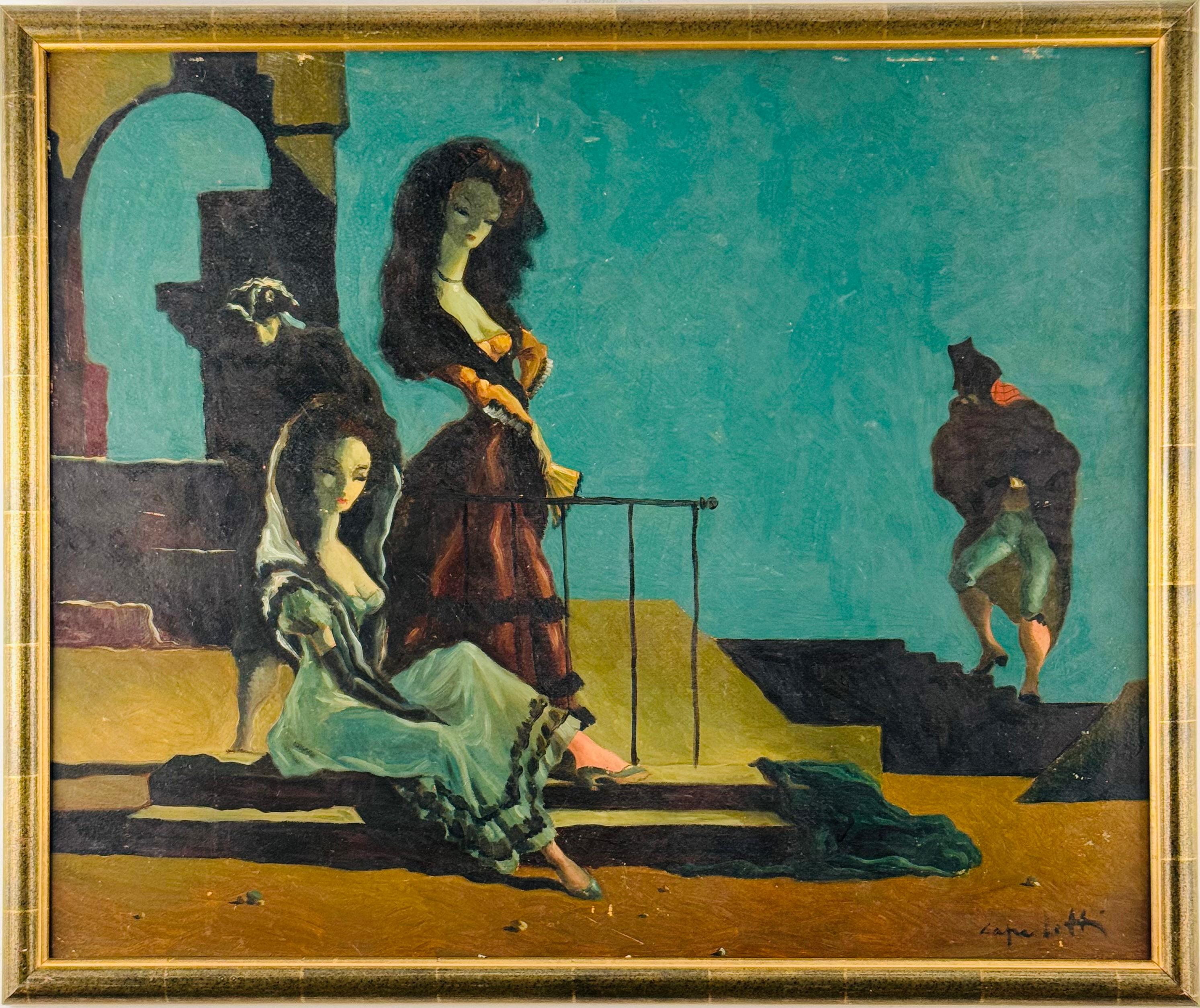
Ver todoLas damas
JOSÉ MANUEL CAPULETTI
Spanish, 1925 - 1976
LAS DAMAS
signed "Capuletti" (lower right)
oil on cardboard
21-1/4 x 25-5/8 inches (54 x 65 cm.)
framed: 22-5/8 x 27 inches (57.5 x 68.5 cm...
Categoría
Década de 1960, Surrealista, Pinturas figurativas
Materiales
Óleo, Cartulina
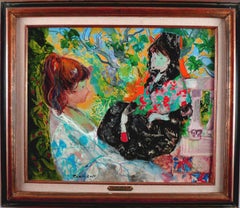
"Espagnoles, 1971", óleo sobre lienzo del siglo XX del artista Emilio Grau Sala
Por Emilio Grau Sala
EMILIO GRAU SALA
Español, 1911 - 1975
ESPAGNOLES, 1971
firmado "Grau Sala" (abajo a la izquierda)
firmado de nuevo, fechado y titulado "Grau Sala, 1971, espagnoles" (en el reverso)...
Categoría
Década de 1970, Posimpresionista, Pinturas figurativas
Materiales
Lienzo, Óleo
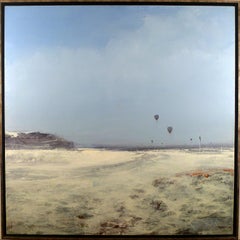
"Concentración", Acrílico sobre panel de madera de principios del siglo XXI por el artista Cesc Farré
CESC FARRÉ I SENDRÓS
Español, 1972 -
CONCENTRACIÓN
firmado "Farré i Sendrós" (abajo a la izquierda)
firmado de nuevo, titulado y fechado "CESC FARRÉ I SENDRÓS / Cesc Farré / CONCENTR...
Categoría
Principios de los 2000, Pinturas figurativas
Materiales
Acrílico, Panel de madera
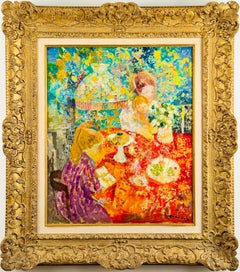
ESCENA FAMILIAR
Por Emilio Grau Sala
EMILIO GRAU SALA
Español, 1911 - 1975
ESCENA FAMILIAR
firmado "Grau Sala" (abajo a la derecha)
firmado, titulado, localizado y fechado "GRAU SALA / SCÈNE FALLIALLE / PARIS 1969" (en ...
Categoría
Década de 1960, Posimpresionista, Pinturas figurativas
Materiales
Lienzo, Óleo
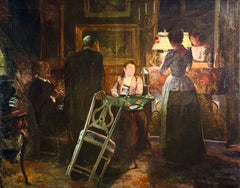
Partida de Tresillo
JOSÉ JIMÉNEZ ARANDA
Español, 1837 - 1903
PARTIDA DE TRESILLO
firmado, localizado y fechado "Jz. Aranda / Madrid. 1893." (abajo a la derecha)
óleo sobre lienzo
80 x 100 cm (31-1/2 x 39-1/3 pulgadas)
sin enmarcar
BIBLIOGRAFÍA
- Este cuadro mencionado e ilustrado en "LA ILUSTRACION ESPAÑOLA Y AMERICANA", Madrid, 15 de septiembre de 1895
- B. Pantorba, José Jiménez Aranda, 1973, p. 75, 203
- José Jiménez Aranda, 1837-1903: Centro Cultural El Monte, Sevilla, octubre de 2005, ilustrado p. 102
EXPUESTO
Exposición Nacional de Madrid de 1895
PROCEDENCIA
Colección privada, EE.UU.
José Jiménez Aranda (7 de febrero de 1837 - 6 de mayo de 1903) fue un pintor español, hermano de los pintores Luis Jiménez Aranda y Manuel Jiménez Aranda.
Fue iniciado en sus primeros pasos como pintor por Manuel Cabral y Eduardo Cano.
Dotado para el dibujo, en 1851 ingresó en la Real Academia de Bellas Artes de Santa Isabel de Hungría de Sevilla. En 1868 estudió las colecciones del Museo del Prado de Madrid, especialmente las de Goya y Velázquez. En 1867 viajó a Jerez de la Frontera para trabajar como restaurador y diseñador de vidrieras. En 1871 se trasladó a Roma, donde permaneció cuatro años, conociendo a Mariano Fortuny, que influyó mucho en sus pinturas.
En 1881 se trasladó a París, donde estudió durante nueve años, pintando con notable éxito obras ambientadas en el siglo XVIII al estilo de Fortuny. En 1890 se trasladó a Madrid, pintando escenas de la vida cotidiana en un estilo más costumbrista.
La muerte de su mujer y su hija en 1892 hizo que regresara a su ciudad natal para el resto de su vida. Allí fue nombrado miembro de la Academia de Bellas Artes, donde se convirtió en profesor, cargo que ocupó hasta su muerte en 1903. Daniel Vázquez Díaz, Eugenio Hermoso, Ricardo López Cabrera, Manuel González Santos...
Categoría
Década de 1890, Realista, Pinturas figurativas
Materiales
Óleo, Lienzo
Francisco Bores, Jornada clara
Por Francisco Bores
FRANCISCO BORES
Español, 1898 - 1972
JOURNÉE CLAIRE
firmado y fechado "Borès 34" (abajo a la izquierda)
óleo sobre lienzo
46 x 38 cm (18 x 15 pulgadas)
enmarcado: 66 x 58 cm (26 x 23 pulgadas)
BIBLIOGRAFÍA:
Francisco Bores, Catálogo razonado, Volumen I - Pintura 1917-1944, Museo Nacional Centro de Arte Reina Sofía, Madrid, 2003, nº 1934 / 15, reproducido en p. 231
PROCEDENCIA
Colección privada, Madrid
Francisco Bores López (Madrid, 5 de mayo de 1898 - París, 10 de mayo de 1972) fue un pintor español de la llamada Nueva Escuela de París.
Su formación artística se originó tanto en la academia de pintura de Cecilio Pla, donde conoció a Pancho Cossío, Manuel Ángeles Ortiz o Joaquín Peinado...
Categoría
Década de 1930, Cubista, Pinturas de interiores
Materiales
Lienzo, Óleo
También te puede gustar
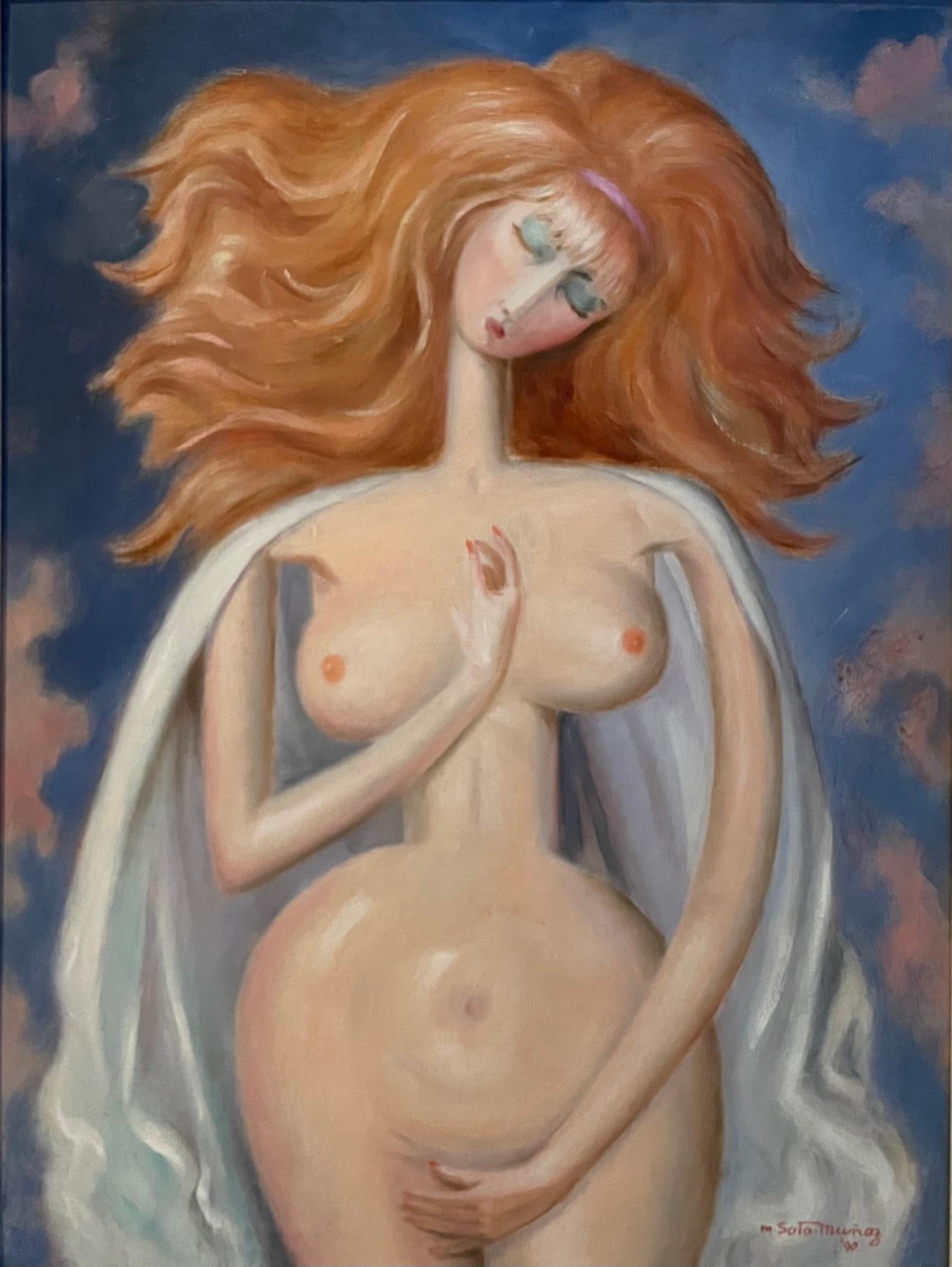
Sin título (Venus)
Manuel Soto-Muñoz (1913-2000), pintor estadounidense de origen puertorriqueño. Galardonada con el premio al mérito Florida Southern College, 1958; premio Art Students League New York...
Categoría
finales del siglo XX, Contemporáneo, Pinturas figurativas
Materiales
Óleo
L
Angelo Caduto, 2003
Por Gigino Falconi
Gigino Falconi nació en Giulianova (Teramo) en 1933. Comenzó a pintar a los dieciséis años, y en 1954 obtuvo el Liceo Artístico de Pescara. Durante los primeros años de su carrera, F...
Categoría
Siglo XXI y contemporáneo, Surrealista, Pinturas figurativas
Materiales
Acrílico
Óleo sobre tela - Primavera
La obra va firmada por el artista en la parte inferior
En la parte trasera, va nuevamente formada, fechada del año 1982 y titulada "Primavera"
Se presenta sin enmarcar la obra
El ...
Categoría
Década de 1970, Surrealista, Pinturas figurativas
Materiales
Óleo
Pintura figurativa surrealista, "Pentimento"
Éste es un cuadro original único en su género, pintado por la artista de San Diego Julia San Román. Es óleo sobre lienzo y sus dimensiones son 30 "x40". No tiene marco. Tras la entre...
Categoría
2.º década del siglo XXI, Surrealista, Pinturas de desnudos
Materiales
Lienzo, Óleo
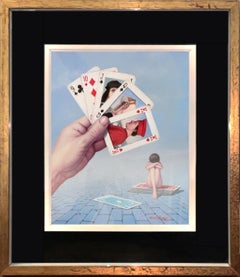
Sin título, pintura surrealista al óleo sobre tabla de Tito Salomoni
Por Tito Salomoni
Sin título
Tito Salomoni, italiano (1928-1989)
Óleo sobre tabla, firmado abajo a la derecha
Tamaño: 29,21 x 22,86 cm (11,5 x 9 pulg.)
Tamaño del marco: 18 x 15,5 pulgadas
Categoría
finales del siglo XX, Surrealista, Pinturas de desnudos
Materiales
Óleo, Tablero
Ohne Titel / Sin título
Esta obra es un trabajo típico de Roberto Guglielmino, conocido por sus paitings surrealistas y figurativos. El artista está representado por la galería de arte Ursula Stross (Austr...
Categoría
Principios de los 2000, Contemporáneo, Pinturas figurativas
Materiales
Lienzo, Óleo