Artículos similares a Retrato de un caballero
¿Quieres más imágenes o vídeos?
Solicita imágenes o vídeos adicionales al vendedor
1 de 6
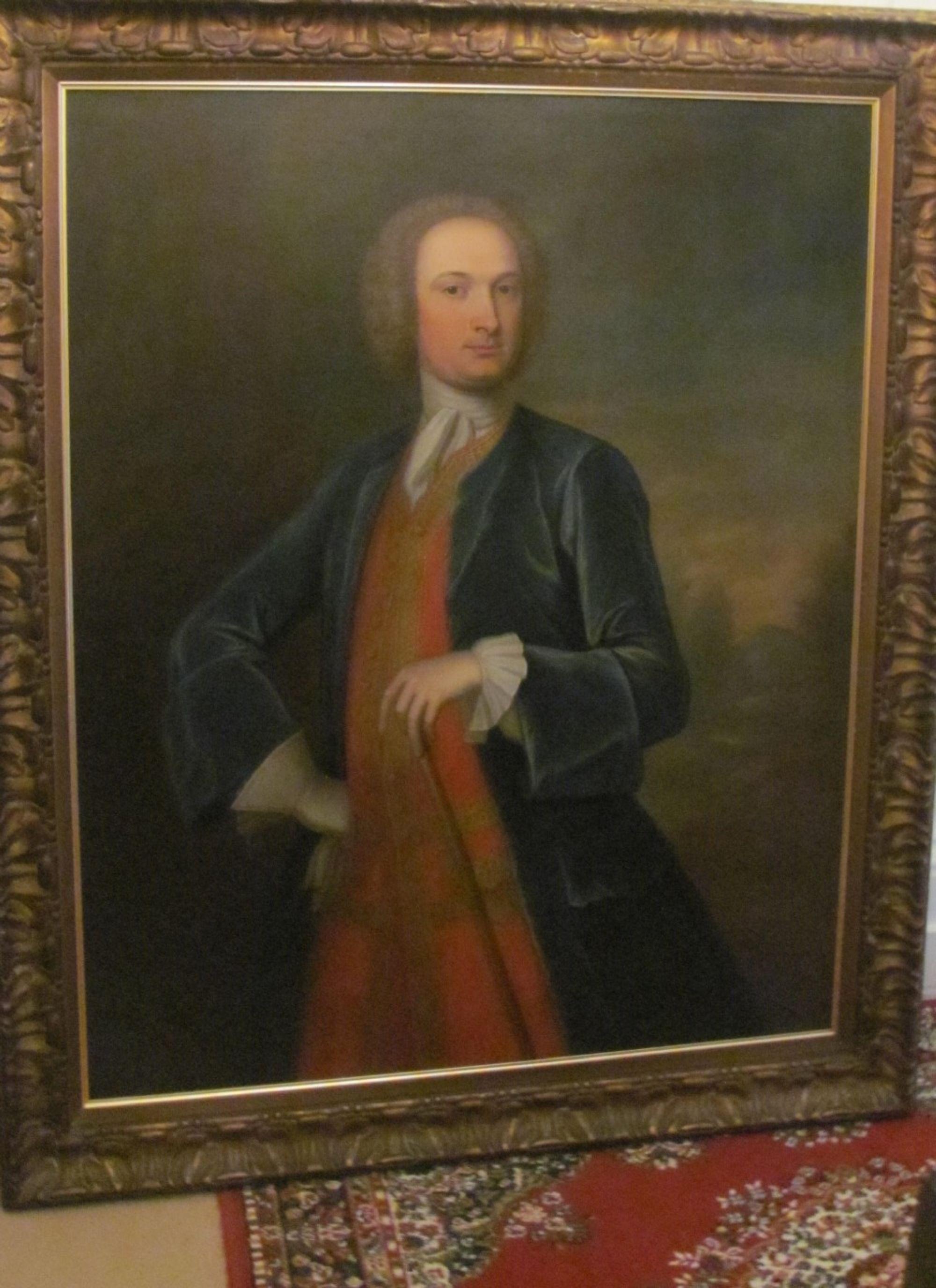
Arthur DevisRetrato de un caballero1755
1755
44.012,82 €
Acerca del artículo
Oil on canvas, signed and dated 'Art Devis/fe 1755' lower left
Image size: 29 1/2 x 24 1/4 inches (75 x 62 cm)
Original ornate gilt wood frame
Provenance:
Ian Douglas Leonard Cochrane, 14th Earl of Dundonald
Christie's London, June 16, 1961, lot 56, to Leggatt for 5,200 Guineas
The Viscountess Rothermere (1929-1992) Anonymous sale ('The Property of a Lady'), London, Christie's, July 16, 1982, lot 60
Private collection, U.K
Sotheby's London, December 14, 2021, lot 52
The Jerold Krouse Collection
Literature:
E.G. D'Oench, Arthur Devis: Master of the Georgian Conversation Piece, unpublished PhD thesis, 1979, p. 469, cat. no. 222
E.G. D'Oench, The Conversation Piece, Arthur Devis and his contemporaries, New Haven 1980, p. 91, cat. no. 222
Exhibited:
Bath, Holbourne Museum, on loan from 1988-2006
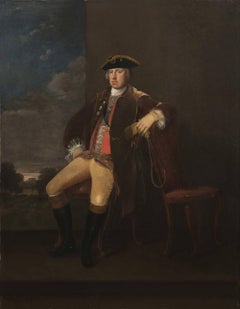
In this portrait, a well-dressed gentleman leans nonchalantly on a chair, the book clasped in his hand operating as a symbol of his education. His posture, with one hand on his hip brushing away his overcoat, has allowed for Devis to masterfully depict a range of different fabric textures - for example, the lace cuffs, the satin waistcoat, and the velvet lapels of his overcoat. Whilst the focus of the portrait is firmly on the powerful presence of its central figure, the beauty of the landscape in the background pays testament to Devis’ early training as a portraitist. The river and rolling hills recede into the background and create a sense of scale, whilst the Church behind the figure’s shoulder provides an aspect of potential realism - perhaps this was a local church associated with the lands, titles or heritage of the sitter. Arthur DevisArthur Devis was born in Preston, Lancashire in 1712, the son of a carpenter and councillor. He moved to London and was trained by Pieter Tillemans, who was known for his sporting and topographical scenes. He produced a number of Italianate landscapes during this time, but soon diverted from landscape painting into portraiture, becoming well-known for his conversation pieces and small-scale works. Devis moved between London and Lancashire, taking commissions and earning acclaim in both locations - he used his father’s position as a town councillor in Lancashire to earn commissions from local noble families. In 1745, he opened a studio in Lincoln’s Inn Fields.Devis is well-known for his conversation pieces, which depict one or more full-length figures within interiors or small-scale landscapes, surrounded by a few identifying or prized possessions. This genre, started by Hogarth, was immensely popular in the 18th century and Devis has been immortalised as one of the most prolific conversation piece artists. He worked largely for the gentry and has become recognisable for his doll-like figures. The uncanny quality of his figures is due to their references being mannequins that Devis would dress and pose for the bodies of his portrait sitters to save their constant attendance at his studio. Devis had little familiarity with human anatomy, having trained under a sporting and topographical artist. For this reason, some of Devis’ works have a clear visual format, with recycled poses and costumes. His interiors and landscape backgrounds were also often imagined.From 1761, Devis exhibited at the Free Society of Artists and became its president in 1780. Although he is best known for his portrait of the landed gentry, Devis also painted in class. He was commissioned to restore paintings for Sir Roger Newdigate, and to clean and repair the Painted Hall at the Royal Naval Hospital, Greenwich. After the founding of the Royal Academy, however, Devis’ reputation began to decline in the face of a younger generation of increasingly innovative artists.Devis sold his estates in 1783 and moved to Brighton, where he would pass away in 1787. Both of his sons, his half-brother, and his son-in-law were respected artists in their own right. His works have taken on a new significance as they represent the social hierarchies between families in the 18th century, through the positioning and posing of the figures.
Sobre el vendedor
5,0
Vendedor Oro
Vendedores premium que mantienen una calificación de +4,3 y tiempos de respuesta de 24 horas
Establecido en 2007
Vendedor de 1stDibs desde 2014
87 ventas en 1stDibs
Tiempo de respuesta usual: 2 horas
- EnvíoRecuperando presupuesto…Envío desde: London, Reino Unido
- Política de devolución
Partes de esta página se han traducido automáticamente. 1stDibs no puede garantizar la exactitud de las traducciones. El inglés es el idioma predeterminado de este sitio web.
Más de este vendedor
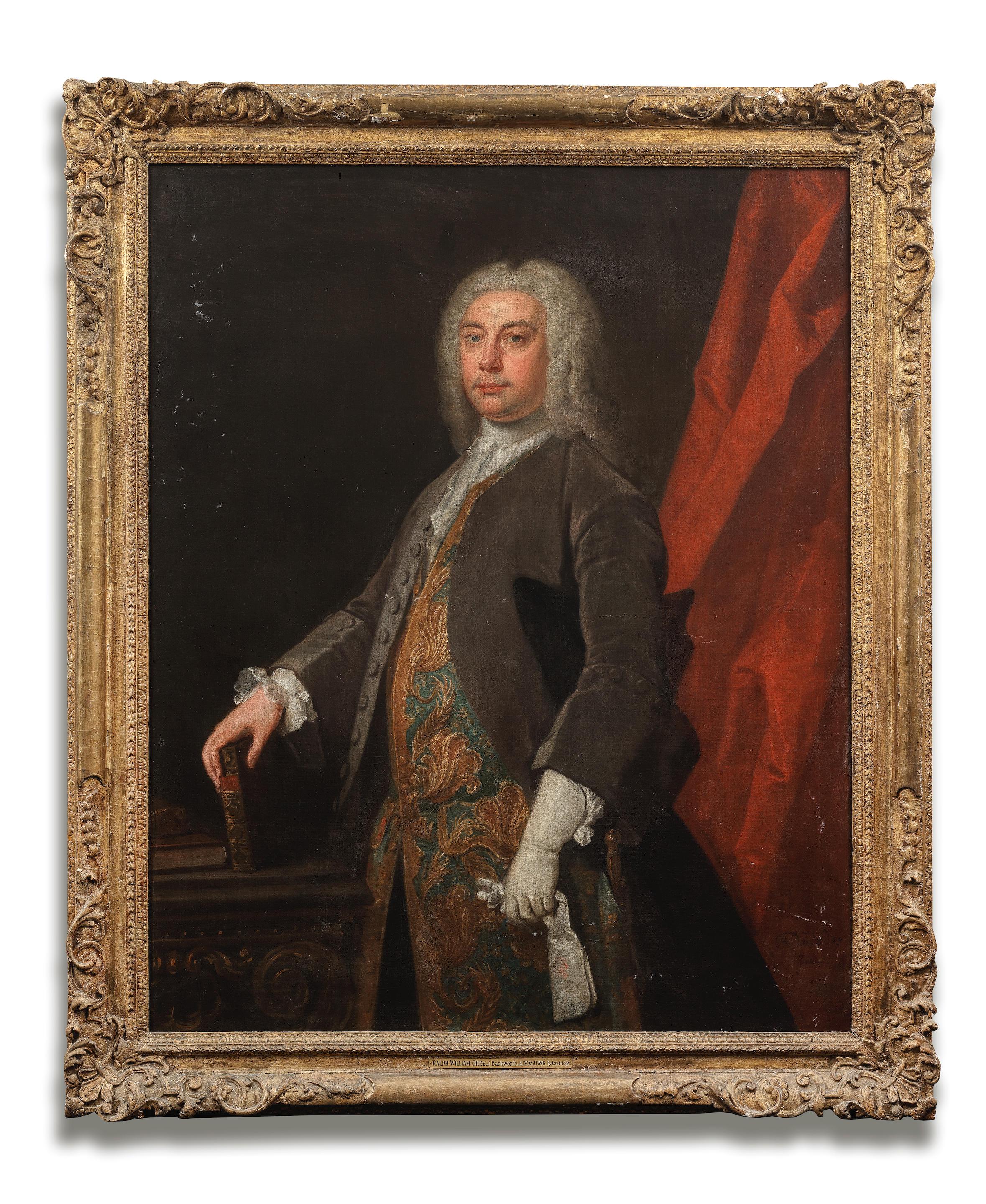
Ver todoRetrato de Ralph William Grey
Por Bartholomew Dandridge
Procedencia
Por descendencia a través de la familia de la niñera a
Colección de R. W. Vivian-Neal de Poundisford Park, Somerset, a quien fue adquirida por
Con Lane Fine Art, Reino Un...
Categoría
mediados del siglo XVIII, Escuela inglesa, Pinturas de retratos
Materiales
Óleo
Retrato de caballero, pintura al óleo del siglo XVIII
Por Anton von Maron
Óleo sobre lienzo
Tamaño de la imagen: 51 x 61 cm (20 x 24 pulgadas)
Marco dorado de época
Se trata de un retrato de medio cuerpo de un caballero vestido con un abrigo esmeralda y ...
Categoría
Década de 1760, Pinturas de retratos
Materiales
Lienzo, Óleo
Retrato del capitán George Meek
William Roth
Nacido en 1754
Retrato del capitán George Meek
Óleo sobre lienzo, firmado y fechado en 1782 abajo a la derecha
Tamaño de la imagen: 64 x 47 cm (25 x 18 ½ pulgadas)
Pro...
Categoría
finales del siglo XVIII, Pinturas de retratos
Materiales
Lienzo, Óleo
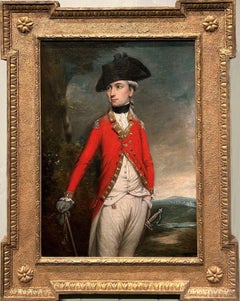
William, I Vizconde Bateman y familia
Óleo sobre lienzo
Tamaño de la imagen: 61 x 47 cm (24 x 18 1/2 pulgadas)
Madera dorada enmarcada
Procedencia
Patrimonio del juez Davis Norton y Florence Edelstein.
William Batema...
Categoría
principios del siglo XVIII, Pinturas figurativas
Materiales
Lienzo, Óleo
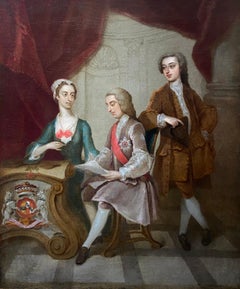
Retrato de William Henry Kerr, conde de Ancram, 4º marqués de Lothian
James Fellowes
Floreció entre 1719 y 1750
Retrato de William Henry Kerr, conde de Ancram, 4º marqués de Lothian
Óleo sobre lienzo, firmado y fechado en 1747
Tamaño de la imagen: 75 x...
Categoría
Década de 1740, Antiguos maestros, Pinturas de retratos
Materiales
Óleo
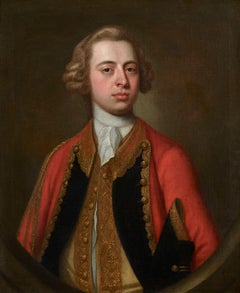
Retrato de un mensajero del rey, Artista inglés del siglo XVIII, Marco original
Por Charles Philips
Charles Philips
1703 - 1747
Retrato de un mensajero del rey
Óleo sobre lienzo
Tamaño de la imagen: 35 ¾ x 28 pulgadas
Marco dorado original
Mensajero del Rey
El trabajo de un Mensaj...
Categoría
siglo XVIII, Pinturas de retratos
Materiales
Lienzo, Óleo
También te puede gustar
Retrato de un caballero - pintura al óleo de arte británico Old Master c1750
Por Thomas Hudson
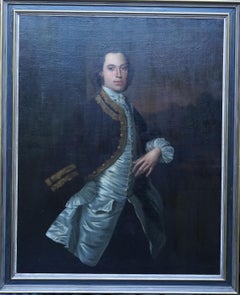
Este magnífico retrato al óleo del Viejo Maestro británico del siglo XVIII se atribuye a Thomas Hudson. Pintado hacia 1750, es un retrato de pie, de tres cuartos de longitud, de un c...
Categoría
Década de 1750, Antiguos maestros, Pinturas de retratos
Materiales
Óleo
5646 € Precio de venta
Descuento del 20 %
Retrato de un caballero, se cree que es Moisés Diego López Pereira
Escuela Austriaca, Siglo XVIII
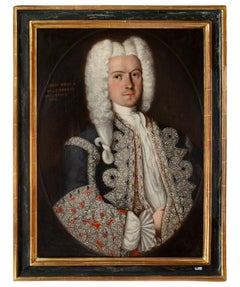
Retrato de un caballero, que se cree que es Moisés Diego López Pereira, I Barón de Aguilar, con un abrigo elaborado y una peluca empolvada.
Óleo sobre...
Categoría
siglo XVIII, Pinturas
Materiales
Lienzo, Óleo
gran retrato caballero del siglo xviii óleo sobre lienzo
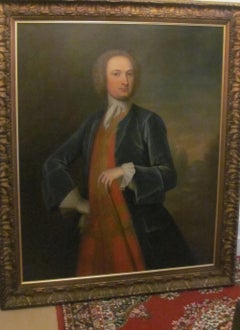
Una fina e imponente Retrato del siglo XVIII de un aristócrata desconocido, en marco dorado
El artista tampoco está identificado, pero se trata sin duda de una mano con talento, en ...
Categoría
siglo XVIII, Antiguos maestros, Pinturas de retratos
Materiales
Óleo
6469 € Precio de venta
Descuento del 44 %
Envío gratuito
Retrato de un caballero acomodado
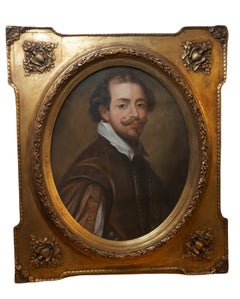
Retrato de caballero acomodado en pastel sobre pergamino.
Firmado a la izquierda: Marteau L. 1760.
Escuela francesa, posiblemente de Louis Marteau (1715 - 1804)
En un marco dorado de...
Categoría
siglo XVIII, Pinturas de retratos
Materiales
Pastel, Papel pergamino
Retrato de un caballero con peluca
Por Enoch Seeman
Enoch Seeman
Tamaño del lienzo: 76 x 62 cm (30 x 25")
Tamaño exterior del marco: 92 x 80 cm (37 x 32 pulg.)
1694-1744
An He nació en Danzig, actual Gdansk (Polonia), hacia 1694...
Categoría
principios del siglo XVIII, Antiguos maestros, Pinturas de retratos
Materiales
Óleo
Retrato de un caballero del Viejo Maestro - Pintura al óleo británica del siglo XVIII
Por Michael Dahl
Este impresionante retrato al óleo del Viejo Maestro del siglo XVIII se atribuye al artista Michael Dahl, nacido en Suecia y afincado en Inglaterra. Pintado hacia 1690 es un suntuoso...
Categoría
siglo XVII, Antiguos maestros, Pinturas de retratos
Materiales
Óleo
8940 € Precio de venta
Descuento del 20 %