Artículos similares a Bandera de la Unión Británica de principios del siglo XX, ca 1918-1952
¿Quieres más imágenes o vídeos?
Solicita imágenes o vídeos adicionales al vendedor
1 de 5
Bandera de la Unión Británica de principios del siglo XX, ca 1918-1952
4198,30 €
Acerca del artículo
BRITISH UNION FLAG OF THE EARLY 20TH CENTURY, WITH BRILLIANT AND UNUSUAL, COBALT BLUE COLORATION, AND A SIMPLIFIED, FOLK STYLE, WITH INCORRECT PROPORTIONS IN THE CROSSES OF ST. ANDREW
SAINT PATRICK, circa 1918-1952
BRITISH UNION FLAG OF THE EARLY 20TH CENTURY, WITH BRILLIANT AND UNUSUAL, COBALT BLUE COLORATION, AND A SIMPLIFIED, FOLK STYLE, WITH INCORRECT PROPORTIONS IN THE CROSSES OF ST. ANDREW
SAINT PATRICK, circa 1918-1952
Web ID: BRITj-833
Disponible: En stock
Tamaño del marco (A x L): Approx. 32" x 38"
Tamaño de la bandera (A x L): 20" x 26.75"
Descripción:
This beautiful example of a British Union flag, made sometime during the 1st or 2nd quarter of the 20th century, sports an attractive list of interesting features. Chief among these are its size, color, and lack of strict adherence to British heraldry. Note the brilliant, cobalt blue color, the striking and most unusual shade of which contrasts beautifully with the bright, scarlet red.
Also note how the profile is rather near-to-square in its appearance, being taller than usual for its length, as well as how the aspects of its crosses do not meet the required criteria, most notably the lack of properly offset positioning in the overlay of the Cross of St. Peter over that of St. Andrew. The crude format either results from its having been homemade, by someone not completely familiar with the requirements, or perhaps by someone unable to complete a flag that displayed them. Yet another reason might be from having been produced overseas.
Various reasons to have produced such a flag do not include use as a port-of-call / courtesy flag (flown out of respect by a foreign ship when entering a British port, in this case), as only the Royal Navy may fly the Union Flag at sea.
Sanctioned for use on important holidays, a far more likely reason for manufacture of a Union Flag, like this one, include display in parades that accompanied the end of WWI or WWII (1918 and 1945, respectfully), in France, Britain, the U.S., or elsewhere. Possible display in France or Belgium, to welcome U.S. troops during WWII, following liberation from the Germans, is a closely related function of significant possibility.
Coronations were the most obvious event that inspired patriotism and warranted Union flag display within Britain. Two occurred in 1936, with that of King Edward VIII in January of that year, who abdicated to marry an American, and so was followed by King George VI (Prince Albert) in December. Another occurred in 1952, when George VI died and Queen Elizabeth II, his daughter, took the throne.
At just 20” x 26.75”, the extremely small scale of this flag would be appropriate for any of the above functions.
Construction: The body of the flag is made entirely of wool bunting, of an especially heavy and durable nature, that has been joined with machine stitching. There is a plain weave cotton binding along the hoist, in the form of an open sleeve, through which either a staff or a rope could be passed. This was applied in the same manner.
Basic Facts Surrounding Use of The British Union Flag / Union Jack: The combination of the cross of St. George, to reflect England, and that of St. Andrew, to signify Scotland, and of St. Peter, to include Ireland (as of January 1st, 1801), create what is properly known as the British “Union Flag,”
The term “Union Jack” comes from the fact that this device, by itself, was not flown on British ships as its primary colors. Instead, it was flown as a “jack,” which is a smaller flag, meant to be flown off the bow, when a ship was at port or anchor.
The British Royal Navy flew the British Union Flag as a jack. The device also served as the canton/union of all British flags flown at sea, in the same way that the blue field with stars constituted the canton/union of the Stars
Stripes on the American national flag, flown by American ships. U.S. Navy ships also flew jacks when at port or anchor. For the majority of U.S. history, this has been a blue flag with white stars. In both Britain and the United States, the signal is officially called the “Union Jack”—a fact that makes the name pretty confusing. In each case, the size is to be that of the canton of the national ensign flown on the respective ship.
In Britain, there were several variations of the national flag, instead of just one, called red, blue, and white ensigns. Each consisted of either a red, white, or blue field, with the British “Union Flag” in the upper corner of the hoist end.
It is of interest to note that no law has ever been passed to make the Union flag / “Union Jack” the national flag of the United Kingdom. Instead, it has become so through precedent. Its first recorded recognition as a national flag came in 1908, when it was stated in Parliament that "the Union Jack should be regarded as the National flag". A more categorical statement was made by the Home Secretary, Sir John Gilmour, in 1933 when he stated that "the Union Jack is the National Flag". It is still officially a flag of the monarch, however, rather than of the nation.
Civilian use of the Union flag is permitted on land, but non-naval/military use at sea is prohibited. On land, the Union Jack can be flown by any individual or organization on any day they wish. Until very recently, however, government use was strictly regulated. Prior to 2007, it could only be flown on government buildings on certain specified days, such as those marking the birthdays of members of the Royal Family, the wedding anniversary of the Monarch, Commonwealth Day, Accession Day, Coronation Day, The Queen's official birthday, Remembrance Sunday and on the days of the State Opening and prorogation of Parliament.
At sea, different rules apply. Prior to 1864, the Red Ensign, White Ensign, and Blue Ensign were all flown by ships of the Royal Navy (RN). In that year, all RN ships were ordered to fly the White Ensign and it became the sole naval flag of the United Kingdom. Until the mid- to late 1960's, the White Ensign was also flown by Canadian, Australian and New Zealand warships. The Blue Ensign was reserved for merchant vessels whose masters are qualified Royal Naval Reserve [RNR] officers and which meet certain other requirements, while the Red Ensign became the British civil ensign.
At sea, the Union Jack is reserved for the RN and no other British ships are permitted to fly it.
Mounting: The flag will be mounted and framed within our own conservation department, which is led by expert staff. Cuidamos mucho el montaje y la presentación de las banderas y hemos conservado miles de ejemplares.
El fondo es de sarga de algodón 100%, de color negro, que se ha lavado y tratado para que no pierda el color. La moldura pintada de negro, dorada a mano y envejecida es italiana. El acristalamiento es acrílico de protección U.V. (plexiglás). No dudes en ponerte en contacto con nosotros para obtener más detalles.
Condition: Excellent, with but extremely minor soiling along the hoist binding.
- Dimensiones:Altura: 81,28 cm (32 in)Anchura: 96,52 cm (38 in)Profundidad: 6,35 cm (2,5 in)
- Materiales y técnicas:
- Lugar de origen:
- Época:
- Fecha de fabricación:1918-1952
- Estado:Ver descripción del artículo.
- Ubicación del vendedor:York County, PA
- Número de referencia:Vendedor: BRITJ-8331stDibs: LU849747654602
Sobre el vendedor
5,0
Vendedor reconocido
Estos prestigiosos vendedores son líderes del sector y representan el escalón más alto en cuanto a calidad y diseño de artículos.
Establecido en 1991
Vendedor de 1stDibs desde 2008
71 ventas en 1stDibs
Tiempo de respuesta usual: Varios días
- EnvíoRecuperando presupuesto…Envío desde: York County, PA
- Política de devolución
Partes de esta página se han traducido automáticamente. 1stDibs no puede garantizar la exactitud de las traducciones. El inglés es el idioma predeterminado de este sitio web.
Más de este vendedor
Ver todoBandera Americana Antigua de Fabricación Casera con Excepcionales Cualidades Folclóricas, 1896-1908
CASERA, ANTIGUA BANDERA AMERICANA CON UN DIMINUTO CANTÓN APOYADO EN LA 6ª FRANJA Y UNA PRESENTACIÓN EXTREMADAMENTE FOLCLÓRICA DE 45 ESTRELLAS EN UN PATRÓN "DENTADO" QUE PODRÍA SER EX...
Categoría
Antiguo, Década de 1890, Estadounidense, Recuerdos políticos y patrióticos
Materiales
Algodón
Bandera Americana Antigua de 38 Estrellas, Estado de Colorado, circa 1876-1889
Bandera de desfile americana antigua de 38 estrellas con orientación de estrellas dispersas, hecha de seda, con escala generosa y colores vivos, estadidad de Colorado, 1876-1889
B...
Categoría
Antiguo, Fines del siglo XIX, Estadounidense, Recuerdos políticos y patr...
Materiales
Seda
Bandera de desfile americana antigua de 45 estrellas, independencia del estado de Utah, ca 1896-1908
BANDERA DE DESFILE AMERICANA ANTIGUA DE 45 ESTRELLAS CON SUS ESTRELLAS DISPUESTAS EN FORMA DE MUESCA, 1896-1908, ESTADIDAD DE UTAH:
Bandera nacional estadounidense de 45 estrellas, ...
Categoría
Antiguo, Década de 1890, Estadounidense, Recuerdos políticos y patrióticos
Materiales
Algodón
13 Star Antique American Parade Flag, ca 1876-1899
13 STAR ANTIQUE AMERICAN PARADE FLAG, WITH A 3-2-3-2-3 CONFIGURATION OF STARS, AN EXTREMELY SCARCE AND UNUSUALLY LARGE VARIETY, MADE circa 1876-1899
13 star American national parade...
Categoría
Antiguo, Fines del siglo XIX, Canadiense, Recuerdos políticos y patrióticos
Materiales
Algodón
Precio a petición
44 Estrellas Bandera Americana Antigua, Estado de Wyoming, ca 1890-1896
BANDERA AMERICANA ANTIGUA DE 44 ESTRELLAS CON UNA DISPOSICIÓN DE RELOJ DE ARENA SOBRE UN CANTÓN AZUL POLVORIENTO; REFLEJA LA ÉPOCA EN QUE WYOMING ERA EL ESTADO MÁS RECIENTE EN UNIRSE...
Categoría
Antiguo, Década de 1890, Estadounidense, Recuerdos políticos y patrióticos
Materiales
Lana
Bandera de Desfile Americana Antigua de 38 Estrellas, Estado de Colorado, ca 1876-1889
38 ESTRELLAS EN UNA CONFIGURACIÓN EXTREMADAMENTE INUSUAL QUE LLEVA UN GRUPO DE 6 ESTRELLAS PEQUEÑAS DENTRO DE UN PATRÓN LINEAL DE ESTRELLAS MÁS GRANDES, 1876-1889, INDEPENDENCIA DEL ...
Categoría
Antiguo, Fines del siglo XIX, Estadounidense, Recuerdos políticos y patr...
Materiales
Algodón
También te puede gustar
Gran bandera británica Union Jack de los años 50 enmarcada y cosida a mano
Bandera Union Jack de 1950 enmarcada, Londres Inglaterra
Esta bandera británica vintage se compró en Londres hace muchos años. Esta Union Jack roja, blanca y azul de los años 50 se ...
Categoría
mediados del siglo XX, Inglés, Moderno de mediados de siglo, Arte decora...
Materiales
Algodón, Plexiglás, Madera
Vintage Siglo XX Bandera de la Unión enmarcada de cristal a cristal c.1940
Un excelente ejemplo del siglo XX de la Bandera de la Unión, a menudo denominada "Jota" de la Unión, aunque técnicamente el término "Jota" sólo se aplica cuando ondea en el mar. Esta...
Categoría
siglo XX, Británico, Otro, Tapices
Materiales
Tela, Vidrio
Antiguo Siglo XX Bandera Real Victoriana Enmarcada c.1900
Excelente estandarte real victoriano del siglo XX presentado en un marco de madera recuperada. Esta bandera, reservada al monarca británico, presenta los tres leones de Inglaterra y ...
Categoría
siglo XX, Británico, Otro, Tapices
Materiales
Tela, Vidrio
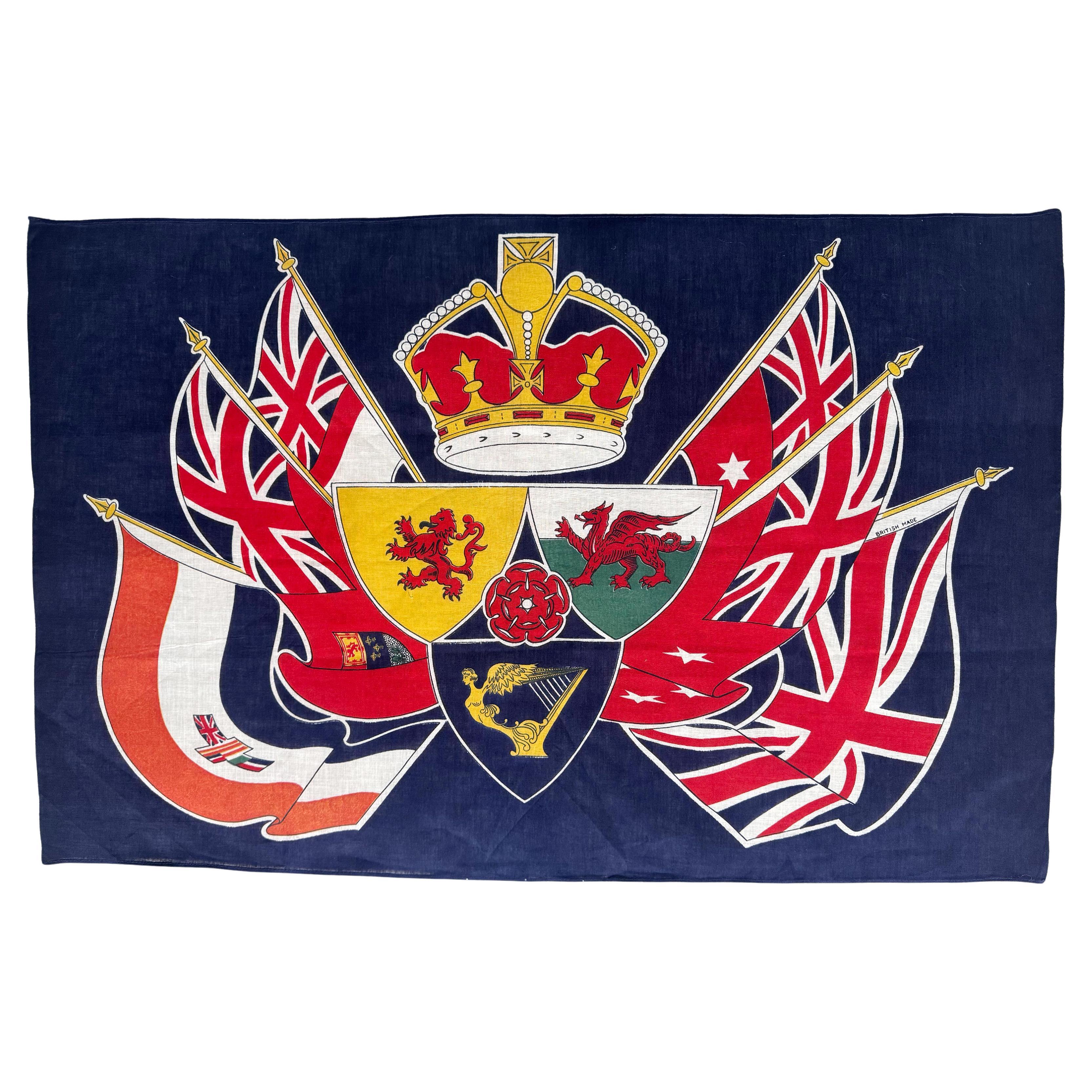
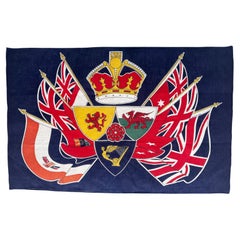
Bandera de la Coronación del Imperio Británico Vintage
Bandera Patriótica de los Dominios Británicos de la Coronación
Familia Real Británica
La bandera representa el Imperio Británico y la unidad entre el Reino Unido y sus dominios dura...
Categoría
mediados del siglo XX, Británico, Recuerdos políticos y patrióticos
Materiales
Algodón
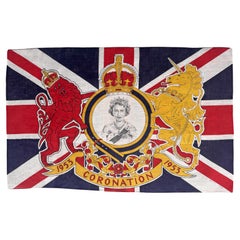
Bandera de la Coronación de la Reina Isabel II 1953
Familia Real Británica
Rara e histórica bandera de la Coronación Real de S.A.R. la Reina Isabel II, 2 de junio de 1953.
Debido a su tamaño, esta bandera se habría utilizado colgada...
Categoría
mediados del siglo XX, Británico, Moderno de mediados de siglo, Recuerdo...
Materiales
Algodón
Bandera de la Coronación de la Reina Isabel II 1953
Familia Real Británica
Rara e histórica bandera de la Coronación Real de S.A.R. la Reina Isabel II, 2 de junio de 1953.
Debido a su tamaño, esta bandera se habría diseñado para col...
Categoría
mediados del siglo XX, Británico, Moderno de mediados de siglo, Recuerdo...
Materiales
Algodón