Ir al contenido principal
¿Quieres más imágenes o vídeos?
Solicita imágenes o vídeos adicionales al vendedor
1 de 13

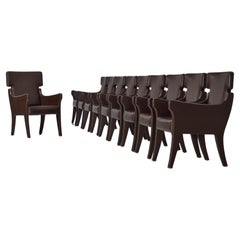
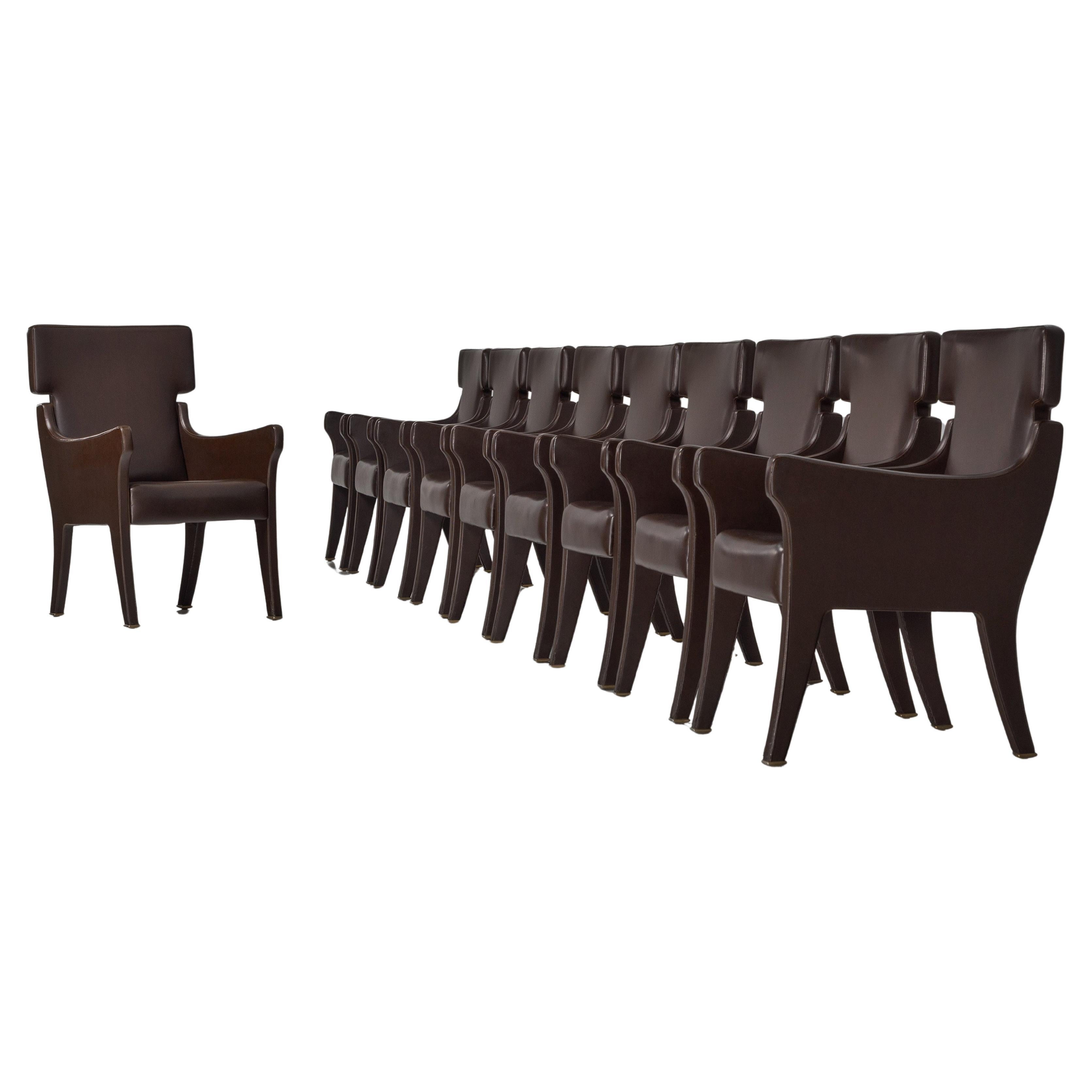
Rare Ignazio Gardella for Azucena Early Set of Ten ‘R63’ Armchairs

34.838,14 €por juego|IVA incluido

Acerca del artículo

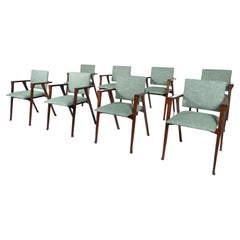
Ignazio Gardella for Azucena, set of ten armchairs, model P10 / R63, faux leather, nickel-plated brass, Italy, design 1963 A rare set of armchairs by Milanese architect Ignazio Gardella and produced under Azucena, the R63 design holds a special place in postwar Italian furniture history. The design was originally conceived for the dining room of the Cavalieri-Hilton hotel (1961-1963). The fact that this particular set includes ten matching pieces makes it especially noteworthy. At first glance, the chair feels both classical and experimental. The most immediately arresting feature is the backrest: broad and vertical, it culminates in a winged headrest that evokes the silhouette of a bergère chair, though here stripped of ornament and reduced to a bold, abstract gesture. The armrests follow this same ethos of simplification. Their soft, outward flare echoes the wings of the headrest and connects the upper structure to the more grounded presence of the legs. The burgundy red upholstery, which extends uniformly over the seat, arms, back, and even the legs, creates a sense of unity that blurs the distinctions between structural elements. The covering doesn’t simply wrap the structure but cuts and bends in precise ways, like tailored clothing, lending the whole object a sartorial sharpness. The detailing at the seams is minimal, almost invisible, yet clearly the result of a refined design and fabrication process. The legs are particularly intriguing. Though quite slender and tapered, they retain a sense of sturdiness. Their slight outward splay introduces a dynamic touch that complements the overall round-contoured character of the chair. Square nickel-plated feet support the legs in a dignified and discreet manner. Biography Ignazio Gardella, a pivotal figure in 20th-century Italian architecture, was born on March 30, 1905, in Milan. He came from a Genoese lineage of engineers and architects, with his father, Arnaldo Gardella, playing a significant role in shaping his early exposure to the discipline. After completing his studies at Liceo Classico Berchet, he pursued civil engineering at the Polytechnic University of Milan. Even before obtaining his degree in 1928, he had already begun working in his father’s studio alongside Luigi Martini. However, after his father’s passing that same year, Gardella decided to chart his own path, distancing himself from the early 20th-century stylistic influences that characterized Martini’s work.      During his university years, Gardella formed connections with some of Italy’s most promising young architects, including Franco Albini, Giovanni Romano, Lodovico Belgiojoso, Gian Luigi Banfi, Enrico Peressutti, and Ernesto Nathan Rogers. These friendships fueled his engagement with contemporary architectural discourse. In 1930, he embarked on a formative journey through Germany, visiting Düsseldorf, Munich, Nuremberg, and Frankfurt – experiences that deepened his understanding of modernist design principles.      By the mid-1930s, Gardella had become an active participant in Milan’s rationalist movement, contributing to discussions spearheaded by the influential magazine “Casabella”, under the leadership of Giuseppe Pagano and Edoardo Persico. His involvement extended to major architectural events, such as the 6th Milan Triennale (1936) and urban planning initiatives like Milano Verde (1938) and the Piano A.R. (1943–1945). A 1939 trip to Scandinavia, where he met Alvar Aalto, Gunnar Asplund, and Sven Markelius, with whom he maintained a lasting friendship.       Gardella’s work from the 1930s demonstrated a commitment to rationalist principles, exemplified in the Tuberculosis Dispensary and Prophylaxis Laboratory in Alessandria (1933–1939). During the postwar reconstruction era, he emerged as a leading intellectual and designer, co-founding the Movement for the Study of Architecture (MSA) in 1947. His teaching career at IUAV, spanning from 1949 to 1975, influenced generations of architects, and his involvement with CIAM (International Congresses of Modern Architecture) placed him at the center of global architectural discourse.      The 1950s and 1960s marked the peak of Gardella’s architectural production characterized by rationalist rigor. This includes the Pavilion of Contemporary Art (PAC) in Milan (1947–1954), the House in Zattere in Venice (1953–1959), and the Olivetti Canteen and Auditorium in Ivrea (1953–1959). His work extended into urban planning, notably in the Metanopoli district, and later into significant public projects, including the Lambrate Railway Station in Milan (1983–2001) and the Faculty of Architecture in Genoa (1975–1989).      As his reputation grew, Gardella became one of the most widely published Italian architects of his time. Gardella’s contributions were widely recognized: he received the Olivetti Award for Architecture (1955), the Golden Lion for Lifetime Achievement at the Venice Architecture Biennale (1996), and the Gold Medal of the President of the Republic for Merit in Science and Culture. His influence extended beyond Italy, with a visiting professorship at Harvard University in 1986, where his monographic exhibition and essay, “The Last Fifty Years of Italian Architecture. Reflected in the eye of an architect”, cemented his intellectual legacy.      In his later years, Gardella remained active in architectural restoration. His work was honored in major exhibitions across Europe, and in 1995, his House in Zattere became the first modern building in Italy to receive official artistic protection – marking the first time that a modern building constructed less than fifty years prior received such recognition. Gardella worked until his final days, passing away on March 15, 1999, in his family home in Oleggio. His legacy continues to inspire architects worldwide.  Initially conceived for the dining room of the Cavalieri-Hilton hotel in Rome, the R63 armchair by Milanese architect Ignazio Gardella owes its strong personality to the decisive shape of the backrest — with a winged headrest recalling a bergère — and the sartorial cut of the cover that extends uniformly over the legs, creating a continuous, refined effect.  Initially conceived for the dining room of the Cavalieri-Hilton hotel in Rome, R63 is strongly characterized by the profile of the backrest, which almost seems to be a simplification of the shapes of a bergère. Another interesting detail is the upholstery that completely covers the legs, combining these slender supports and the seat and backrest into one, for a continuous effect with a sartorial cut. Please note that we advise reupholstery before use. This item contains threadbare upholstery with loose seams and small stains. Reupholstery can be done before shipping by our experienced craftspeople in our own in-house restoration atelier. With high attention for the original, they make sure every piece contains its value and is ready for the many years to come. We kindly ask you to contact our design experts for further information about the endless possibilities our restoration and upholstery atelier has to offer. Of course, a locally organized reupholstery is possible as well.
  • Creador:
    Azucena (Fabricante),Ignazio Gardella (Diseñador)
  • Dimensiones:
    Altura: 90 cm (35,44 in)Anchura: 61 cm (24,02 in)Profundidad: 65 cm (25,6 in)Altura del asiento: 44 cm (17,33 in)
  • Se vende como:
    Juego de 10
  • Estilo:
  • Materiales y técnicas:
  • Lugar de origen:
  • Época:
  • Fecha de fabricación:
    1960s
  • Estado:
    Desgaste acorde con la edad y el uso. Every item Morentz offers is checked by our team of 30 craftspeople in our in-house workshop. Special restoration or reupholstery requests can be done. Check ‘About the item’ or ask our design specialists for detailed information on the condition.
  • Ubicación del vendedor:
    Waalwijk, NL
  • Número de referencia:
    Vendedor: 501169901stDibs: LU933145344512
Más de este vendedor

Ver todo
Augusto Savini para Pozzi Juego de cuatro sillas Pamplona
Por Pozzi, Augusto Savini
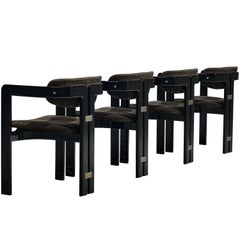
Augusto Savini para Pozzi, Sillas de comedor 'Pamplona', madera lacada, tela, aluminio, Italia, 1965 Sillones "Pamplona" de madera lacada en negro y tapicería marrón. Un diseño cara...
Categoría

Vintage, Década de 1960, Italiano, Moderno de mediados de siglo, Sillones

Materiales

Tela, Madera

Giovanni Battista Bassi para Poltronova Conjunto de seis sillones "Elisa
Por Giovanni Bassi, Poltronova
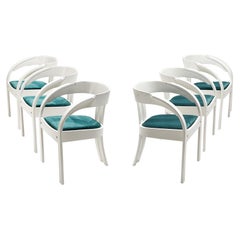
Giovanni Battista Bassi para Poltronova, juego de seis sillones, modelo "Elisa", terciopelo, haya lacada, Italia, años 60 Estas maravillosas sillas se basan en una construcción sól...
Categoría

Vintage, Década de 1960, Italiano, Moderno de mediados de siglo, Sillas ...

Materiales

Terciopelo

Conjunto italiano de seis sillas de comedor de mediados de siglo en fresno y cuero
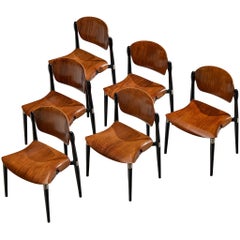
Juego de seis sillas, fresno, cuero, Italia, años 60 Este elegante conjunto de seis sillas se fabricó en Italia en la década de 1960, combinando la cálida madera de fresno con el ri...
Categoría

Vintage, Década de 1960, Italiano, Moderno de mediados de siglo, Sillas

Materiales

Cuero, Ceniza

Pierre Gautier-Delaye Conjunto de doce sillas de comedor
Pierre Gautier-Delaye, juego de doce sillas de comedor, haya, Francia, años 1960 Este conjunto de doce sillas de comedor rústicas y modestas está fabricado en madera de haya teñida....
Categoría

Vintage, Década de 1960, Francés, Moderno de mediados de siglo, Sillas d...

Materiales

Haya

Guido Faleschini para I4 Mariani Conjunto de diez sillas de comedor "Dilos
Por Guido Faleschini, i4 Mariani
Guido Faleschini para i4 Mariani Juego de diez sillas de comedor "Dilos", cuero, haya, Italia, hacia 1975 Estas sillas "Dilos" han sido diseñadas por el creativo diseñador italiano ...
Categoría

Vintage, Década de 1970, Francés, Posmoderno, Sillas de comedor

Materiales

Cuero, Haya

Conjunto italiano de diez sillones geométricos de madera teñida
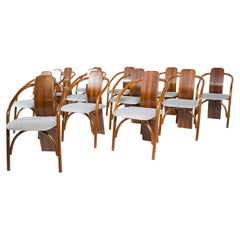
Conjunto de diez sillones, haya teñida, polipiel, Italia, años 70. Sencillo pero elegante conjunto italiano de diez sillas de comedor. En su ejecución destacan las líneas geométrica...
Categoría

Vintage, Década de 1970, Italiano, Moderno de mediados de siglo, Sillones

Materiales

cuero de imitación, Haya

También te puede gustar

Ignazio Gardella P10 sillones Azucena Italia 1963
Por Azucena, Ignazio Gardella
Estos 10 raros sillones modelo P10 totalmente tapizados son un diseño elegante y decorativo de Ignazio Gardella, uno de los maestros del diseño italiano del siglo XX. Tapizados en po...
Categoría

Vintage, Década de 1960, Italiano, Moderno de mediados de siglo, Sillones

Materiales

Latón

Antonio Citterio Sillones Flexform Italia 1970
Por Flexform, Antonio Citterio
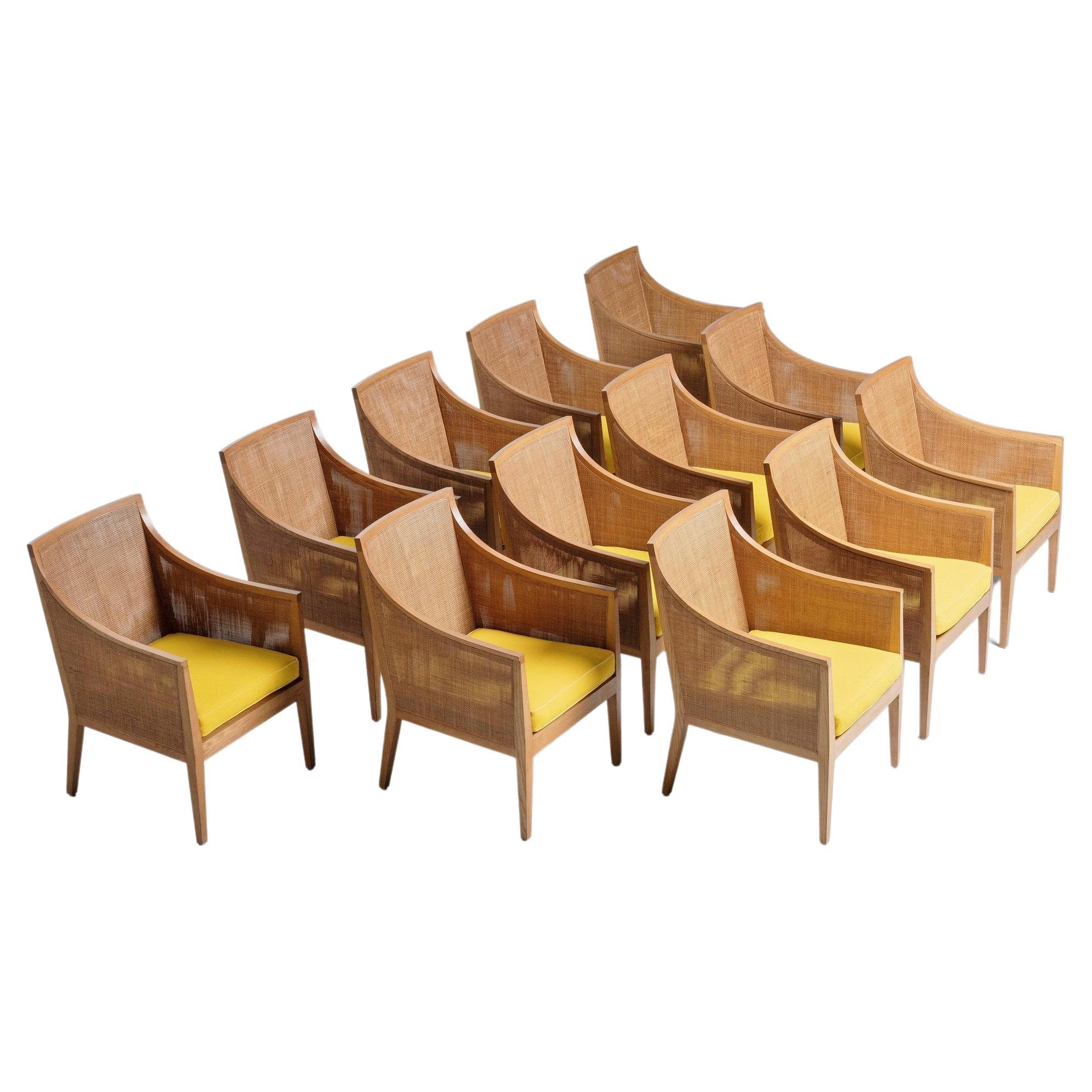
Bonito par de sillones de Antonio Citterio y fabricados en Italia por Flexform en 1970. El armazón es de madera de haya y está revestido de ratán por dentro y por fuera. El modelo...
Categoría

Vintage, Década de 1970, Italiano, Moderno de mediados de siglo, Sillones

Materiales

Tela, Ratán, Haya

Conjunto de seis sillones "Korium" de Tito Agnoli para Matteo Grassi
Por Tito Agnoli, Matteo Grassi
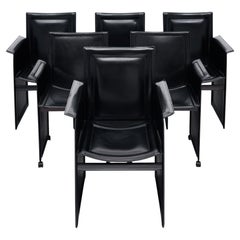
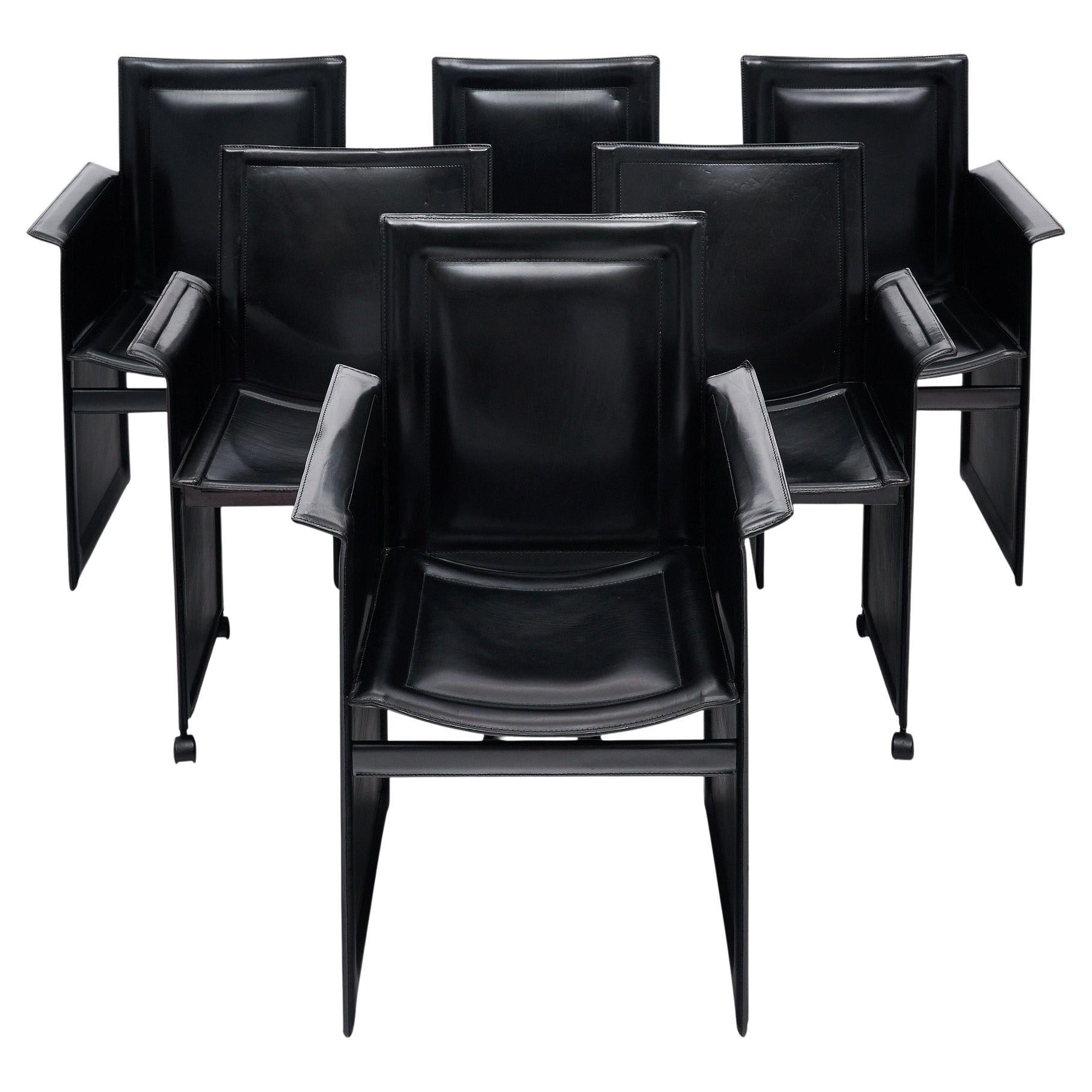
Conjunto de seis sillones de Tito Agnoli diseñados para Matteo Grassi en 1979. Estas sillas italianas presentan una estructura metálica y piel cosida de alta calidad en tono negro. S...
Categoría

Vintage, Década de 1970, Italiano, Moderno de mediados de siglo, Sillas ...

Materiales

Metal

Sillas modernas de mediados de siglo Modelo "830" de Mario Marenco y Antonella Scarpitta
Por Mario Marenco, Antonella Scarpitta
Sillas modernas de mediados de siglo Modelo "830" de Mario Marenco y Antonella Scarpitta para Mobil Girgi, años 80 - 13 disponibles
Categoría

Vintage, Década de 1980, Italiano, Moderno de mediados de siglo, Sillas ...

Materiales

Madera

Juego de 6 sillas Franco Albini "Luisa", producción Carlo Poggi, años 50
Por Franco Albini, Succ. Carlo Poggi
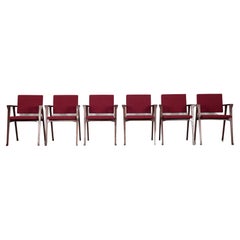
Conjunto de 6 sillones italianos de madera y tela Modelo "Luisa" diseñados por el diseñador italiano Franco Albini y producidos por Poggi Pavia 1955. Bibliografía: Italien 1950er Ja...
Categoría

mediados del siglo XX, Italiano, Moderno de mediados de siglo, Sillas de...

Materiales

Tela, Madera

Vico Magistretti Sillas de comedor "Carimate" para Cassina, 1960, Lote de 10
Por Vico Magistretti, Cassina
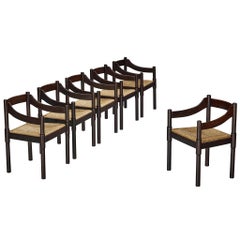
Sillas de comedor "Carimate" de Vico Magistretti para Cassina, madera lacada en rojo y asiento de paja, Italia, 1960, lote de diez. La silla "Carimate" es una de las más famosas d...
Categoría

Vintage, Década de 1960, Italiano, Moderno de mediados de siglo, Sillas

Materiales

Paja, Madera