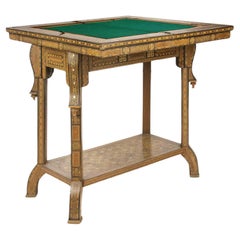
Artículos similares a Italian Game Table with 18th C. Trompe-l
œil Scagliola TableTop and 19th C. Base
Cargando vídeo
¿Quieres más imágenes o vídeos?
Solicita imágenes o vídeos adicionales al vendedor
1 de 16
Italian Game Table with 18th C. Trompe-l
œil Scagliola TableTop and 19th C. Base
12.500 €IVA incluido
Acerca del artículo
Scagliola games table with trompe-l'œil decoration
Italy
Scagliola, Cherry
Table Top Early 18th Century, Table Base Mid 19th Century
Dimensions: H x W x D: 79 x 113 x 67 cm
Description:
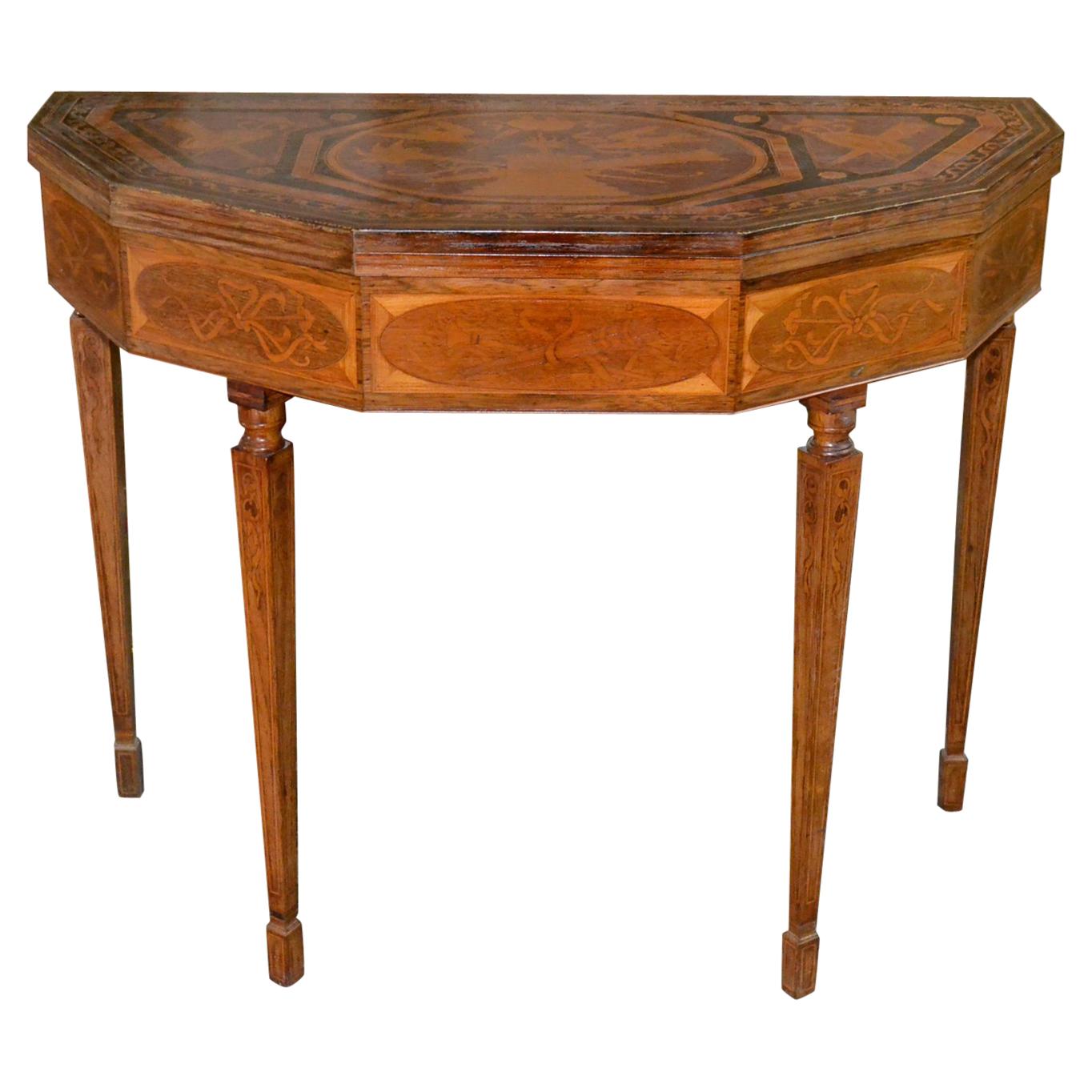
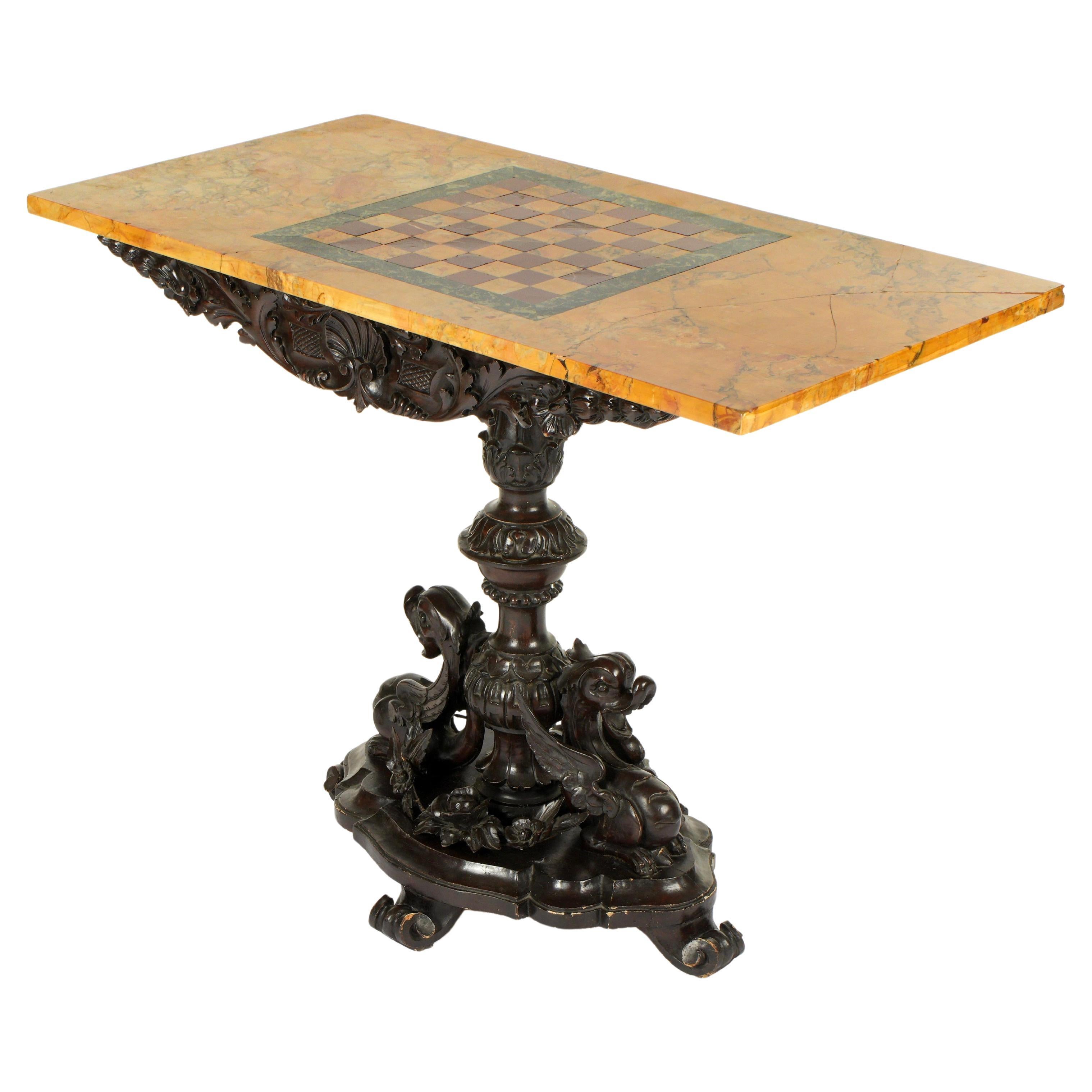
The table frame is made of solid cherry wood. The curved, sawn-out frames are mortised into the studs of the curved legs. This stable substructure supports the top of inlaid stucco marble, known as scagliola, which is framed by a cherry frame.
The panel is decorated with numerous inlaid playing cards. It appears to be a 32-card sheet of French origin with the inscription G.DE PARIS and the names of jacks, queens and kings with great names from historical, mythological and biblical contexts. For example, we see ALEXANDRE - Alexander the Great, King of Macedonia, CÉSAR - Gaius Julius Caesar, Roman general, PALLAS - Pallas Athena, Greek goddess of wisdom, DAVID - King David from the Bible and HECTOR - The Trojan prince and hero from Homer's "Iliad" - to name but a few.
The cards lie in the middle of the pack, partly sorted by rank, partly still upside down in the pile. The 8 of spades lies torn into two halves in the centre of the action.
The black background appears to be made of granite. Like the entire plate, including the playing cards and the frame made of different coloured pieces of marble, this is the Scagliola technique, which is rarely used today.
In this process, which was already in use in antiquity, the marble, which was very precious at the time, was imitated using a mixture of plaster, bone glue, water and colour pigments. Natural stones such as marble and granite could be perfectly imitated by colouring the plaster and twisting and kneading the mass together.
The structures are therefore not just painted on the surface, as with stucco lustro, but can be found in the entire mass, which has the advantage that the slab could be ground and polished. The individual pieces could be easily cut and joined together so that the observer can hardly distinguish a well-made scagliola panel from a pietra dura panel (real stone inlays).
And the stone surfaces of the present work are also deceptively real imitations; take a look at the black background, for example, which gives the impression of real granite stone with its many tiny light-coloured inclusions.
The scagliola technique had its heyday in the Italian Baroque period, when entire interiors were designed in this way. The advantages were obvious. The material could be produced on site and did not have long delivery routes, any colour and texture could be created, even those that did not occur in nature, and the relatively light material could be produced in any size, which made it suitable for wall panelling, high columns and ceiling cladding. It was also significantly cheaper than the painstakingly quarried and elaborately cut marble.
Today, only a few people are still familiar with the production of scagliola, the so-called stucco marble. Due to the abandonment of such elaborate interior design in classicism and better and cheaper marble quarrying techniques from the age of industrialisation onwards, the scagliola technique fell out of fashion and this table is a rare example of this fascinating craft.
Condition:
Wonderful condition with an authentic patina of age. The table top is no longer high-gloss, as it certainly was originally, but has become matt over the years. All traces of age and use in the wood have been deliberately preserved and conserved. The surface has been gently cleaned and refreshed with shellac.
You can find out more about the Scagliola technique in the following specialist literature:
Hojer / Ottomeyer - Residenz München II - Die deutschen Möbel des 16.-18. Jahrhunderts from. S. 57
- Dimensiones:Altura: 79 cm (31,11 in)Anchura: 113 cm (44,49 in)Profundidad: 67 cm (26,38 in)
- Materiales y técnicas:
- Lugar de origen:
- Época:
- Fecha de fabricación:1800
- Estado:Desgaste acorde con la edad y el uso. Wonderful condition with an authentic patina of age. The table top is no longer high-gloss, as it certainly was originally, but has become matt over the years. All traces of age and use in the wood have been deliberately preserved and conserved.
- Ubicación del vendedor:Greven, DE
- Número de referencia:1stDibs: LU5419248387602
Sobre el vendedor
5,0
Vendedor Platino
Vendedores premium con una calificación de +4,7 y tiempos de respuesta de 24 horas
Establecido en 2014
Vendedor de 1stDibs desde 2020
219 ventas en 1stDibs
Tiempo de respuesta usual: 1 hora
- EnvíoRecuperando presupuesto…Envío desde: Münster, Alemania
- Política de devolución
Partes de esta página se han traducido automáticamente. 1stDibs no puede garantizar la exactitud de las traducciones. El inglés es el idioma predeterminado de este sitio web.
Más de este vendedor
Ver todoMesa consola de ajedrez, estilo Luis XVI, mesa de juego, Francia, S. XIX
Antigua mesa de ajedrez y cartas de estilo Luis XVI del siglo XIX.
Cuando está cerrada, vemos una consola apoyada en largas patas puntiagudas y en sabots de latón.
La parte superior...
Categoría
Antiguo, siglo XIX, Francés, Luis XVI, Mesas de juego y mesas de té
Materiales
Caoba
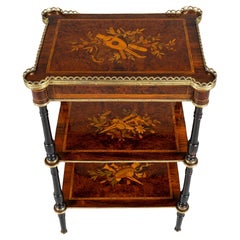
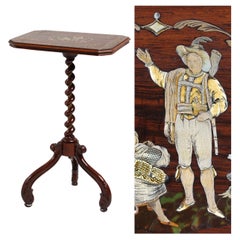
Etapa Napoleón III francesa del siglo XIX, mesa auxiliar, marquetería, París circa 1870
Etapa antigua con marquetería fina
París
Madera, latón
hacia 1870
Dimensiones: Alto × Ancho × Fondo: 77 × 50 × 37 cm
Descripción:
Mueble auxiliar de tres niveles con cuerpo de una...
Categoría
Antiguo, Década de 1870, Francés, Napoleón III, Mesas auxiliares
Materiales
Latón
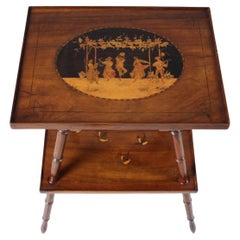
Art Nouveau Etagere, Mesa auxiliar, Madera de frutal con bonitas incrustaciones, Francia, Alrededor de 1910
Escritorio antiguo
Francia (?)
Madera de frutal
Art Nouveau hacia 1910
Dimensiones: Alto x Ancho x Fondo: 69 x 42 x 31 cm
Descripción:
Mesa auxiliar delicada con dos esta...
Categoría
principios del siglo XX, Francés, Art Nouveau, Mesas auxiliares
Materiales
Madera frutal
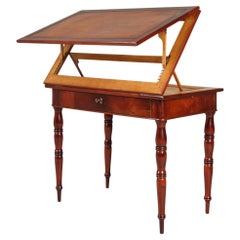
Mesa de arquitecto de mediados del siglo XIX, caoba, Francia, hacia 1850
Mesa de arquitecto de altura regulable
Francia
Caoba
Mediados del siglo XIX
Dimensiones: Alto x Ancho x Fondo: 79 x 93 x 56 cm, ajuste de altura: 79 - 120 cm
Descripción:
Rara mes...
Categoría
Antiguo, Mediados del siglo XIX, Francés, Luis Felipe, Escritorios
Materiales
Caoba
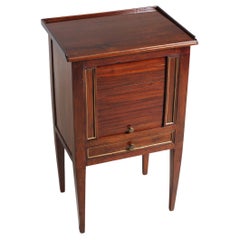
Mesa auxiliar del siglo XIX, Francia, c. 1890
Kleines Beistellmöbel mit Rolloverschluss und Schublade. Beistelltisch aus massivem Nussbaum mit dezenten Kontrasten aus Messing.
Empirestil, entstanden um 1890.
Tamaño A x B x T: ...
Categoría
Antiguo, Década de 1890, Francés, Renacimiento del imperio, Mesas auxili...
Materiales
Nogal
Mesa auxiliar de mediados del siglo XIX con fantástica marquetería
Mesa auxiliar con marquetería fina
Francia - Mediados del siglo XIX
Dimensiones: Alto x Ancho x Fondo: 77 x 47 x 37 cm
Descripción:
Excepcional mesa auxiliar de la época en torno ...
Categoría
Antiguo, Mediados del siglo XIX, Francés, Carlos X, Mesas auxiliares
Materiales
Metal
También te puede gustar
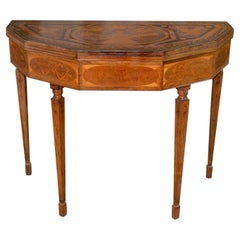
Mesa de juego italiana del siglo XIX con marquetería
Maravillosa mesa de juego italiana neoclásica de caoba con incrustaciones del siglo XIX.
Categoría
Antiguo, siglo XIX, Italiano, Neoclásico, Mesas de juego
Materiales
Caoba
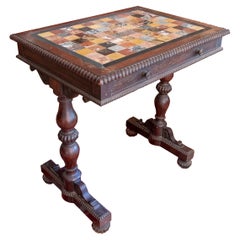
Siglo XIX, Mesa con tapa de Pietra Dura italiana y mármol espécimen
Mesa del siglo XIX con tablero de Pietra dura italiana y mármol espécimen.
Categoría
Antiguo, Mediados del siglo XIX, Italiano, Mesas
Materiales
Piedra, Mármol negro belga, Mármol de Siena
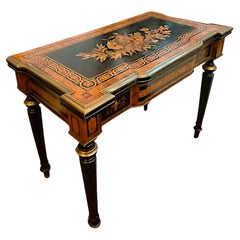
Mesa de juego de 1810 con exquisitas incrustaciones - Italia
Mesa de juego de 1810 con exquisitas incrustaciones - Italia
Exquisitas incrustaciones y bordes, con adornos de latón en las patas y los bordes.
Un objeto de la máxima calidad.
Com...
Categoría
Antiguo, Early 19th Century, Italian, Imperio, Mesas de juego
Materiales
Latón
19º francés. C. Mesa de Juego de Madera Ebonizada y Marquetería Estilo Luis XV, Table a Jeux
Acaba de llegar, se trata de una Mesa de Juego francesa de estilo Luis XV de marquetería y madera ebonizada o, como decimos en francés, Table a Jeux.
El tablero de esta encantadora m...
Categoría
Antiguo, Década de 1890, Francés, Provincial francés, Mesas de juego
Materiales
Madera
Mesa de juego ornamentada con tapa de mármol italiano Pietra DURA
Mesa de juego ornamentada con tapa de mármol italiano Pietra DURA. Mesa rectangular con tablero de mármol de Siena y tablero de ajedrez con incrustaciones de pietra dura. Delantal de...
Categoría
Antiguo, siglo XIX, Italiano, Renacimiento, Mesas de juego
Materiales
Mármol
Mesa de juego vintage, Italia, principios del siglo XX
La mesa de juego vintage es un elemento de diseño realizado a principios del siglo XX.
Una mesa de diseño único finamente incrustada con motivos decorativos.
Apertura superior (di...
Categoría
principios del siglo XX, Italiano, Mesas
Materiales
Madera