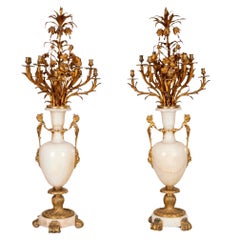
Artículos similares a Pair of candelabrum with 9 lights in gilded, silvered and burnished bronze
¿Quieres más imágenes o vídeos?
Solicita imágenes o vídeos adicionales al vendedor
1 de 21
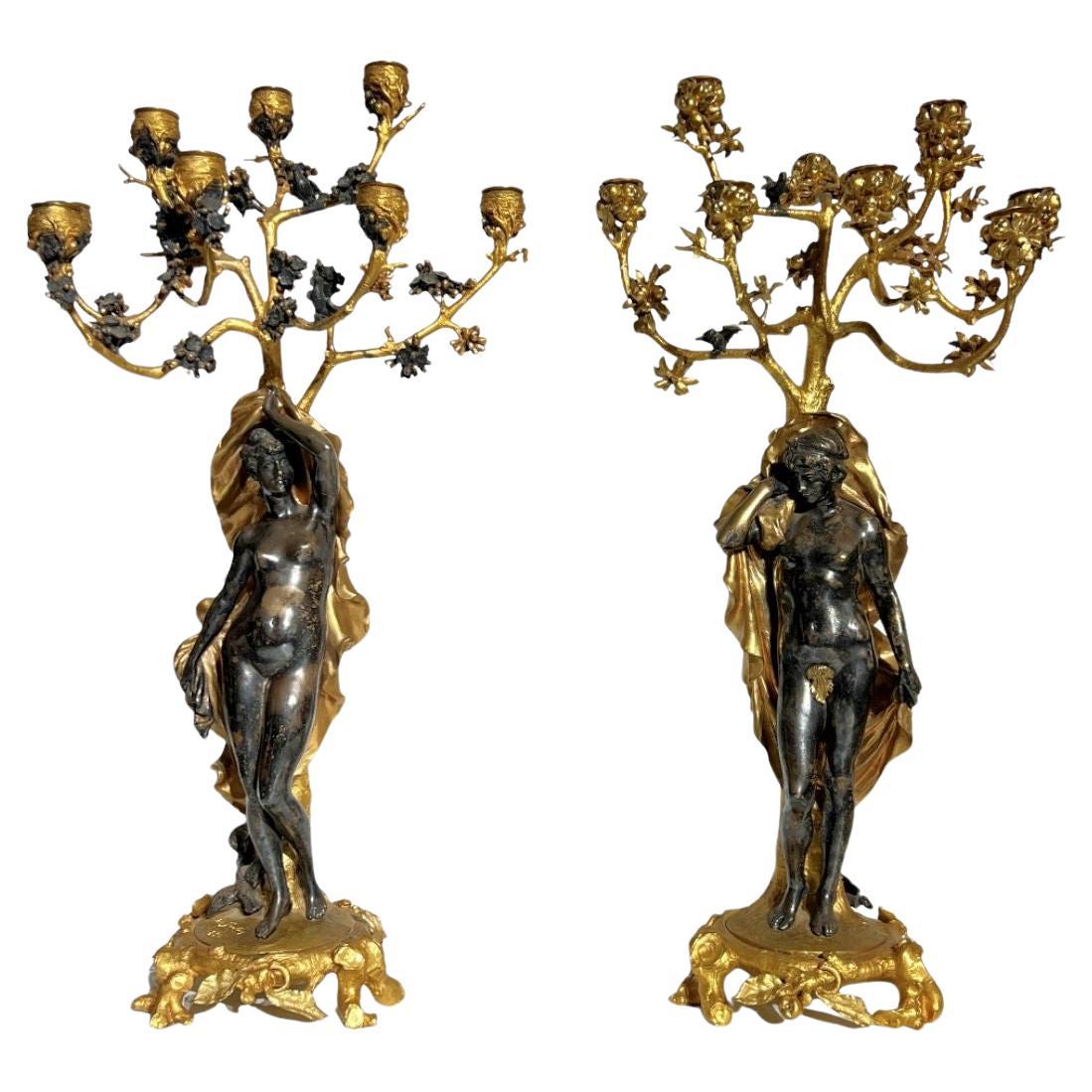
Pair of candelabrum with 9 lights in gilded, silvered and burnished bronze
281.250 €IVA incluido
Acerca del artículo
This splendid pair of candelabrum was made by Auguste-Louis Marquis (bronze maker) for the Maison Giroux circa 1855 in gilded, silvered and burnished bronze, the set on a cylindrical stand made of blackened wood resting on a square base.
Reflection of the eclecticism from the second half of the 19th century, our pair of candelarbum illustrates the exuberance of the Napoleon III style and the classicism of the Louis XVI style. The bronze maker has represented here the theme of the silent children, through winged putti with one finger put on their mouth, in burnished bronze. From their free hands, they hold a gilt bronze quiver where is resting a roses bouquet below large lily flowers being shaped to be light arms and of which the flowers are lightened up with a beautiful silver work. The putti are lightly dressed with a drapery hold by a strap roses garland and are bearing a crown of this same flower in their hair. About the cylindrical stand made of blackened wood, it is very typical of the Louis XVI style with its gilded bronze decoration of flowers garlands and laurel leaves flowers on which they stand.
We find on a sketching book indexing the works made by the maison Giroux, conserved in the Musée des Arts Décoratifs of Paris, a drawing depicting one of our candelabra, allowing us to confirm that they were sold by the maison created by Alphonse Giroux in the late 1790’s.
This store which was originally selling all kind of supplies and small objects such as paints, varnishes, albums, writing-papers, fans, toys, boxes and souvenirs, but also lithographs, drawings and watercolors, considerably developed in the first decades of the 19th century. First, because they count among the clients, important persons such as the Duchesse de Berry, Louis XVIII or even Charles X, then by the drive given by Alphonse Giroux’s sons who joined the firm in 1833. Thus, Alphonse-Gustave Giroux, the eldest son, had the idea to sell small furniture. Even though he was an artist himself, he worked like furniture dealers of the 18th century, with artists who did not have the right to put their signature and exerted a hold over the design of the creation that he chose. He also decided to move the store in the new Opera district on the corner of the 43 boulevard des Capucines and the 24 rue Neuve des Capucines in 1855.
On this same year, the company which had already won medals for the quality of its production during previous events, sells during the World Fair, to the Impress Eugénie, a bonheur du jour, conserved today in the château de Compiègne. In 1867, the store direction is given to Ferdinand Duvinage, Harinkouck and Brune. Little things are known about Harinkouck and Brune who seem to have been associated for a short period of time as Duvinage remains the only one in 1874.
A similar pair, a little bit smaller, with only 7 light arms, and made entirely of gilded bronze is illustrated on Marie-France Dupuy-Bellet’s book: Les bronzes du mobilier national 1800-1870, on the page 303.
The handwritten documentation of the Mobilier national allows to name their author: Auguste-Louis Marquis, who delivered them to the Garde-Meuble in April 1855 for the Palais Royal. They are next send, 22 years later to the Palais de l’Élysée where their presence is mentioned in the Ladies Salon in 1894.
The maison Chaumont and Marquis, founded in 1731, made and sold bronze, chandeliers, clocks, candelabrum, etc. They participated during the World Fairs of 1862 and 1867.
Thus, as written above, it seems that Alphonse Giroux asked Auguste Marquis to make a model of candelabrum from his original one, while imposing his modifications that we can notice by comparing the formal differences between the two pair of candelabrum. This manner to ask other artists to create models is really usual for the important companies selling art in the late 19th century. We can also mentionned l'Escalier de Cristal which worked with Gabriel Viardot, Emile Gallé and others, or Edouard Lièvre who worked for the maison Barbedienne.
Bibliography :
Marie-France Dupuy-Bellet, L’heure, le feu, la lumière, Les bronzes du mobilier National 1800-1870, Editions Faton, 2005
- Dimensiones:Altura: 232 cm (91,34 in)Anchura: 58 cm (22,84 in)Profundidad: 72 cm (28,35 in)
- Estilo:Napoleón III (En el estilo de)
- Materiales y técnicas:
- Lugar de origen:
- Época:
- Fecha de fabricación:Circa 1855
- Estado:
- Ubicación del vendedor:SAINT-OUEN-SUR-SEINE, FR
- Número de referencia:Vendedor: 132001stDibs: LU7662232252852
Sobre el vendedor
Aún no hay opiniones
Vendedor reconocido
Estos prestigiosos vendedores son líderes del sector y representan el escalón más alto en cuanto a calidad y diseño de artículos.
Vendedor de 1stDibs desde 2022
6 ventas en 1stDibs
Tiempo de respuesta usual: 4 horas
- EnvíoRecuperando presupuesto…Envío desde: SAINT-OUEN-SUR-SEINE, Francia
- Política de devolución
Partes de esta página se han traducido automáticamente. 1stDibs no puede garantizar la exactitud de las traducciones. El inglés es el idioma predeterminado de este sitio web.
Más de este vendedor
Ver todoPareja de lámparas antiguas de cristal
Este hermoso par de lámparas se fabricó en cristal a finales del siglo XIX, principios del XX
Las lámparas se componen de colgantes de cristal de diferentes formas y tamaños unidos ...
Categoría
principios del siglo XX, Francés, Belle Époque, Lámparas de mesa
Materiales
Cristal, Mármol
Pareja de jarrones de porcelana montados en bronce dorado, hacia 1890
Por Manufacture Nationale de Sèvres, Charles Labarre
Este bellísimo par de jarrones ovoides y cubiertos fue realizado en porcelana de Sèvres y montado en bronce dorado. Los dos jarrones representan una decoración pintada por Charles La...
Categoría
Antiguo, siglo XIX, Francés, Napoleón III, Jarrones
Materiales
Bronce
BACCARAT, Pareja de jarrones montados, hacia 1878
Por Baccarat
Fundada bajo el reinado de Luis XV, la fábrica francesa de cristal Baccarat demostró su excelencia en las Exposiciones Universales a lo largo del siglo XIX.
Este par de jarrones, d...
Categoría
Antiguo, Fines del siglo XIX, Francés, Napoleón III, Jarrones
Materiales
Cristal, Bronce
Centro de mesa de estilo Napoléon III en bronce dorado y cristal chapado, verso 185
Antigua colección del castillo de Dampierre
Importante centro de mesa compuesto por cuatro piezas en bronce dorado acabado ciselé y cristal taillé, de estilo Napoléon III. Hay dos p...
Categoría
Antiguo, Década de 1850, Napoleón III, Servicio de mesa
Materiales
Cristal, Bronce
Pareja de jarrones de porcelana de Sèvres montados en bronce dorado pintados por J. Machereau
Por Manufacture Nationale de Sèvres, Charles Labarre
Esta hermosa pareja de jarrones cubiertos de porcelana procede originalmente de la Manufactura de Sèvres, donde se compraron las piezas blancas en 1869, decoradas y luego montadas en...
Categoría
Antiguo, siglo XIX, Francés, Napoleón III, Jarrones
Materiales
Bronce
Suspensión de bronce dorado con gemas de vidrio, época de Napoleón III
Esta lámpara de bronce dorado tiene ocho ramas que adoptan la forma de cristalerías y velas y rodean una semiesfera decorada con piedras preciosas de cristal. Fruto de un trabajo muy...
Categoría
Antiguo, siglo XIX, Francés, Napoleón III, Candelabros y lámparas colgantes
Materiales
Multi piedra preciosa, Bronce
También te puede gustar
Pareja de grandes candelabros franceses de bronce y bronce dorado
Por François Rémond
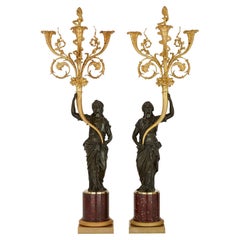
Este impresionante par de candelabros presenta dos doncellas de modelado clásico, que sostienen sobre su cabeza un extravagante conjunto dorado lleno de frutas, del que salen sendos ...
Categoría
Antiguo, Fines del siglo XIX, Francés, Neoclásico, Candelabros
Materiales
Bronce, Ormolú
Pareja Excepcional de Candelabros Franceses de Bronce Dorado y Plateado del Siglo XIX
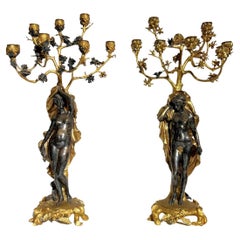
Pareja de candelabros figurados neoclásicos de bronce plateado y dorado diseñados por el autor, ensayista y artista francés,
Judith Gautier (1845-1917), firmado y fechado en 1886, q...
Categoría
Antiguo, Fines del siglo XIX, Francés, Renacimiento neoclásico, Candelabros
Materiales
Bronce
Pareja de candelabros franceses de bronce dorado del siglo XIX con base de mármol
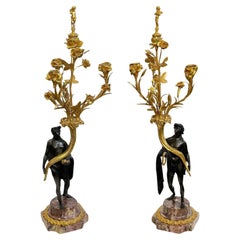
Pareja de candelabros figurados de bronce patinado y dorado Napoleón III. Asentadas sobre bases de mármol real rouge, las figuras parecen sostener graciosamente una cornocupia llena ...
Categoría
Antiguo, Fines del siglo XIX, Francés, Candelabros
Materiales
Mármol, Bronce
Pareja (2) de magníficos candelabros franceses de bronce de latón dorado
Pareja (2) de magníficos candelabros franceses de bronce dorado y bronce patinado.
Pareja de candelabros franceses de bronce dorado y bronce patinado
Francés, siglo XX
Magnífica pa...
Categoría
siglo XX, Francés, Candeleros
Materiales
Latón
Pareja Candelabros Siglo XIX Napoleón III
Este elegante par de candelabros ejemplifica la grandeza y la refinada estética del periodo de Napoleón III en Francia. Los candelabros muestran una armoniosa mezcla de influencias c...
Categoría
Antiguo, siglo XIX, Francés, Napoleón III, Candeleros
Materiales
Malaquita, Bronce
7035 € Precio de venta juego
Descuento del 23 %
Pareja monumental de candelabros de bronce Napoleón III
Monumental pareja de antiguos candelabros franceses Napoleón III de bronce y ónice blanco, de finales del siglo XIX. En forma de balaustre con asas de bronce dorado en forma de busto...
Categoría
Antiguo, siglo XIX, Francés, Napoleón III, Candelabros
Materiales
Ónix, Bronce