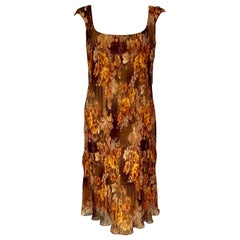
Madame Gres 4 Piece Ensemble
About the Item
The dress has a burnt orange bodice made from wide bands of satin ribbon sewn in place at the front. They wrap and tie at the neck and waistline forming large drapey bows. There is a series of hooks and eyes at the left side and a hook and eye at the back of the neck as well. This is paired with a long flowing divided skirt in a heathered brown wool jersey cut on the bias. There is a center back zipper and a hook and eye for closure.
There are two other pieces with this ensemble; a toga like wrap and a shrug, both made from the same soft wool jersey as the skirt. The long wrap is cut in an asymmetrical style and there is a single shoulder strap. It also has a single hook corresponding to a single eye on the waistband to keep it in place. This piece can be left to drape or tossed over your bare shoulder. The shrug is a long rectangle sewn like a tube at both ends. This versatile piece can be worn loosely draped, gathered at the shoulders, or any other style you prefer. Both the top and the skirt bear the Gres label. There are some small marks on the bodice, otherwise all four pieces are in excellent condition.
Measurements;
Top
Bust 32"
Waist 27"
Skirt
Waist 26"
Hips 40"
Length 44"
Wraps One size fits all
- Designer:
- Place of Origin:
- Period:
- Material Notes:Wool and satin
- Condition:Excellent.
- Seller Location:New Hope, PA
- Reference Number:1stDibs: AU11080347749
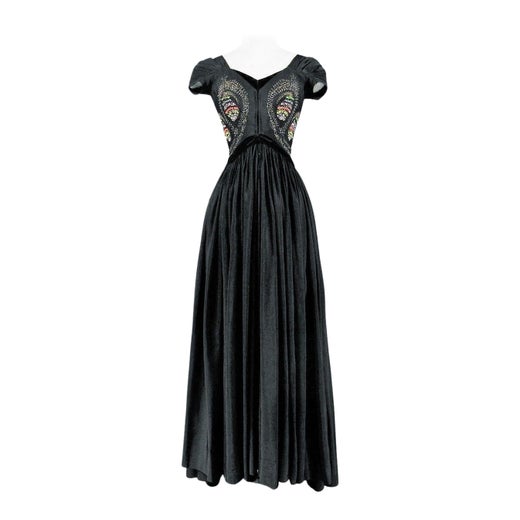
Madame Gres
Forever credited with having altered the fashion world with her pleated silk dresses, Madame Grès was one of the greatest couturiers of the 20th century. She defied the orders of Nazi soldiers and designed gowns and evening dresses that mirrored the colors and pattern of the French flag, working by hand with material that hung directly from live models. A consummate artist, Grès created garments that were demonstrative of exemplary construction and meticulous attention to detail — her signature floor-length gowns left a lasting impact on every aspect of haute couture.
Born Germaine Émilie Krebs to a French Jewish family in Paris, Grès initially studied painting and sculpture. For her, making dresses and working in sculpture were one and the same, and she pursued a career in fashion. Grès worked in millinery and was trained in haute couture dressmaking at the illustrious House of Prémet.
Grès opened her inaugural couture fashion house in 1932, and within a couple of years she began working under the name Alix Barton — the surname came from her coworker, couturier Julie Barton — calling her business La Maison Alix and creating gowns until 1942 in what became her signature style. She perfected modern pleating techniques and worked directly on live models, mostly with generous amounts of silk jersey and airy silk paper taffeta. Her designs showed the influence of Greco-Roman sculpture and would go on to help shape the work of Jean-Paul Gaultier, Jil Sander and Azzedine Alaïa, who also thought of haute couture as sculpture.
Grès’s work was photographed by the likes of Horst P. Horst, and her gowns for Jean Giraudaux’s play The Trojan War Will Not Take Place in 1935 established her as a leading designer, though Nazi occupation stalled her growth.
During WWII, Grès refused to design the utilitarian garb that German forces requested and instead made clothes using the colors of the French flag as her own act of rebellion. Ultimately, she was forced to close her boutique in Paris. The designer married Russian painter Serge Czerefkov, changed her name to Grès — which is how her husband signed his name — and fled to the Pyrenees before returning to establish her second couture house under her new name.
Madame Grès’s second maison was widely successful and attracted a long list of rich and powerful clientele ranging from movie stars to royalty. A single dress could take hundreds of hours to complete. Some of the couturier’s clients became deeply loyal over the course of her career, including the Duchess of Windsor, Oscar-winning actresses Grace Kelly and Greta Garbo, iconic Tiffany Co. jewelry designer Paloma Picasso and former First Lady Jacqueline Kennedy. Grès guarded her personal life closely and let her delicate, impeccable work speak for itself.
Original Madame Grès evening dresses and gowns, coats, jackets and day dresses, which transformed women into Greek deities, are held in the collections of the Metropolitan Museum of Art, the Museum at FIT and the Musée Bourdelle.
“Her dresses were about a sense of power, strength and beauty, not objectification,” explains Patricia Mears, deputy director of the Museum at FIT and author of Madame Grès: Sphinx of Fashion. “Everyone knows Chanel, Dior and Saint Laurent,” Mears says, “but I believe that the great triumvirate was Madeleine Vionnet, Balenciaga and Madame Grès — those who knew how to make clothes with their own hands, couturiers in the old sense of the word.”
Find vintage Madame Grès clothing and accessories on 1stDibs.
You May Also Like
1990s French Evening Dresses and Gowns
2010s Evening Dresses
21st Century and Contemporary British Evening Dresses and Gowns
1980s Italian Skirts
Early 2000s French Evening Dresses and Gowns
1950s American Cocktail Dresses

2010s Italian Day Dresses

2010s French Evening Gowns
1990s Italian Evening Dresses and Gowns
21st Century and Contemporary British Mini Dress
More From This Seller
View All1940s American Evening Dresses
Late 20th Century American Informal Dresses
21st Century and Contemporary American Evening Dresses
21st Century and Contemporary American Evening Dresses
1970s American Cocktail Dresses
1990s American Cocktail Dresses