Articles similaires à Impressionistic Portrait of the Equestrian Artist Baptista Schreiber - Drawing
Vous voulez plus d
images ou de vidéos ?
Demander au vendeur plus d
images ou de vidéos
1 sur 11
Gosta von HennigsImpressionistic Portrait of the Equestrian Artist Baptista Schreiber - Drawing1910-1920
1910-1920
650 €TVA incluse
À propos de cet article
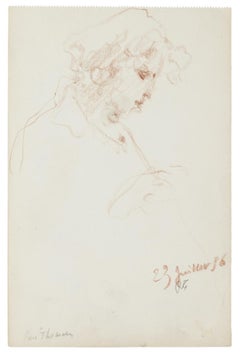
This expressive and atmospheric graphite drawing by Gösta von Hennigs (1866–1941) portrays the celebrated equestrian artist Baptista Schreiber within the charged setting of a circus manège. In the foreground, Schreiber is captured in an impressionistic moment of motion, her head turned toward her horse Menelik, which is only faintly suggested in the background. Behind her, her partner stands ready to lift her onto the horse, reinforcing the sense of immediacy and preparation before performance. On the reverse (a tergo), Schreiber is depicted riding her horse Menelik in the arena, wearing a striking feathered headdress. The audience appears schematically in the background, while to the right stands a male figure, possibly the circus director or presenter. The drawing is possibly a study for a painting, probably executed around 1905- 1915, and demonstrates von Hennigs’s assured command of line and movement, as well as his keen interest in performers and modern spectacle. The back panel has an old note describing the present drawing and attesting the artist, signed by Sven Petersohn, artexpert and one of the authors of the Swedish National Encyclopedia of Swedish artists. It is not signed.
Carl Gustaf Albert von Hennigs (1866-1941) was a Swedish painter whose career spans the transition from late 19th-century Impressionism to a highly personal engagement with modern urban and performative life.
Von Hennigs received his artistic training at the Artists’ Association School (Konstnärsförbundets skola) between 1891 and 1893, where he studied under Richard Bergh, Per Hasselberg, and Anders Zorn. During his early career, he painted street scenes, and focused on Stockholm motifs rendered in an impressionistic manner. He was an active member of the Artists’ Association (Konstnärsförbundet) and participated in many of its exhibitions until the organisation was dissolved in 1920.
From the early 1900s, von Hennigs gradually moved away from purely urban landscapes and developed a distinctive new subject matter. From around 1903 onwards, he increasingly drew inspiration from the world of the circus, the arena, and the manège, a thematic focus that earned him the epithet “the circus painter.” His works from this period depict acrobats, riders, jugglers, and clowns, executed in oil and watercolour. These compositions are marked by strong, vibrant colours and an impressionistic handling that emphasises movement, rhythm, and spectacle.
Stylistically, von Hennigs evolved from Impressionism toward a more decorative expression, influenced in part by Japanese colour woodcuts. His choice of viewpoints and compositional cropping often recalls Edgar Degas, particularly in the way figures are captured mid-motion and seen from unconventional angles. This approach allowed him to convey the fleeting, dynamic nature of performance with immediacy and visual intensity.
The Artists’ Association exhibition in Stockholm in 1912 marked a major breakthrough in his career. Prince Eugen purchased nine of his works at the exhibition, which were subsequently incorporated into the collection at Prins Eugens Waldemarsudde.
Von Hennigs’s reputation as an artist of movement and light was summarised in Svenska Dagbladets Yearbook in 1941, which noted his particular strength in capturing motion and the interplay of light and colour, while also observing a certain coolness in his work, arising from a strong focus on visual sensation despite the temperament of his motifs.
In addition to his artistic practice, von Hennigs played an important role in Swedish art education. He served as acting professor at the Royal University College of Fine Arts (Konsthögskolan) in Stockholm from 1928 to 1933. Today, Gösta von Hennigs is regarded as a key figure in Swedish early modern painting, especially celebrated for his vivid and innovative depictions of circus and performance life.
His works can be found in the Swedish National Museum, Modern museum of art, Prince Eugen Waldemarsudde and others.
Baptista Schreiber’s fame as an equestrian artist cannot be fully understood without placing her celebrated horse Menelik at the centre of her life and career. Schreiber, also known as Mijares-Schreiber, was the owner and trainer of Menelik, a white Arabian stallion who came to be regarded as the most famous circus horse in Sweden. Their partnership symbolized the height of artistic horsemanship in the early 20th century, when the bond between rider and horse was central to the show.
Menelik arrived in Schreiber’s life under extraordinary circumstances. In 1914, he was presented to her as a gift from Queen Alexandra of Great Britain and the British royal court, an exceptional gesture that reflects both Schreiber’s international reputation and the prestige surrounding her performances. The stallion was named after Emperor Menelik II of Ethiopia, a name that further enhanced the horse’s aura of strength, nobility, and exotic distinction.
Menelik’s death in 1931 caused widespread public attention and marked the end of an era. Together, their story has become part of Swedish cultural memory, illustrating how artistic performance, personal attachment, and public recognition could intersect in a way that elevated a circus horse to the level of a national icon.
- Créateur:Gosta von Hennigs (1866 - 1941, Suédois)
- Année de création:1910-1920
- Dimensions:Hauteur : 39 cm (15,36 po)Largeur : 33 cm (13 po)Profondeur : 2 cm (0,79 po)
- Support:
- Mouvement et style:
- Période:
- État:The drawing is in good condition. The paper has turned slightly brown. It has presently an acid free mounting.
- Adresse de la galerie:Stockholm, SE
- Numéro de référence:1stDibs : LU2608217370262
À propos du vendeur
5,0
Vendeur Or
Vendeurs premium dont la note est supérieure à 4,3 et le délai de réponse de 24 heures maximum
Vendeur 1stDibs depuis 2023
33 ventes sur 1stDibs
Temps de réponse habituel : <1 heure
- ExpéditionRecherche du devis...Expédition depuis : Stockholm, Suède
- Politique des retours
Certaines parties de cette page ont été traduites automatiquement. 1stDibs ne garantit pas l
exactitude des traductions. L
anglais est la langue par défaut de ce site web.
Plus d articles de ce vendeur
Tout afficherPortrait d
une gitane - Dessin du 19e siècle
Portrait de femme à la mine de plomb sur papier par Johannes Collin (1873-1951), signé "Johannes Collin 98" et titré "Zigenerska". Cette œuvre précoce et inhabituelle de Collin témoi...
Catégorie
années 1890, Autres styles artistiques, Dessins et aquarelles - Portrait
Matériaux
Papier, Graphite
Officier de cavalerie sur son cheval
Une aquarelle sur papier finement travaillée représente un officier de cavalerie à cheval - tenue et costume officiels - peint avec la clarté délicate qui a fait la réputation d'Egro...
Catégorie
Milieu du XIXe siècle, Autres styles artistiques, Dessins et aquarelles ...
Matériaux
Papier, Aquarelle
A.Profiles d
une femme assise sur une chaise
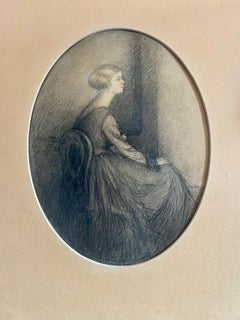
Dessin ovale d'une grande finesse de l'artiste finlandaise Ester Profiles représentant une jeune femme de profil assise sur une chaise. La pièce n'est suggérée que par un fond diffus...
Catégorie
Années 1910, Jugendstil, Dessins et aquarelles - Portrait
Matériaux
Papier, Fusain, Gouache
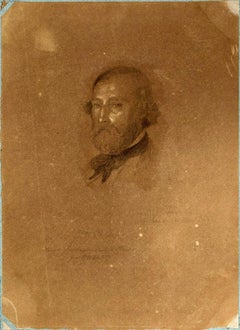
Portrait Gustav Wilhelm Palm - 19e siècle Crayon et pastel sur papier
Portrait de Gustaf Wilhelm Palm (1810-1890) par Lorenz Frølich (1820-1908)
Signé avec un monogramme et daté de mai 1849. Crayon et pastel sur papier. 29,5 × 21 cm.
Ce portrait du pei...
Catégorie
années 1840, Naturalisme, Dessins et aquarelles - Portrait
Matériaux
Papier, Pastel, Crayon carbone
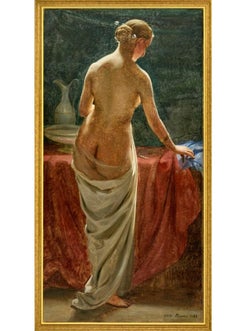
Psyché - Huile sur toile du 19e siècle
Par Otto Bache
Dans cette huile sur toile néoclassique signée et datée "Otto Bache 1864", l'artiste représente Psyché debout, le dos tourné au spectateur, à côté d'une table drapée de rouge. Ses ch...
Catégorie
années 1860, Autres styles artistiques, Peintures - Figuratif
Matériaux
Huile
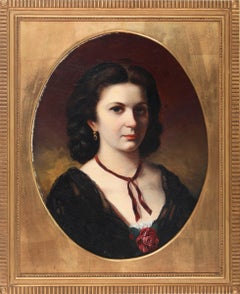
Princesse russe Olga Gortschakoff - Portrait du XIXe siècle, huile sur toile
Portrait de la princesse Olga Gortschakoff par l'artiste féminine du XIXe siècle Elise Hügel.
Portrait ovale de la princesse Olga Gortschakoff (1838-1926), plus tard baronne von Mey...
Catégorie
années 1850, Autres styles artistiques, Peintures - Portrait
Matériaux
Toile, Huile
Suggestions
Portrait - Dessin au crayon sur papier - Milieu du XXe siècle
Portrait est un dessin original au crayon sur papier, réalisé par un artiste anonyme au milieu du 20e siècle. Avec un autre dessin au dos.
Bonnes conditions.
Catégorie
Milieu du XXe siècle, Moderne, Dessins et aquarelles - Figuratif
Matériaux
Crayon
Portrait - Dessin au fusain de Pierre Georges Jeanniot - Début du XXe siècle
Par Pierre Georges Jeanniot
Portrait est un dessin original sur papier réalisé par le peintre Pierre Georges Jeanniot (1848-1934).
Dessin au crayon.
Signé à la main en bas.
Bon état, sauf pour les marges vie...
Catégorie
Début du 20ème siècle, Moderne, Dessins et aquarelles - Portrait
Matériaux
Crayon
Portrait d
une femme - Dessin d
Herman Paul, annes 1890
Portrait d'une dame est un dessin au crayon réalisé par Hermann Paul.
Signé à la main dans le coin inférieur gauche. Passpartout inclus cm 51x35
Bon état.
René Georges Hermann-Pa...
Catégorie
années 1890, Moderne, Dessins et aquarelles - Figuratif
Matériaux
Papier, Crayon
Portrait d
une femme - Dessin original au fusain Début du XXe siècle
Portrait de femme est une œuvre d'art originale réalisée par un artiste inconnu.
Dessin à la pointe grise et aquarelle non signée, écrite derrière CH.L. Papier collé sur carton. Di...
Catégorie
Début du 20ème siècle, Moderne, Dessins et aquarelles - Figuratif
Matériaux
Papier, Crayon
Étude pour un portrait - dessin original au crayon - 20ème siècle
"Étude pour un portrait" est un dessin original à la détrempe sur papier, réalisé par un artiste français anonyme du XXe siècle .
L'état de conservation des œuvres d'art est très bo...
Catégorie
20ième siècle, Moderne, Dessins et aquarelles - Figuratif
Matériaux
Crayon
Equestrienne", Salon d
Automne, Musée du Luxembourg, Post-impressionnisme français
Par Henri Ottmann
Signée en bas à droite " Henry Ottmann " (français, 1877-1927) et réalisée vers 1915.
Un élégant dessin au crayon et au lavis d'encre représentant deux femmes conversant, l'une assi...
Catégorie
Années 1910, Peintures - Figuratif
Matériaux
Papier, Encre de Chine, Crayon
