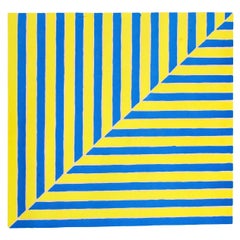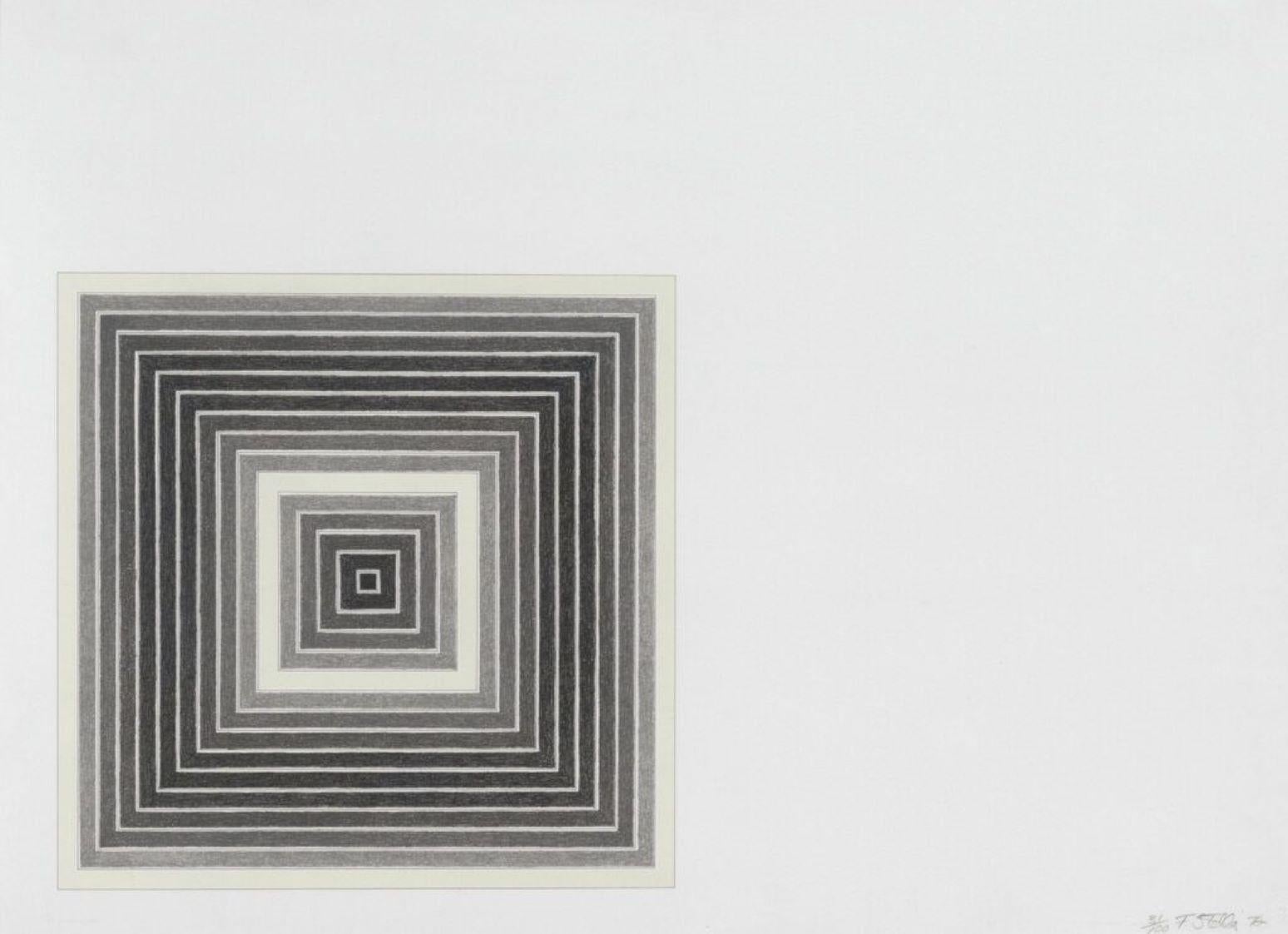
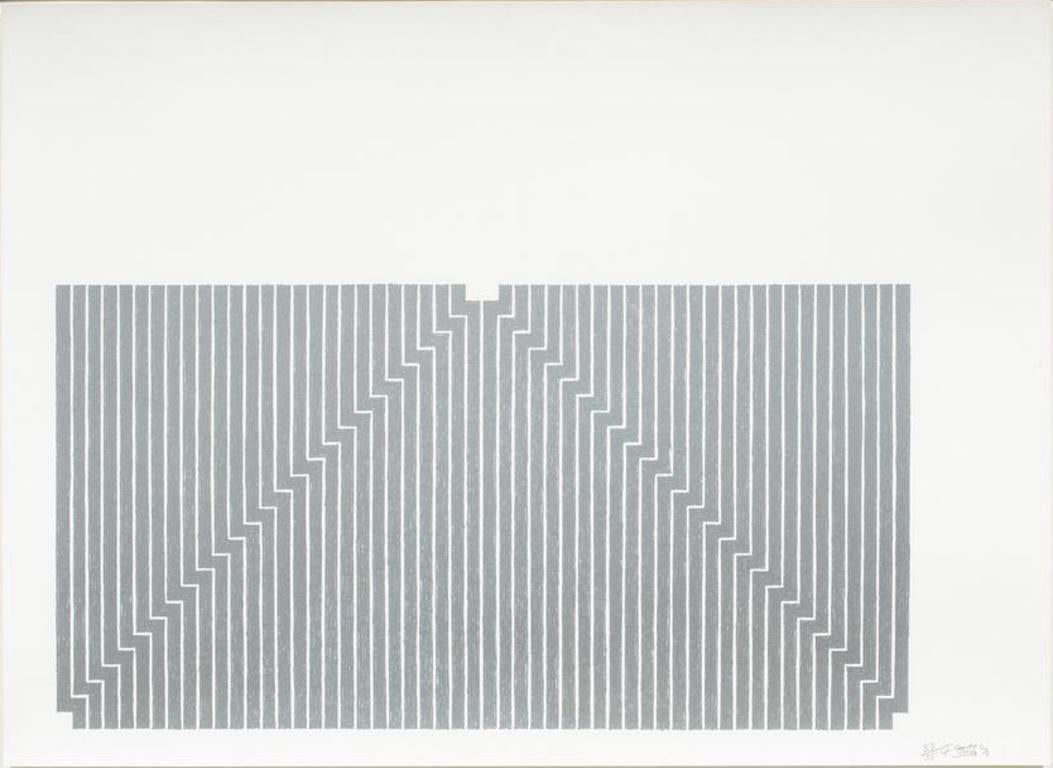
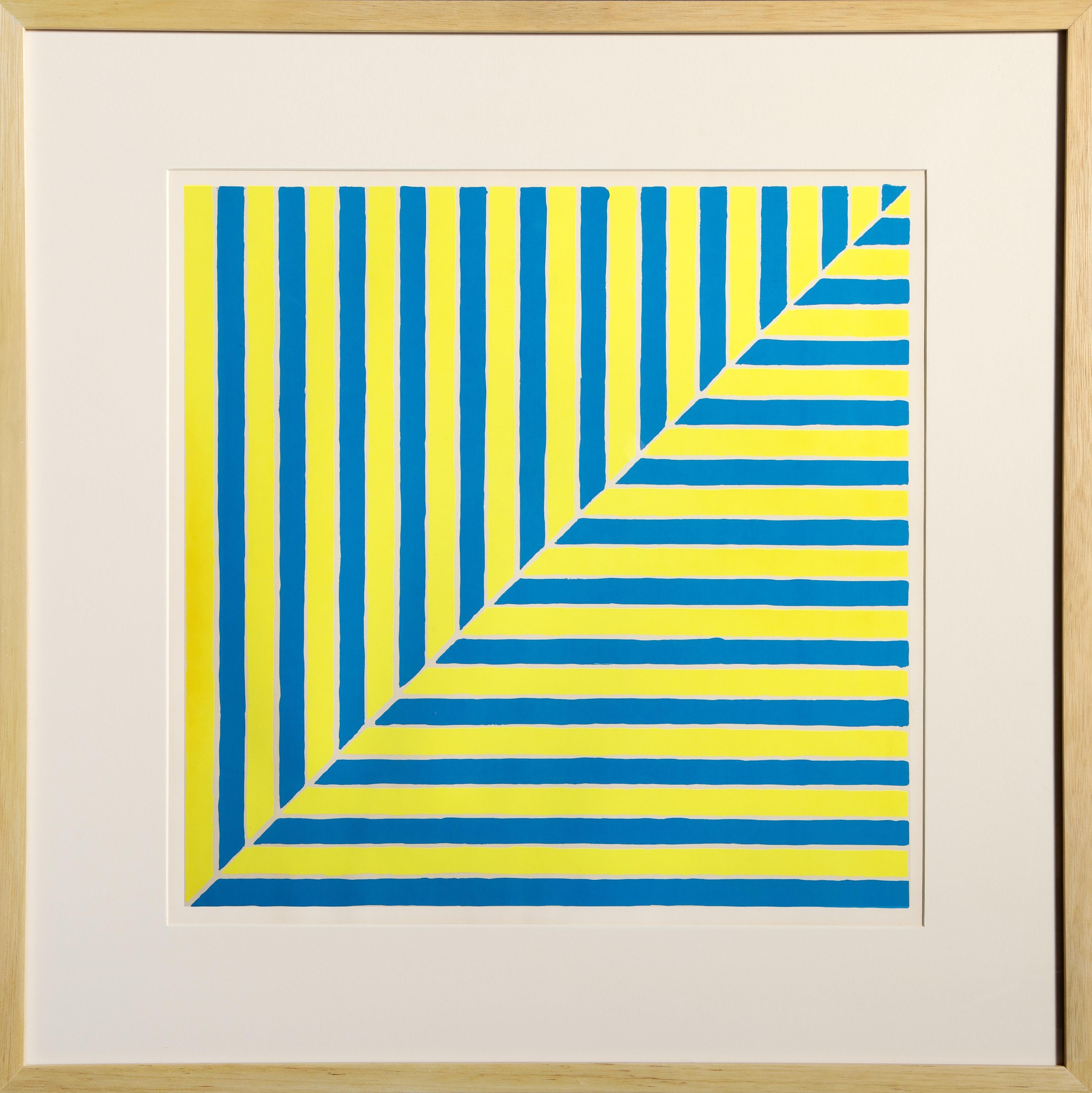
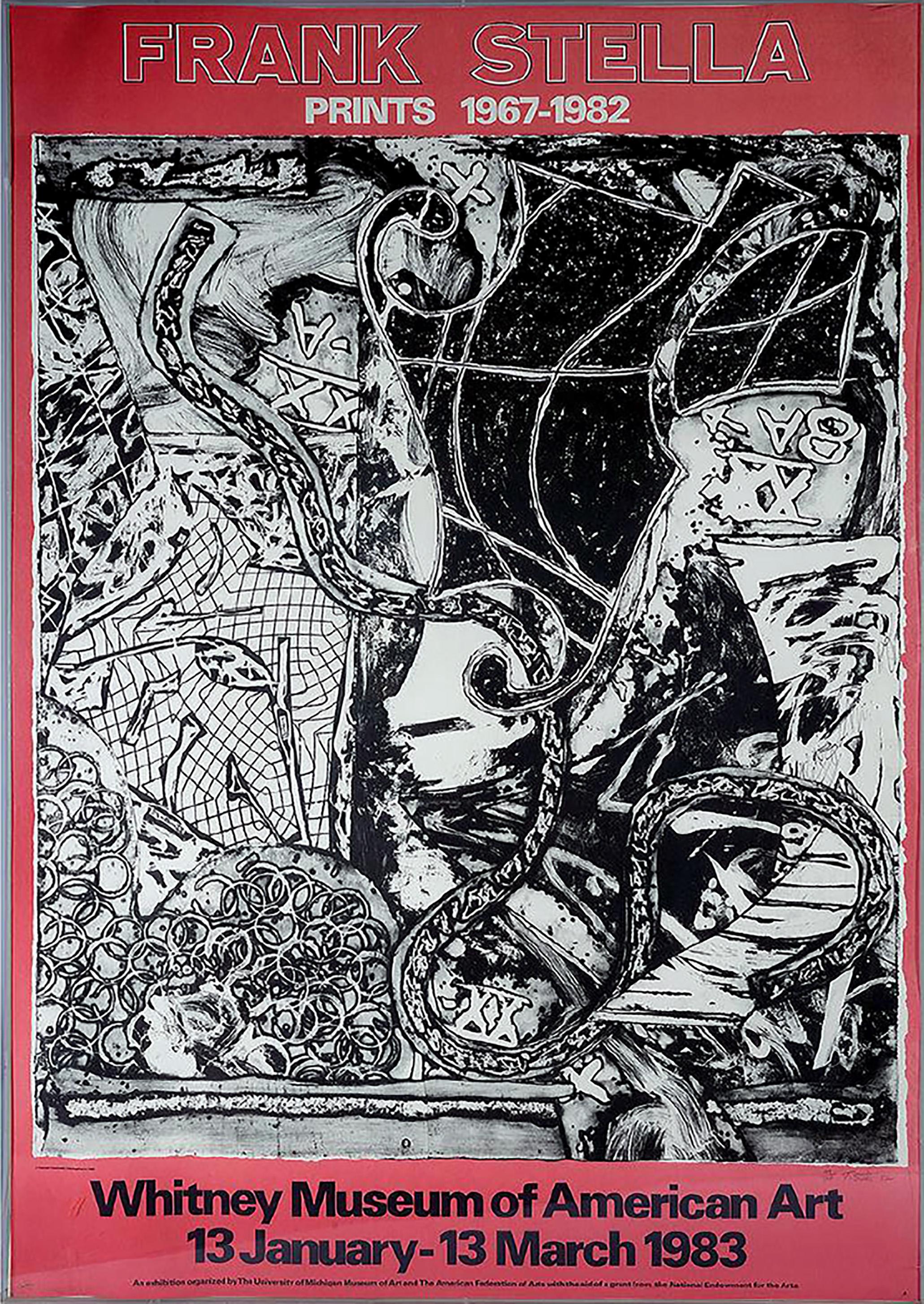
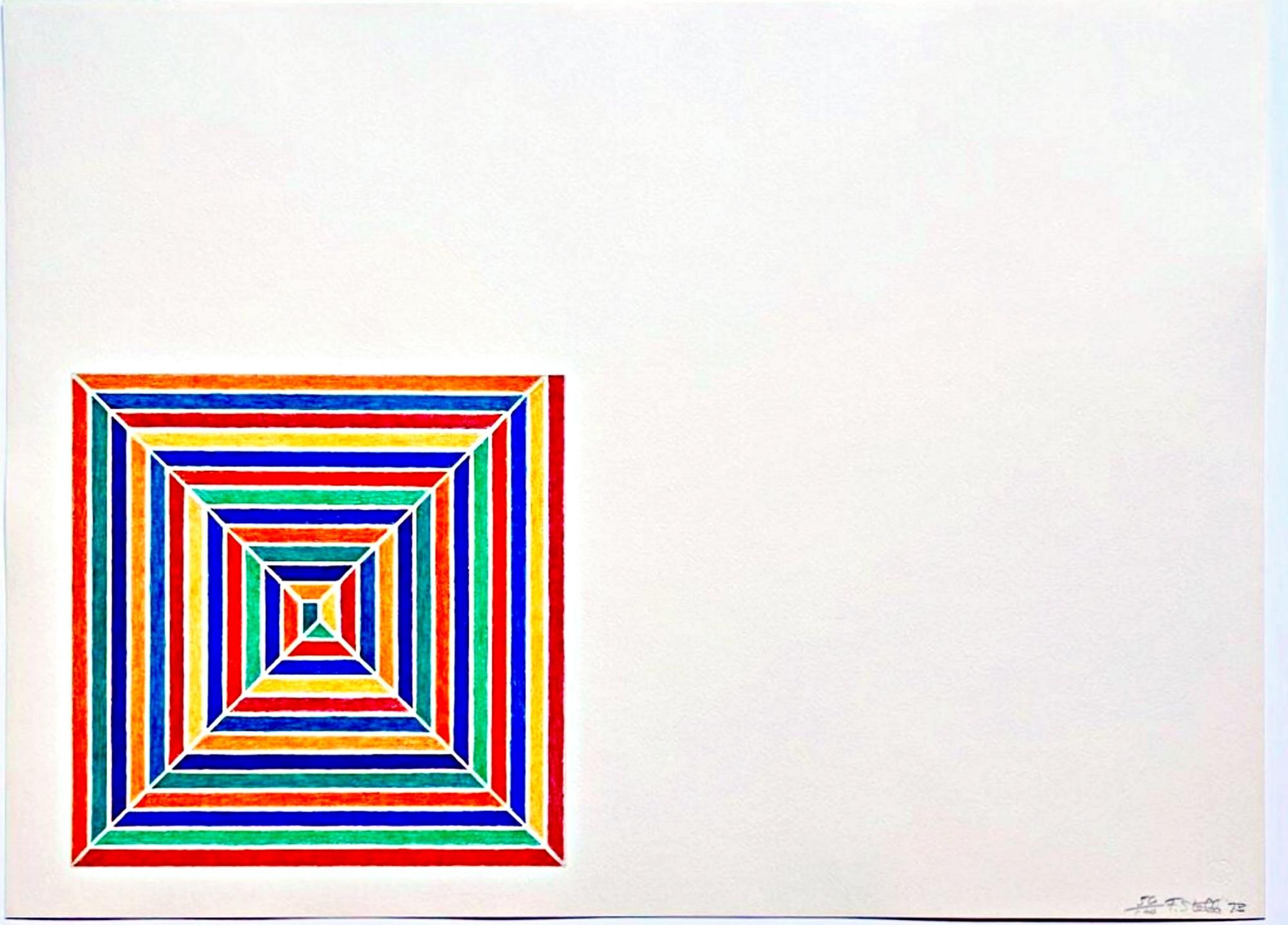
Frank StellaFrank Stella -Attica Defense Fund historic LtEd Geometric abstraction lithograph1974
1974
À propos de cet article
- Créateur:Frank Stella (1936, Américain)
- Année de création:1974
- Dimensions:Hauteur : 74,93 cm (29,5 po)Largeur : 74,93 cm (29,5 po)
- Support:
- Mouvement et style:
- Période:
- État:
- Adresse de la galerie:New York, NY
- Numéro de référence:1stDibs : LU1745217369442
Frank Stella
Frank Stella était l'une des figures centrales de l'art américain d'après-guerre. Partisan du minimalisme et de l'abstraction non représentative, Stella était un peintre, graveur et sculpteur.
Originaire du Massachusetts, Stella a fréquenté la Phillips Academy à Andover et a obtenu un BA à Princeton, où il a étudié l'art et la théorie des couleurs avec Josef Albers et Hans Hofmann. Stella fréquentait les galeries new-yorkaises lorsqu'elle était étudiante et était intriguée par les œuvres de Jackson Pollock et Franz Kline, tous deux au sommet de leur puissance créatrice à la fin des années 1950.
Après s'être installée à New York en 1958, Stella s'est rapprochée de l'abstraction géométrique et du style de peinture sobre de Barnett Newman et Jasper Johns.
Les images plates et graphiques de Johns d'objets communs tels que des cibles et des drapeaux incitent les spectateurs à s'interroger sur la nature essentielle de la représentation et à se demander si ces images sont réellement des peintures ou simplement de nouvelles itérations des objets eux-mêmes. Stella a poussé plus loin le raisonnement de Johns, en considérant les peintures sur toile comme des objets à part entière, comme des sculptures, plutôt que comme des représentations. Cela l'a conduit à rejeter certaines conventions formelles, à éviter les croquis et à utiliser souvent des matériaux non traditionnels, comme la peinture domestique.
En 1959, Stella crée sa série "Black Paintings", dans laquelle des bandes de peinture noire sont séparées par de fines et précises bandes de toile nue. À une époque où la peinture contemporaine était synonyme de gestes sauvages, de peinture épaisse et d'abandon formel, ces pièces ont fait sensation. La même année, les œuvres de Stella ont été incluses dans l'exposition "Sixteen Americans" au Museum of Modern Art à New York, et il a rejoint la liste des artistes représentés par la Leo Castelli Gallery. En 1960, il commence à introduire de la couleur dans son travail et en utilisant des toiles de forme non conventionnelle pour compléter ses compositions.
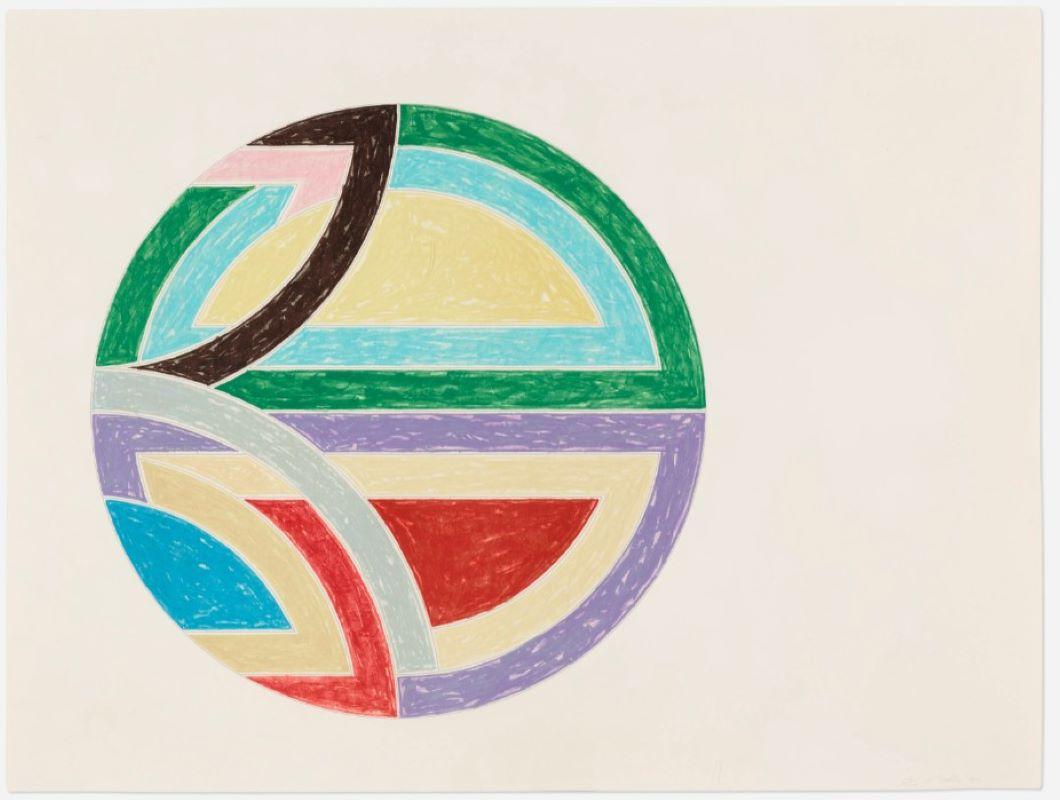
Dans sa série "Eccentric Polygon", datant de 1965 et 66, Stella adopte l'asymétrie et les couleurs vives, créant des formes délimitées par des champs peints et par les bords de la toile. Cette série a été suivie par la série "Protractor" de 1967-70, caractérisée par des cercles et des arcs colorés. Nommées d'après les villes anciennes dont Stella avait remarqué les plans circulaires lors de ses voyages au Moyen-Orient dans les années 1960, ces œuvres se composent généralement de plusieurs toiles posées à plat les unes contre les autres, de sorte que les figures géométriques de chaque section s'assemblent en un ensemble plus vaste et plus complexe.
C'est également au milieu des années 1960 que Stella commence à explorer la gravure, en travaillant d'abord avec Kenneth Tyler, de I.G.G.A., puis en installant du matériel d'impression dans son propre Studio. En 1968, il crée la série "V" de lithographies, qui comprend l'estampe Quathlamba I. Après une exposition personnelle au Museum of Modern Art en 1970 ADS, Stella commence à travailler en trois dimensions, ajoutant des éléments en relief aux peintures, qui pourraient presque être considérées comme des sculptures murales.
La série "Polish Village" (1970-1973) de Stella a été inspirée par des photos documentaires et des dessins architecturaux de synagogues polonaises qui avaient été détruites par les nazis pendant la Seconde Guerre mondiale. Les œuvres qui en résultent - composées principalement de peinture et de tissu sur du contreplaqué - sont plus robustes et moins polies que ses séries précédentes.
Moby Dick d'Herman Melville a été la muse de Stella pour une série d'œuvres tridimensionnelles qu'il a créées dans les années 1980 et dans lesquelles les formes d'ondes, les éléments architecturaux et les solides platoniciens jouent un rôle prépondérant. Au cours de cette période, Stella adopte un nouveau style exubérant qui est illustré dans "La Scienza della Fiacca".
En 1997, l'artiste a supervisé la création du Stella Project, une œuvre de 5 000 pieds carrés à l'intérieur du Moores Opera House de l'Université de Houston. Une grande sculpture autonome de Stella se trouve à l'extérieur de la National Gallery of Art (a) Gallery of Art à Washington, D.C.
Les œuvres de Stella font partie des collections de nombreux musées importants dans le monde entier, notamment le Museum of Modern Art de New York et Metropolitan Museum of Art; la Menil Collection, à Houston ; le Hirshhorn Museum and Sculpture Garden, à Washington, D.C. ; et le San Francisco Museum of Modern Art. Il s'est vu décerner la médaille nationale des arts par le président Obama en 2009, et a reçu le Lifetime Achievement Award in Contemporary Sculpture par le International Sculpture Center en 2011.
Trouvez des œuvres d'art originales de Frank Stella à vendre sur 1stDibs.
- ExpéditionRecherche du devis...Expédition depuis : New York, NY
- Politique des retours
Plus d articles de ce vendeur
Tout afficherannées 1970, Géométrique abstrait, Estampes - Abstrait
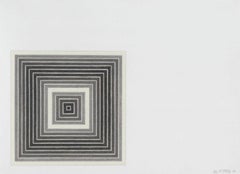
Lithographie
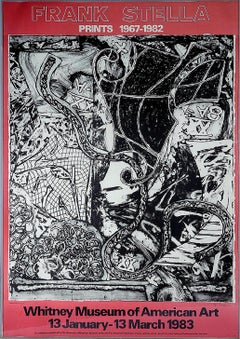
années 1980, Expressionnisme abstrait, Estampes - Abstrait
Lithographie, Offset
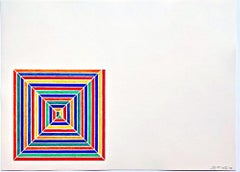
années 1970, Géométrique abstrait, Estampes - Abstrait
Lithographie
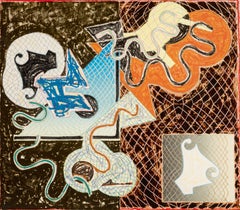
années 1980, Expressionnisme abstrait, Estampes - Abstrait
Technique mixte, Lithographie, Écran
Début des années 2000, Expressionnisme abstrait, Estampes - Abstrait
Lithographie, Offset

années 1980, Expressionnisme abstrait, Estampes - Abstrait
Lithographie, Offset
Suggestions
années 1970, Géométrique abstrait, Estampes - Abstrait
Lithographie
années 1960, Géométrique abstrait, Estampes - Abstrait
Écran
années 1970, Géométrique abstrait, Estampes et éditions
Lithographie, Écran
années 1970, Estampes et éditions
Lithographie
années 1970, Géométrique abstrait, Estampes et éditions
Lithographie, Écran
Milieu du XXe siècle, Américain, Mid-Century Modern, Estampes
Papier