Articles similaires à Richard Pettibone - The Appropriation Warhol, Stella Lichtenstein, Unique Signed
Vous voulez plus d
images ou de vidéos ?
Demander au vendeur plus d
images ou de vidéos
1 sur 9
Richard PettiboneRichard Pettibone - The Appropriation Warhol, Stella Lichtenstein, Unique Signed1970
1970
15 718,75 €
À propos de cet article
Richard Pettibone
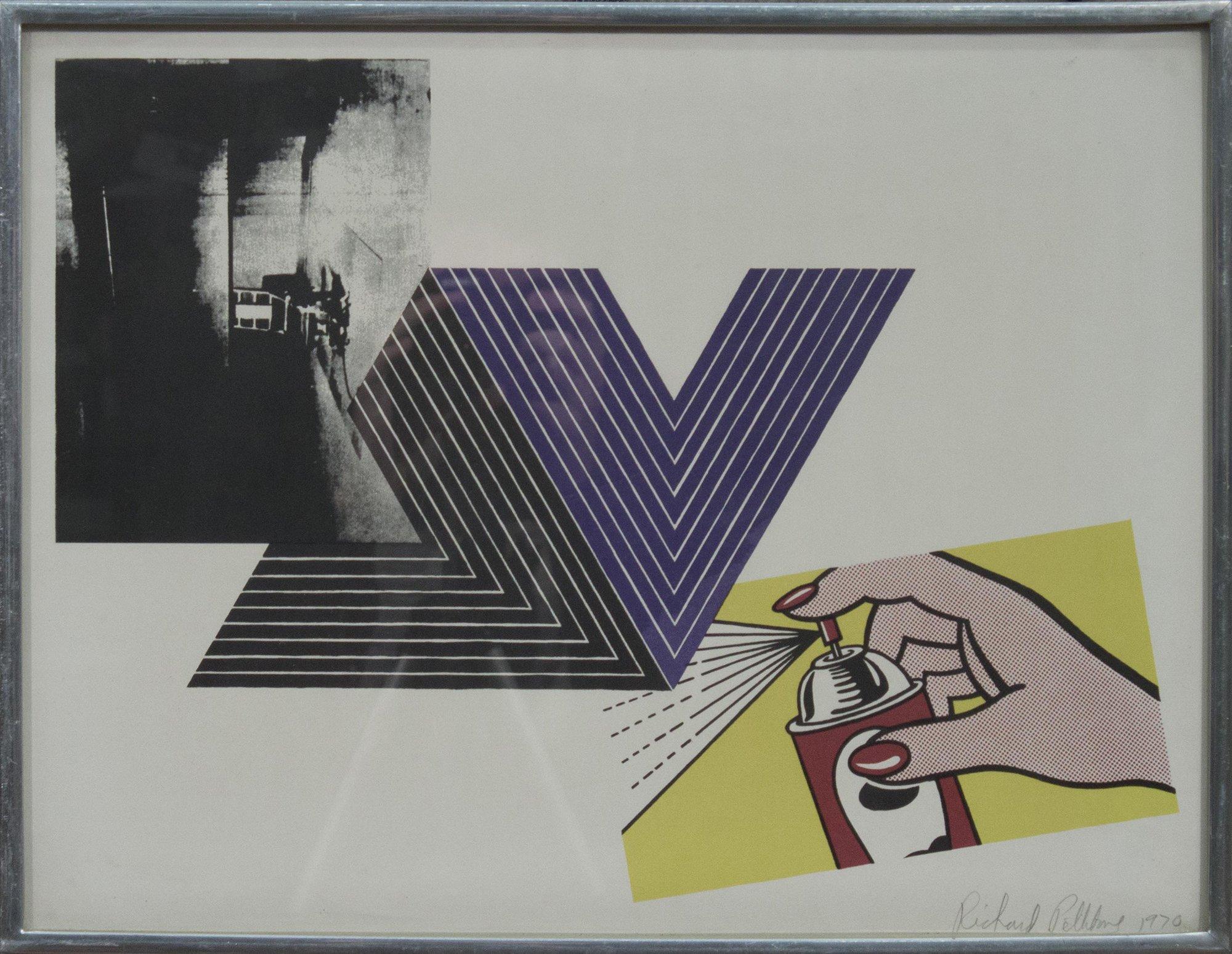
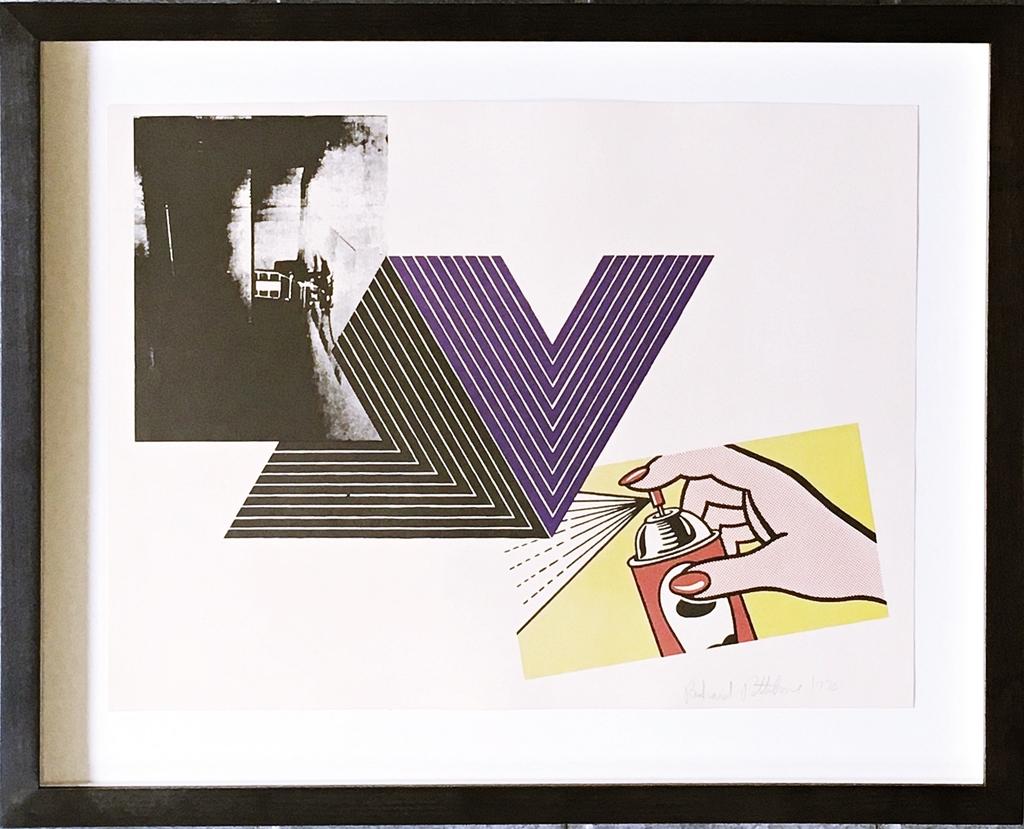
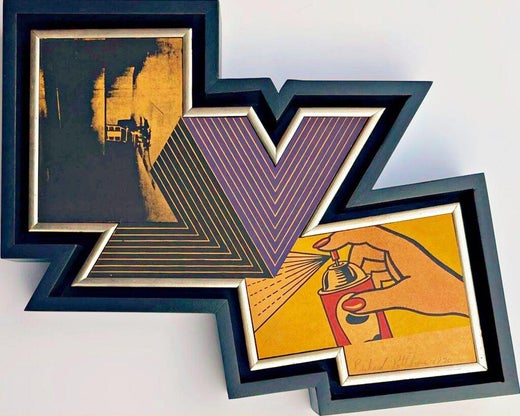
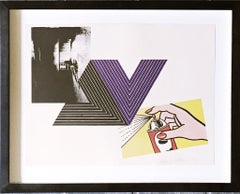
The Appropriation Print Andy Warhol, Frank Stella, Roy Lichtenstein, 1970
Silkscreen in colors on masonite board (unique variant on sculpted board)
Hand-signed by artist, Signed and dated on the front (see close up image)
Bespoke frame Included
This example of Pettibone's iconic Appropriation Print is silkscreened on masonite board rather than paper, giving it a different background hue, and enabling it work to be framed so uniquely.
The Appropriation print is one of the most coveted prints Pettibone ever created ; the regular edition is on a full sheet with white background; the present example was silkscreened on board, allowing it to be framed in 3-D. While we do not know how many examples of this graphic work Pettibone created, so far the present work is the only one example we have ever seen on the public market since 1970. (Other editions of The Appropriation Print have been printed on vellum, wove paper and pink and yellow paper.)
This 1970 homage to Andy Warhol, Frank Stella and Roy Lichtenstein exemplifies the type of artistic appropriation he was engaging in early on during the height of the Pop Art movement - long before more contemporary artists like Deborah Kass, Louise Lawler, etc. followed suit.
This silkscreen was in its original 1970 vintage period frame; a bespoke custom hand cut black wood outer frame was subsequently created especially to house the work, giving it a distinctive sculptural aesthetic.
Measurements:
Framed 14.5 inches vertical by 18 inches horizontal by 2 inches
Work
13 inches vertical by 16.5 inches horizontal
Richard Pettibone biography:
Richard Pettibone (American, b.1938) is one of the pioneering artists to use appropriation techniques. Pettibone was born in Los Angeles, and first worked with shadow boxes and assemblages, illustrating his interest in craft, construction, and working in miniature scales. In 1964, he created the first of his appropriated pieces, two tiny painted “replicas” of the iconic Campbell’s soup cans by Andy Warhol (American, 1928–1987). By 1965, he had created several “replicas” of paintings by American artists, such as Warhol, Roy Lichtenstein (1923–1997), Ed Ruscha (b.1937), and others, among them some of the biggest names in Pop Art. Pettibone chose to recreate the work of leading avant-garde artists whose careers were often centered on themes of replication themselves, further lending irony to his work. Pettibone also created both miniature and life-sized sculptural works, including an exact copy of Bicycle Wheel by Marcel Duchamp (French, 1887–1968), and in the 1980s, an entire series of sculptures of varying sizes replicating the most famous works of Constantin Brancusi (Romanian, 1876–1957). In more recent years, Pettibone has created paintings based on the covers of poetry books by Ezra Pound, as well as sculptures drawn from the grid compositions of Piet Mondrian (Dutch, 1872–1944). Pettibone straddles the lines of appropriation, Pop, and Conceptual Art, and has received critical attention for decades for the important questions his work raises about authorship, craftsmanship, and the original in art. His work has been exhibited at the Institute for Contemporary Art in Philadelphia, the Museum of Modern Art in New York, the Museum of Contemporary Art in Miami, and the Laguna Art Museum in Laguna Beach, CA. Pettibone is currently based in New York.
"I wished I had stuck with the idea of just painting the same
painting like the soup can and never painting another painting.
When someone wanted one, you would just do another one.
Does anybody do that now?"
Andy Warhol, 1981
Since the mid-1960s, Richard Pettibone has been making
hand-painted, small-scale copies of works by other artists — a
practice due to which he is best known as a precursor of appropriation art — and for a decade now, he has been revisiting subjects from across his career. In his latest exhibitions at
Castelli Gallery, Pettibone has been showing more of the “same”
paintings that had already been part of his 2005–6 museum retrospective,1
and also including “new” subject matter drawn from
his usual roster of European modernists and American postwar
artists. Art critic Kim Levin laid out some phases of the intricate spectrum from copies to repetitions in her review of the
Warhol-de Chirico showdown, a joint exhibition at the heyday
of appropriation art in the mid-1980s when Warhol’s appropriations of de Chirico’s work effectively revaluated “the grand
old auto-appropriator”.
Upon having counted well over a dozen
Disquieting Muses by de Chirico, Levin speculated: “Maybe he
kept doing them because no one got the point. Maybe he needed the money. Maybe he meant it when he said his technique
had improved, and traditional skills were what mattered.”
On
the other side, Warhol, in her eyes, was the “latter-day exemplar
of museless creativity”.
To Pettibone, traditional skills certainly
still matter, as he practices his contemporary version of museless creativity. He paints the same painting again and again,
no matter whether anybody shows an interest in it or not. His
work, of course, takes place well outside the historical framework of what Levin aptly referred to as the “modern/postmodern wrestling match”,
but neither was this exactly his match
to begin with.
Pettibone is one of appropriation art’s trailblazers, but his diverse
selection of sources removes from his work the critique of the
modernist myth of originality most commonly associated with
appropriation art in a narrow sense, as we see, for example, in
Sherrie Levine’s practice of re-photographing the work of Walker
Evans and Edward Weston. In particular, during his photorealist
phase of the 1970s, Pettibone’s sources ranged widely across
several art-historical periods. His appropriations of the 1980s
and 1990s spanned from Picasso etchings and Brancusi sculptures to Shaker furniture and even included Ezra Pound’s poetry.
Pettibone has professed outright admiration for his source artists, whose work he shrinks and tweaks to comic effect but, nevertheless, always treats with reverence and care. His response
to these artists is primarily on an aesthetic level, owing much
to the fact that his process relies on photographs. By the same
token, the aesthetic that attracts him is a graphic one that lends
itself to reproduction. Painstakingly copying other artists’ work by hand has been a way of making
it his own, yet each source is acknowledged in
his titles and, occasionally, in captions on white
margins that he leaves around the image as an
indication that the actual source is a photographic image. The enjoyment he receives in copying
is part of the motivation behind doing it, as is
the pleasure he receives from actually being with
the finished painting — a considerable private
dimension of his work. His copies are “handmade
readymades” that he meticulously paints in great quantities in his studio upstate in New York; the commitment
to manual labor and the time spent at material production has
become an increasingly important dimension of his recent work.
Pettibone operates at some remove from the contemporary art
scene, not only by staying put geographically, but also by refusing to recoup the simulated lack of originality through the
creation of a public persona.
In so doing, Pettibone takes a real
risk. He places himself in opposition to conceptualism, and he is
apprehensive of an understanding of art as the mere illustration
of an idea. His reading of Marcel Duchamp’s works as beautiful
is revealing about Pettibone’s priorities in this respect.
When
Pettibone, for aesthetic pleasure, paints Duchamp’s Poster for
the Third French Chess Championship three times in slightly different sizes, he refuses the separation between the intellectual
and retinal dimensions, as well as any conceptual concern about
the redundancy of the material object.
-Courtesy of Castelli Gallery
- Créateur:Richard Pettibone (1938, Américain)
- Année de création:1970
- Dimensions:Hauteur : 36,83 cm (14,5 po)Largeur : 45,72 cm (18 po)Profondeur : 5,08 cm (2 po)
- Support:
- Mouvement et style:
- Période:
- État:Very good vintage condition; the inner metal frame is vintage and the outer bespoke black wood frame is new; there is minor wear to the outer edges of the board.
- Adresse de la galerie:New York, NY
- Numéro de référence:1stDibs : LU1745217440852
Richard Pettibone
Richard Pettibone a été l'un des premiers artistes à utiliser les techniques d'appropriation. Né à Los Angeles, Pettibone a d'abord travaillé avec des boîtes d'ombres et des assemblages, illustrant son intérêt pour l'artisanat, la construction et le travail à l'échelle miniature.
(Biographie fournie par ArtWise)
À propos du vendeur
5,0
Vendeur Platine
Vendeurs premium dont la note est supérieure à 4,7 et le délai de réponse de 24 heures maximum
Établi en 2007
Vendeur 1stDibs depuis 2022
479 ventes sur 1stDibs
Temps de réponse habituel : 1 heure
- ExpéditionRecherche du devis...Expédition depuis : New York, NY
- Politique des retours
Certaines parties de cette page ont été traduites automatiquement. 1stDibs ne garantit pas l
exactitude des traductions. L
anglais est la langue par défaut de ce site web.
Plus d articles de ce vendeur
Tout afficherImpression d
appréciation Pop Art : Andy Warhol, Frank Stella, Roy Lichtenstein, SIGNÉ
Par Richard Pettibone
Richard Pettibone
La gravure d'appropriation : Andy Warhol, Frank Stella, Roy Lichtenstein, 1970
(La chaise électrique d'Andy Warhol, L'impératrice des Indes de Frank Stella et Le sp...
Catégorie
années 1970, Pop Art, Estampes - Abstrait
Matériaux
Écran, Crayon
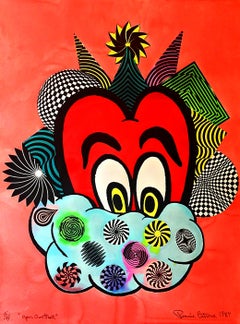
« Your Own Heart » signé par Warhol, Haring, Basquiat
Scharf
Par Ronnie Cutrone
Ronnie Cutrone
Votre propre cœur, 1987
Aquarelle et sérigraphie sur papier
Signée, datée et numérotée dans une édition de 7 exemplaires, chaque œuvre étant unique.
40 × 30 pouces
Fan...
Catégorie
années 1980, Art urbain, Dessins et aquarelles - Abstrait
Matériaux
Technique mixte, Aquarelle, Feutre indélébile, Écran
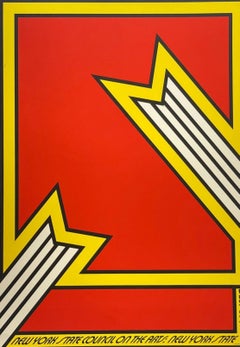
Vintage 1970 New York State Council on the Arts Award Nicholas Krushenick
Par Nicholas Krushenick
Nicholas Krushenick
Affiche du prix du Conseil des arts de l'État de New York, 1970
Sérigraphie sur papier vélin - affiche originale de 1970, pas de réimpression
Non signé, non numér...
Catégorie
années 1970, Pop Art, Estampes - Abstrait
Matériaux
Écran, Offset
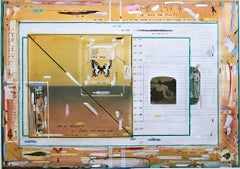
Robert Petersen, étude couleur n°1 unique, signée, peinture abstraite encadrée, juin 1984
Robert Petersen
Juin 1984 Étude de couleurs n° 1, 1989
Techniques mixtes sur papier
Signé à la main, titré et daté sur la partie inférieure du recto
Il s'agit d'une œuvre unique
Cadr...
Catégorie
années 1980, Contemporain, Technique mixte
Matériaux
Papier, Technique mixte
Robert Petersen - Signed collage, gold leaf acrylic painting Leo Castelli label
Robert Petersen
May 1987, 1987
Pure pigment collage, gold leaf, acrylic painting and drawing
Signed, titled and dated on the front. The back of the frame bears the label of Castelli ...
Catégorie
années 1980, Contemporain, Peintures - Abstrait
Matériaux
Feuille d or
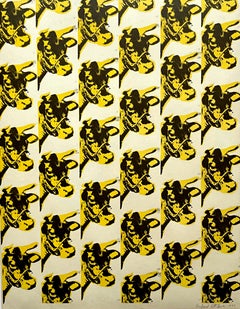
Andy Warhol
s Cow Wallpaper, papier peint d
appropriation signé au crayon, célèbre tirage d
appropriation
Par Richard Pettibone
Richard Pettibone
Papier peint Andy Warhol Cow
Sérigraphie sur papier
26 1/2 × 20 3/4 pouces
Signé et daté à la main en graphite au recto.
Non encadré
En savoir plus sur Richard Pet...
Catégorie
années 1970, Pop Art, Estampes - Abstrait
Matériaux
Écran
Suggestions
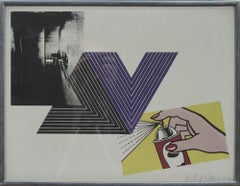
1970 « Appropriation print with Warhol, Lichtenstein
Par Richard Pettibone
Cette sérigraphie de Richard Petcone, intitulée Appropriation, réunit de manière créative des œuvres emblématiques de trois des artistes pop et minimalistes les plus influents : Andy...
Catégorie
années 1970, Pop Art, Estampes et éditions
Matériaux
Écran
5 239 € Prix de vente
20 % de remise
Untitled VI, sérigraphie géométrique Pop Art de Nicholas Krushenick
Par Nicholas Krushenick
Artistics : Nicholas Krushenick, Américain (1929 - 1999)
Titre : Untitled VI from Fire-Flash-Fire-Fade Portfolio (Sans titre VI du portefeuille Fire-Flash-Fire-Fade)
Année : 1971
Méd...
Catégorie
années 1970, Pop Art, Estampes - Abstrait
Matériaux
Écran
North End, Nicholas Krushenick
Par Nicholas Krushenick
Artistics : Nicholas Krushenick (1929-1999)
Titre : Extrémité nord
Année : 1979
Edition : 15/200, plus épreuves
Support : Sérigraphie sur papier vélin
Taille : 36 x 26 pouces
Condit ...
Catégorie
années 1970, Pop Art, Estampes - Abstrait
Matériaux
Écran
764 € Prix de vente
20 % de remise
Crise d
identité ( sérigraphie unique embellie à la main)
Par Ronnie Cutrone
Unique embelli à la main avec de la peinture acrylique et un marqueur sur une sérigraphie. Signé et daté à la main par Ronnie Cutrone. Encadré sur mesure comme indiqué sur la phot...
Catégorie
années 1980, Pop Art, Technique mixte
Matériaux
Papier, Acrylique, Écran, Feutre indélébile
1 964 € Prix de vente
25 % de remise
Exposition privée, peinture à l
acrylique Pop Art de Michael Knigin
Par Michael Knigin
Artiste : Michael Knigin, Américain (1942 - 2011)
Titre : Showing privé
Année : 1990
Moyen : Acrylique et émail sur toile sur panneau, signé, titré et daté au verso
Taille : 24 x 52 ...
Catégorie
années 1990, Pop Art, Peintures - Abstrait
Matériaux
Émail
Dominique, lithographie offset Pop Art de Steve Leal
Par Steve Leal
Steve Leal, Américain (1962 - ) - Dominique, Année : circa 1983, Medium : Lithographie offset, signée à l'encre et numérotée au crayon, édition : 184/200, Taille : 27 x 20.5 in. ...
Catégorie
années 1980, Pop Art, Estampes - Portrait
Matériaux
Lithographie, Offset