George Richmond RA
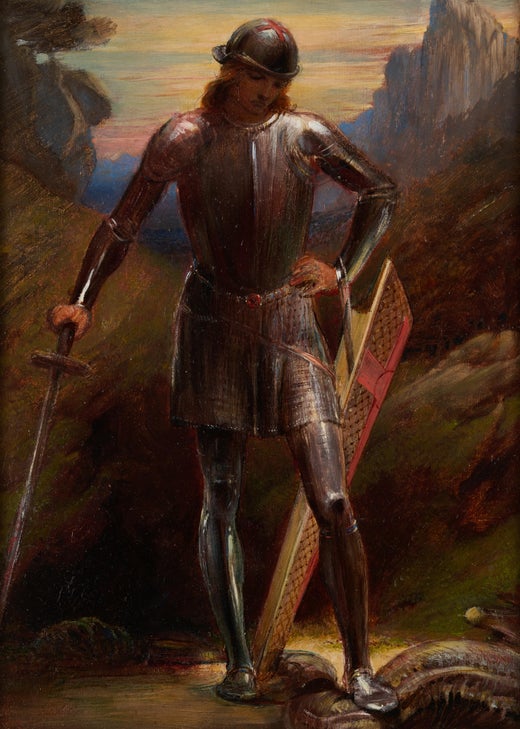
The Red Cross Knight Slaying the Dragon
1809-1896
Oil on paper
Image size: 12 3/4 x 9 1/4 inches (32.5 x 23.5 cm)
Pre-Raphaelite frame
Provenance
Estate of the artist
Edith Richmond (1845-1934), the artist's daughter
George Henry John Richmond (1889-1967), nephew of the above, a gift in 1926
Thence by descent to the present owners
Literature
George Richmond, the artist's account book, (unpublished), National Portrait Gallery, listed under 1872, p. 54
Raymond Lister, George Richmond, A Critical Biography, London, 1981, p. 101
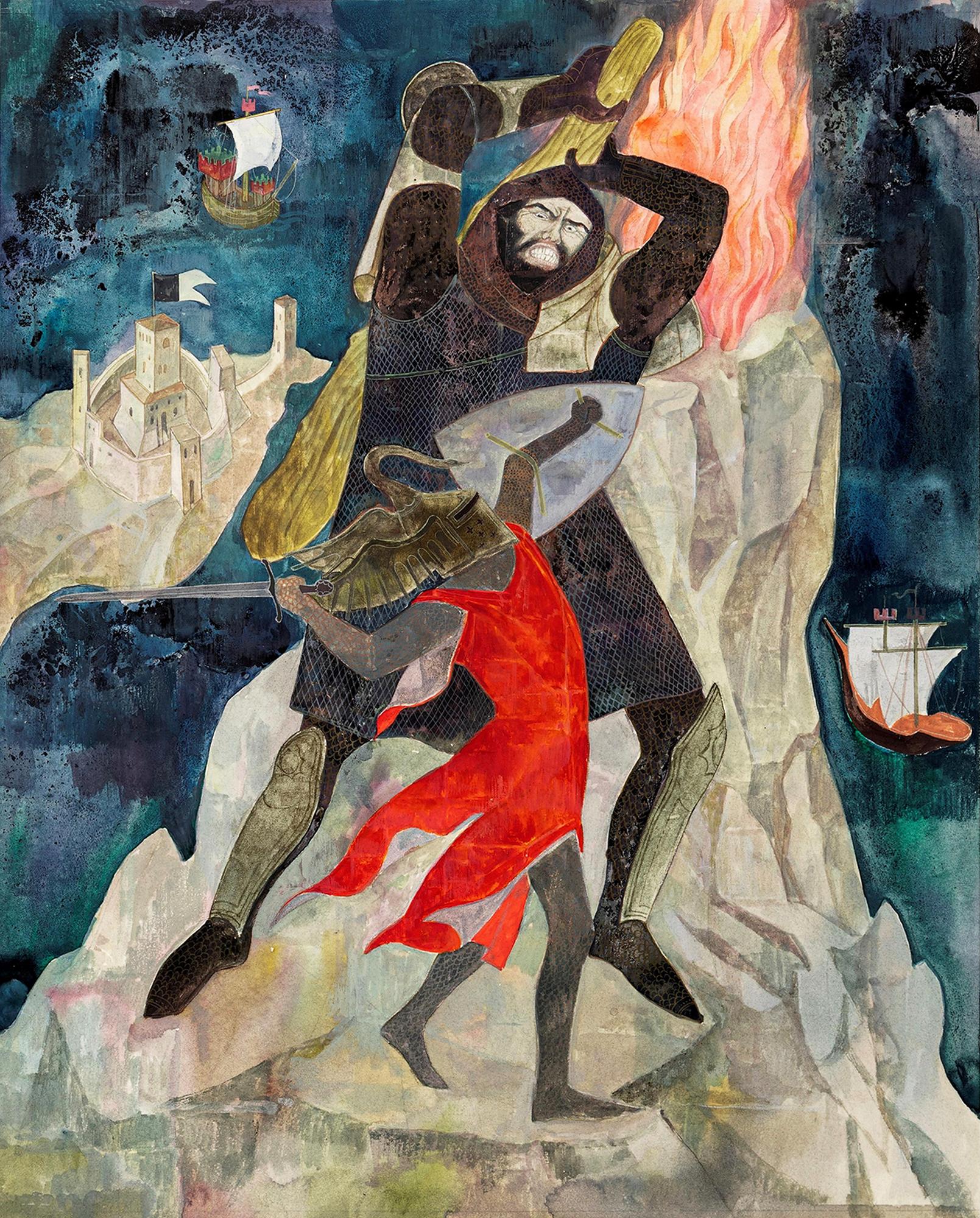
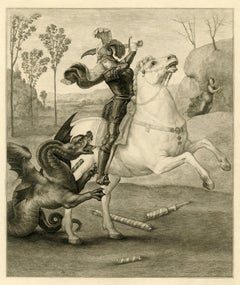
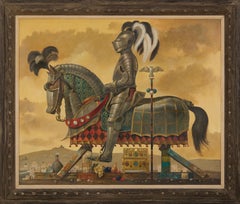
This work was painted by Richmond in 1872, towards the end of his life and after he had gained much commercial success. The theme of the painting demonstrates that Richmond’s adoration for symbolist literary themes spanned his whole life, despite his economic decision to abandon the William Blake-inspired ‘Ancients’ and turn to portrait painting. The painting depicts the Red Cross Knight of Edmund Spenser’s The Faerie Queen slaying the dragon in an allegory for the triumph of holiness over sin. The religious aspect of this story was undoubtedly poignant for Richmond, who was a devout Christian.
The work has a distinct Romanticist impression, with its thematic focus on the mystical and spiritual. The attention to light in this painting is truly astonishing, albeit subtle - the reflections on the dragon’s scales and the Knight’s armour are masterful. A beautifully rendered shadow is cast over the Knight’s face from his helmet, as he looks down towards the beast he has just slain. The sunset in the background casts the painting in a hazy golden glow, heightening the romantic and chivalrous undertones of the work, whilst dowsing the sky in an explosion of dusky colour that demonstrates the extent of Blake’s influence on Richmond’s art.
George Richmond RA
George Richmond was born in London in 1809, the son of the miniature painter Thomas Richmond. One of his earliest memories was attending the Life Guards marching home to the Brompton barracks after the Waterloo campaign - according to Richmond, he trailed behind the Duke of York for a mile in order to sketch him for his father, from whom he was taught how to draw and paint. At the age of 15, Richmond went to study at the Royal Academy under Samuel Palmer and Henry Fuseli, the latter of whom became a lifelong friend.
At the age of 16, Richmond had an important encounter with William Blake in which he came to greatly admire the painter and poet, often using him for artistic inspiration. Richmond was there when Blake died in 1827 and took his death mask. Alongside Palmer and his fellow students Calvert and Tatham, Richmond formed The Ancients, a group who were proclaimed followers of William Blake. Richmond was also a devout Christian, with Biblical scenes and fables also inspiring his artworks.
In 1828, Richmond travelled to Paris after raising funds by painting miniatures. He wanted to study art and anatomy, with his time spent between art school and hospitals. Upon returning to England, he spent time at the White Lodge in Richmond Park with Lord Sidmouth, painting a portrait of him that is now on display in the National Portrait Gallery. In 1830, Richmond exhibited two paintings at the Royal Academy, both inspired by Ben Jonson’s writings, indicating the artistic inspiration he found when it came to depicting literary subjects. By the time of his death, Richmond had exhibited almost 200 paintings at the RA.
After Richmond’s lover’s father had refused to accept their marriage, the couple eloped to Scotland, where Richmond had to put his love of Blake on hold and become a portraitist to earn money. His watercolour portrait of William Wilberforce became incredibly well known, and earned Richmond a number of other commissions from British gentry and nobility.
In 1837, Richmond travelled with his family and Samuel Palmer to Rome, after experiencing poor health and the death of three of his children. In Italy, he made many studies of the Sistine Chapel’s paintings, and visited Naples, Pompeii, and cities in Tuscany. After two years, he returned to England much restored and befriended John Ruskin.
Richmond was so well renowned that he was twice asked to become the Director of the National Gallery, refusing the role both times. He had honorary degrees from the universities of Oxford and Cambridge, and was a fellow of both the Society of Antiquaries and the Royal Institute of British Architects. In 1857, Richmond became an associate of the Royal Academy, and eventually a full member in 1866.
Before 1846, Richmond worked in crayon and watercolour. After this year, he began to paint in oil and completed many portraits in this medium, which were then reproduced as engravings. Richmond’s artistic prowess rendered him one of England’s experts on painting restoration, a discipline which became increasingly important to him as he became older.
George Richmond passed away in 1896, the year after having seen his son, prominent painter William Blake Richmond, earn his academician status at the Royal Academy. His sitters included Charles Dickens, John Ruskin, Charlotte Bronte, and HRH The Prince of Wales. His works are found in collections such as the London National Portrait Gallery, the Edinburgh Portrait Gallery, and the Victoria and Albert Museum.