Articles similaires à Grand Kabuki Stainless Steel Abstract Brutalist Sculpture
Vous voulez plus d
images ou de vidéos ?
Demander au vendeur plus d
images ou de vidéos
1 sur 6
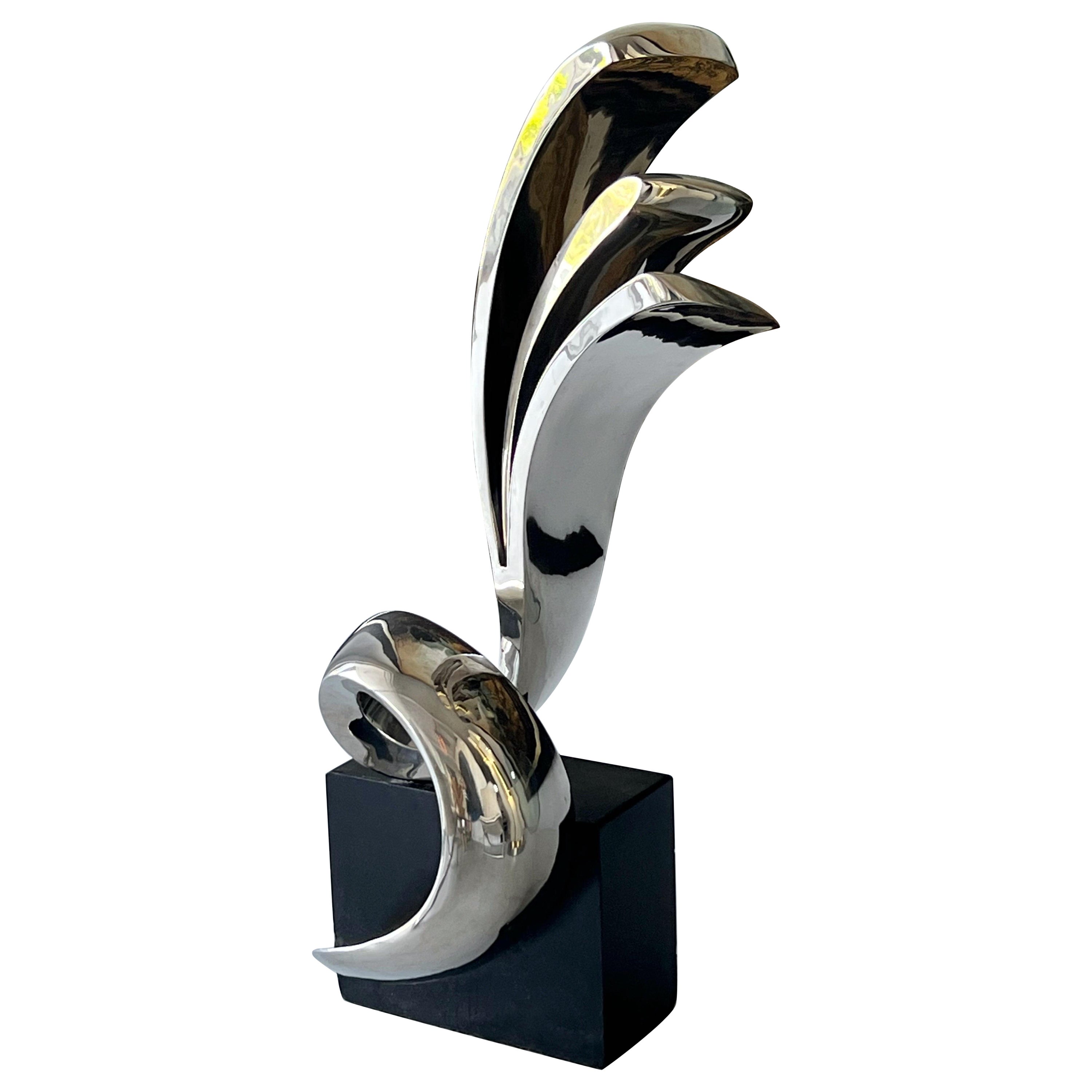
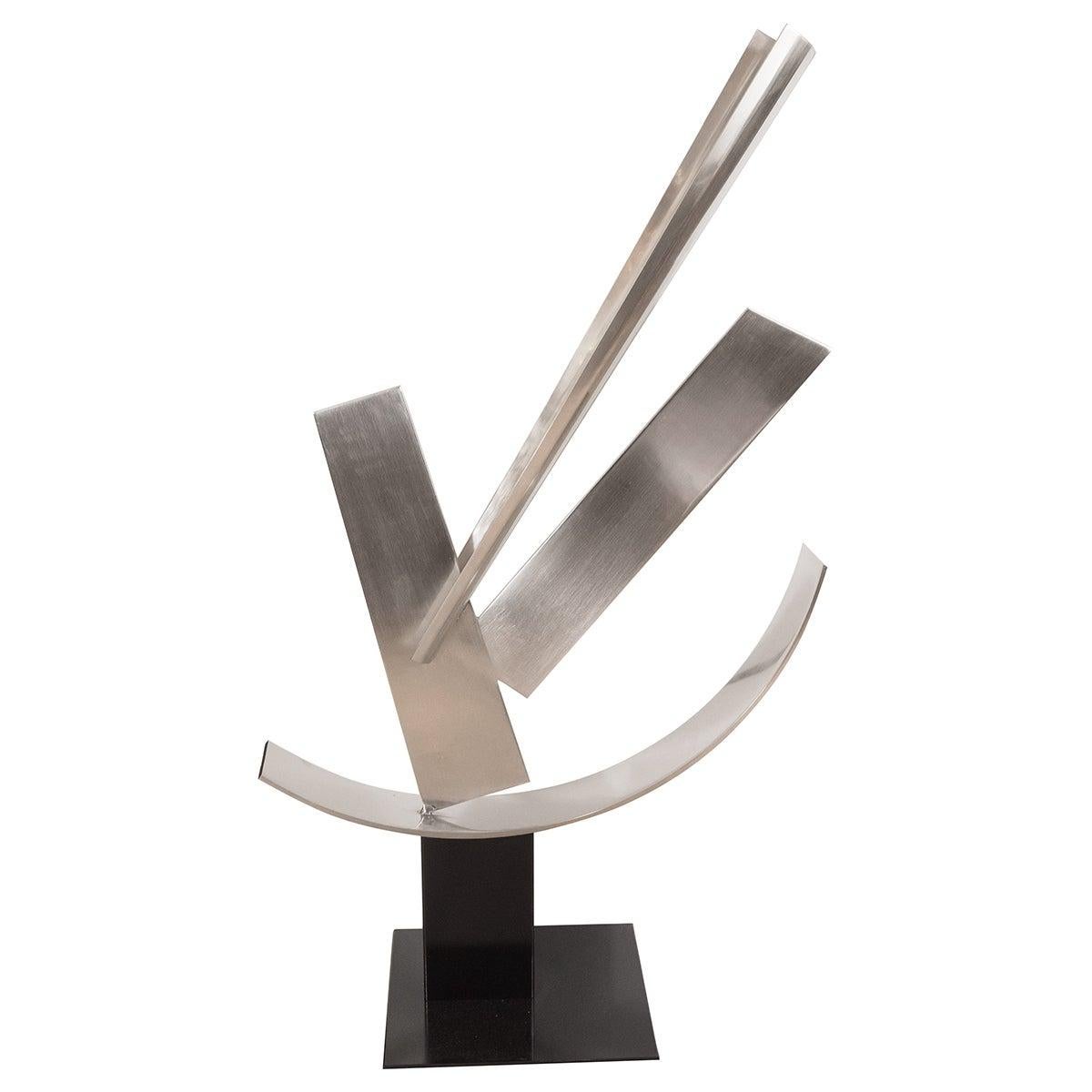
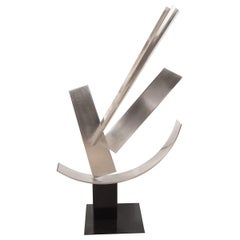
Alfred Van LoenGrand Kabuki Stainless Steel Abstract Brutalist Sculpture
2 442,79 €
À propos de cet article
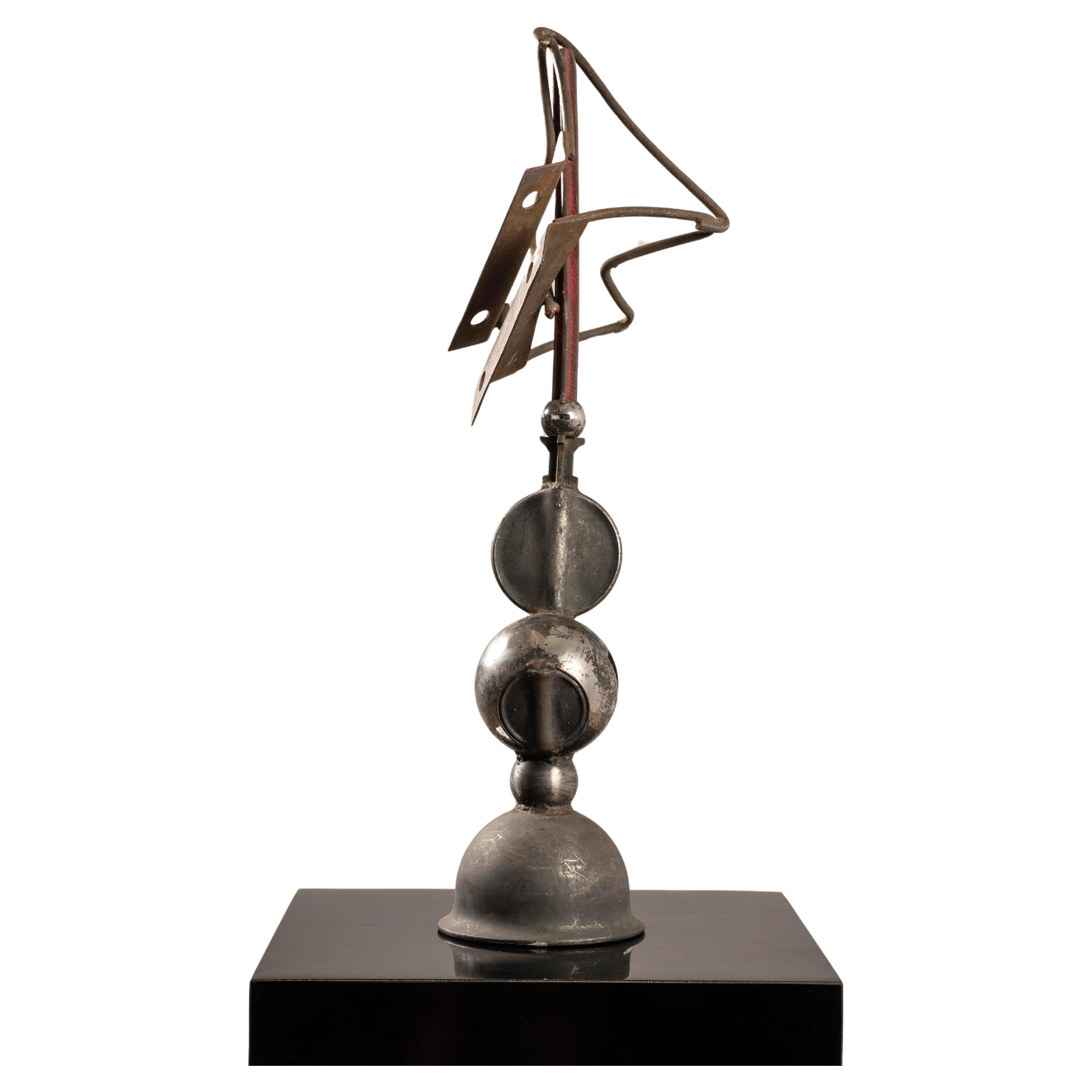
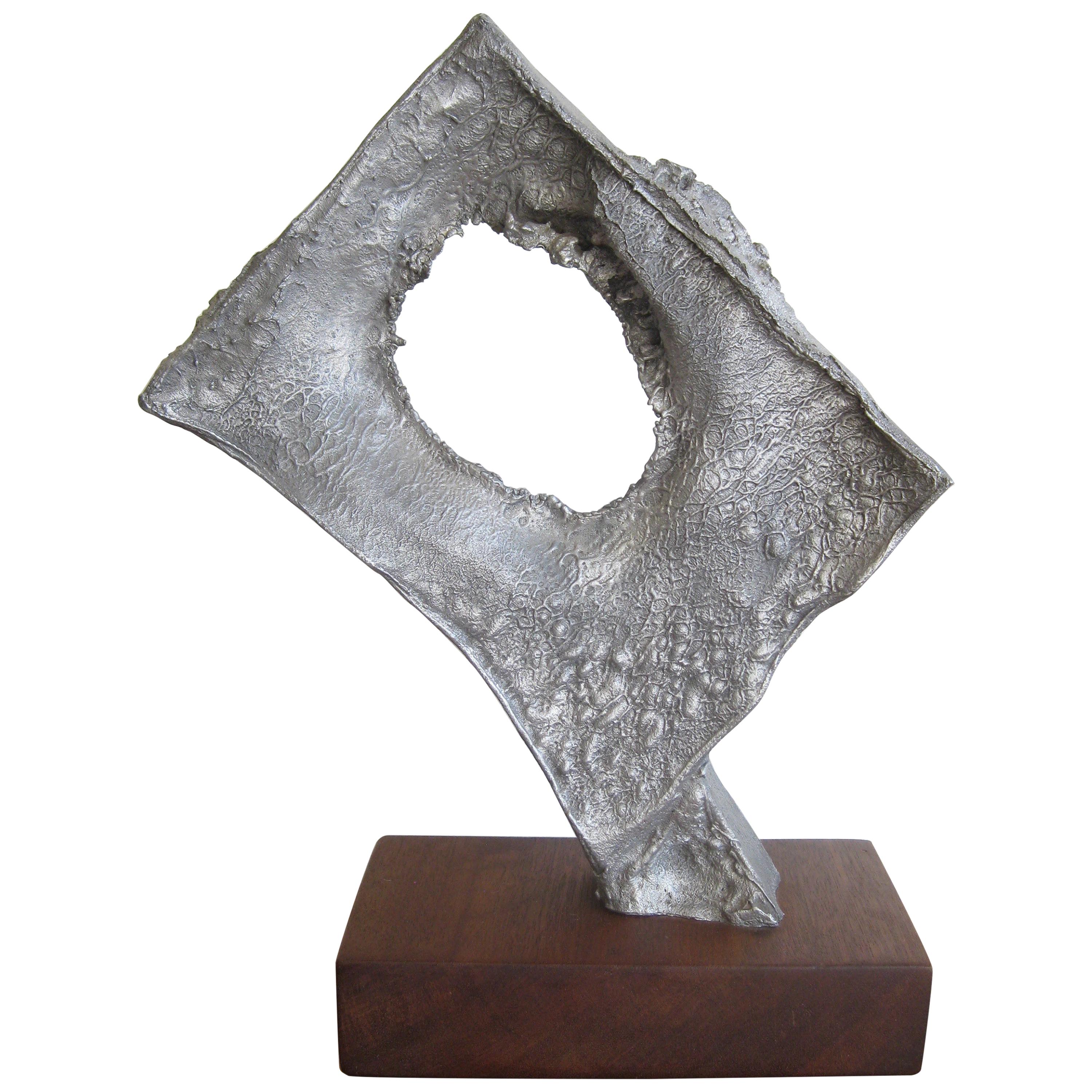
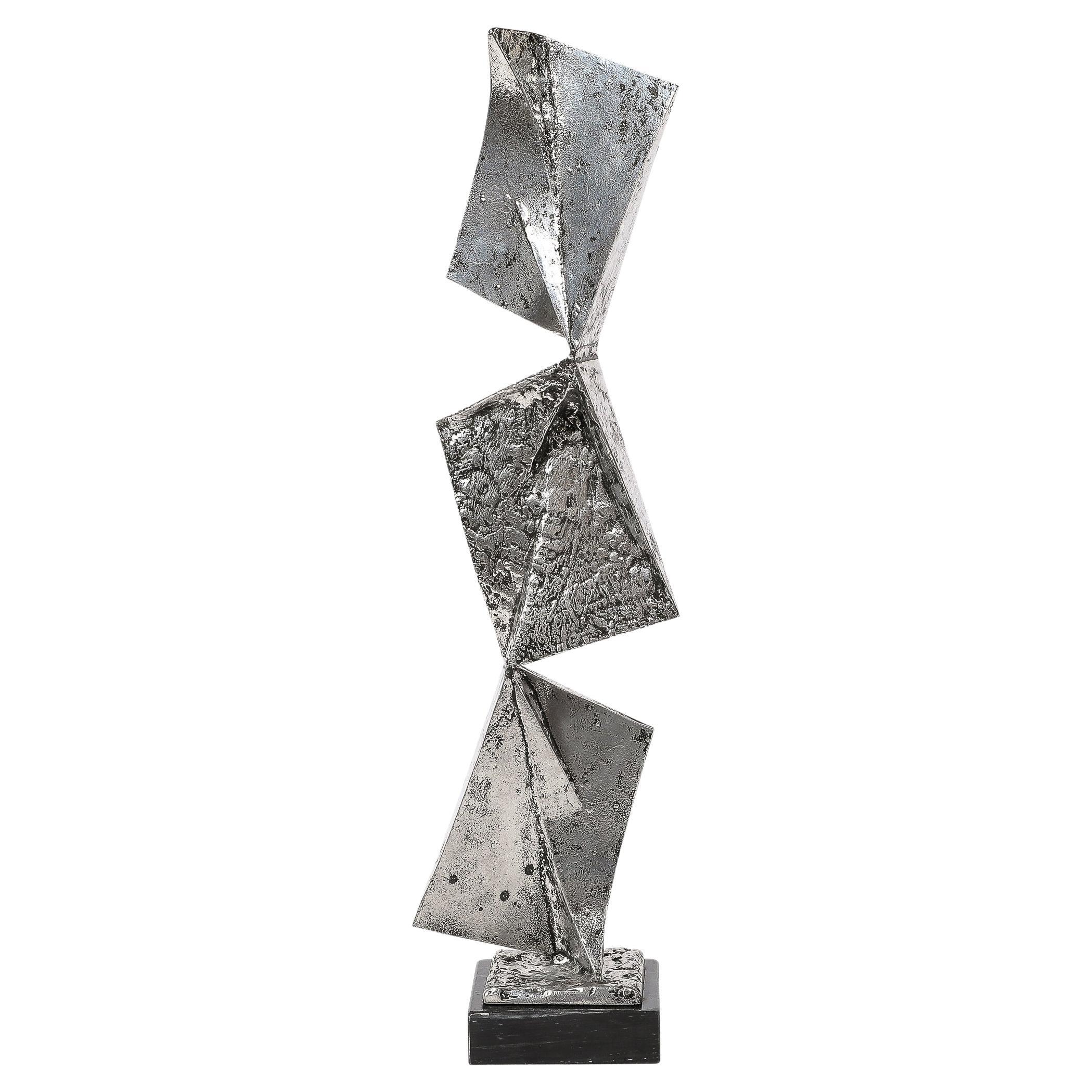
Alfred Van Loen 1978 (1968 in casting?) signed 18 1/2" x 5 1/2" abstract stainless steel sculpture "Grand Kabucki", mounted on wood base, overall size 21 1/2" x 7"
If there are any gaps in Van Loen's life as a U.S. citizen, they come in the early-1950s when he abandoned the Bohemian life of a young, promising New York artist and traveled to Mexico and briefly to Europe. In 1958, he married Helen Roberts (his second marriage ended in divorce and his first marriage, in pre-war Europe, is shrouded in mystery). ....Another room, the dust-free vault, contains a representative array of the work for which he is best known. Van Loen's reputation is built on his works as a direct carver a sculptor who carves into stone without preliminary blueprints, models or drawings. "They are a waste of time," he says. "I never start a piece until I see it finished in my mind." In all of these endeavors, Van Loen is a man in love with the materials. He is an artist who is part scientist, part architect, part explorer and part inventor. "I can only take credit when I feel I have taken a piece of nature and returned it to a natural form giving it just a different kind of life. And then I am happy about it." Van Loen looks sturdy and robust, despite recurring bouts of ill health related to diabetes. He is a tall, lean man whose strong face is chiseled with elean lines across his forehead. His translucent, gray-blue eyes are set beneath well-defined brows, and his head has the craggy but proud look of a Bighorn ram, his graying hair sweeping in a single curl behind each ear. He is a man of uninhibited confidence and ego, displayed in a voice still accented with German that booms out each sentence. But he is also a creature of humility groomed by his awe and reverence for God's work, for the art of every living thing. Van Loen is a prolific and steady worker with uncompromising ideals personally and professionally. He is a teacher who is fair but not lenient. He is a father who is playful but not unmindful of his responsibilities as a parent. wife - Van Loen further isolated himself from the cultural capital and "the sickness of the art world in New York City." Since then, Van Loen has become a bigger star in a smaller galaxy, with a devoted following of patrons and students. Whether casting medals, drawing in unbroken lines (similar to those of Picasso and Calder), painting in watercolors or carving stones and wood, Van Loen is the quintessential craftsman. The real Van Loen is in all of his work. He finds endless lines of continuity and form in the trees and birds and plants that surround him. His two lives. One begins in Germany, where he was born in 1924. The other picks up in 1947 when he arrived in New York. At age six, he says, his wealthy, Jewish parents Karl and Hedwig Lowenthal, owners of a sporting good store sent him to school at a Dominican cloister in Venlo, Holland. In 1938, forced to flee Nazi persecution in Germany, the family moved to Amsterdam, where Alfred joined them. A small carved crucifix which he produced caught the eye of a sponsor who enrolled him in the Royal Academy of Art in Amsterdam in 1941. Surrounded by the cruelty and destruction of war, the young artist became involved in the underground, spying and distributing anti-Nazi pamphlets. Betrayed by his best friend, he was arrested by the Gestapo and spent 16 months in Auschwitz. When he got out, he says, he had only 72 pounds distributed on his 6-foot, 2-inch frame. He did not expect to live. AFTER HIS RECOVERY, he changed his family name, Lowenthal, to Van Loen and returned to the Royal Academy to finish the formal and classical training in anatomy, architectural drawing, pottery, carpentry and casting. By the time he graduated, the war was over, and he decided to come to the United States. When Van Loen talks about this part of his background, the details are sketchy, sometimes contradictory. He does not dwell on that period of his life, and he will not be pressed for specifics. "People should never forget the atrocities of that war," he says. "But they should not continue, living with the memories of it." There are happier memories of his life in the United States, which began April 4, 1947, when a rebuilt troop transport brought 800 emigrants, including the 22-year-old Van Loen, to New York.
Alfred VAN LOEN (1924-1994) German/Dutch/American
Birth place: Oberhausen-Osterfeld, Germany
Profession: Sculptor, educator
Studied: Royal Acad. Art, Amsterdam, Holland, 1941-46.
Exhibited: PAFA Ann., 1950, 1954, 1960; NAD, 1964; WMAA,1957, 1967; Emil Walters Gal., NYC, 1968; Stony Brook Mus., 1968; Heckshere Mus., Huntington, NY, 1971; Harbor Gal., Cold Spring Harbor, NY, 1970s. Awards: first prize, Village AC, 1949; Louisa Robbins Award, Silvermine Guild Artists, 1956; first prize sculpture, Am. Soc. Contemporary Artists, 1964.
Member: AEA; Am. Soc. Contemp Artists; Am. Crafts Council; Long Island Univ. Pioneer Club; Huntington Artists Group.
Work: MMA; MoMA; Brooklyn Mus., NY; Nat. Mus., Jerusalem, Israel. Commissions: brass fountain, James White Community Center, Salt Lake City, UT, 1958; Peace Window, Community Church, New York, 1963; Crescendo, State Univ. NY Agric.
Tech. College Farmingdale, 1969; Jacob's Dream (brass), Little Neck Jewish Center, NY, 1970; bronze
acrylic portrait of Guy Lombardo, Hall of Fame, Stony Brook, NY, 1972.
Preferred media: stone, acrylic.
Publications: "Simple Methods of Sculpture," Channel Press, 1958; "Instructions to Sculpture," C.W. Post College, 1966;
"Origin of Structure and Design," Hamilton Press, 1967;
"Drawings by Alfred Van Loen," Harbor Gallery Press, 1969.
Teaching: instructor, Hunter College, 1953-54
instructor, North Shore Community ACr., NY, 1955-61;
asst. professor sculpture, C.W. Post College, Long Island Univ., 1962-.
- Créateur:Alfred Van Loen (1924 - 1994, Américain)
- Dimensions:Hauteur : 54,61 cm (21,5 po)Largeur : 17,78 cm (7 po)
- Support:
- Mouvement et style:
- Période:
- État:
- Adresse de la galerie:Surfside, FL
- Numéro de référence:1stDibs : LU38217514442
À propos du vendeur
4,9
Vendeur Platine
Vendeurs premium dont la note est supérieure à 4,7 et le délai de réponse de 24 heures maximum
Établi en 1995
Vendeur 1stDibs depuis 2014
1 864 ventes sur 1stDibs
Temps de réponse habituel : <1 heure
- ExpéditionRecherche du devis...Expédition depuis : Surfside, FL
- Politique des retours
Certaines parties de cette page ont été traduites automatiquement. 1stDibs ne garantit pas l
exactitude des traductions. L
anglais est la langue par défaut de ce site web.
Plus d articles de ce vendeur
Tout afficherSculpture abstraite moderniste en acier inoxydable soudé et réfléchissant Gary Steele
Gary Kahle (Américain, 1942- )
Sculpture abstraite en métal sur socle noir,
Signé à la main et daté de 1984
25 1/2" H x environ 18" L x et 12 1/2" D.
Provenance : Collection Palm...
Catégorie
années 1980, Abstrait, Sculptures - Abstrait
Matériaux
Acier inoxydable
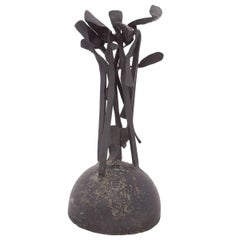
Sculpture expressionniste brutaliste mi-siècle moderne soudée d
après Paul Evans
Dans cette sculpture en bronze, l'artiste (inconnu) a soudé un groupe de totems ou de monuments en une pièce unifiée. T
Sculpture abstraite DADA : Assemblages
En revanche, la sculpture abstraite a suivi une voie légèrement différente. Plutôt que de se concentrer sur des sujets non figuratifs, il s'est concentré sur les matériaux, d'où l'émergence de l'Assemblage Art - une forme d'art visuel tridimensionnel réalisé à partir d'objets de la vie quotidienne, dits "trouvés" par l'artiste (objets trouves). Populaire dans les années 1950 et 1960 en Amérique, l'assemblage a effectivement comblé le fossé entre le collage et la sculpture, tandis que son utilisation de matériaux non artistiques - une caractéristique de l'art Néo-DADA - a anticipé l'utilisation d'objets produits en masse dans le Pop-Art. La sculpture d'assemblage est illustrée par les œuvres de Louise Nevelson (1899-1988), comme Mirror Image 1 (1969, Museum of Fine Arts, Houston), et par Jean Dubuffet (1901-85) et son Monument à la bête debout (1960, James R&R Thompson Center, Chicago). L'idiome a été considérablement stimulé par une importante exposition - The Art of Assemblage - au Museum of Modern Art, à New York, en 1961.
Parmi les autres exemples de "junk art" de style néo-dadaïste, citons Hudson River Landscape (1951, Whitney Museum of American Art) et Australia (1951, MoMA, NY), tous deux de David Smith (1906-1965) ; Untitled (wood, metal pieces, nails) (1960, Museum of Modern Art NYC) de Jesus Rafael Soto (b.1923) ; et certaines "combinaisons" de Robert Rauschenberg (1925-2008), telles que First Landing Jump (composée de : peinture, tissu, métal, cuir, appareil électrique, câble, peinture à l'huile, tableau) (1961, MoMA, NY). Untitled (industrial felt) (1967, Kunsthalle, Hamburg) de Robert Morris (né en 1931) est un autre exemple de l'utilisation de matériaux inhabituels dans la sculpture, tout comme le minimaliste Monument For Vladimir Tatlin (neon-lighting tubes...
Catégorie
Milieu du XXe siècle, Expressionnisme abstrait, Sculptures - Abstrait
Matériaux
Métal
Sculpture expressionniste abstraite brutaliste mi-siècle moderne soudée
Sculpture abstraite DADA : Assemblages
En revanche, la sculpture abstraite a suivi une voie légèrement différente. Plutôt que de se concentrer sur des sujets non figuratifs, il s'es...
Catégorie
Milieu du XXe siècle, Expressionnisme abstrait, Sculptures - Abstrait
Matériaux
Métal
L
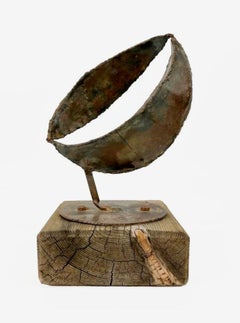
art israélien de 1965 Sculpture abstraite brutaliste en acier soudé Eli Ilan
Eli Ilan (אלי אילן), 1928-1982 était un sculpteur israélien.
Forme de cosse organique abstraite. En acier ou en fer, montée sur un socle en bois.
Ilan est né à Winnipeg, au Manitoba. Il s'inscrit à un programme de pré-médecine à l'université de Colombie-Britannique à Vancouver et émigre en Israël en 1948. Il a ensuite étudié l'archéologie préhistorique et l'anthropologie physique à l'Université hébraïque de Jérusalem. En 1956, il retourne au Canada pour étudier la sculpture à l'Ontario College of Art & Design. Il a vécu au kibboutz Sasa de 1959 à 1963. Il est décédé en 1982 à Césarée, en Israël.
Éducation
1955 Université hébraïque, Jérusalem, archéologie préhistorique et anthropologie physique
1956 Ontario College of Art, Toronto, Canada, sculpture sous la direction de Thomas Bowie
1959 Training College, Ottawa, techniques d'identification criminelle
1969 Festival d'art, Peinture et Sculpture en Israël. Ganei Hataarucha, Tel Aviv
Artistes : Chana Orloff, Eli Ilan, Zvi Aldouby, Jacob El Hanani, Ludwig Blum, Aharon Bezalel, Koki Doktori, Israel Hadany, Marcel Janco, Dov Feigin, Abel Pann, Esther Peretz Arad, Reuven Rubin, Ivan Schwebel, Jakob Steinhardt, Boris Schatz...
Catégorie
années 1960, Abstrait, Sculptures - Abstrait
Matériaux
Acier inoxydable
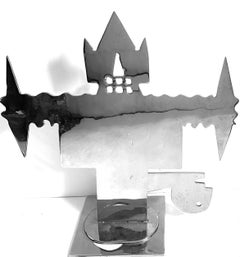
Grande sculpture abstraite moderne en acier poli et chrome Mod de Jack Schuyler
Jack Schuyler (1912-2002) Sculpture en métal poli "Abstract Figural Composition" signée à la main et datée de 1982.
Mesure 27" x 26-1/2" x 10.5" pouces.
On ne sait pas grand-chose ...
Catégorie
années 1980, Postmoderne, Sculptures - Abstrait
Matériaux
Acier inoxydable
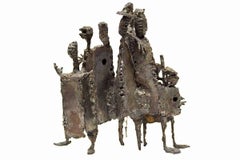
Sculpture expressionniste brutaliste mi-siècle moderne soudée
Dans cette sculpture en bronze, l'artiste (inconnu) a soudé un groupe de figures en une pièce unifiée. Ces figures prennent des caractéristiques animales et humaines, ce qui est évident dans la forme de leurs corps et de leurs visages.
Sculpture abstraite DADA : Assemblages
En revanche, la sculpture abstraite a suivi une voie légèrement différente. Plutôt que de se concentrer sur des sujets non figuratifs, il s'est concentré sur les matériaux, d'où l'émergence de l'Assemblage Art - une forme d'art visuel tridimensionnel réalisé à partir d'objets de la vie quotidienne, dits "trouvés" par l'artiste (objets trouves). Populaire dans les années 1950 et 1960 en Amérique, l'assemblage a effectivement comblé le fossé entre le collage et la sculpture, tandis que son utilisation de matériaux non artistiques - une caractéristique de l'art Néo-DADA - a anticipé l'utilisation d'objets produits en masse dans le Pop-Art. La sculpture d'assemblage est illustrée par les œuvres de Louise Nevelson (1899-1988), comme Mirror Image 1 (1969, Museum of Fine Arts, Houston), et par Jean Dubuffet (1901-85) et son Monument à la bête debout (1960, James R&R Thompson Center, Chicago). L'idiome a été considérablement stimulé par une importante exposition - The Art of Assemblage - au Museum of Modern Art, à New York, en 1961.
Parmi les autres exemples de "junk art" de style néo-dadaïste, citons Hudson River Landscape (1951, Whitney Museum of American Art) et Australia (1951, MoMA, NY), tous deux de David Smith (1906-1965) ; Untitled (wood, metal pieces, nails) (1960, Museum of Modern Art NYC) de Jesus Rafael Soto (b.1923) ; et certaines "combinaisons" de Robert Rauschenberg (1925-2008), telles que First Landing Jump (composée de : peinture, tissu, métal, cuir, appareil électrique, câble, peinture à l'huile, tableau) (1961, MoMA, NY). Untitled (industrial felt) (1967, Kunsthalle, Hamburg) de Robert Morris (né en 1931) est un autre exemple de l'utilisation de matériaux inhabituels dans la sculpture, tout comme le minimaliste Monument For Vladimir Tatlin (neon-lighting tubes...
Catégorie
Milieu du XXe siècle, Expressionnisme abstrait, Sculptures - Abstrait
Matériaux
Métal
Suggestions
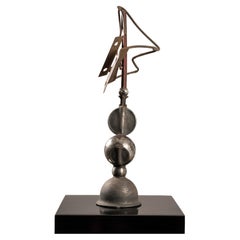
Sculpture abstraite Claude Viseux, 1970, acier inoxydable
Par Claude Viseux
Claude Viseux est un peintre, sculpteur et graveur aquafortiste et lithographe français né le 3 juillet 1927 à Champagne-sur-Oise et mort le 9 novembre 2008 à Anglet.
'est dans les a...
Catégorie
Vintage, années 1970, Inconnu, Sculptures et objets ciselés
Matériaux
Acier inoxydable
1 520 € Prix de vente
20 % de remise
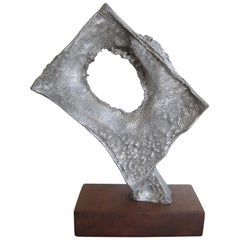
Sculpture abstraite brutaliste en aluminium coulé du milieu du siècle dernier, à la manière de Donald Drumm
Par Donald Drumm
Merveilleuse sculpture abstraite en aluminium coulé, de style moderne du milieu du siècle, datant des années 1960. Je ne trouve pas de signatures ou de marques mais il est très bien ...
Catégorie
Milieu du XXe siècle, Sculptures - Abstrait
Matériaux
Aluminium
1 291 € Prix de vente
20 % de remise
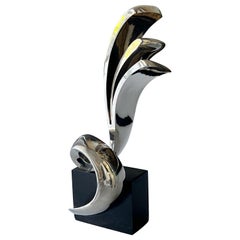
Sculpture abstraite en acier inoxydable de Peter Chinni 1969
Par Peter Chinni
Une grande sculpture en acier inoxydable poli de Peter Chinni. Signé, daté et numéroté 1/8
Catégorie
Vintage, années 1960, Américain, Sculptures - Abstrait
Matériaux
Acier inoxydable
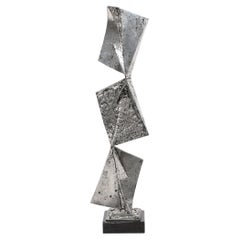
Sculpture abstraite moderniste du milieu du siècle dernier en aluminium moulé et soudé d
Arthur Court
Par Arthur Court
Cette sculpture géométrique abstraite en aluminium moulé et soudé d'Arthur Court, de style moderniste du milieu du siècle, est originaire des États-Unis, vers 1975. Il s'agit d'une c...
Catégorie
Vintage, années 1970, Américain, Mid-Century Modern, Sculptures - Abstrait
Matériaux
Aluminium
Sculpture abstraite en acier inoxydable
Sculpture abstraite en acier inoxydable.
Catégorie
Vintage, années 1960, Américain, Mid-Century Modern, Sculptures - Abstrait
Matériaux
Acier inoxydable
Exploration - 21e siècle, Contemporain, Sculpture abstraite, Acier inoxydable
Par Liechennay
Sculpture en acier inoxydable
Catégorie
XXIe siècle et contemporain, Contemporain, Sculptures - Abstrait
Matériaux
Acier inoxydable
265 600 € Prix de vente
20 % de remise