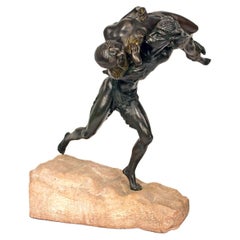
Articles similaires à Centaur abducting a woman
Vous voulez plus d
images ou de vidéos ?
Demander au vendeur plus d
images ou de vidéos
1 sur 15
Aimé-Jules DalouCentaur abducting a womancirca 1895-1902
circa 1895-1902
27 000 €TVA incluse
À propos de cet article
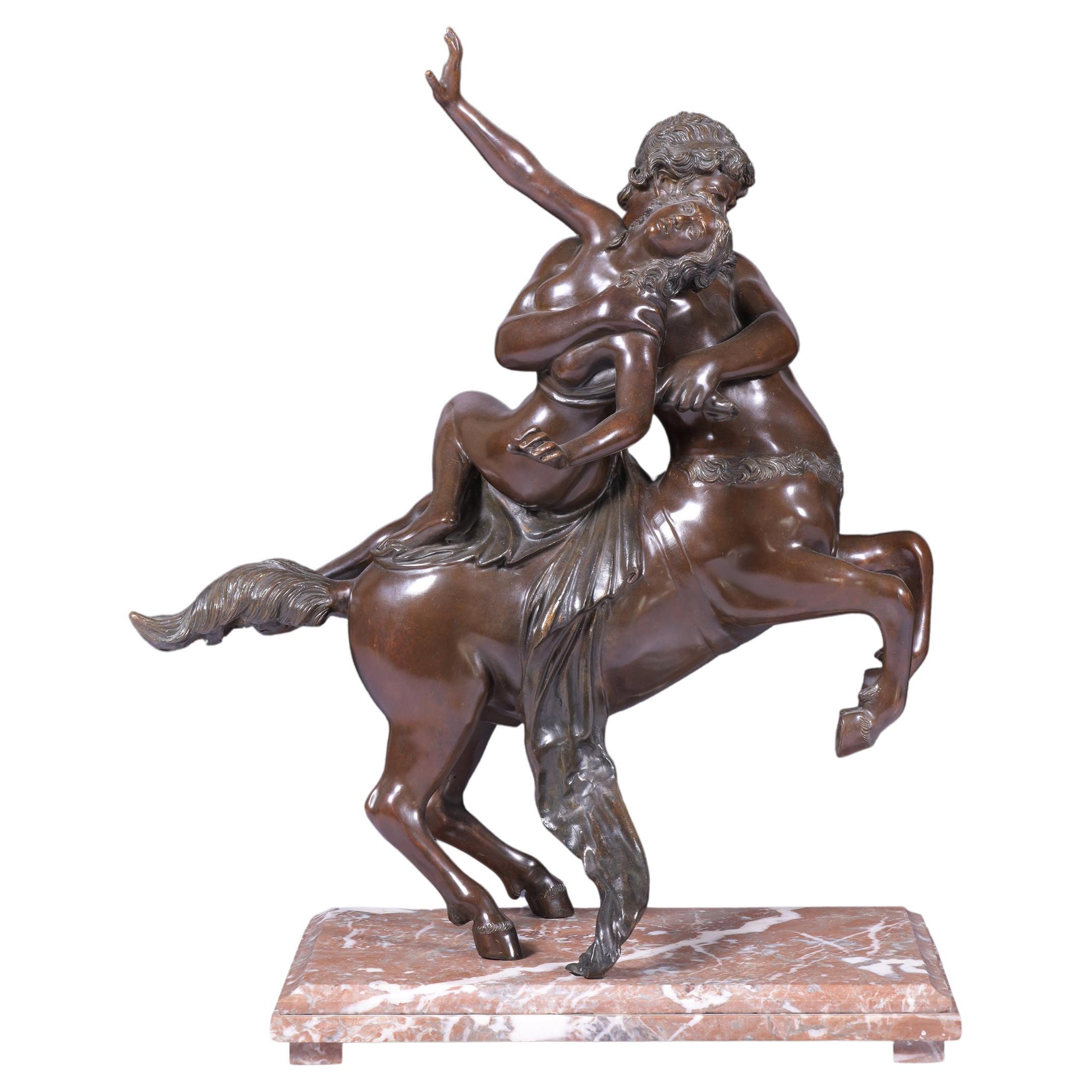
Centaur abducting a woman
by Aimé-Jules DALOU (1838-1902)
A bronze group sculpture with a dark brown patina
Signed on the base "Dalou"
Cast by "A.A. Hébrard" (with the foundry stamp)
The casts by Hébrard are always the finest ones regarding Dalou's works. Perfect in quality of cast and patina.
France
posthumous cast around 1910
height 27 cm
width 21 cm
depth 15,5 cm
A similar model reproduced in "Jules Dalou, le sculpteur de la République", Exhibition held at the Musée du Petit Palais, Paris, 2013, page 415, n°337.
Biography :
Aimé-Jules Dalou, said Jules Dalou (1838-1902) was a French sculptor, born from Protestants glovers craftsmen who raised in secularism and love of the Republic. Jules Dalou was very young talented for modeling and drawing, which earned him the attention of Jean-Baptiste Carpeaux, who made him entered in 1852 in the Little School, the future National School of Decorative Arts in Paris. In 1854, he was admitted to the School of Fine Arts in Paris, where he studied painting in the workshop of Abel de Pujol and sculpture in the workshop of Francisque Duret. He began to earn his living by working for decorators, and began his friendship with Auguste Rodin. Dalou then produced decorative sculptures for buildings on major Parisian avenues, such as the Hotel de la Paiva, on the Champs-Elysees Avenue. He presented but failed four times to Rome prize competition, but exhibited at the 1869 Salon his "Daphnis and Chloe" and the "Embroiderer" at the Salon of 1870, two pieces acquired by the French state. Dalou had one child, Georgette, a girl born with a mental handicap. This is to ensure funding for her daughter's life accommodation in the Orphanage of Arts, that Dalou bequeathed the funds from his workshop to this institution.
After the bloody week of May 1871 Dalou, his wife and their daughter were threatened as Communards, forced into exile and requested asylum. They then joined England and were greeted by his former fellows of the Little School, the painter Alphonse Legros. With Legros, much introduced in the City, he made a serie of terracotta statuettes inspired by boulonnaise peasants or intimate subjects (readers, lullabies), and portraits of the English aristocracy. He became professor for modeling at the National Art Training School, his influence was decisive for many British sculptors. He received orders for a public fountain in marble titled "Charity" (1877) near the Royal Exchange in London, and a monument dedicated to Queen Victoria's grandchildren located in the private chapel of Frogmore at Windsor Castle.
In May 1874, the Paris War Council condemned Dalou in absentia to hard labor for life. Having refused to beg for mercy, he was only in May 1879 being granted amnesty and his family finally returned from exile. His group "The Triumph of the Republic", originally planned for the Place de la Republique in Paris, was finally erected on the Place du Trône, renamed Place de La Nation in 1880. Dalou devoted twenty years to the realization of this monument. The years 1881 and 1882 were difficult, but the 1883 Salon finally revealed him to the French public. He exhibited his two high reliefs: "The Brotherhood of Peoples" and "Mirabeau answering Dreux-Brézé", for which he was awarded the Medal of Honor. Fleeing the world and living in family, Dalou engaged in considerable work and many orders both private and public. For the Universal Exhibition of 1889, was inaugurated on the Place de la Nation the plaster of "The Triumph of the Republic" commissioned by the city of Paris in 1879. Although the bronze version of the group was inaugurated in 1899, this work won the grand prize for sculpture in the exhibition. Dalou left the French Society of Artists in 1890 to expose at the National Society of Fine Arts, of which he was a founding member with Ernest Meissonier, Auguste Rodin and Pierre Puvis de Chavannes. Awarded Knight of the Legion of Honor in 1883, and promoted to officer by President Carnot in 1889, he was elevated to the rank of Commander of the same order in 1899 by President Loubet at the inauguration of the monument of "The Triumph of the Republic".
Dalou had no time to complete his last great project, a monument dedicated to workers, the idea came to him in 1889 after the first opening of "TheTriumph of the Republic". The formality of the ceremony and military parades held the people away from the official event. Dalou was disappointed. True to its republican ideals, he had hoped that this inauguration was an opportunity of great popular democratic party (as it was at the inauguration of the bronze in 1899). His idea was then to pay tribute to the world of workers, craftsmen and peasants with this work being the central subject. At the end of his career Dalou described the project as follows: "I think I have finally found the monument to the workers that I seek since 1889. Sober, without molding or ornament, I wish it'd be severe and imposing. Will I execute it? There is the question. I am old and my health is so weak."
- Créateur:Aimé-Jules Dalou (1838 - 1902, Français)
- Année de création:circa 1895-1902
- Dimensions:Hauteur : 27 cm (10,63 po)Largeur : 21 cm (8,27 po)Profondeur : 15,5 cm (6,11 po)
- Support:
- Mouvement et style:
- Période:
- État:
- Adresse de la galerie:PARIS, FR
- Numéro de référence:Vendeur : N.X1stDibs : LU2514216390642

Aimé-Jules Dalou
Aimé-Jules Dalou (1838-1902) est l'un des rares sculpteurs français de la fin du XIXe siècle dont la réputation n'a d'égale que celle de ses contemporains, Henri Chapu (1833-1891) et Marius Jean Antonin Mercié (1845-1916). Dalou a eu une influence considérable et a été l'un des membres fondateurs de la Société des Artistes Français et, plus tard, de la Société Nationale des Beaux-Arts. Il a été officiellement récompensé par le plus haut grade de la Légion d'Honneur deux ans avant sa mort, lors de l'inauguration du Triomphe de la République, en 1899. Il commence sa formation artistique en 1852 à la Petite École après y avoir été encouragé par Jean-Baptiste Carpeaux, où il étudie le dessin et le modelage. Carpeaux a continué à soutenir Dalou tout au long de sa carrière et a fortement influencé sa sculpture. Dalou a commencé à travailler dans le domaine de la sculpture décorative pour deux entreprises parisiennes, les orfèvres Lefèvre et Favière. À cette époque, il contribue à l'élaboration des caractéristiques architecturales de l'Hôtel de la Païva, la résidence de l'infâme courtisane française Esther Lachmann, connue sous le nom de "La Païva". L'approche unique de Dalou réside dans le large éventail de sujets, de sources picturales et sculpturales, à travers lesquels il a absorbé un spectre impressionnant d'inspiration. L'œuvre d'un sculpteur du XVIIIe siècle, Louis-François Roubiliac, a joué un rôle important dans le développement artistique de Dalou, dont il a étudié les sculptures pendant son séjour à Londres. L'œuvre de Dalou comprend des frises, des maquettes, des reliefs et des figures individuelles en bronze. Il est connu pour ses compositions de groupes allégoriques d'inspiration baroque, ainsi que pour ses représentations des classes laborieuses rurales françaises. Dalou a encouragé les étudiants en art à se libérer des contraintes des traditions établies. Son style et ses enseignements sont considérés comme ayant éveillé une nouvelle génération de jeunes sculpteurs britanniques dont le travail a été plus tard aligné sur le mouvement de la Nouvelle Sculpture.
À propos du vendeur
5,0
Vendeur reconnu
Ces vendeurs prestigieux sont des leaders du secteur. Ils représentent le summum en matière de qualité et de design.
Établi en 1992
Vendeur 1stDibs depuis 2023
11 ventes sur 1stDibs
Temps de réponse habituel : 1 heure
- ExpéditionRecherche du devis...Expédition depuis : PARIS, France
- Politique des retours
Certaines parties de cette page ont été traduites automatiquement. 1stDibs ne garantit pas l
exactitude des traductions. L
anglais est la langue par défaut de ce site web.
Plus d articles de ce vendeur
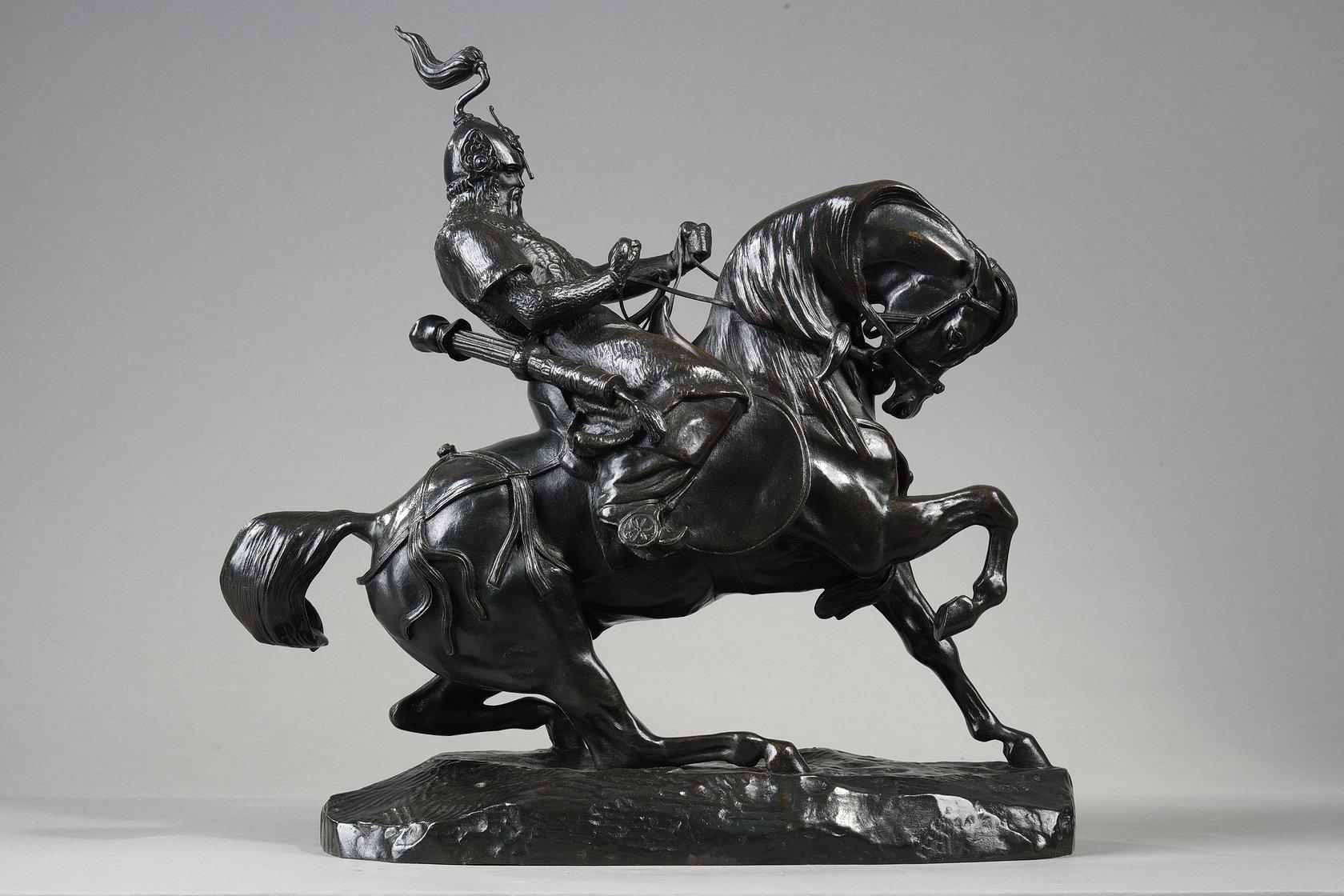
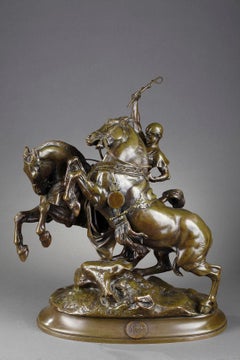
Tout afficherGuerrier tartare arrêtant son cheval
Par Antoine-Louis Barye
Guerrier tartare arrêtant son cheval
par Antoine-louis BARYE (1796-1875)
Groupe équestre en bronze à patine nuancée brun-vert foncé
toute marque de fonte
ancienne édition coulée
F...
Catégorie
Fin du XIXe siècle, École française, Sculptures - Figuratif
Matériaux
Bronze
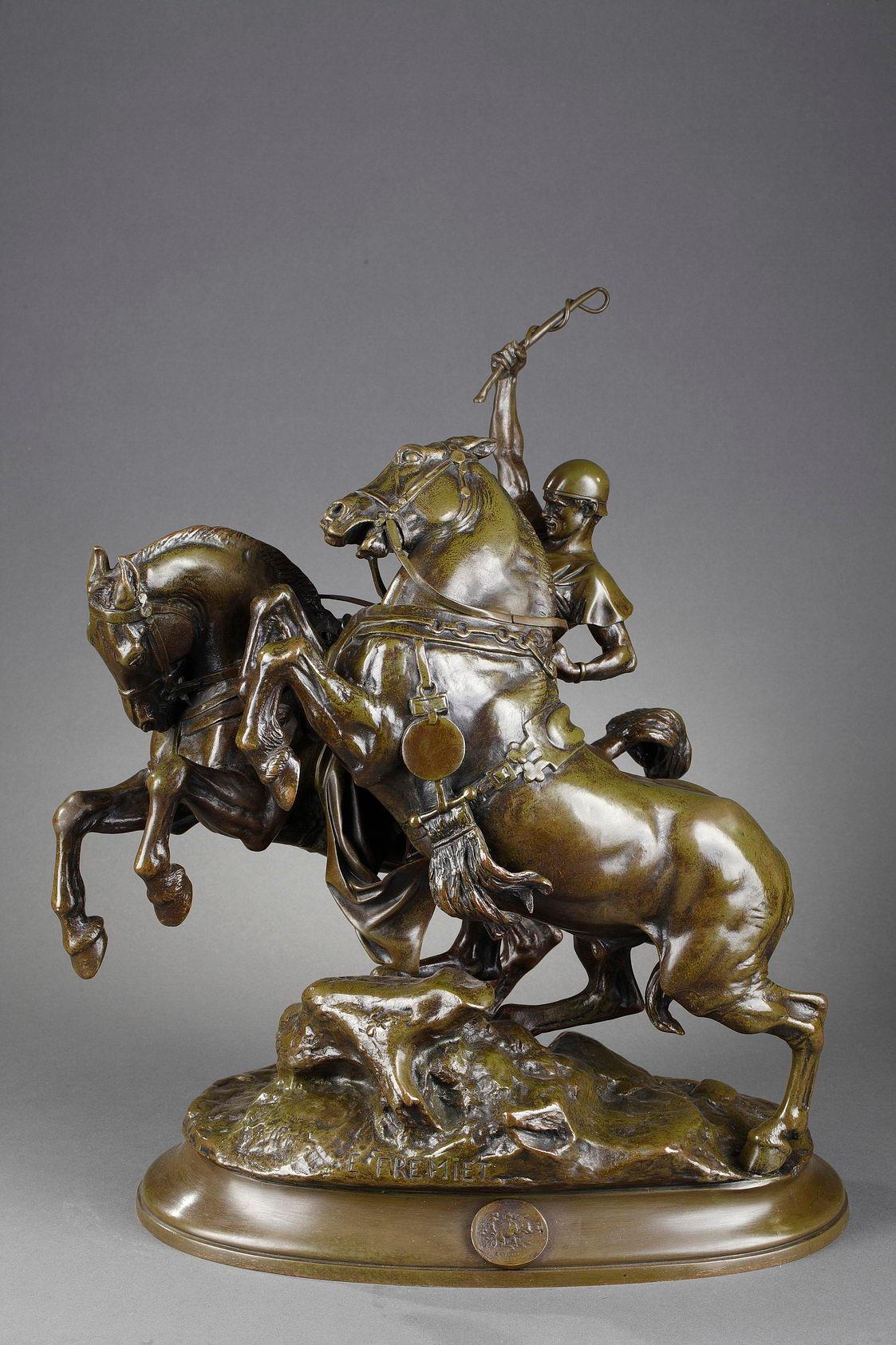
Le conducteur romain sur son chariot
Par Emmanuel Fremiet
Le conducteur romain sur son chariot
par Emmanuel Fremiet (1824-1910)
Groupe en bronze avec sa patine verte nuancée d'origine
signé sur la base " E. Fremiet ".
cast by En savoir plu...
Catégorie
Fin du XIXe siècle, École française, Sculptures - Figuratif
Matériaux
Bronze
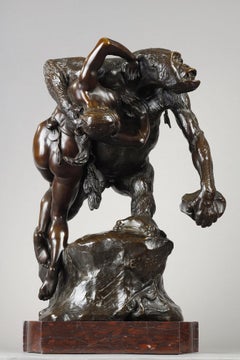
Gorilla enlève une femme
Par Emmanuel Fremiet
Emmanuel FREMIET (1824-1910)
Gorilla enlève une femme
Rare groupe en bronze à patine brun foncé verdâtre
signé "E. Fremiet" sur la base
coulée par " F. Barbedienne Fondeur " (marqu...
Catégorie
Fin du XIXe siècle, École française, Sculptures - Figuratif
Matériaux
Bronze
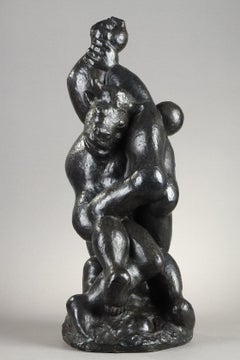
Thésée et le Minotaure
Par Baltasar Lobo
Thésée et le Minotaure
par Baltasar LOBO (1910-1993)
Groupe en bronze à patine brun foncé verdâtre
Signé au bas du dos " Lobo ".
Coulée par " Susse Fondeur Paris " (avec la marque d...
Catégorie
années 1970, École française, Sculptures - Figuratif
Matériaux
Bronze
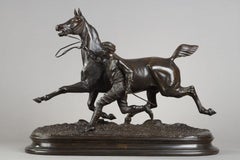
Entraînement des chevaux avec son palefrenier
Entraînement des chevaux avec son palefrenier
par Arthur Marie Gabriel comte du Passage (1838-1909)
Groupe en bronze à patine brun foncé nuancée
Signé s...
Catégorie
Fin du XIXe siècle, École française, Sculptures - Figuratif
Matériaux
Bronze
La caresse de l
amour
Par Albert-Ernest Carrier-Belleuse
"Caresse d'amour"
par Albert-Ernest CARRIER-BELLEUSE (1824-1887)
Sculpture de groupe en bronze à patine brun foncé nuancée
Signé au dos "A. Carrier-Belleuse"
Reposant sur une base ...
Catégorie
années 1870, École française, Sculptures - Figuratif
Matériaux
Bronze
Suggestions
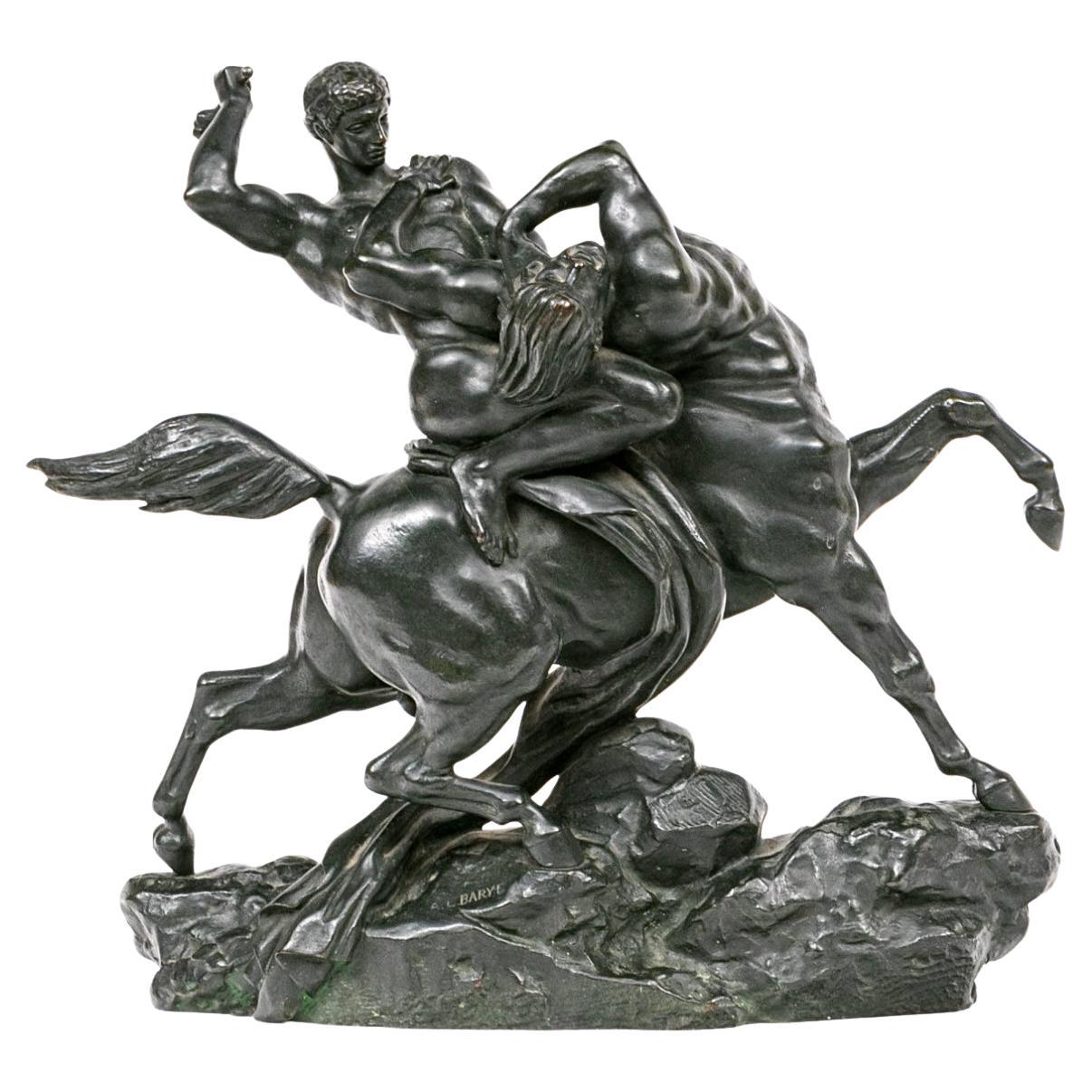
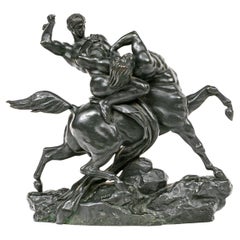
Antoine Louis Barye Thésée terrassant le Bienor du Centaure
Par Antoine-Louis Barye
Antoine Louis Barye Thésée terrassant le Centaure Bienor Groupe en bronze patiné noir.
Groupe en bronze français intitulé "Thesee combattant le centaure Bienor, esquisse".
Fonte d'a...
Catégorie
Antiquités, années 1850, Français, Beaux-Arts, Sculptures - Figuratif
Matériaux
Bronze
Combat : indien, cheval et buffle
Combat : Indien, cheval et buffle : Arthur Putnam (6 septembre 1873 - 27 mai 1930) était un sculpteur et animalier américain reconnu pour ses sculptures en bronze d'animaux sauvages....
Catégorie
Début du XXe siècle, Romantique, Sculptures - Figuratif
Matériaux
Bronze
Prix sur demande
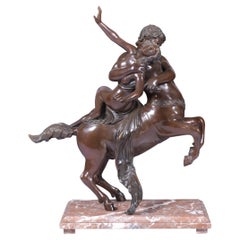
Groupe de Nessus fuyant Deianira en bronze français du 19ème siècle
Par Giambologna
Groupe de Nessus en bronze du Grand Tour français déguisant Deianira d'après Giambologna sur socle en marbre.
D'après le modèle de Giambologna
Années 1880 environ
Français
...
Catégorie
Antiquités, XIXe siècle, Français, Grec classique, Sculptures - Figuratif
Matériaux
Marbre, Bronze
Persée libère Andromède
JEAN-LÉON GRÉGOIRE
Français, (1840-1890)
Persée libère Andromède
Bronze patiné ; Signé 'L. GREGOIRE'
25 1/2 x 13 x 11 pouces
Notes :
Jean-Léon Grégoire commence à exposer au S...
Catégorie
années 1870, Sculptures - Figuratif
Matériaux
Bronze
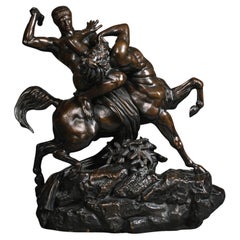
Antoine Louis Barye (1795-1875), Thésée combattant le centaure Bianor
Par Antoine-Louis Barye
Groupe en bronze patiné, intitulé "Thésée Combattant le Centaure Bianor", fondu par Ferdinand Barbedienne, d'après le modèle d'Antoine Louis Barye (1795-1875).
Signé " I.L.A. A. " e...
Catégorie
Antiquités, XIXe siècle, Français, Grec classique, Sculptures - Figuratif
Matériaux
Bronze
Art Deco Satyr Abducting a Nymph Sculpture by Marcel Bouraine
Par Marcel-André Bouraine
Sculpture Art Déco en bronze patiné à froid de Marcel-André Bouraine intitulée Satyre enlevant une nymphe. La pièce repose dans un rocher sculpté à la main.
Fabriqué en France
Cir...
Catégorie
20ième siècle, Français, Art déco, Sculptures - Figuratif
Matériaux
Calcaire, Bronze