Articles similaires à Antique Armadillo, Pangolin
Anteater Lithographs – Brodtmann c.1830

Vous voulez plus d
images ou de vidéos ?
Demander au vendeur plus d
images ou de vidéos
1 sur 9
Antique Armadillo, Pangolin
Anteater Lithographs – Brodtmann c.1830
440 €par ensemble|TVA incluse
À propos de cet article
Antique Armadillo, Pangolin
Anteater Lithographs – Brodtmann c.1830
This striking pair of early 19th-century zoological lithographs was produced around 1830 by the Swiss artist and lithographer Karl Joseph Brodtmann, after the scientific studies of the naturalist Heinrich Rudolf Schinz. The plates originate from Schinz’s *Geïllustreerde Natuurlijke Geschiedenis van Menschen en Dieren* and related natural history publications, which played a key role in introducing exotic mammals to a European audience.
The left plate is devoted to armadillos. It shows the common armadillo (Dasypus novemcinctus), often referred to as the nine-banded armadillo, alongside a larger, heavily armoured species historically described as the “shielded armadillo.” The animals are depicted in profile, allowing a clear view of their segmented bony armour, elongated tails, and clawed feet adapted for digging. These prints fascinated early 19th-century viewers, as armadillos were among the most unusual mammals known from the Americas, frequently nicknamed “little armored pigs” in older European sources.
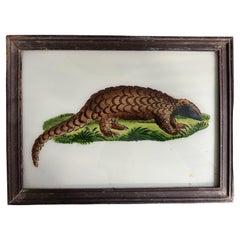
The right plate features two other remarkable insect-eating mammals. At the top is the long-tailed pangolin (Manis tetradactyla), also known as the scaly anteater, shown with its distinctive overlapping keratin scales and powerful tail. Pangolins were long surrounded by myth and curiosity in Europe, often described as “walking pinecones.” Below is the giant anteater (Myrmecophaga tridactyla), sometimes called the great ant-eater, recognisable by its elongated snout, bushy tail, and bold shoulder markings. The protruding tongue is subtly indicated, emphasizing its specialised feeding behaviour.
Together, these plates form a visually powerful and coherent set highlighting mammals defined by armour, scales, and specialised anatomy. They appeal strongly to collectors of natural history illustration and to interior designers seeking unusual, conversation-starting imagery. Displayed side by side, the prints create a balanced composition that combines scientific clarity with strong decorative presence.
Condition report:
Overall good antique condition. Light foxing and scattered age-related spotting visible, consistent with lithographs from circa 1830. No major tears or losses observed.
Framing tips:
Frame as a pair with wide off-white or light taupe mats and simple black, dark walnut, or ebonised frames to emphasize the fine engraved textures and sculptural forms.
Keywords:
antique animal print, armadillo lithograph, pangolin print, scaly anteater, giant anteater, ant-eater, exotic mammals, 19th century natural history, Brodtmann lithography, Schinz zoology, scientific illustration, antique zoological art, animal prints for interior
Technique: Lithography
Maker: Karl Joseph Brodtmann, Switzerland, circa 1830
- Dimensions:Hauteur : 26 cm (10,24 po)Largeur : 32,2 cm (12,68 po)Profondeur : 0,2 mm (0,01 po)
- Vendu en tant que:Lot de 2
- Matériaux et techniques:
- Lieu d origine:
- Période:
- Date de fabrication:circa 1830
- État:Overall good antique condition. Light foxing and scattered age-related spotting visible, consistent with lithographs from circa 1830. No major tears or losses observed.
- Adresse du vendeur:Langweer, NL
- Numéro de référence:Vendeur : BG-13176-107, -1081stDibs : LU3054348134162
À propos du vendeur
5,0
Vendeur reconnu
Ces vendeurs prestigieux sont des leaders du secteur. Ils représentent le summum en matière de qualité et de design.
Vendeur Platine
Vendeurs premium dont la note est supérieure à 4,7 et le délai de réponse de 24 heures maximum
Établi en 2009
Vendeur 1stDibs depuis 2017
2 821 ventes sur 1stDibs
Temps de réponse habituel : 1 heure
- ExpéditionRecherche du devis...Expédition depuis : Langweer, Pays-Bas
- Politique des retours
Certaines parties de cette page ont été traduites automatiquement. 1stDibs ne garantit pas l
exactitude des traductions. L
anglais est la langue par défaut de ce site web.
Plus d articles de ce vendeur
Tout afficherGravure animalière ancienne avec paresseux, tatous et pangolin - vers 1825
Titre : Gravure animalière ancienne avec paresseux, tatous et pangolin - Début du 19e siècle
Description : Cette étonnante gravure du début du 19e siècle, coloriée à la main, présen...
Catégorie
Antiquités, années 1820, Estampes
Matériaux
Papier
Antique Porcupine, Agouti
Tapir Lithographs – Brodtmann after Schinz c.1830
Antique Porcupine, Agouti & Tapir Lithographs – Brodtmann after Schinz c.1830
This finely executed pair of early 19th-century zoological lithographs was produced circa 1830 by the S...
Catégorie
Antiquités, années 1830, Suisse, Estampes
Matériaux
Papier
Pair of Antique Zoological Engravings – Exotic Mammals, c.1830
Pair of Antique Zoological Engravings – Exotic Mammals, c.1830
This rare matched pair of early nineteenth-century zoological engravings presents exotic mammals as they were understo...
Catégorie
Antiquités, années 1830, Allemand, Estampes
Matériaux
Papier
370 € / ensemble
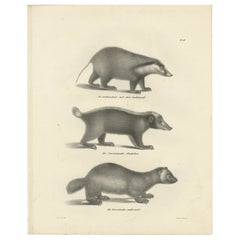
Lithographie du XIXe siècle représentant un pécari à collier, une mouffette javanaise et un carcajou nordique
Lithographie du XIXe siècle représentant un pécari à collier, une mouffette javanaise et un carcajou nordique
Cette lithographie détaillée du XIXe siècle représente trois mammifèr...
Catégorie
Antiquités, années 1830, Estampes
Matériaux
Papier
« The Mammals », lithographies d
histoire naturelle des héritiers, publiées en 1836
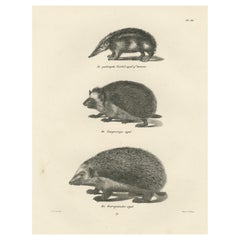
La lithographie que vous avez fournie illustre trois espèces de hérissons, avec des détails anatomiques précis. Comme les gravures précédentes, celle-ci fait partie de "De Zoogdieren...
Catégorie
Antiquités, années 1830, Estampes
Matériaux
Papier
Antique Rodents
Hares Lithographs – Rabbits, Guinea Pig
Jerboa c.1830
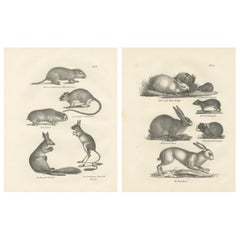
Antique Rodents & Hares Lithographs – Rabbits, Guinea Pig & Jerboa c.1830
This finely engraved pair of early 19th-century zoological lithographs was created around 1830 by the Swiss...
Catégorie
Antiquités, années 1830, Suisse, Estampes
Matériaux
Papier
Suggestions
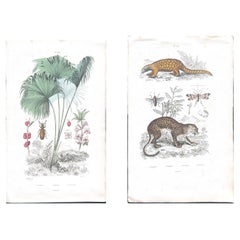
Pangolin, panthère et insectes - Gravure zoologique ancienne originale, vers 1849
Pangolin, panthère et insectes - Gravure zoologique ancienne originale, vers 1849
Dict. Univ. d'Hist. NAT, planche 431
Description :
Une captivante gravure zoologique originale colo...
Catégorie
Antiquités, XIXe siècle, Français, Estampes
Matériaux
Papier
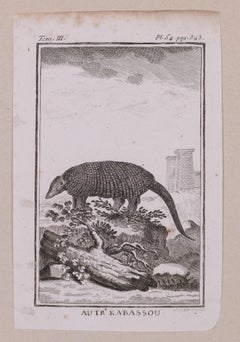
Gravure d
origine Armadillo - XIXe siècle
Armadillo est une lithographie originale réalisée par un artiste anonyme à la fin du XIXe siècle.
Titre original : Autre Kabassou. En haut de l'empreinte : Tom. III, Pl. 54 pag. 343...
Catégorie
XIXe siècle, Estampes - Animaux
Matériaux
Eau-forte
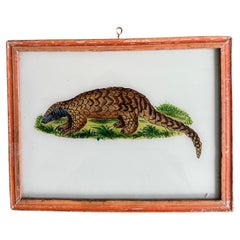
Portrait de tatou du 19e siècle : Étude détaillée d
histoire naturelle
Cette captivante peinture de tatou du XIXe siècle offre une représentation détaillée et réaliste de cette créature unique. L'attention portée par l'artiste à la texture de l'armure d...
Catégorie
Antiquités, XIXe siècle, Anglais, Peinture et sérigraphie
Matériaux
Verre
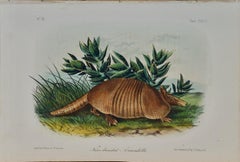
Tatou : une lithographie originale du 19e siècle de John J. Audubon, coloriée à la main
Par John James Audubon
Il s'agit d'une lithographie originale du 19e siècle de John James Audubon, coloriée à la main, intitulée "Nine-banded Armadillo", No. 30, Plate CXLVI, tirée de "Viviparous Quadruped...
Catégorie
Milieu du XIXe siècle, Naturalisme, Estampes - Animaux
Matériaux
Lithographie
539 € Prix de vente
20 % de remise
« Grand portrait Armadillo du 19e siècle : art animalier détaillé de la faune
Cet impressionnant portrait de tatou du XIXe siècle capture les caractéristiques distinctes de cette créature fascinante avec des détails méticuleux. Le rendu habile de l'artiste met...
Catégorie
Antiquités, XIXe siècle, Anglais, Peinture et sérigraphie
Matériaux
Verre
Pangolin De L
Inde - Lithographie originale de Paul Gervais - 1854
Par Paul Gervais
Pangolin De L'Inde est une lithographie originale sur papier couleur ivoire, réalisée par Paul Gervais (1816-1879). L'œuvre est tirée de la série "Les Trois Règnes de la Nature", et ...
Catégorie
années 1850, Moderne, Estampes - Animaux
Matériaux
Papier, Lithographie