Articles similaires à Lions, Tigers
Spotted Cats — Decorative Natural History Print c.1790

Vous voulez plus d
images ou de vidéos ?
Demander au vendeur plus d
images ou de vidéos
1 sur 9
Lions, Tigers
Spotted Cats — Decorative Natural History Print c.1790
220 €TVA incluse
À propos de cet article
Wild Cats of the World — Hand-Colored Natural History Engraving, Bertuch c.1790
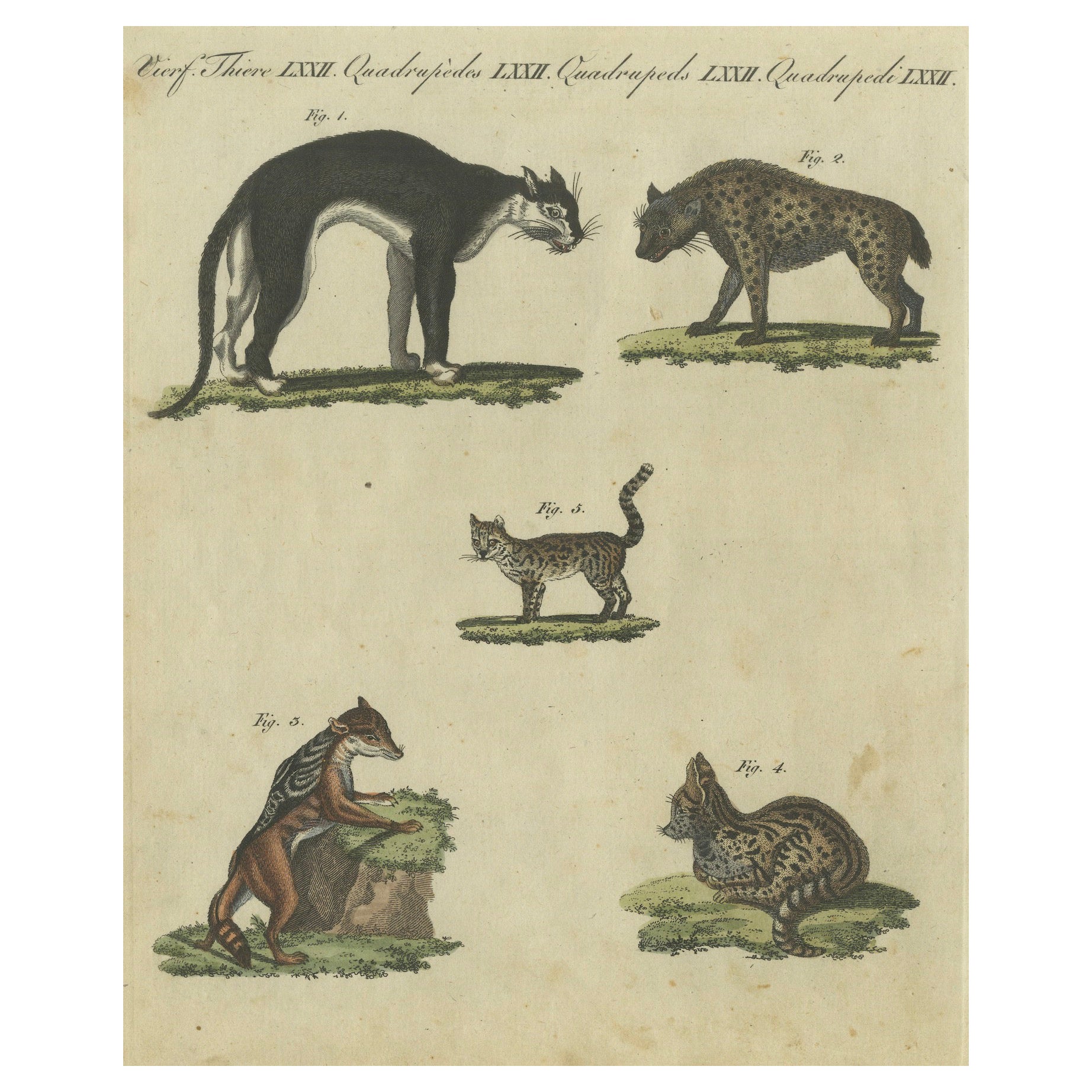
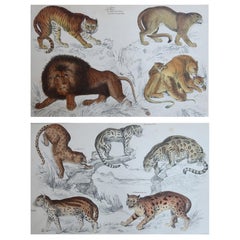
This finely detailed late-18th-century natural history engraving depicts a group of wild quadrupeds, presented as six individual figures arranged across the sheet. The animals include a reclining lion, a standing lioness, a tiger in motion, and several spotted and striped wild cats, each carefully differentiated by posture, coat pattern, and expression. The plate reflects the Enlightenment-era ambition to classify and visually compare animal species through clear, instructive imagery.
The print is titled “Vierf Thiere V / Animalia quadrup. V / Quadruped. V” and was published as plate 8 in volume I of Bilderbuch für Kinder (Picture Book for Children), the celebrated educational encyclopedia edited by Friedrich Justin Bertuch and issued in Weimar between 1790 and 1830. This monumental project comprised twelve volumes with a total of 1,185 hand-colored plates and approximately 6,000 individual engravings, making it one of the most ambitious illustrated educational works of its time.
Bertuch’s Bilderbuch für Kinder was intended not only for children but also for families, teachers, and collectors, presenting knowledge of nature, geography, technology, and culture in a visually engaging and accessible format. The engravings were produced by artists associated with the Princely Free Drawing School in Weimar, ensuring a consistently high artistic and technical standard.
This plate was engraved by Jacob Xaver Schmuzer, after various zoological sources. Schmuzer was a highly respected German engraver, particularly known for his contributions to illustrated natural history works, including Unterhaltungen aus der Naturgeschichte by Gottlieb Tobias Wilhelm. His confident line work and careful modeling are evident here, especially in the rendering of fur texture, musculature, and movement. The original hand coloring adds warmth and clarity, enhancing both the scientific and decorative qualities of the image.
Today, prints from Bertuch’s Bilderbuch are sought after by collectors of natural history, animal imagery, and Enlightenment-era educational material. With its balanced composition and richly detailed animal figures, this engraving also works beautifully as wall art, appealing equally to collectors, interior designers, and admirers of early zoological illustration.
Condition report:
Good condition for its age. Light overall toning and minor handling wear consistent with late-18th-century paper. Original hand coloring well preserved. Please study the image carefully for exact condition.
Framing tips:
A natural wood, light walnut, or simple black frame complements the subject. Use an off-white or light cream mat to highlight the hand coloring and give the figures visual space.
Technique: Etching with original hand coloring on laid paper
Maker: Jacob Xaver Schmuzer after various sources, published by Friedrich Justin Bertuch, Weimar, circa 1790
- Dimensions:Hauteur : 26,5 cm (10,44 po)Largeur : 21,3 cm (8,39 po)Profondeur : 0,2 mm (0,01 po)
- Matériaux et techniques:Papier,Gravé
- Lieu d origine:
- Période:
- Date de fabrication:circa 1790
- État:Good condition for its age. Light overall toning and minor handling wear consistent with late-18th-century paper. Original hand coloring well preserved. Please study the image carefully for exact condition.
- Adresse du vendeur:Langweer, NL
- Numéro de référence:Vendeur : BG-14144-11stDibs : LU3054348154032
À propos du vendeur
5,0
Vendeur reconnu
Ces vendeurs prestigieux sont des leaders du secteur. Ils représentent le summum en matière de qualité et de design.
Vendeur Platine
Vendeurs premium dont la note est supérieure à 4,7 et le délai de réponse de 24 heures maximum
Établi en 2009
Vendeur 1stDibs depuis 2017
2 826 ventes sur 1stDibs
Temps de réponse habituel : 1 heure
- ExpéditionRecherche du devis...Expédition depuis : Langweer, Pays-Bas
- Politique des retours
Certaines parties de cette page ont été traduites automatiquement. 1stDibs ne garantit pas l
exactitude des traductions. L
anglais est la langue par défaut de ce site web.
Plus d articles de ce vendeur
Tout afficherRemarquable gravure colorée à la main de 1805 représentant des chats sauvages et des lapins prédateurs
Gravure manuscrite de 1805 représentant des chats sauvages et des mammifères prédateurs de Bertuch
Description : Cette remarquable gravure coloriée à la main, tirée du *Porte-Feu...
Catégorie
Antiquités, Début des années 1800, Estampes
Matériaux
Papier
Gravure Big Cats
Marsupials : Lion, Tigre, Kangourou - Antique 1867
Gravure Big Cats & Marsupials : Lion, Tigre, Kangourou - Antique 1867
Cette étonnante gravure ancienne représente une variété de grands félins, de marsupiaux et d'autres mammifères ...
Catégorie
Antiquités, années 1860, Allemand, Estampes
Matériaux
Papier
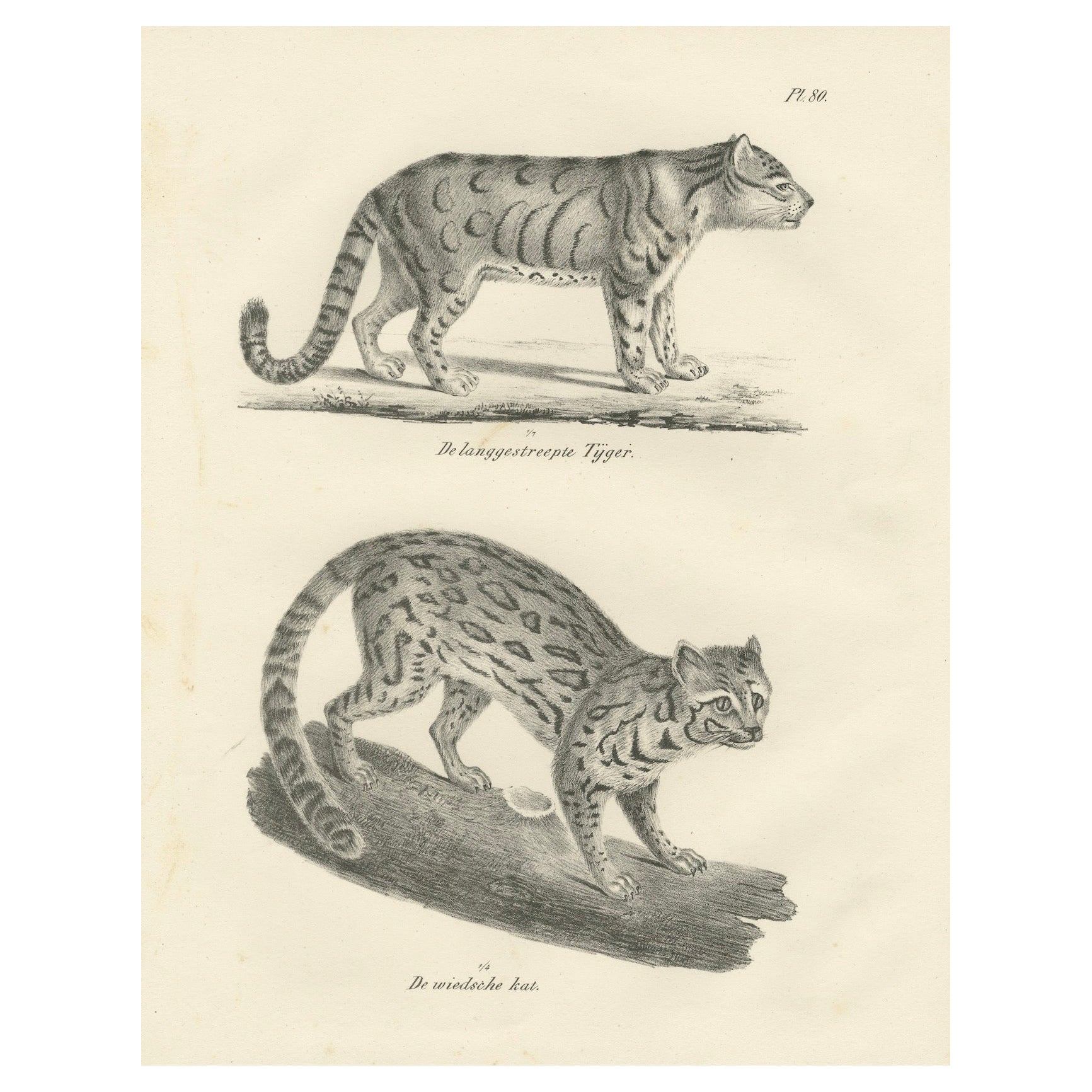
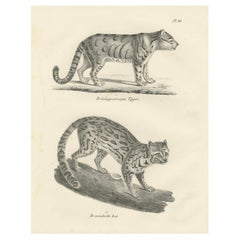
Lithographie du 19e siècle représentant le tigre à longues rayures et le chat sauvage d
Asie
Lithographie du 19e siècle représentant le tigre à longues rayures et le chat sauvage d'Asie
Cette remarquable lithographie du XIXe siècle met en scène deux félins fascinants : le...
Catégorie
Antiquités, années 1830, Estampes
Matériaux
Papier
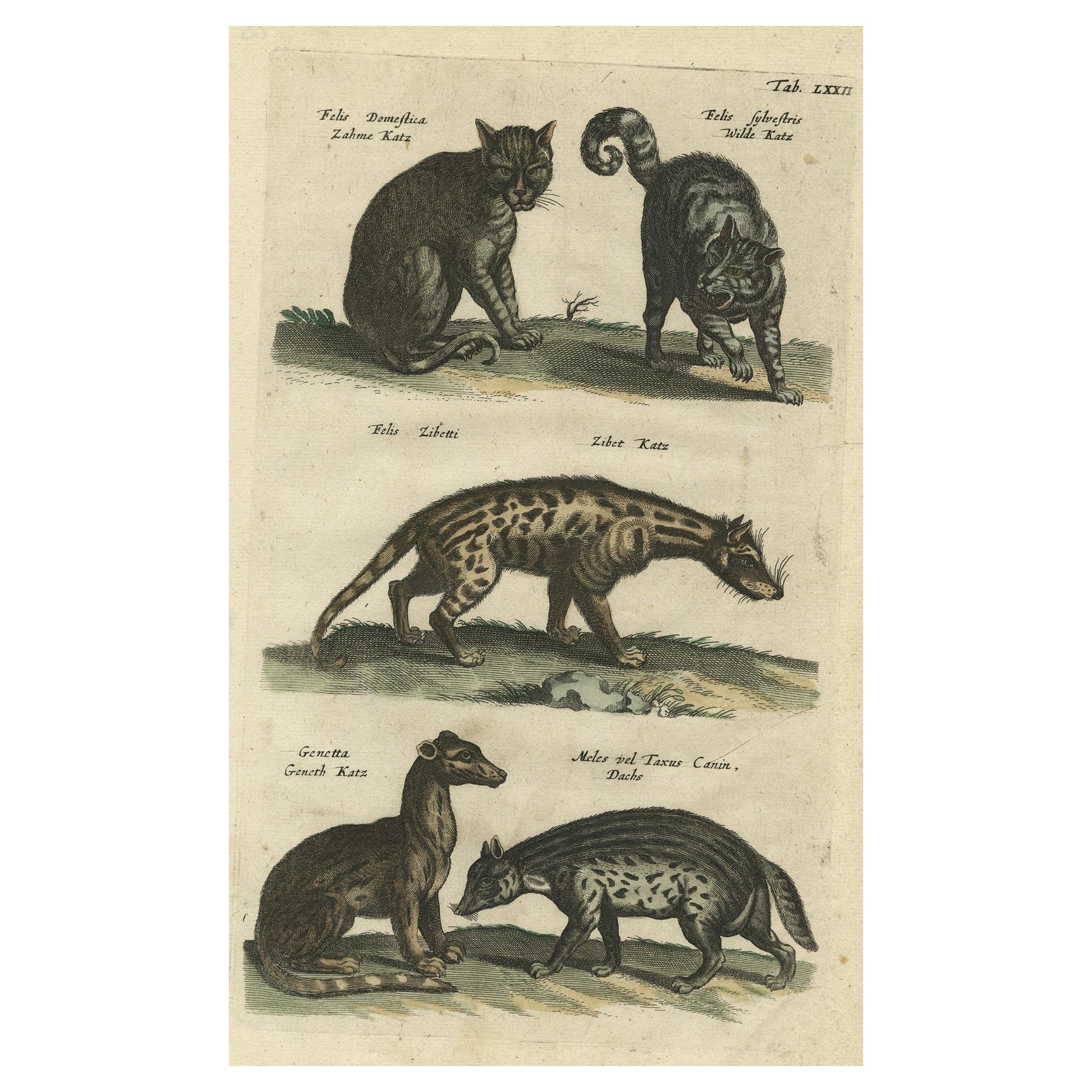
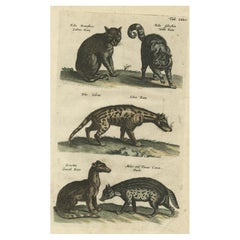
Impression ancienne de spécimens de chats domestiques et sauvages, y compris le civet, 1657
Gravure ancienne des espèces de chats domestiques et sauvages ; Felis domestica, Zahme Katz (chat domestique) - Felis sylvestris, Wilde Katz (chat sauvage) - Felis Zibetti, Zibet Kat...
Catégorie
Antiquités, années 1650, Estampes
Matériaux
Papier
232 € Prix de vente
20 % de remise
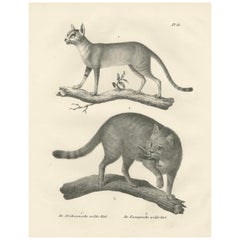
Lithographie du XIXe siècle représentant les chats sauvages d
Afrique et d
Europe dans des poses naturelles
Lithographie du XIXe siècle représentant les chats sauvages d'Afrique et d'Europe dans des poses naturelles
---
Cette lithographie du XIXe siècle, magnifiquement détaillée, représ...
Catégorie
Antiquités, années 1830, Estampes
Matériaux
Papier
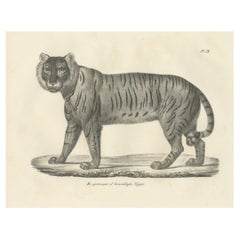
Lithographie du XIXe siècle représentant le majestueux tigre rayé ou royal
Lithographie du XIXe siècle représentant le majestueux tigre rayé ou royal
Cette captivante lithographie du XIXe siècle représente le tigre rayé ou royal (De gestreepte of koninkl...
Catégorie
Antiquités, années 1830, Estampes
Matériaux
Papier
Suggestions
Impressions animalières originales, lions et tigres, 1847
De superbes images de lions et de tigres
Sans cadre.
Lithographies d'après le capitaine Brown avec couleurs originales à la main.
Publié en 1847.
La mesure est pour 1 impression...
Catégorie
Antiquités, années 1840, Anglais, Artisanat, Estampes
Matériaux
Papier
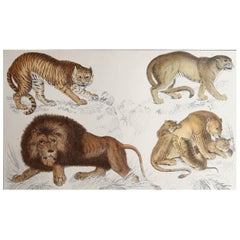
Impression ancienne originale de lions et de tigres, 1847, non encadrée
Superbe image de lions.
Non encadré. Il vous donne la possibilité de réaliser un montage en utilisant les cadres de votre choix.
Lithographie d'après le Cpt. Brown avec couleur...
Catégorie
Antiquités, années 1840, Anglais, Artisanat, Estampes
Matériaux
Papier
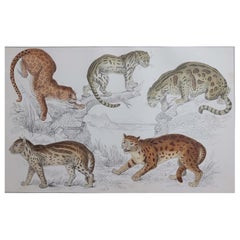
Impression ancienne originale de chats, 1847, non encadrée
Superbe image de chats.
Non encadré. Il vous donne la possibilité de réaliser un montage en utilisant les cadres de votre choix.
Lithographie d'après le Cpt. Brown avec couleur ori...
Catégorie
Antiquités, années 1840, Anglais, Artisanat, Estampes
Matériaux
Papier
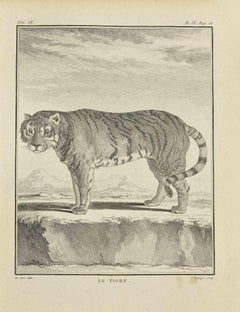
Le Tigre - Gravure de Jean Charles Baquoy - 1771
Le Tigre est une gravure réalisée par Jean Charles Baquoy en 1771.
Il appartient à la suite "Histoire Naturelle de Buffon".
La signature de l'Artistics est gravée en bas à droite.
...
Catégorie
années 1770, Moderne, Estampes - Figuratif
Matériaux
Eau-forte
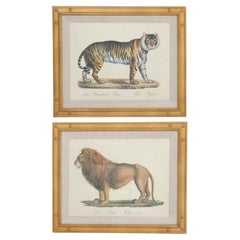
Lithographies de Bigli de Karl Joseph Brodtmann
Deux lithographies représentant un lion et un tigre, par le graveur suisse Karl Joseph Brodtmann (1787-1862). Publiées à l'origine au début du XIXe siècle, ces lithographies ont été ...
Catégorie
20ième siècle, Suisse, Estampes
Matériaux
Verre, Bois doré, Papier
1 570 € / ensemble
L
Ocelot - Gravure de Jean Charles Baquoy - 1771
L'Ocelot est une gravure réalisée par Jean Charles Baquoy en 1771.
Il appartient à la suite "Histoire Naturelle de Buffon".
La signature de l'Artistics est gravée en bas à droite.
...
Catégorie
années 1770, Moderne, Estampes - Figuratif
Matériaux
Eau-forte