Articles similaires à 18th century, Pair of Italian painting with Pastoral Scenes, Londonio school
Vous voulez plus d
images ou de vidéos ?
Demander au vendeur plus d
images ou de vidéos
1 sur 20
18th century, Pair of Italian painting with Pastoral Scenes, Londonio school
34 500 €TVA incluse
À propos de cet article
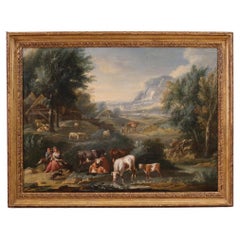
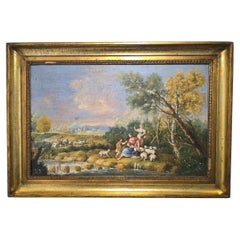
Pair of large paintings depicting pastoral scenes, Londonio school, second half of the 18th century
Frame: W 157 x H 130 x D 9 cm; canvas: 139 x 110 cm
This pair of large-scale paintings, presented in antique gilded wooden frames with mouldings and corner carvings, depicts 18th-century pastoral scenes typical of the Lombard tradition (Italy) and close to the manner of the Londonio family and their followers, recalling the Bergamo area. The compositions are lively, rich in figures, set outdoors and placed within rural landscapes.
In the painting on the left, the foreground features a group of shepherds and young shepherdesses arranged in a way that guides the viewer’s gaze toward the centre of the scene. A seated woman holds a lamb on her lap and appears to be interacting with two young girls who approach her affectionately. To the left, another young woman stands holding a wicker basket filled with straw and two chicks. Her balanced pose and simple yet well-kept attire contribute to the everyday character of the scene.
On the right, a young shepherd with a staff resting across his shoulders oversees a varied flock of sheep and goats. The animals, rendered with naturalistic accuracy, are one of the most characteristic elements of the Londonio tradition: expressive, vivid, and carefully portrayed in their postures and in the depiction of their fur. Alongside the sheep appear a donkey and other animals, further enriching the narrative. The background reveals a soft, rolling landscape crossed by a fence and dominated by a distant village, with houses and a church standing out against a cloudy sky. Warm tones and diffused light create a serene, bucolic atmosphere suggestive of a peaceful working day among fields and pastures.
The second painting, presented here on the right, features an equally elaborate and lively scene built through a collective narrative of human and animal figures. In the foreground on the left, an elderly shepherd sits on the ground, surrounded by his sheep; his relaxed posture, serene face, and the presence of a small dog by his side infuse the scene with a sense of domestic intimacy. At the centre stands a younger man beside a horse carrying a gourd water flask, a wine barrel, and—attached to the saddle—several baskets containing two small lambs. His gesture, with an outstretched arm pointing into the distance, introduces narrative dynamism and leads the viewer’s eye toward the background. Next to him, on the right, a woman adds a familiar and almost affectionate tone to the pastoral scene. Other figures appear behind her, forming a compact, industrious group. The horse and the various sheep and goats, painted with evident naturalistic attention, again confirm the stylistic influence of the Londonio school, known for its detailed and lively depictions of farm animals. The background presents a wide hilly landscape with a small village perched on a rise. A woodland area with lush green trees adds depth, while the bright sky streaked with light clouds harmonizes the entire composition.
The atmosphere of these paintings reflects the simple everyday life of a rural community absorbed in its work, captured in moments of pause or transition. The overall effect conveys a sense of familial harmony, typical of Lombard rustic scenes, where the relationship between people, animals, and landscape is depicted with tenderness and narrative engagement.
The figures are reinterpreted in a personal way and gathered into an original composition, drawing inspiration from various engravings by Francesco Londonio, to which they clearly relate through formal and thematic affinities.
The Londonio family holds a significant place in the artistic history of Lombardy, in the north of Italy, in the 18th century. Its most renowned member is Francesco Londonio (1723–1783), a Milanese painter and engraver, though the family also included other artists who contributed to the creation of a true school devoted to pastoral painting. The Londonio workshop in Milan became a training ground for several artists: not an institutional school, but a creative environment where style, subjects, and ways of depicting the rural world were handed down.
The term Londonio school refers to a group of painters, mostly Lombard, active between the second half of the 18th century and the early 19th century, who drew inspiration from Francesco Londonio’s pastoral scenes, his affectionate naturalism in the depiction of animals, the intimate, everyday compositions, warm colours and soft light, and above all his celebrated engravings, true iconographic matrices used as models.
Many of these artists cannot always be precisely identified, but belong to a broad productive stream: works destined for villas, country houses, and bourgeois residences seeking elegant, reassuring rural subjects.
Francesco Londonio was born in Milan in 1723. Tradition cites an early training with Ferdinando Porta, a late-Baroque Milanese painter, and later with Benigno Bossi, whose influence brought him closer to engraving. Painting and printmaking remained central throughout his production. Londonio became famous for a genre highly prized at the time: rustic painting. His works portray scenes of shepherds, farmers, flocks of sheep and goats, domestic animals, rustic interiors, and rural landscapes.
His style combines elements of Lombard naturalism with influences from Antonio Allegri known as Correggio, Ceruti, Philip Peter Roos, Van Laer and Domenico Brandi, whom he encountered during his travels to Cremona, Rome, and Naples; all fused with a sentimental and idyllic tone that made his works popular among the nobility, the bourgeoisie, and the ecclesiastical world. Admirers included Archbishop Pozzobelli, Cardinal Vitaliano Borromeo, and Cardinal Angelo Maria Durini.
In addition to his paintings, Londonio produced numerous etchings—often on the same pastoral subjects—which helped spread his fame beyond Lombardy and are today considered central to the 18th-century Italian engraving tradition. He spent most of his life in Milan, where he continued to paint, engrave, and teach. He died in 1783, leaving a vast corpus of paintings and prints.
Londonio is regarded as one of the foremost interpreters of Lombard pastoral painting in the 18th century.
The author of this pair of works belongs to this tradition, drawing upon Londonio’s iconographic models and reinterpreting them freely. The ability to rework these schemes without losing their original matrix reveals not only a thorough understanding of Londonio’s pictorial language but also a desire to update it through freer and more personal solutions.
In this sense, the two paintings under examination stand as significant testimony to the success of the Londonio school in the late 18th century and beyond, showing how his legacy continued to influence artists and patrons sensitive to rural atmospheres, the gentle naturalism of the figures, and the carefully constructed spatial arrangements.
The lively colour palette and balanced composition make these large-format works highly decorative and particularly pleasant. They may be displayed above consoles or chests of drawers, or hung side by side on the wall of a living room, study, entrance hall, or corridor, enhancing the charm and dynamism of the décor.
We apologize for any translation errors from Italian. Please contact us to request the expertise in Italian.
- Dimensions:Hauteur : 130 cm (51,19 po)Largeur : 157 cm (61,82 po)Profondeur : 9 cm (3,55 po)
- Style:Baroque (De la période)
- Matériaux et techniques:
- Lieu d origine:
- Période:
- Date de fabrication:second-half of 18th Century
- État:Usure conforme à l âge et à l utilisation.
- Adresse du vendeur:IT
- Numéro de référence:1stDibs : LU4405247962572
À propos du vendeur
5,0
Vendeur professionnel agréé
Chaque vendeur répond à des normes strictes en matière d
authenticité et de fiabilité
Établi en 1980
Vendeur 1stDibs depuis 2019
56 ventes sur 1stDibs
Temps de réponse habituel : <1 heure
- ExpéditionRecherche du devis...Expédition depuis : Italie
- Politique des retours
Certaines parties de cette page ont été traduites automatiquement. 1stDibs ne garantit pas l
exactitude des traductions. L
anglais est la langue par défaut de ce site web.
Plus d articles de ce vendeur
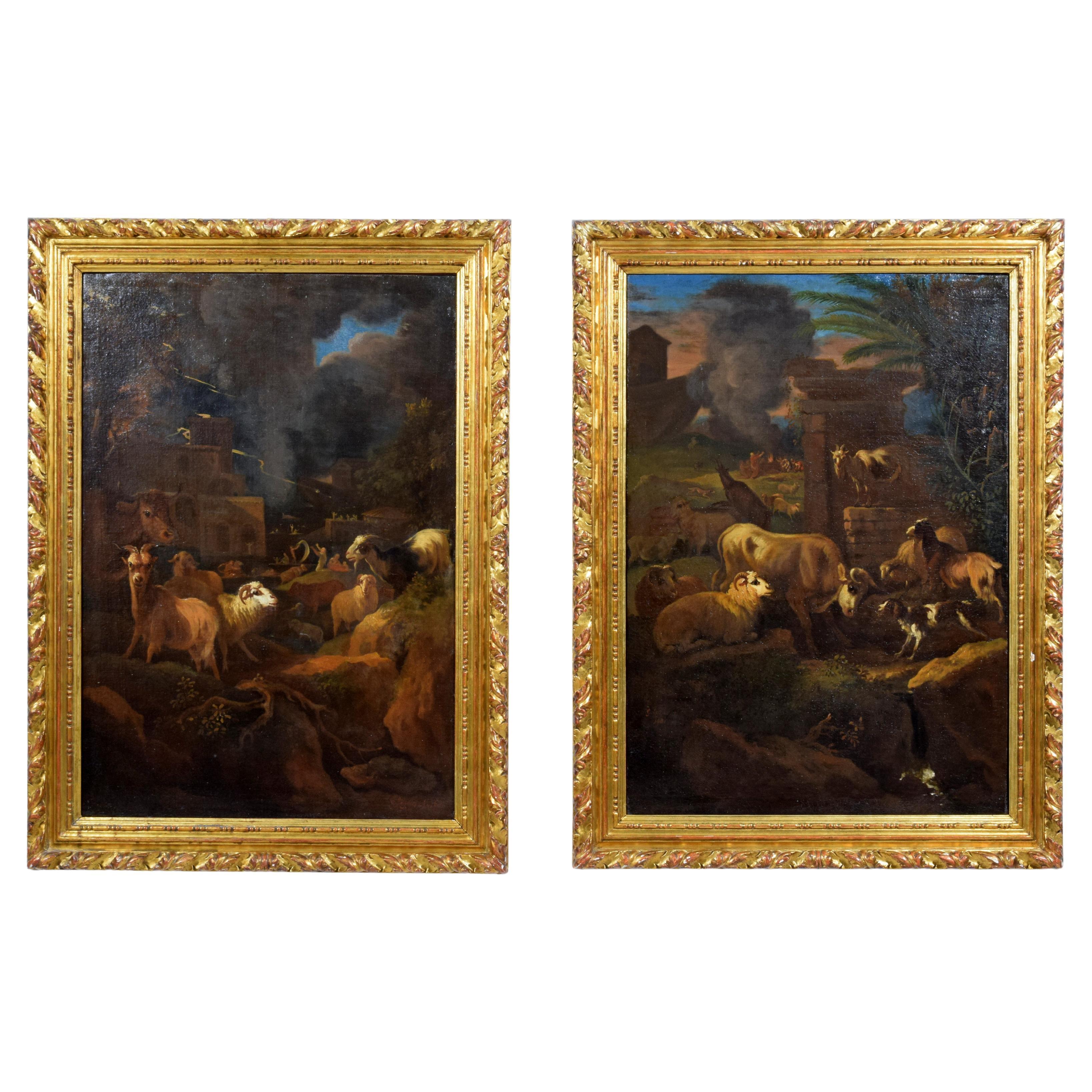
Tout afficher1681, Paire de peintures signées Grechetto da Leone sous le nom de Govaert G. VAN DER LEEUW
1681, Paire de peintures signées Grechetto da Leone sous le nom de Govaert G. VAN DER LEEUW
Huile sur toile
Dimensions : cm L 91 x H 123 x P 6 ; toile : cm L 72 x H 103,5
Cette pair...
Catégorie
Antiquités, 1680, italien, Baroque, Peintures
Matériaux
Toile
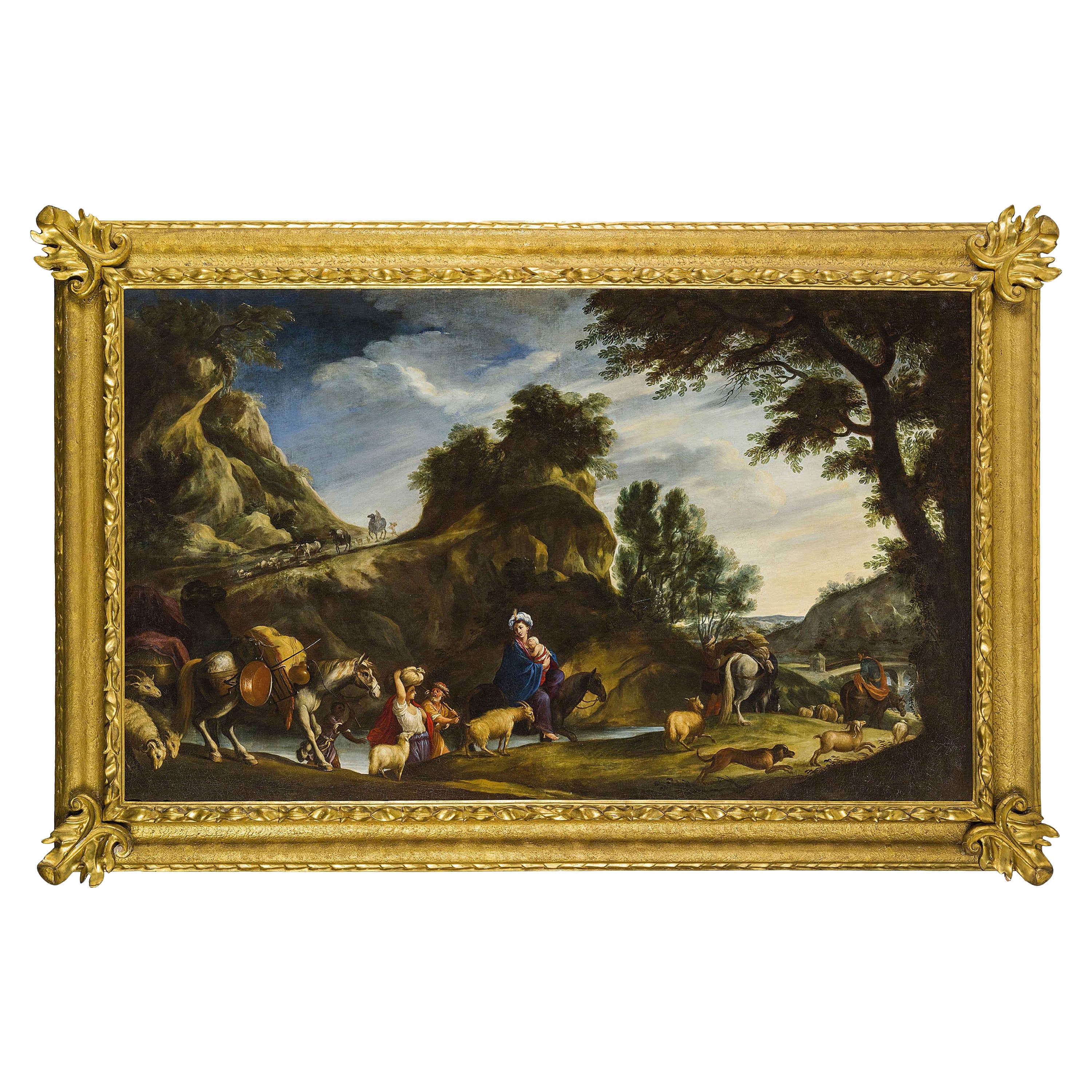
Peinture italienne du XVIIe siècle de Pier Francesco Cittadini, Jacob et sa famille
Pier Francesco Cittadini (Milan, 1616-Bologne, 1681)
"Jacob et sa famille vont en Egypte"
Huile sur toile, cm 109 x 190 (toile seulement)
Le précieux tableau, réalisé à l'huile ...
Catégorie
Antiquités, Milieu du XVIIe siècle, Européen, Baroque, Peintures
Matériaux
Toile, Bois doré
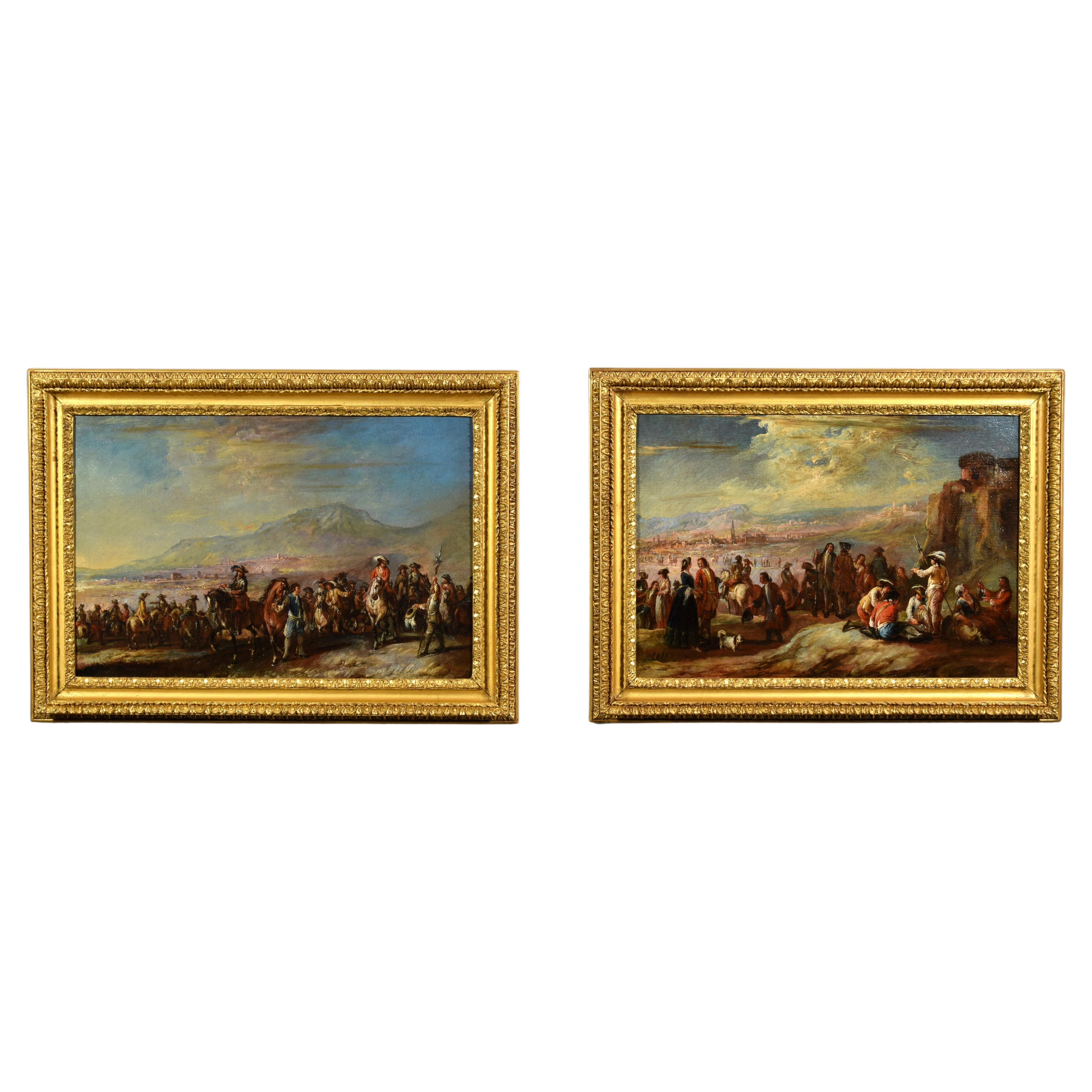
Paire de peintures italiennes à l
huile sur toile du 18ème siècle par Francesco Simonini
Par SIMONINI
Francesco SIMONINI (Parma, 16 juin 1686 - Parma, 1766)
"Le reste des soldats" et "La marche des soldats"
huile sur toile
cm 40 x 58 et 40 x 60 ; cadre : h 52,5 x L 70,5 x P 6 et h...
Catégorie
Antiquités, Début du XVIIIe siècle, italien, Baroque, Peintures
Matériaux
Toile
23 400 € Prix de vente
35 % de remise
18e siècle, paire de natures mortes italiennes, attribuée à Francesco Lavagna
Par Francesco Lavagna
Francesco Lavagna (Italie, Naples 1684-1724)
Paire de tableaux représentant des natures mortes composées de fleurs et de pastèques avec un jardin en arrière-plan
Les peintures, de ...
Catégorie
Antiquités, Début du XVIIIe siècle, italien, Baroque, Peintures
Matériaux
Toile
Paire de peintures allégoriques italiennes de Vittorio Amedeo Rapous, 18ème siècle
Par Vittorio Amedeo Rapous
Paire de peintures allégoriques italiennes du 18e siècle par Vittorio Amedeo Rapous
Paire de tableaux représentant l'Allégorie du printemps avec putti et l'Allégorie de l'automne av...
Catégorie
Antiquités, Fin du XVIIIe siècle, italien, Rococo, Peintures
Matériaux
Toile
30 400 € Prix de vente
20 % de remise
XVIIe siècle, Peinture italienne Allégorie du suiveur de printemps de Jacopo Bassano
Par Jacopo Bassano
Suiveur de Jacopo Da Ponte, dit Jacopo Bassano (Bassano del Grappa, vers 1510 - Bassano del Grappa, 13 février 1592), XVIIe siècle.
Allégorie du printemps
Dimensions : Avec cadre : cm L 122,5 x H 89 x P 6,5. Toile : cm L 106,5 x H 72
Le tableau, d'un grand effet décoratif et accompagné d'un cadre en bois sculpté et doré non coeval, est l'œuvre d'un peintre, actif au milieu du XVIIe siècle, adepte de la célèbre école vénitienne de Bassano da Ponte...
Catégorie
Antiquités, Fin du XVIIe siècle, italien, Baroque, Peintures
Matériaux
Toile
Suggestions
ÉCOLE BRITANNIQUE "Paysage avec figures et animaux" 19e siècle
ÉCOLE BRITANNIQUE
"Paysage avec figures et animaux" 19e siècle
Huile sur toile
Récupéré.
Dim. : 50 x 58 cm
bonnes conditions
Catégorie
Antiquités, XIXe siècle, Anglais, Baroque, Peintures
Matériaux
Peinture
Paire de peintures pastorales françaises du 19ème siècle à l
huile sur panneau dans des cadres dorés
Décorez un bureau ou une étude avec cette élégante paire de tableaux anciens. Créées en France vers 1880 et peintes sur carton, ces deux œuvres colorées sont présentées dans un cadre...
Catégorie
Antiquités, Fin du XIXe siècle, Français, Peintures
Matériaux
Bois doré
Paire de peintures pastorales françaises du 19ème siècle signées dans des cadres noirci
Décorez un bureau ou une étude avec cette élégante paire de tableaux anciens. Fabriquées en France vers 1870, les œuvres d'art peintes à la main sur toile sont placées à l'intérieur ...
Catégorie
Antiquités, Milieu du XIXe siècle, Français, Peintures
Matériaux
Toile
huile sur toile du XVIIIe siècle Peinture de paysage bucolique italien, 1770
École vénitienne de la seconde moitié du XVIIIe siècle. Peinture à l'huile sur toile représentant un paysage arcadien de genre pastoral. Ce type de représentation picturale s'est imp...
Catégorie
Antiquités, 1770s, Italian, Peintures
Matériaux
Toile
Huile sur toile italienne du XVIIIe siècle - Scène pastorale
Huile sur toile italienne du XVIIIe siècle - Scène pastorale
Elégante huile sur toile italienne représentant une scène pastorale, peinte au 18e siècle. La composition capture un mom...
Catégorie
Antiquités, années 1760, Peintures
Matériaux
Fruitiers
Paire de tableaux du 17e siècle sur la nature vivante Huile sur toile École flamande
École flamande, 17e siècle
Couple vivant dans la nature avec des animaux
Mesures : Huile sur toile, cm 25 x 35 - Avec cadre cm 37 x 48
Dans la première œuvre, un lièvre et d...
Catégorie
Antiquités, 17ème siècle, Peintures
Matériaux
Toile