Articles similaires à Japanese Antique Flap-Front Storage Cabinet with Kanji Markings, Late Meiji Era

Chargement de la vidéo
Vous voulez plus d
images ou de vidéos ?
Demander au vendeur plus d
images ou de vidéos
1 sur 21
Japanese Antique Flap-Front Storage Cabinet with Kanji Markings, Late Meiji Era
2 427,69 €
À propos de cet article
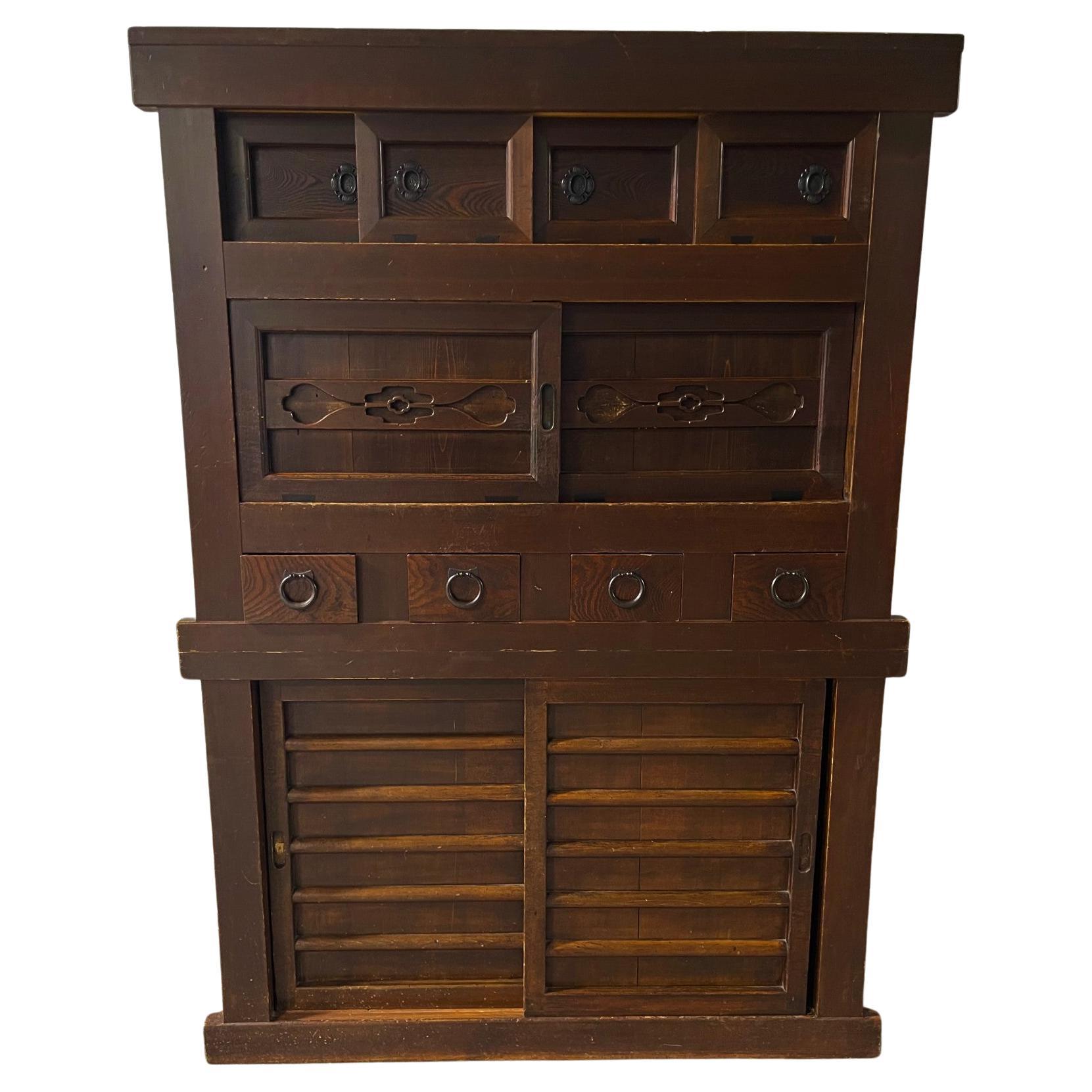
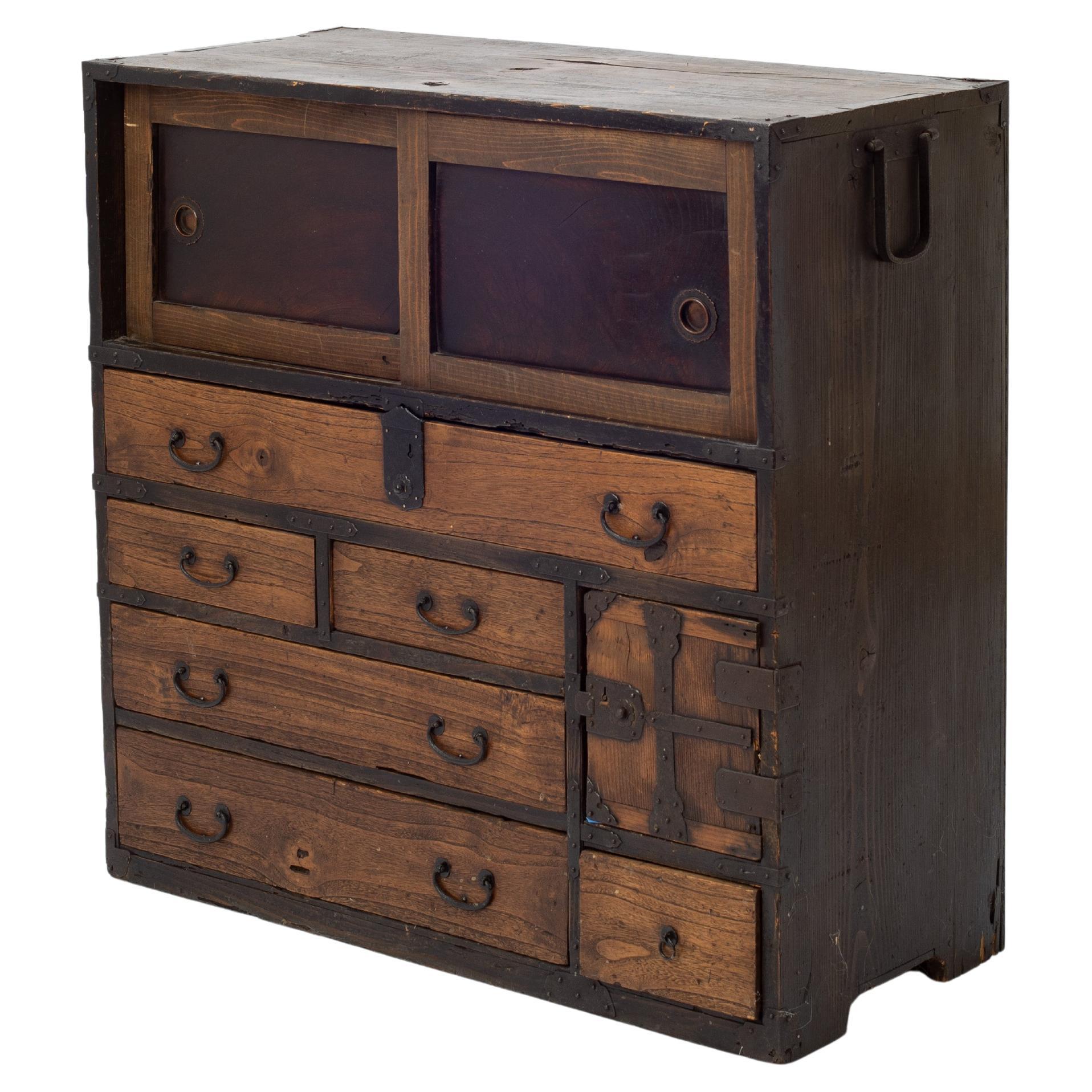
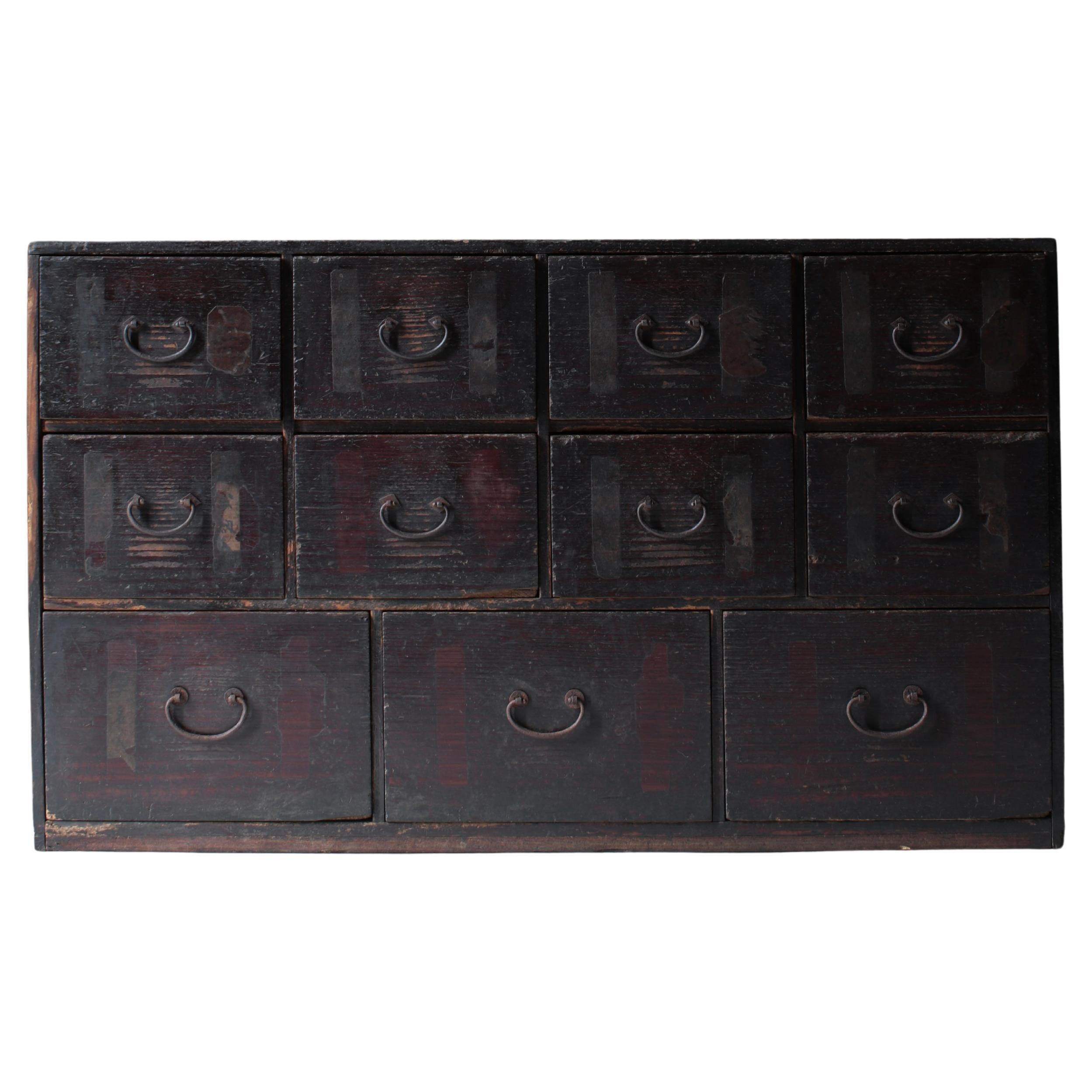
This Japanese antique storage cabinet features traditional flap-front doors, commonly known as pata-pata doors, and dates to the Meiji period (late 19th–early 20th century).
The most distinctive feature of this piece is the handwritten kanji found on the doors. They read “No. 1,” “No. 2,” “No. 3,” and so on, written in old-form kanji. Notably, the character used for “number” is a now-obsolete kanji that specifically denotes rank or grade, rather than simple numerical order. This character is no longer used in modern Japanese, and even among native Japanese speakers today, few can readily read it or immediately grasp its meaning. Its presence reflects a historical system of classification once familiar in everyday life, but now largely forgotten.
The fourth tier bears no marking. In traditional Japanese culture, the number four shares its pronunciation with the word for “death” and was therefore considered inauspicious. The deliberate omission of this number offers a subtle yet telling glimpse into the beliefs and daily sensibilities of the time—customs that are rarely observed in contemporary Japan.
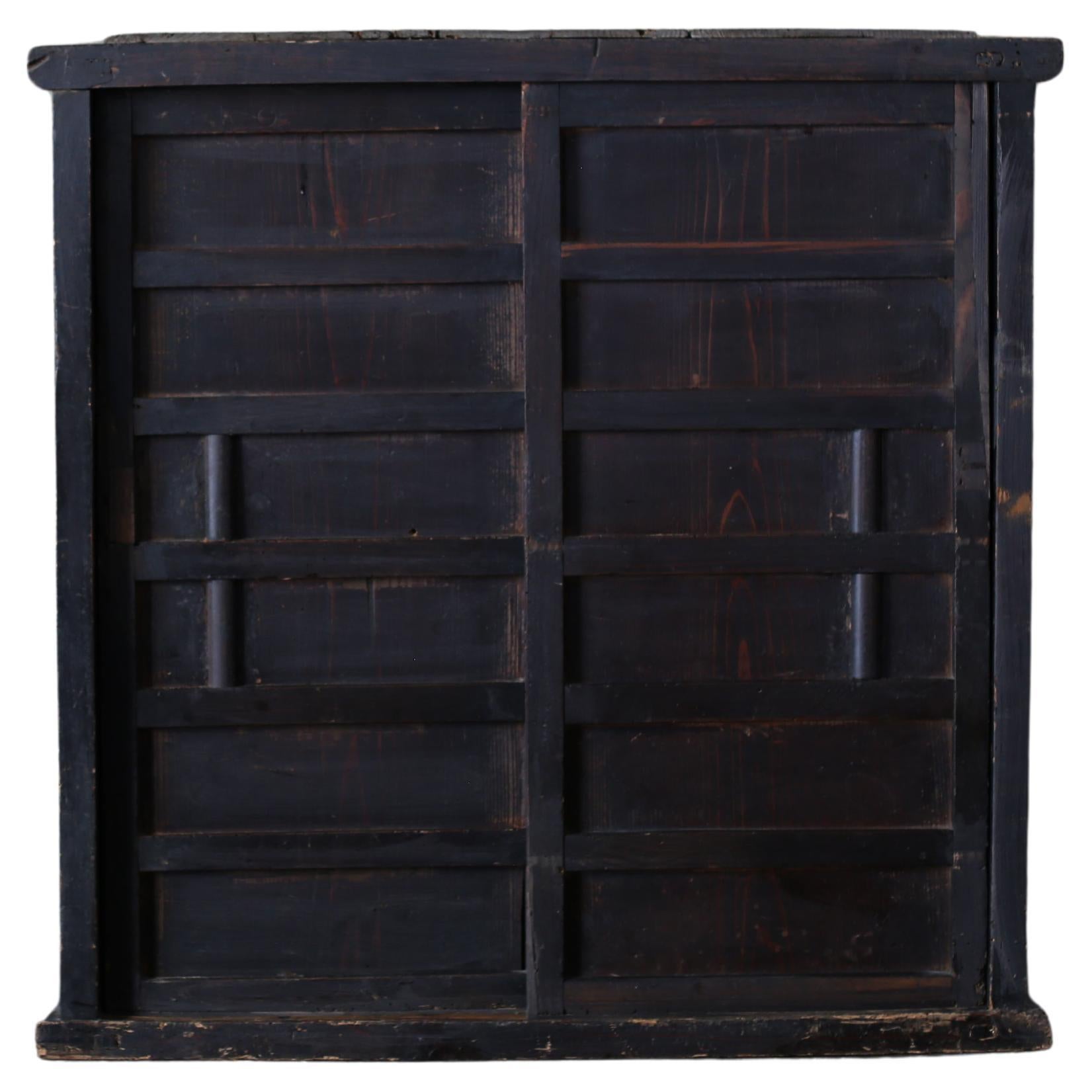
At the lower section, the sliding doors are marked with the characters for “left” and “right.” While their exact purpose remains unclear, these markings suggest practical use in a workshop or production environment, where materials or components needed to be sorted and stored according to specific positions or categories.
The cabinet is crafted from Japanese cedar. The door frames are finished in black urushi lacquer, now gently worn, thinned, and partially rubbed away through decades of use. Other surfaces are finished with traditional kakishibu (persimmon tannin) and pine soot. Areas with a subtle reddish tone derive from bengara (red iron oxide), later overcoated with pine soot, resulting in a deep, layered surface that has matured naturally over time. These variations are not decorative effects, but traces of use and age that give the piece its quiet depth.
The door handles are made of antimony and formed in a delicate flower-petal shape—an exceptionally rare detail for utilitarian storage furniture. Only the handle corresponding to the now-lost “No. 5” door has been replaced with a brass handle, reflecting a practical repair made during the cabinet’s long working life.
Rather than presenting a fixed or restored ideal, this cabinet retains the marks of use, belief, and adaptation accumulated over time. It stands as a material record of everyday craftsmanship, shaped by function and quietly enriched by age—an embodiment of the wabi-sabi sensibility found in authentic Japanese antiques.
Condition Notes:
- Structure is sound and stable with no structural issues
- All flap-front (pata-pata) doors and lower sliding doors operate smoothly
- A visible age-related crack is present in the panel of one sliding door, caused by natural wood movement over time; this does not affect stability or use.
- Surface shows age-related wear including scratches, rubbing, thinning lacquer, and areas of loss consistent with long-term use
- Black urushi lacquer on the door frames shows wear and fading from age and handling
- Variations in color and finish are present, including darker areas and subtle reddish undertones from traditional finishes
- Handwritten kanji markings show fading and wear consistent with age
- Most original antimony flower-shaped handles remain intact
- One handle, corresponding to the missing “No. 5” door, has been replaced with a brass handle; replacement is stable and functional
Cleaned gently with water only.
As an authentic Late Meiji–period piece, this cabinet shows natural signs of age and use consistent with Japanese antiques. Surface wear, wood movement, small marks, and past repairs are part of its history and character, not defects. Please review all photos carefully before purchasing.
Interior dimensions:
Flap-front compartments: W 29.9" × D 11.2" × H 7.1" (76.0 × 28.5 × 18.0 cm)
Sliding-door compartment: W 29.9" × D 10.0" × H 14.4" (76.0 × 25.5 × 36.5 cm)
Weight:
52.5 lbs (23.8 kg)
Shipping Information:
We ship from Japan. I will provide my own shipping quote. Please ask.
Import duties, taxes, and customs fees are the responsibility of the buyer.
Approach to Selection and Restoration:
Each piece is individually selected through our own eye, then restored to reveal its most compelling state. Movement, stability, and surface are considered as one—shaped through practice to be lived with naturally, honoring the wood’s natural patina while avoiding environmentally harsh chemical strippers or forceful abrasion.
- Dimensions:Hauteur : 149 cm (58,67 po)Largeur : 81,5 cm (32,09 po)Profondeur : 31,5 cm (12,41 po)
- Style:Meiji (De la période)
- Matériaux et techniques:
- Lieu d origine:
- Période:
- Date de fabrication:Late Meiji Era (circa 1900–1912)
- État:Usure conforme à l âge et à l utilisation. Cleaned gently with water only. Doors and sliding doors operate smoothly. The structure is sound with no structural issues. The piece has been carefully inspected, and no issues were found beyond those noted above.
- Adresse du vendeur:Hitachiomiya-shi, JP
- Numéro de référence:1stDibs : LU7430248098762
À propos du vendeur
5,0
Vendeur Platine
Vendeurs premium dont la note est supérieure à 4,7 et le délai de réponse de 24 heures maximum
Établi en 2019
Vendeur 1stDibs depuis 2022
83 ventes sur 1stDibs
Temps de réponse habituel : 1 heure
- ExpéditionRecherche du devis...Expédition depuis : Hitachiomiya, Japon
- Politique des retours
Certaines parties de cette page ont été traduites automatiquement. 1stDibs ne garantit pas l
exactitude des traductions. L
anglais est la langue par défaut de ce site web.
Plus d articles de ce vendeur
Tout afficherArmoire japonaise vintage à portes coulissantes (Cha Tansu), début de l
ère Showa, Wabi Sabi
Cette armoire japonaise à portes coulissantes (cha tansu) a été fabriquée au début de la période Showa (1926-1945) en cyprès hinoki, un bois apprécié pour...
Catégorie
Milieu du XXe siècle, Japonais, Showa, Meubles de rangement
Matériaux
Cyprès, Bois
Grand Tansu japonais ancien, portes à panneaux, ère Meiji 1868-1912, Wabi Sabi
Ce grand tansu antique de Mizuya a été fabriqué à l'époque Meiji (1868-1912).
Ses portes coulissantes simples et sa finition sombre et usée par le temps reflètent la beauté tranquil...
Catégorie
Antiquités, Milieu du XIXe siècle, Japonais, Meiji, Meubles de rangement
Matériaux
Cèdre
Petite commode ancienne japonaise, ère Keio (période Edo, 1867), Wabi Sabi
Cette petite commode ancienne a été fabriquée à l'époque de Keio (1867).
Fabriquée en cèdre japonais et finie avec une laque japonaise traditionnelle (urushi), la surface a développ...
Catégorie
Antiquités, Milieu du XIXe siècle, Japonais, Edo, Commodes et coffres à ...
Matériaux
Cèdre
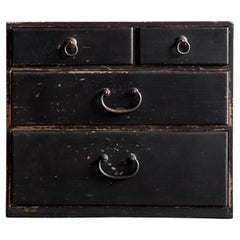
Armoire japonaise ancienne à portes coulissantes (Cha Tansu), époque Taisho (1912-1926), Wabi
Ce meuble japonais à portes coulissantes (cha tansu) a été fabriqué pendant la période Taisho (1912-1926) en utilisant une combinaison judicieuse de bois ...
Catégorie
Début du 20ème siècle, Japonais, Taisho, Meubles de rangement
Matériaux
Bois, Cèdre
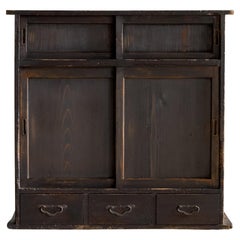
Commodes japonaises anciennes de l
ère Meiji (1868-1912)Wabi Sabi
Cette commode ancienne a été fabriquée à la fin de l'ère Meiji (1868-1912).
Cette commode japonaise, fabriquée à l'ère Meiji, est une pièce intemporelle qui raconte une histoire d'é...
Catégorie
Antiquités, Fin du XIXe siècle, Japonais, Meiji, Commodes et coffres à t...
Matériaux
Bois

1 387 € Prix de vente
36 % de remise
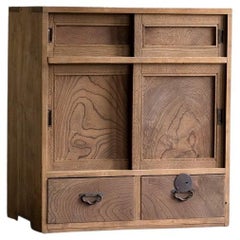
Petite armoire ancienne japonaise avec porte en bois, époque Taisho
1912-1926
Wabi Sabi
Ce petit meuble ancien a été fabriqué à l'époque Taisho (1912-1926), reflétant le savoir-faire exceptionnel de cette période. La face avant est réalisée en bois de keyaki, dont les v...
Catégorie
Début du 20ème siècle, Japonais, Taisho, Meubles de rangement
Matériaux
Bois
Suggestions
Japanese Antique Massive Tansu Chest 1860s-1900s / Cabinet Cupboard Wabi Sabi
This is a large, old black tansu chest made in Japan, dating to the Meiji period (1860s–1900s). Crafted from Japanese cedar, it is substantial in scale yet maintains a calm, restrain...
Catégorie
Début du 20ème siècle, Japonais, Meiji, Meubles de rangement
Matériaux
Cèdre
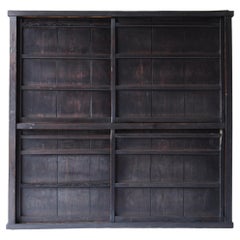
Armoire de rangement japonaise Tansu avec portes coulissantes, période Meiji, 19e siècle
Grand Tansu de cuisine japonais à deux sections, fin du 19e siècle. La partie inférieure de l'intérieur a été modifiée pour accueillir un téléviseur. Une partie de la section inférie...
Catégorie
Antiquités, Fin du XIXe siècle, Japonais, Meiji, Meubles de rangement
Matériaux
Orme
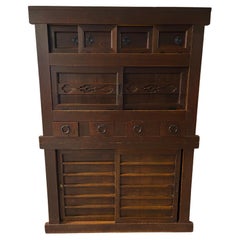
BK Antiques Tansu japonais 1860s-1900s ③ / Cabinet Sideboard Wabi Sabi
Cette commode fait partie d'un ensemble de trois commodes utilisées dans la même vieille maison japonaise.
À en juger par son état actuel, il semble être assez ancien. Il est dans so...
Catégorie
Début du 20ème siècle, Japonais, Edo, Meubles de rangement
Matériaux
Cèdre
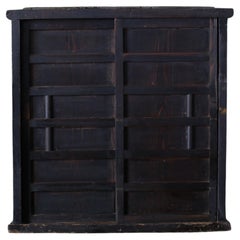
Grand meuble Tansu japonais Wabi Sabi en deux sections, fin de la période Edo
Un grand tansu japonais à deux sections datant du milieu du 19e siècle.
En cèdre joliment patiné, avec plusieurs tiroirs, portes coulissantes et quincaillerie en fer.
Une conce...
Catégorie
Antiquités, Milieu du XIXe siècle, Japonais, Meubles de rangement
Matériaux
Fer
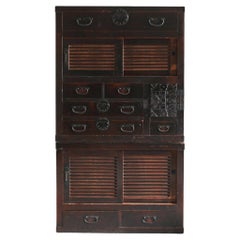
6 844 €
Livraison gratuite
Coffre de marchand Tansu japonais du 19e siècle de l
ère Meiji
Construit en cyprès et en orme, ce coffre de commerçant présente des ferrures en fer noirci et deux poignées épaisses sur le dessus de la pièce pour en faciliter le transport. Il com...
Catégorie
Antiquités, Fin du XIXe siècle, Japonais, Meiji, Meubles de rangement
Matériaux
Fer
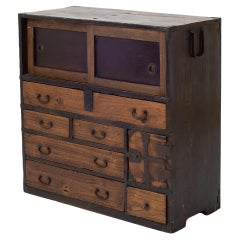
Meuble de rangement Tansu japonais ancien / 1868-1912 / Wabi-Sabi Mingei
Il s'agit d'un vieux tiroir japonais.
Il est utilisé dans les magasins depuis la période Edo dans la région de Tohoku, et on estime qu'il a été fabriqué vers la période Meiji.
Le m...
Catégorie
Antiquités, Fin du XIXe siècle, Japonais, Meiji, Commodes et coffres à t...
Matériaux
Fer