Articles similaires à Pair of candelabrum with 9 lights in gilded, silvered and burnished bronze
Vous voulez plus d
images ou de vidéos ?
Demander au vendeur plus d
images ou de vidéos
1 sur 21
Pair of candelabrum with 9 lights in gilded, silvered and burnished bronze
281 250 €TVA incluse
À propos de cet article
This splendid pair of candelabrum was made by Auguste-Louis Marquis (bronze maker) for the Maison Giroux circa 1855 in gilded, silvered and burnished bronze, the set on a cylindrical stand made of blackened wood resting on a square base.
Reflection of the eclecticism from the second half of the 19th century, our pair of candelarbum illustrates the exuberance of the Napoleon III style and the classicism of the Louis XVI style. The bronze maker has represented here the theme of the silent children, through winged putti with one finger put on their mouth, in burnished bronze. From their free hands, they hold a gilt bronze quiver where is resting a roses bouquet below large lily flowers being shaped to be light arms and of which the flowers are lightened up with a beautiful silver work. The putti are lightly dressed with a drapery hold by a strap roses garland and are bearing a crown of this same flower in their hair. About the cylindrical stand made of blackened wood, it is very typical of the Louis XVI style with its gilded bronze decoration of flowers garlands and laurel leaves flowers on which they stand.
We find on a sketching book indexing the works made by the maison Giroux, conserved in the Musée des Arts Décoratifs of Paris, a drawing depicting one of our candelabra, allowing us to confirm that they were sold by the maison created by Alphonse Giroux in the late 1790’s.
This store which was originally selling all kind of supplies and small objects such as paints, varnishes, albums, writing-papers, fans, toys, boxes and souvenirs, but also lithographs, drawings and watercolors, considerably developed in the first decades of the 19th century. First, because they count among the clients, important persons such as the Duchesse de Berry, Louis XVIII or even Charles X, then by the drive given by Alphonse Giroux’s sons who joined the firm in 1833. Thus, Alphonse-Gustave Giroux, the eldest son, had the idea to sell small furniture. Even though he was an artist himself, he worked like furniture dealers of the 18th century, with artists who did not have the right to put their signature and exerted a hold over the design of the creation that he chose. He also decided to move the store in the new Opera district on the corner of the 43 boulevard des Capucines and the 24 rue Neuve des Capucines in 1855.
On this same year, the company which had already won medals for the quality of its production during previous events, sells during the World Fair, to the Impress Eugénie, a bonheur du jour, conserved today in the château de Compiègne. In 1867, the store direction is given to Ferdinand Duvinage, Harinkouck and Brune. Little things are known about Harinkouck and Brune who seem to have been associated for a short period of time as Duvinage remains the only one in 1874.
A similar pair, a little bit smaller, with only 7 light arms, and made entirely of gilded bronze is illustrated on Marie-France Dupuy-Bellet’s book: Les bronzes du mobilier national 1800-1870, on the page 303.
The handwritten documentation of the Mobilier national allows to name their author: Auguste-Louis Marquis, who delivered them to the Garde-Meuble in April 1855 for the Palais Royal. They are next send, 22 years later to the Palais de l’Élysée where their presence is mentioned in the Ladies Salon in 1894.
The maison Chaumont and Marquis, founded in 1731, made and sold bronze, chandeliers, clocks, candelabrum, etc. They participated during the World Fairs of 1862 and 1867.
Thus, as written above, it seems that Alphonse Giroux asked Auguste Marquis to make a model of candelabrum from his original one, while imposing his modifications that we can notice by comparing the formal differences between the two pair of candelabrum. This manner to ask other artists to create models is really usual for the important companies selling art in the late 19th century. We can also mentionned l'Escalier de Cristal which worked with Gabriel Viardot, Emile Gallé and others, or Edouard Lièvre who worked for the maison Barbedienne.
Bibliography :
Marie-France Dupuy-Bellet, L’heure, le feu, la lumière, Les bronzes du mobilier National 1800-1870, Editions Faton, 2005
- Dimensions:Hauteur : 232 cm (91,34 po)Largeur : 58 cm (22,84 po)Profondeur : 72 cm (28,35 po)
- Style:Napoléon III (Dans le style de)
- Matériaux et techniques:
- Lieu d origine:
- Période:
- Date de fabrication:Circa 1855
- État:
- Adresse du vendeur:SAINT-OUEN-SUR-SEINE, FR
- Numéro de référence:Vendeur : 132001stDibs : LU7662232252852
À propos du vendeur
Aucune évaluation pour le moment
Vendeur reconnu
Ces vendeurs prestigieux sont des leaders du secteur. Ils représentent le summum en matière de qualité et de design.
Vendeur 1stDibs depuis 2022
6 ventes sur 1stDibs
Temps de réponse habituel : 4 heures
- ExpéditionRecherche du devis...Expédition depuis : SAINT-OUEN-SUR-SEINE, France
- Politique des retours
Certaines parties de cette page ont été traduites automatiquement. 1stDibs ne garantit pas l
exactitude des traductions. L
anglais est la langue par défaut de ce site web.
Plus d articles de ce vendeur
Tout afficherPaire de lampes anciennes en cristal
Cette magnifique paire de lampes a été fabriquée en cristal à la fin du 19e siècle ou au début du 20e siècle.
Les lampes sont composées de pendentifs en cristal de différentes formes...
Catégorie
Début du 20ème siècle, Français, Belle Époque, Lampes de bureau
Matériaux
Cristal, Marbre
Paire de vases en porcelaine montés en bronze doré, vers 1890
Par Manufacture Nationale de Sèvres, Charles Labarre
Cette très belle paire de vases ovoïdes et couverts a été réalisée en porcelaine de Sèvres et montée en bronze doré. Les deux vases représentent un décor peint par Charles Labarre ( ...
Catégorie
Antiquités, XIXe siècle, Français, Napoléon III, Vases
Matériaux
Bronze
64 500 € / ensemble
BACCARAT, Paire de vases montés, vers 1878
Par Baccarat
Fondée sous Louis XV, la cristallerie française Baccarat a démontré son excellence lors des expositions universelles tout au long du XIXe siècle.
Cette paire de vases, au flair élé...
Catégorie
Antiquités, Fin du XIXe siècle, Français, Napoléon III, Vases
Matériaux
Cristal, Bronze
Centre de table de style Napoléon III en bronze doré et cristal taillé, vers 185
Ancienne collection du château de Dampierre
Important centre de table composé de quatre pièces en bronze doré finement ciselé et cristal taillé, de style Napoléon III. Deux pièces s...
Catégorie
Antiquités, années 1850, Napoléon III, Plats de service
Matériaux
Cristal, Bronze
Paire de vases en porcelaine de Sèvres montés en bronze doré peints par J. Machereau
Par Manufacture Nationale de Sèvres, Charles Labarre
Cette belle paire de vases couverts en porcelaine provient de la Manufacture de Sèvres où les pièces blanches ont été achetées en 1869, décorées puis montées en bronze doré par J. Ma...
Catégorie
Antiquités, XIXe siècle, Français, Napoléon III, Vases
Matériaux
Bronze
Suspension en bronze doré avec pierres précieuses en verre, période Napoléon III
Ce lustre en bronze doré comporte huit branches qui prennent la forme de verres et de bougies et entourent une demi-sphère ornée de pierres précieuses en verre. Fruit d'un travail tr...
Catégorie
Antiquités, XIXe siècle, Français, Napoléon III, Lustres et suspensions
Matériaux
Multi-pierres, Bronze
Suggestions
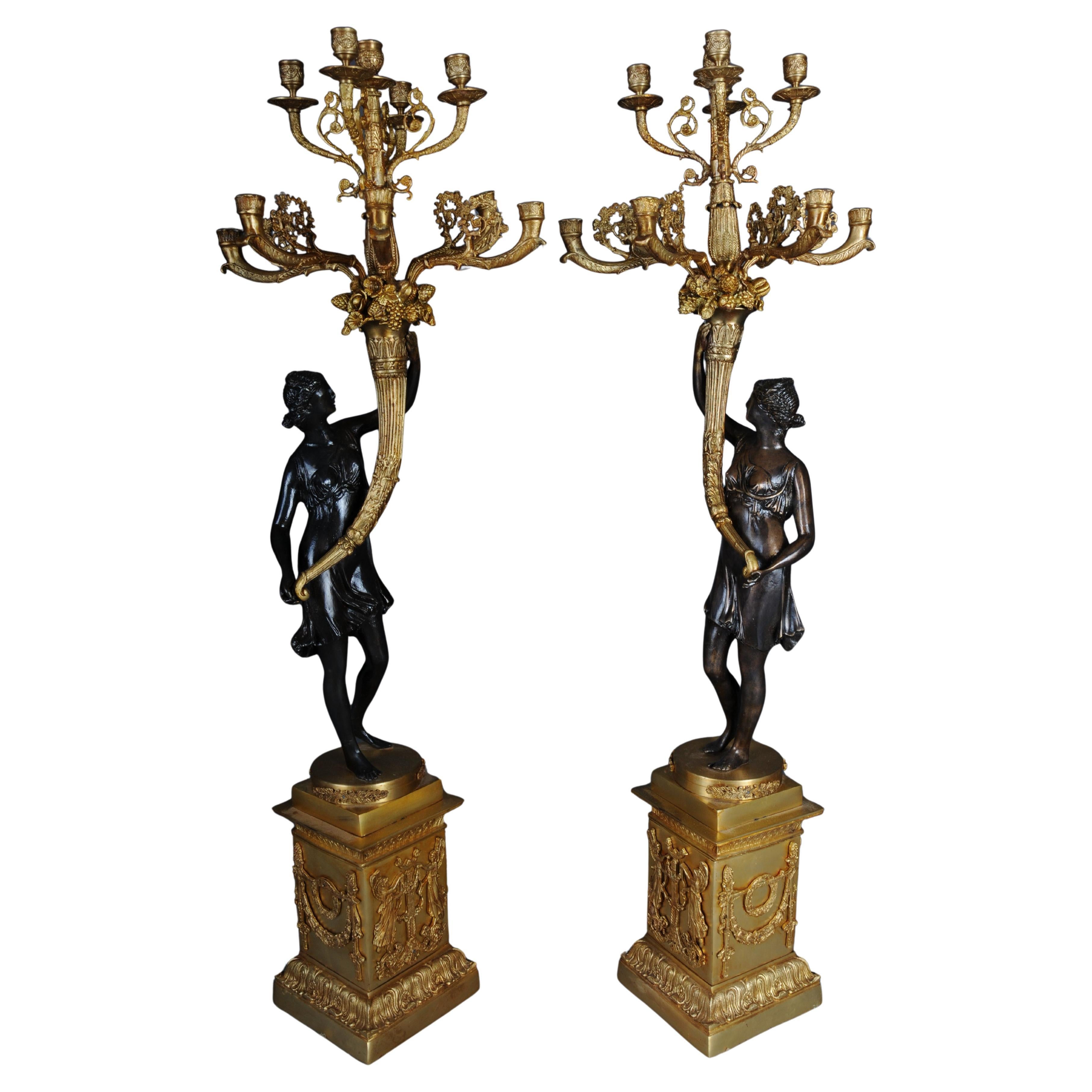
Paire de grands candélabres français en bronze et bronze doré
Par François Rémond
Cette impressionnante paire de candélabres présente deux vierges au modèle classique, tenant au-dessus de leur tête un extravagant tableau doré rempli de fruits, d'où sortent chacun ...
Catégorie
Antiquités, Fin du XIXe siècle, Français, Néoclassique, Candélabres
Matériaux
Bronze, Bronze doré
29 408 € / ensemble
Paire de candélabres français exceptionnels du 19ème siècle en bronze doré et argenté
Paire de candélabres figuratifs néoclassiques en bronze argenté et doré conçus par l'auteur, essayiste et artiste français,
Judith Gautier (1845-1917), signé et daté de 1886, représ...
Catégorie
Antiquités, Fin du XIXe siècle, Français, Néo-classique, Candélabres
Matériaux
Bronze
Paire de candélabres français du 19ème siècle en bronze doré avec base en marbre
Paire de candélabres figuratifs en bronze patiné et doré Napoléon III. Posées sur des socles en marbre royal rouge, les figures semblent tenir gracieusement une corne d'abondance rem...
Catégorie
Antiquités, Fin du XIXe siècle, Français, Candélabres
Matériaux
Marbre, Bronze
Paire (2) de magnifiques candélabres français en laiton doré et bronze
Paire (2) de magnifiques candélabres français en laiton doré et bronze patiné.
Paire de candélabres français en bronze doré et bronze patiné
Français, 20ème siècle
Magnifique paire...
Catégorie
20ième siècle, Français, Bougeoirs
Matériaux
Laiton
4 840 € / ensemble
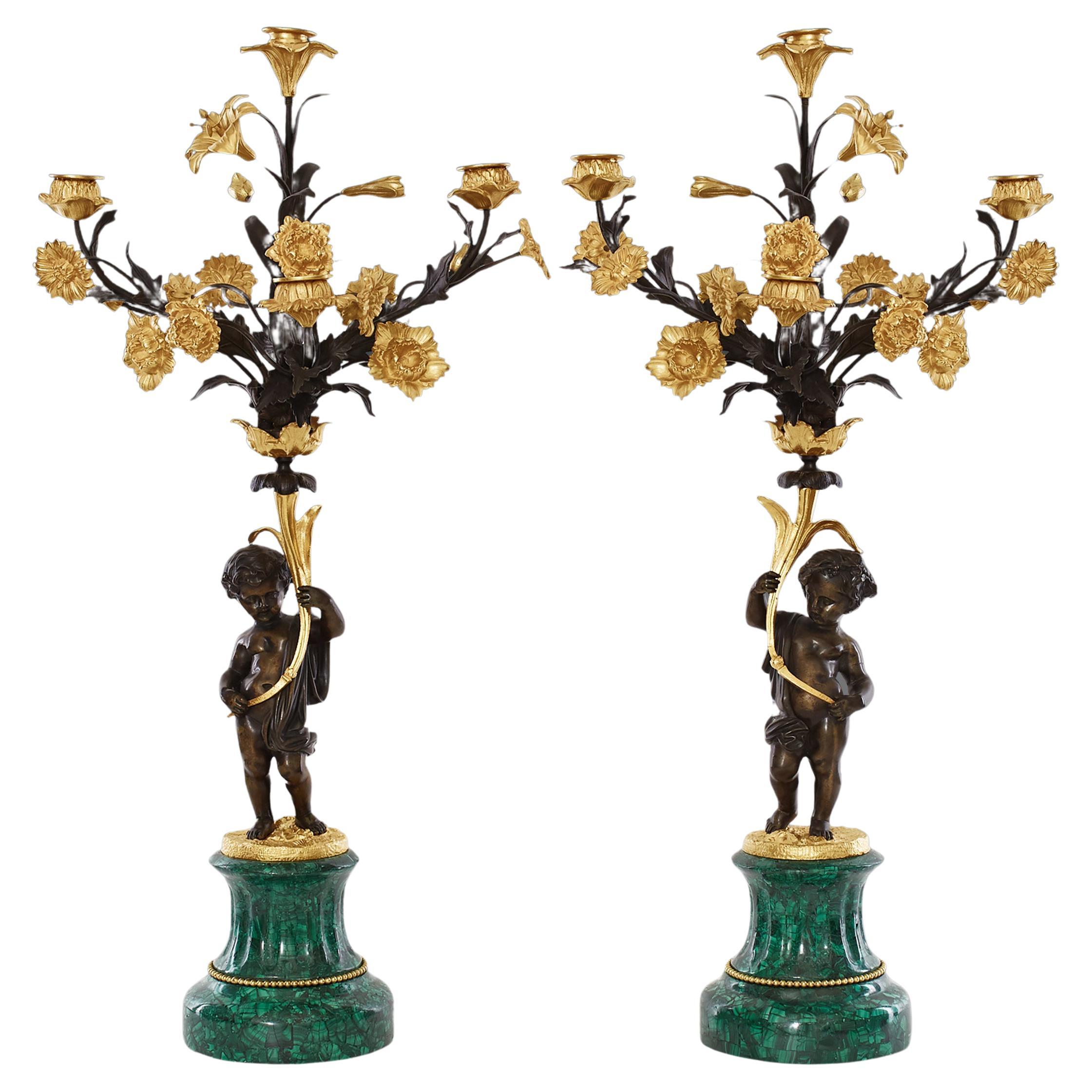
Paire de candélabres 19ème siècle Napoléon III
Cette élégante paire de candélabres illustre la grandeur et l'esthétique raffinée de la période Napoléon III en France. Les candélabres présentent un mélange harmonieux d'influences ...
Catégorie
Antiquités, XIXe siècle, Français, Napoléon III, Bougeoirs
Matériaux
Malachite, Bronze
7 035 € Prix de vente / ensemble
23 % de remise
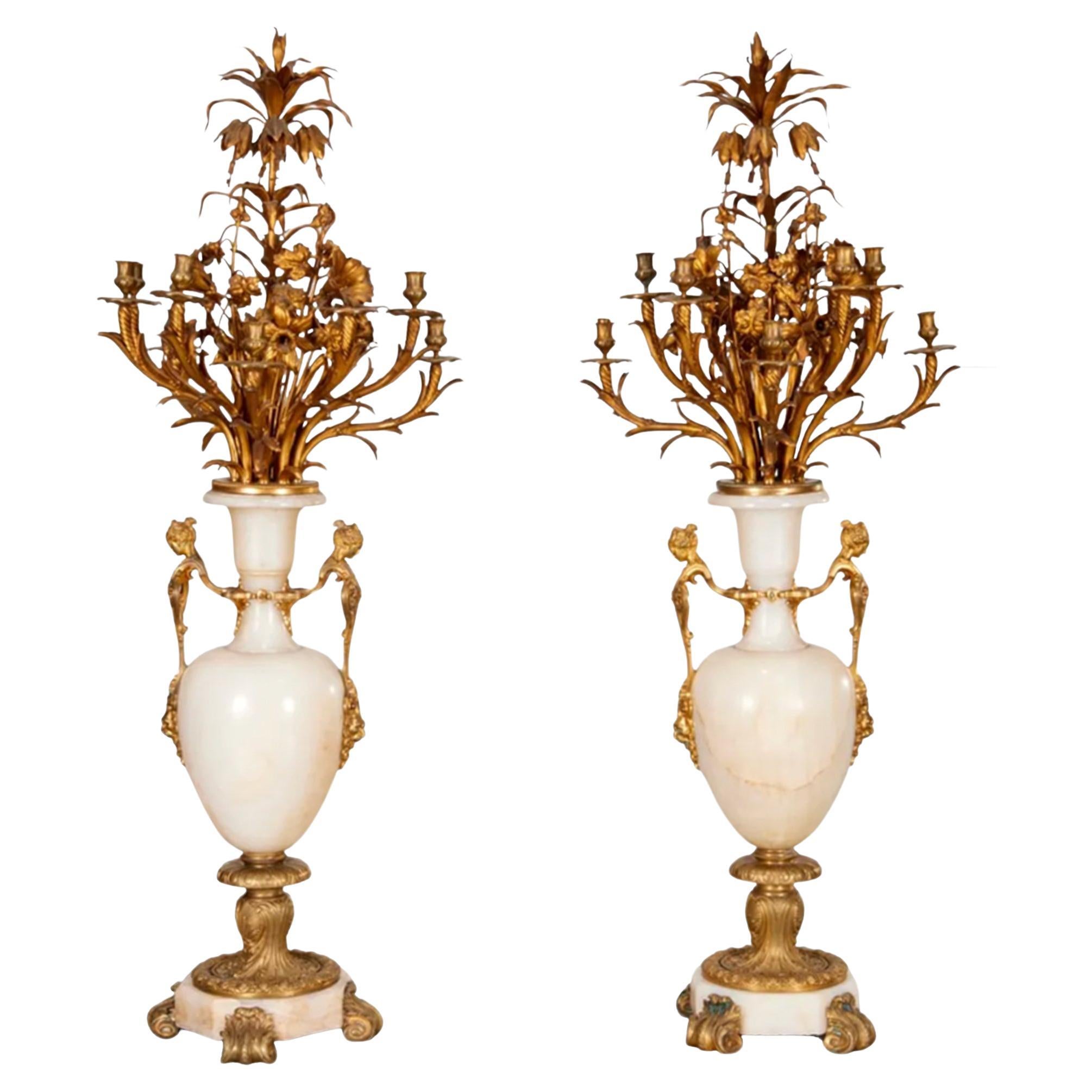
Paire monumentale de candélabres Napoléon III en bronze
Paire monumentale de candélabres anciens français Napoléon III en bronze et onyx blanc, datant de la fin du XIXe siècle. En forme de balustre avec des poignées en bronze doré en form...
Catégorie
Antiquités, XIXe siècle, Français, Napoléon III, Candélabres
Matériaux
Onyx, Bronze