Furniture

to
258
958
858
1,387
547
29
385
243
102
90
87
51
25
24
18
18
16
15
14
14
12
12
12
9
107
374
906
576
221
382
203
36
13
24
24
24
94
69
76
40
17
1,184
777
378
261
223
1,108
355
337
282
215
1,963
1,521
1,622
36
35
30
29
26
Furniture For Sale
Search Within: Swing
Original Vintage Road Safety Poster By Breaking Traffic Laws You Risk Your Life
Located in London, GB
Original vintage Russian avant-garde road safety poster designed by V. Klimashin. Amazingly dynamic image of a careless tram rider jumping off in fr...
Category

1930s Russian Vintage Furniture

Materials

Lithograph, Paper

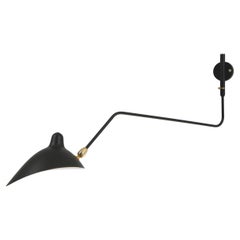
Serge Mouille - Rotating Sconce with 1 Curved Arm
Located in Stratford, CT
DESCRIPTION: The one arm curved sconce is both stylish and practical as it can be used in many different design applications. The shade tilts and revolves on a brass fitting while ...
Category

21st Century and Contemporary French Mid-Century Modern Furniture

Materials

Aluminum, Steel

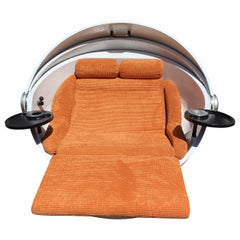
Original Sunball Chair by Gunter Ris and Ferdinand Selldorf for Rosenthal
Located in Little Burstead, Essex
This is a fully restored original version of this 1960's iconic classic astronaut's helmet style space age outdoor swivel chair, As you can imagin...
Category

Mid-20th Century German Space Age Furniture

Materials

Velvet, Fiberglass

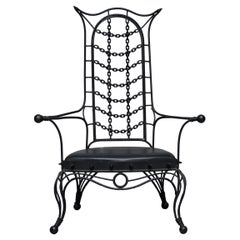
Interesting Iron Workers Gothic Sexy Dungeon Iron Throne Armchair Part Suite
Located in West Sussex, Pulborough
We are delighted to offer for sale this rather interesting metal workers sexy Gothic dungeon throne armchair Well, where to begin, what an interestin...
Category

20th Century English Gothic Furniture

Materials

Iron

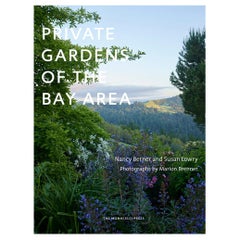
Private Gardens of the Bay Area
Located in New York, NY
Seasoned garden writers Susan Lowry and Nancy Berner, along with leading landscape photographer Marion Brenner, tour more than thirty-five private gardens in the San Francisco Bay Ar...
Category

2010s Chinese Furniture

Materials

Paper

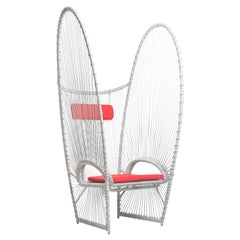
Papillon Easy Armchair by Kenneth Cobonpue
Located in Geneve, CH
Papillon easy armchair by Kenneth Cobonpue. Materials: polyethelene, steel. Also available in other colors. Dimensions: 91 cm x 108 cm x H 192 cm. The Papillon easy armchair a...
Category

2010s Philippine Modern Furniture

Materials

Steel

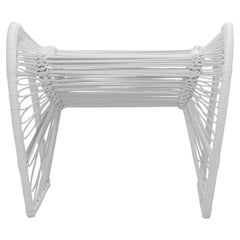
Papillon Ottoman by Kenneth Cobonpue
Located in Geneve, CH
Papillon ottoman by Kenneth Cobonpue. Materials: polyethelene, steel. Also available in other colors. Dimensions: 54 cm x 76 cm x H 55cm The Papillon easy armchair and swing f...
Category

2010s Philippine Modern Furniture

Materials

Steel

Porcelain Plaque of a 19th Century German Market by KPM
Located in London, GB
The 1844 summer market in the town of Lengerich, in the western German province of Westphalia, is the subject of this antique KPM porcelain plaque...
Category

Mid-19th Century German Antique Furniture

Materials

Porcelain, Giltwood

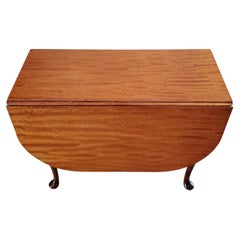
18th Century George III Period Figured Cherry Antique Drop Leaf Table
Located in Forney, TX
A very fine quality antique Georgian drop-leaf table, likely English or Irish, George III Period (1760-1820), featuring a rare and magnificent highly figured curly cherry top with ou...
Category

18th Century European Georgian Antique Furniture

Materials

Cherry

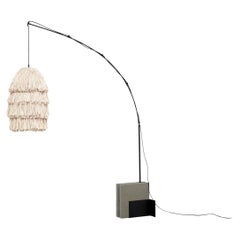
Beige Fran M Stand Floor Lamp by Llot Llov
Located in Geneve, CH
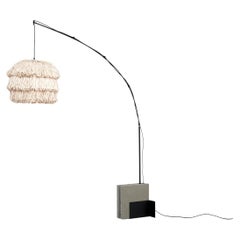
Beige Fran M stand floor lamp by Llot Llov Handcrafted light object Dimensions: D 45 x W 205.8 x H 250 cm Materials: raffia fringes, glass fiber, steel, concrete Colour: beige Also available in green, coral, black. Another member of the FRAN family is the floor lamp FRAN STAND. The pole that supports the FRANs lamp body is made of glass fiber and is plugged together according to the tent pole...
Category

2010s German Modern Furniture

Materials

Concrete, Steel

Coral Fran CS Stand Floor Lamp by Llot Llov
Located in Geneve, CH
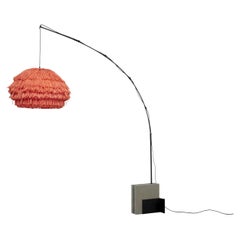
Coral Fran CS stand floor lamp by Llot Llov Handcrafted light object Dimensions: D 65 x W 205.8 x H 250 cm Materials: raffia fringes, glass fiber, steel, concrete Colour: coral Also available in green, beige, black. Another member of the FRAN family is the floor lamp FRAN STAND. The pole that supports the FRANs lamp body is made of glass fiber and is plugged together according to the tent pole...
Category

2010s German Modern Furniture

Materials

Concrete, Steel

Beige Fran L Stand Floor Lamp by Llot Llov
Located in Geneve, CH
Beige Fran L stand floor lamp by Llot Llov Handcrafted light object Dimensions: D 50 x W 205.8 x H 250 cm Materials: raffia fringes, glass fiber, steel, concrete Colour: beige Also a...
Category

2010s German Modern Furniture

Materials

Concrete, Steel

Green Fran S Stand Floor Lamp by Llot Llov
Located in Geneve, CH
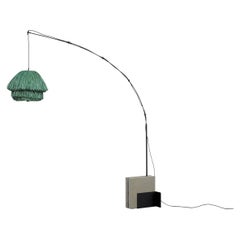
Green Fran S stand floor lamp by Llot Llov Handcrafted light object Dimensions: D 40 x W 205.8 x H 250 cm Materials: raffia fringes, glass fiber, steel, concrete Colour: green Also available in beige, coral, black. Another member of the FRAN family is the floor lamp FRAN STAND. The pole that supports the FRANs lamp body is made of glass fiber and is plugged together according to the tent pole...
Category

2010s German Modern Furniture

Materials

Concrete, Steel

George III Sweetmeat Basket made in London in 1786 by Hester Bateman.
Located in London, GB
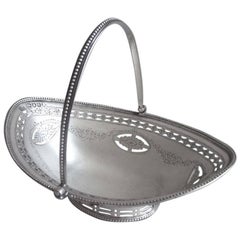
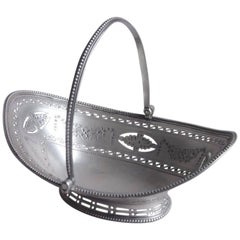
The Basket stands on an oval foot which is pierced with horizontal pails and roundels and displays an applied beaded rim. The arched swing handle, and rim of the main body, are also ...
Category

1780s English George III Antique Furniture

Materials

Silver

Four Seats "Longarina", by Sergio Rodrigues, 1965, Brazilian Mid-Century Modern
Located in Sao Paulo, SP
The exceptional auditorium armchair designed by the legendary Brazilian architect and designer Sérgio Rodrigues in 1965 showcases his genius for combining materials and proportions t...
Category

Mid-20th Century South American Mid-Century Modern Furniture

Materials

Wood

Doorstop "Golfer" by Hubley, circa 1920
Located in Incline Village, NV
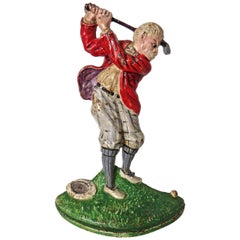
This doorstop, also known as "Overhead Swinging Golfer," is more difficult to find than it's "Putting Golfer" counterpart doorstop; which is also made by Hubley. Manufactured by the Hubley Manufacturing Company of Lancaster, Pennsylvania in 1920, this cast iron doorstop is in outstanding all original bright paint with no touch up or restoration of any kind, and in wonderful patina. It depicts an older, grey haired man, with typical knicker golf garb, taking a wild swing at a golf ball resting on the grass. It has a semi "hollow" rear with a "238" factory marking, indicating that it is, in fact, by Hubley and original. It is noted in Jeanne Bertoia's 1985 book on doorstops page 60; and referenced on page 211 of the Smith book on doorstops. A must for the doorstop or golfing memorabilia...
Category

Early 20th Century American Folk Art Furniture

Materials

Iron

Antique Sheffield Plated Wire Work Basket
Located in West Palm Beach, FL
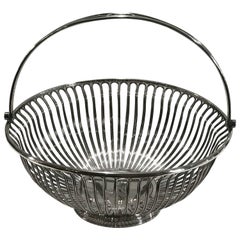
Antique Sheffield Plated Wire Work Basket Embrace the charm of history with our stunning Antique Sheffield plated wire work basket. Handcrafted with...
Category

Early 19th Century English Georgian Antique Furniture

Materials

Sheffield Plate

Very Interesting Iron Workers Gothic Sexy Dungeon Wrought Iron Bench Part of Set
Located in West Sussex, Pulborough
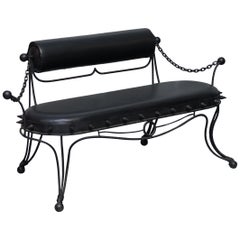
We are delighted to offer for sale this rather interesting metal workers sexy Gothic dungeon bench Well, where to begin, what an interesting piece…. Umm… it looks like it came from ...
Category

20th Century English Gothic Furniture

Materials

Iron

French Onyx and Enamel Miniature Table Cabinet
Located in London, GB
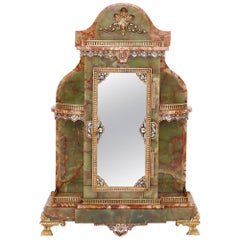
This elegant dressing table cabinet uses precious materials on a delicate scale, resulting in a piece that is both practical and luxurious. ...
Category

Early 20th Century French Belle Époque Furniture

Materials

Onyx, Marble, Ormolu, Bronze, Enamel

Fine Antique English Coromandel Decanter / Drinks Box, circa 1880
Located in Bath, GB
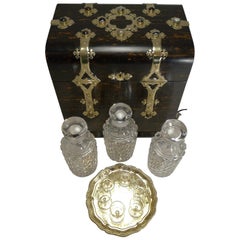
A truly magnificent drinks / decanter box made from exotic Coromandel mounted with polished brass mounts inset with a plethora of different kinds of cabochon cut and polished onyx st...
Category

1880s English Late Victorian Antique Furniture
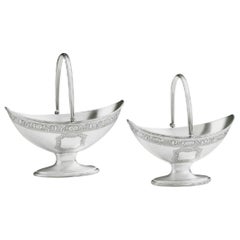
Pair of George III Baskets in Sizes Made in London in 1791 by Robert Hennell
Located in London, GB
The baskets would have been used for sugar and cream and stand on a stepped oval pedestal foot decorated with prick dot and bright cut bands. The main bodies are "Boat" shaped in for...
Category

Late 18th Century English George III Antique Furniture

Materials

Silver

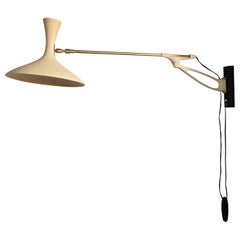
Rare Cosack Louis Kalff Royal Telescope Articulating Wall Light, Germany, 1950s
Located in Lisse, NL
Wonderfully stylish and pleasing to the eye swing light, easy to wall mount. This rare design wall lamp from the midcentury era is by Louis Kalff and it was manufactured by Gebrüder...
Category

Mid-20th Century German Mid-Century Modern Furniture

Materials

Metal, Aluminum, Brass

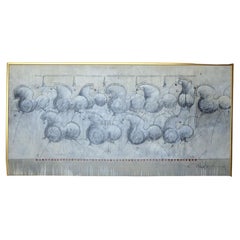
Acrylic and Crayon on Canvas by Bernardo Nieves
Located in Los Angeles, CA
Bernardo Nieves is a Venezuelan artist born on October 18th, 1961, in the quaint, small-town (at the time), city of Barquisimeto. A plastic self-taught artist who has sought instruction and knowledge with great effort, that began as a craft simple craft "hobby" which takes a big part in his life that today is grateful for. From his first steps in painting, passion for landscaping washes are printed on cardboard chimo-sepia, where he expressed his vision through cobbled streets, adobe houses, and mills. In this quest for artistic development, reconciles with oil, and monochrome images become hearty in colorful expressions by the nobility of the art. This new knowledge drives him to plot their future goals. At the end of this decade and early next, develops their technical experience in new materials and strengthens brushwork. In the 80s, a new inspiration emerges from the vegetation decorating fields, valleys, and forests. And these reasons are the ones he will project to a higher level by giving importance to his image as an artist. Towards the end of the century decade, he fully converts in "artist" by trade, then, what began as a pleasure is now his passion in one hundred percent of his time. Individual and group exhibits were already part of their commitments and his time was most devoted to art; during the last five years of the '90s was when his career took a new impulse and his image reached more interesting levels. It is here, while changes in his artistic life are in full swing, the artist pierced the thin line that divides the creative artist and the creator-artist and in the effort to show his graphics concepts, he developed mural projects which found acceptance among his colleagues and Barquisimeto people. So many events together were not enough to Bernardo, who while all these facts, internally was engendering a new graphic idea that definitely will take him to what he is now: the artist that succeeded. From the year 2000 an overturn of his motivations are mixed with trends and those landscapes: the Avila, forests, and valleys, suddenly a "coup" of artistic movement when the first Equus figure came out. These floating horses, first in earthy ochre, of long and slender limbs, have occupied the whole life of the artist. From stained canvases...
Category

21st Century and Contemporary Venezuelan Furniture

Materials

Canvas, Acrylic, Crayon

Hester Bateman, a Very Fine George III Sweetmeat Basket Made in London in 1786
Located in London, GB
The Basket stands on an oval foot which is pierced with horizontal pails and roundels and displays an applied beaded rim. The arched swing handle and rim of the main body, are also d...
Category

Late 18th Century English Antique Furniture
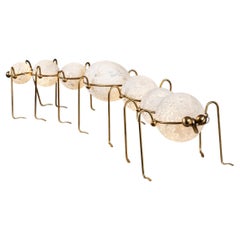
Caterpillar, Floor Lamp Sculpture, Vincent Darré and Ludovic Clément d’Armont
Located in Geneve, CH
Caterpillar, floor lamp sculpture, Vincent Darré and Ludovic Clément d’Armont Blown glass, textile, brass. Dimensions: 22 x 105 x 30 cm. Created in cooperation with designer Vin...
Category

2010s French Post-Modern Furniture

Materials

Brass

Spider, Floor Lamp Sculpture, Vincent Darré and Ludovic Clément D’armont
Located in Geneve, CH
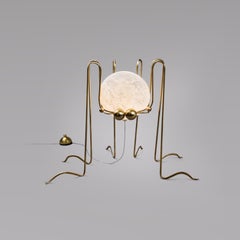
Spider, floor lamp sculpture, Vincent Darré and Ludovic Clément d’Armont Blown glass, textile, brass Dimensions: 55 x 37 x 37 cm. Created in cooperation with designer Vincent Da...
Category

2010s French Post-Modern Furniture

Materials

Brass

Dragonfly, Floor Lamp Sculpture, Vincent Darré and Ludovic Clément D’armont
Located in Geneve, CH
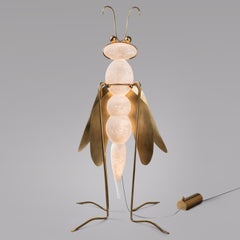
Dragonfly, floor lamp sculpture, vincent Darré and Ludovic Clément d’Armont. Material: blown glass, textile, brass. Dimensions: 120 x 75 x 43 cm. Cr...
Category

2010s French Modern Furniture

Materials

Brass

Carlo Scarpa Cognac Leather “Kentucky” Dining Chair for Bernini, 1977, Set of 5
Located in Vicenza, IT
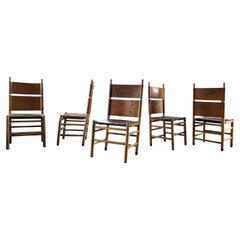
Set of 5 mod. 783 “Kentucky” dining chairs, designed by Carlo Scarpa for the Italian manufacturer Bernini in 1977. Structure made from oak and walnut timber. Seats and backrest made from cognac leather. Excellent vintage condition. Carlo Scarpa designed this chair for the “Scuderia” series., the last project he made for Bernini. The architect took inspiration from the “shaker” movement. He designed the chair slightly inclined at the front. This feature allows you to swing backward (until you lean on a wall) and remain in balance. Born in Venice on June 2nd, 1906, Carlo Scarpa began working at a very early age. A year after he had first qualified as an architect in 1926, he began working for the Murano glassmakers Cappellin & Co. in a consultative capacity. From 1927, Carlo Scarpa began to experiment with the Murano glass, and this research not only gave him excellent results here but would also inform his progress for many years to come. Between 1935 and 1937, as he entered his thirties, Carlo Scarpa accepted his first important commission, the renovation of Venice’s Cà Foscari. He adapted the spaces of this stately University building that stands on the Grand Canal banks, creating rooms for the Dean’s offices and a new hall for academic ceremonies; Mario Sironi and Mario De Luigi were charged with doing the restoration work on the frescos. After 1945, Carlo Scarpa found himself constantly busy with new commissions, including various furnishings and designs for the renovation of Venice’s Hotel Bauer and designing a tall building in Padua and a residential area in Feltre, all worth mentioning. One of his key works, despite its relatively modest diminished proportions, was the [bookshop known as the] Padiglione del Libro, which stands in Venice’s Giardini di Castello and clearly shows Scarpa’s passion for the works of Frank Lloyd Wright. In the years which were to follow, after he had met the American architect, Scarpa repeated similar experiments on other occasions, as can be seen, in particular, in the sketches he drew up in 1953 for villa Zoppas in Conegliano, which show some of his most promising work. However, this work unfortunately never came to fruition. Carlo Scarpa later created three museum layouts to prove pivotal in terms of how twentieth-century museums were set up from then on. Between 1955 and 1957, he completed extension work on Treviso’s Gipsoteca Canoviana [the museum that houses Canova’s sculptures] in Possagno, taking a similar experimental approach to the one he used for the Venezuelan Pavilion at [Venice’s] Giardini di Castello which he was building at the same time (1954-56). In Possagno Carlo Scarpa was to create one of his most significant ever works, which inevitably bears comparison with two other museum layouts that he was working on over the same period, those of: – Galleria Nazionale di Sicilia, housed in the Palazzo Abatellis in Palermo (1953-55) – Castelvecchio in Verona (1957- 1974), all of which were highly acclaimed, adding to his growing fame. Two other buildings, which are beautifully arranged in spatial terms, can be added to this long list of key works that were started and, in some cases, even completed during the nineteen fifties. After winning the Olivetti award for architecture in 1956, Scarpa began work in Venice’s Piazza San Marco on an area destined to house products made by the Industrial manufacturers Ivrea. Over the same period (1959-1963), he also worked on the renovation and restoration of the gardens and ground floor of the Fondazione Querini Stampalia in Venice, which many consider one of his greatest works. While he busied himself working on-site at the Fondazione Querini Stampalia, Carlo Scarpa also began work building a villa in Udine for the Veritti family. To shed some light on the extent to which his work evolved over the years, it may perhaps be useful to compare this work with that of his very last building, villa Ottolenghi Bardolino, which was near to completion at the time of his sudden death in 1978. Upon completion of villa Veritti over the next ten years, without ever letting up on his work on renovation and layouts, Scarpa accepted some highly challenging commissions, working on the Carlo Felice Theatre in Genoa and another theatre in Vicenza. Towards the end of this decade, in 1969, Rina Brion commissioned Carlo Scarpa to build the Brion Mausoleum in San Vito d’Altivole (Treviso), a piece he continued to work on right up until the moment of his death. Nevertheless, even though he was totally absorbed by work on this mausoleum, there are plenty of other episodes which can offer some insight into the final years of his career. As work on the San Vito d’Altivole Mausoleum began to lessen from 1973, Carlo Scarpa started building the new headquarters for the Banca Popolare di Verona. He drew up plans that were surprisingly different from the work he was carrying out at the same time on the villa Ottolenghi. However, the plans Carlo Scarpa drew up, at different times, for a monument in Brescia’s Piazza della Loggia commemorating victims of the terrorist attack on May 28th, 1974, make a sharp contrast to the work he carried out in Verona, almost as if there is a certain hesitation after so many mannered excesses. The same Pietas that informs his designs for the Piazza Della Loggia can also be seen in the presence of the water that flows through the Brion Mausoleum, almost as if to give a concrete manifestation of pity in this twentieth-century work of art. Carlo Scarpa has put together a highly sophisticated collection of structures, occupying the mausoleum’s L-shaped space stretching across both sides of the old San Vito d’Altivole cemetery. A myriad of different forms and an equally large number of different pieces, all of which are separate and yet inextricably linked to form a chain that seems to offer no promise of continuity, rising up out of these are those whose only justification for being there is to bear the warning “si vis vitam, para mortem,” [if you wish to experience life prepare for death] as if to tell a tale that suggests the circle of time, joining together the commemoration of the dead with a celebration of life. At the entrance of the Brion Mausoleum stand the “propylaea” followed by a cloister which ends by a small chapel, with an arcosolium bearing the family sarcophagi, the main pavilion, held in place on broken cast iron supports, stands over a mirror-shaped stretch of water and occupies one end of the family’s burial space. The musical sound of the walkways teamed with the luminosity of these harmoniously blended spaces shows how, in keeping with his strong sense of vision, Carlo Scarpa could make the most of all of his many skills to come up with this truly magnificent space. As well as a great commitment to architectural work, with the many projects which we have already seen punctuating his career, Carlo Scarpa also made many equally important forays into the world of applied arts. Between 1926 and 1931, he worked for the Murano glassmakers Cappellin, later taking what he had learned with him when he went to work for the glassmakers Venini from 1933 until the 1950s. The story of how he came to work on furniture design is different, however, and began with the furniture he designed to replace lost furnishings during his renovation of Cà Foscari. The later mass-produced furniture started differently, given that many pieces were originally one-off designs “made to measure.” Industrial manufacturing using these designs as prototypes came into being thanks to the continuity afforded him by Dino Gavina, who, as well as this, also invited Carlo Scarpa to become president of the company Gavina SpA, later to become SIMON, a company Gavina founded eight years on, in partnership with Maria Simoncini (whose own name accounts for the choice of company name). Carlo Scarpa and Gavina forged a strong bond in 1968 as they began to put various models of his into production for Simon, such as the “Doge” table, which also formed the basis for the “Sarpi” and “Florian” tables. In the early seventies, other tables that followed included “Valmarana,” “Quatour,” and “Orseolo.” While in 1974, they added couch and armchair “Cornaro” to the collection and the “Toledo” bed...
Category

1970s Italian Mid-Century Modern Vintage Furniture

Materials

Walnut, Leather, Plastic

Psiqué Dressing Mirror, Mahogany, Bronze, Marble, 19th Century
Located in Madrid, ES
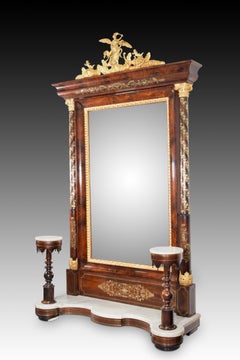
Note the neoclassical influence of the decorative elements and the composition of the furniture, highlighting the figure inspired by the classical mythology of the upper part (it is ...
Category

19th Century European Neoclassical Antique Furniture

Materials

Marble, Bronze, Other

Grand French Three-Piece Desk Set, Hand Painted Porcelain Inset, circa 1860
Located in Bath, GB
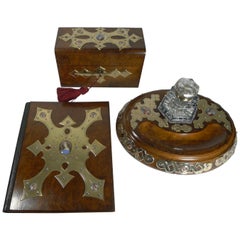
Wonderful to find a top-notch, highly decorative and most unusual desk set, French in origin dating to around 1860. Made from nutty coloured burl Walnut, all three pieces are mounted with the most wonderful polished brass mounts all inset with fabulous hand painted porcelain plaques. Our restorer had to remove all the mounts to professionally clean and on doing so found the name of the figure depicted on the plaques, "Ninon De Lenclos" a French Author, Courtesan, Freethinker and Patron of the Arts. The set is made up of a Stationery box with brass swing handles each side; the box complete with a working tasselled key. The box opens to reveal the wonderful original gilded leather lining with the original paper lining the sides of the dividers. The lock and hinges are beautifully engraved, a true sign of quality. The next piece is a hefty large oval Walnut Inkstand with a large glass inkwell...
Category

1860s French Victorian Antique Furniture

Materials

Brass

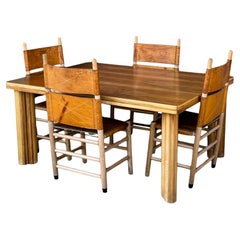
Carlo Scarpa Walnut and Leather "Scuderia" Dining Room Set for Bernini, 1977
Located in Vicenza, IT
Scuderia dining room set, designed by Carlo Scarpa for the Italian manufacturer Bernini in 1977. Composed of 5 mod. 783 “Kentucky” dining chairs...
Category

1970s Italian Mid-Century Modern Vintage Furniture

Materials

Leather, Plastic, Walnut

Mid-20th Hollywood Regency Credenza or Dresser by Renzo Rutili for Johnson Furn
Located in Topeka, KS
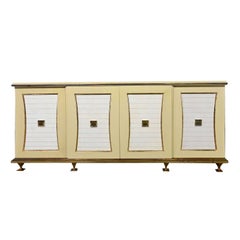
Gorgeous vintage Hollywood Regency Art Deco credenza or dresser by Renzo Rutili for Johnson Furniture comprised of an off-white painted top, ends & front o...
Category

Mid-20th Century American Hollywood Regency Furniture

Materials

Metal, Brass

Monumental Mid-Century P.E. Guerin NY Signed Cartonnier File Cabinet Table Chest
Located in Forney, TX
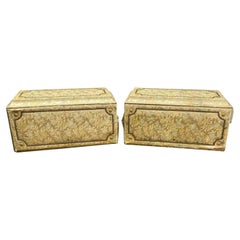
A large vintage upholstered cartonnier by legendary American luxury artisans P.E. Guerin. (Two available / Sold each) Exquisitely hand-crafted in Greenwich Village, New York City in the mid 20th century, the monumental size cartonnier (French name for an ornamental box...
Category

Mid-20th Century American Furniture

Materials

Metal, Brass, Bronze

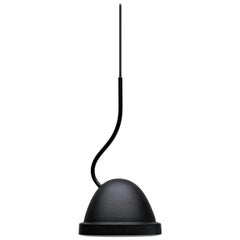
Jacco Maris LED Insider Pendant
Located in Yonkers, NY
Handmade in Holland not only has a nice “ring” to it, it means Jacco Maris’ fixtures exhibit exemplary quality and jaw-dropping style only a lover of experimentation could achieve. W...
Category

21st Century and Contemporary Dutch Modern Furniture

Materials

Aluminum

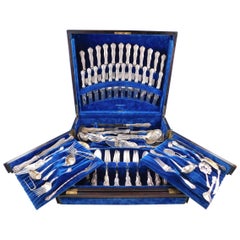
Imperial Queen by Whiting Sterling Silver Flatware Set Service 167 Pieces Dinner
Located in Big Bend, WI
Superb Imperial Queen by Whiting sterling silver flatware set - 167 pieces including many fabulous serving pieces. The classic shell motif pa...
Category

Early 20th Century Furniture

Materials

Sterling Silver

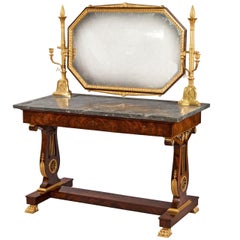
19th Century French Empire Mahogany, Gilt and Marble Topped Dressing Table
By François-Honoré-Georges Jacob-Desmalter
Located in London, GB
Constructed using a fine Honduras mahogany with gilt highlights, Bleu Tarquin marble and richly dressed with fire gilt ormolu mounts of the highest quality. The table of lyre end sup...
Category

19th Century French Empire Antique Furniture

Materials

Marble, Ormolu

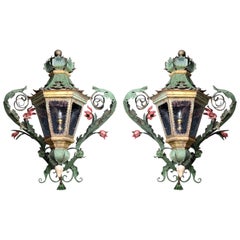
Amazing Pair of 19th Century Venetian Persecution Toleware Lanterns
Located in London, GB
Amazing Venetian toleware lanterns We are proud to offer a fabulous matched pair of 19th century Venetians toleware and wrought iron lanterns in origi...
Category

19th Century Italian Victorian Antique Furniture

Materials

Wrought Iron, Tin

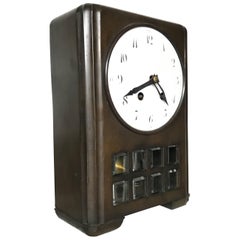
Rare Art Deco / Bauhaus Bronze Table or Mantel Clock by Lenzkirch / C.Kühling
Located in Lisse, NL
Bronze table clock from the transitional period between Art Nouveau and Art Deco. This rare bronze table clock is by Lenzkirch and it dates from the transitional period of the Jugen...
Category

Early 20th Century German Art Deco Furniture

Materials

Bronze, Enamel

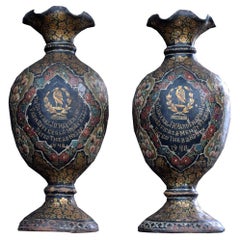
Mid-20th Century Ceremonial Vases
Located in London, GB
Mid-20th century ceremonial vases We are proud to offer a rare example of a matched pair of ceremonial decorative vases dated 1948. Hand painted leather forms covered in floral motifs, and with a central coat of arms (DTO FAVENE) stating “To General J.H Marden & Mrs Marden, Frum Officers & Men of BTC. ESP, Dated The 22 Sep 1948. History: The Remarkable O.B.E. Group of 20 awarded Lieutenant-General John Harold Marden, O.B.E., Commander-in-Chief of Bahawalpur State Forces, late 2nd / 76th Punjabis. Having served as a Second Lieutenant late on in the Great War, and on the North West Frontier in 1919-21 with the forces of the Maharajah of Nabha. Some years later in the 1930s he joined the Army of Bahawalpur, becoming its Commander-in-Chief, and serving (and being wounded) during the periods of unrest leading up to and after the partition of India and the creation of the Dominion of Pakistan in 1947. He served as a Personal Aide to the Amir of Bahawalpur until his death in 1974, and features heavily in the book ‘Divide...
Category

1940s Indian Mid-Century Modern Vintage Furniture

Materials

Leather

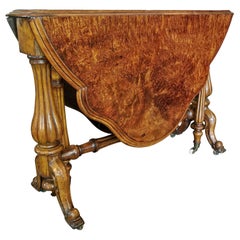
19th Century English Burl Walnut Sutherland Table
Located in Dallas, TX
Late 19th century English drop-leaf table from the Mid-Victorian Era. Made of gorgeous yellowish-brown walnut with a fantastic burl walnut table top. The patina on the top is simply glorious!! The table was made circa 1850-60. It sits on beautifully turned fluted legs with the porcelain and brass casters. Two of the legs swing inwards and outwards to extend the 2 leaves of the table. Fully extended the table has a fabulous curved and indented edge, in an oval shape on both ends. The center column is beautifully turned and fluted. The 2 side columns are again beautifully turned and fluted and end with 2 extending scrolling supports that end in turned bulbous twin feet. This is a high quality item and highly desirable! Antique Sutherland Tables...
Category

Mid-19th Century English High Victorian Antique Furniture

Materials

Walnut, Burl

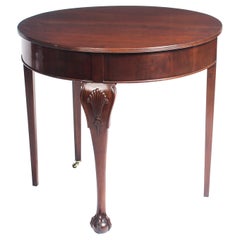
Antique Victorian Mahogany Demilune Card Console Tea Table, 19th Century
Located in London, GB
This is a beautiful antique Victorian mahogany demi lune side table, 19th century in date. The table is made of solid mahogany with a moulded top above a plain frieze and is raised ...
Category

1850s English Victorian Antique Furniture

Materials

Mahogany

Biedermeier Picture Clock with Musical Movement, Austria, circa 1825
Located in Incline Village, NV
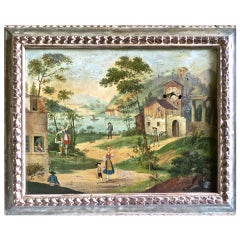
These painting clocks are very rare, especially containing the music box. Of Austrian manufacture circa 1820-1830, this Biedermeier picture (painting) clock is a naive and charming oil painting on metal, which depicts nine people dressed in colorful period clothes at various activities; a woman with her child and carrying fruit in a basket atop her head, two young lovers, a man in a boat, another man walking with his dog, while still another gentleman leaves the town hall. A woman at the window...
Category

19th Century Austrian Biedermeier Antique Furniture

Materials

Metal

Pair of Louis XVI Style Vitrines with Wedgwood Plaques by Zwiener, circa 1880
Located in Brighton, West Sussex
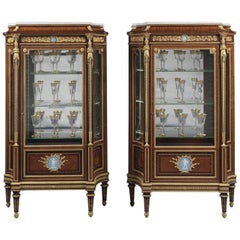
An important pair of Louis XVI style gilt-bronze mounted vitrines with wedgwood Jasperware plaques, by Joseph-Emmanuel Zwiener. French, circa 1880. Stamped 'NZ', 'NZ.309' and 'ZJ' to the reverse of the bronze mounts. Signed to the reverse of the lockplate 'Mon THEAU THIEFFINE Succ./SERRURIER PARIS'. This rare pair of vitrines, each have a shaped Carrera marble top above a frieze centred by a round classical Jasperware plaque flanked by gilt-bronze putti figures and scrolling acanthus running pattern. Below is a gilt-bronze framed bevelled glass door above a panel centred by a finely modelled Jasperware plaque of a putto representing the seasons. The door is flanked to either side by gilt-bronze monnaie pattern and headed by a pair of exceptionally fine female canephor figures. The shaped sides have corresponding bevelled glass panels and the vitrine is raised on tapering fluted legs. The distinctive canephor figures, finely cast as female caryatids with ringlets in their hair and supporting baskets of fruit upon their heads, is a distinctive and celebrated model unique to Zwiener. Many of Zwieners bronzes are executed in the Louis XV style, with flowers and scrolling acanthus leaves and an emphasis on asymmetry, typical of the work of his bronze sculptor Léon Messagé. The mounts employed on this rare pair of vitrines however sees Zwiener creating his own up-to-date reinterpretation of the Louis XVI style, drawing inspiration from established Louis XVI models such as those designed by Weisweiler for Marie-Antoinette's Dressing table. [See Mestdagh, p.305]. A second distinctive feature of the vitrines is the finely modelled Wedgwood Jasperware plaques incorporated in the frieze of each vitrine and beneath the doors. Wedgwood exhibited at nearly all of the Universal Exhibitions held in 19th century France, displaying amongst other pieces, plaques specifically intended to be mounted on to furniture. The first vitrine displays to the frieze a finely modelled plaque in the classical style, depicting a group of putti at play, one being pushed on a swing, while another plays a trumpet and a small attentive dog watches from below. Beneath the glass panelled door a larger Jasperware plaque is incorporated depicting a putto figure with a garland of flowers, emblematic of spring. The second vitrine has a classical plaque...
Category

Late 19th Century French Louis XVI Antique Furniture

Materials

Bronze

Shop Unique Furniture on 1stDibs

When it comes to shopping for vintage, new and antique furniture — whether you’re finally moving into that long-coveted loft apartment, ranch-style home, townhouse or furnishing your weekend house on the lake — you should think of your home as a stage for the seating, tables, lighting, storage cabinets and other pieces that best match your personality.

Coziness, comfort and creating a welcoming space are among the important things to consider when buying furniture, whether that means seeking strict cohesion or rooms characterized by a mix-and-match assembly of varying shapes, colors and materials. And for those who now work from home, exercise, eat and relax within the same four walls every day, they’ll also want to think about flexibility and an innovative approach.

Have you built your dream kitchen?

Is your current living-room furniture all that it could be?

Does your toast-worthy bar or vintage bar cart exude equal parts class and cheeriness?

And importantly, is your home officebackyard or otherwise — a happy one, regardless of the design style you happen to gravitate toward?

Although mid-century modern, rustic, minimalist, Art Deco and contemporary looks remain popular, they aren’t the only styles available to design connoisseurs.

Furniture styles are nothing if not fluid, meaning what’s popular one year may not be the next. That’s why it’s crucial to not only pay attention to interior-design trends but also focus on the styles that speak to you. That way, you (and your interior designer, if that is in the plans) can work to create a home that’s entirely your own, complete with impressively modern decor as well as an array of history’s universally renowned iconic designs.

It’s difficult to single out well-recognized designs from what is a crowded pantheon of celebrated and seminal furnishings. Certain outstanding designs have such stellar quality they’ve endured for decades as bona fide cultural treasures, still being manufactured, in many cases, by the same venerable companies that shepherded them into being (think Herman Miller, Knoll and Fritz Hansen). Some works come immediately to mind as contenders for any short list. When you’re discussing the most popular mid-century modern chairs, for example, no tally would be complete without citing designs by Arne Jacobsen, Charlotte Perriand, Charles and Ray Eames and Hans Wegner.

Good furniture, be it authentic vintage furniture or new custom furniture, allows you to comfortably sit and tell your favorite stories. Great furniture tells a story of its own.

On 1stDibs, find everything from sofas to serveware to credenzas to coffee tables, and every other type of antique, vintage and new furniture you need to create a singular space that you’ll be proud to call home.