Furniture

to
31
324
74
203
187
51
92
17
12
12
7
7
7
6
5
4
3
3
2
2
1
1
18
47
138
238
35
34
41
3
7
12
7
3
7
8
14
111
107
94
74
56
208
188
142
108
63
441
266
375
106
37
10
8
6
Furniture For Sale
Search Within: Morgan
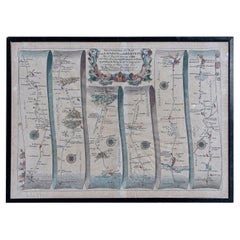
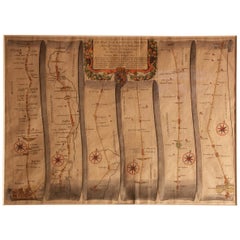
Map Road Strip Britannia Sheet 2 John Ogilby London Aberistwith Islip Bramyard
Located in BUNGAY, SUFFOLK
From John Ogilby's, 'Britannia, an Illustration of the Kingdom of England and Dominion of Wales'. First published in 1675 it remains the greatest advance ...
Category

17th Century English Baroque Antique Furniture

Materials

Paper

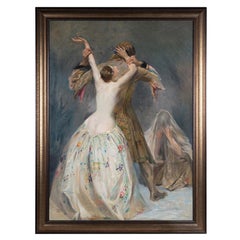
Hamilton Hamilton Oil on Canvas "Othello and Desdemona"
Located in Los Angeles, CA
Hamilton Hamilton (American, 1847-1928) A large and impressive oil on canvas "Othello and Desdemona" after the William Shakespeare's play "Othe...
Category

1920s American Art Nouveau Vintage Furniture

Materials

Canvas, Giltwood

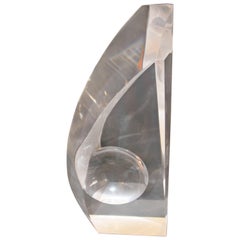
Bijan Bahar Lucite Sculpture 1/1
Located in Palm Springs, CA
A unique work by Bijan Bahar signed and numbered 1/1. It has been polished. There is some minor crazing on an edge that we tried to capture in a picture. a brief bio of the artist A bio af the artist follows: Museum Shows / Collections Some of Commissions / Collections Irvine Foundation, Los Angeles, CA Mr. R. Lichtenstein, Int. Riverside Museum of Art, Riverside, CA Mr. Ali Sobhani, CA Newport Harbor Art Museum, Newport Beach, CA 3700 Wilshire Blvd, LA, CA Museum of Science and Industry, Los Angeles, CA Mrs. Rose Freeman, CA Smithsonian Institute, Washington DC Mr. and Mrs. Wiernik, PA Las Vegas Museum of Art, Las Vegas, NV Mr. Sam Francis, Int. Baccarat Museum,cycling Paris, France Pat Sajak gift Laguna Beach Art Museum Metro Goldwyn-Mayer, CA The Walker Art Museum, KS Long Beach Children's Hospital Art Institute of Chicago CBS The Modern Museum of Art Orange County Performing Arts Center, CA Showcase of the World Treasures Tehran, Iran Memorial Medical Center Foundation, CA Presidential Citation Award A.S.I.D. BelAge Hotel, WH, CA Mayo Clinic, Scottsdale, AZ McDonald Corporation Intel Museum Baccarat Crystal, Paris, France Standard Oil, Chicago, Ill. Exhibitions Xerox Jefferson Airplane, Int. International Contemporary Art Fair, Japan Mr. Frederick Weisman, Int. Vorpal Galleries, NY and CA Mr. Arnon Milchan, Int. Baccarat, NY, and Paris, France Dr. Peter Kraus, CA Fluor Corporation Bishop Gerald McAllister, OK Gillman Galleries, Chicago, Il. Mr. M. Epstein S. Schwimer, BH, CA Dana Reich Galleries, SF, CA Mr. Noel Blank Denise Rene Gallery, New York Mr. E. Shore / Mr. C. Paul Cedar-Sinai Medical Center,NIKE LA, CA Mr. Harold Holder Masterpiece Publishing, Inc , CA Mr. Tom Vardon Adamson Duvannes Gallery, LA, CA Mr. Ron Davis...
Category

1970s American Vintage Furniture

Materials

Acrylic

Bijan Bahar Lucite Sculpture 1/1
$2,400 Sale Price
50% Off
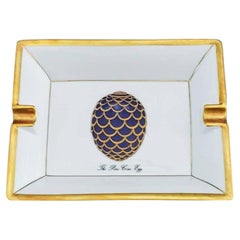
Fabergé Limoges Porcelain Hand Painted Egg Decorative Table Tray Ashtray
Located in Forney, TX
A rare and stunning Fabergé Limoges French porcelain hand painted parcel gilt tray. Created exclusively by House of Fabergé and Limoges porcelain as ...
Category

Late 20th Century French Empire Furniture

Materials

Porcelain

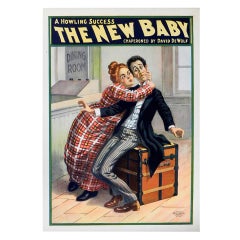
Original 1902 American Playhouse Poster
By U.S. Litho Company
Located in Peekskill, NY
This was an estate find and part of a beautiful collection of rare excellent turn of the century posters. They were hidden away for over a 100 years. About the poster: You'd think that a play called 'The New Baby' might feature said child in its promotional material. But here's the thing, there really isn't a baby at the center of the comedy, and that's the crux of this entertainment. The plot concerns a husband who is so bored with country life that he dreams up the idea of having an illegitimate son in London as a way to get into town for an occasional 'night off'. When his wife decides that the child should be adopted, the expected comic tissue of falsehoods and misunderstandings frays and hilarity ensues. Adapted from German by A. Bourchier, the farce opened in London in 1896 to what a local critic termed 'much mirth'. Several years later, when the play had crossed the Atlantic and entered the repertory of David de Wolf - cleverly called the Baby's 'chaperone' on the poster - and his troupe of travelling players, that understated review was translated into the more American howling success'. The cast and director would've been totally unfamiliar with the British hinterlands, so this splendid design concentrates on the hi-jinks of the characters and their situation.' At the start of the 20th century, America was in the full glory of its cultural adolescence, bursting with energy and optimism. In 1900 in New York there were 33 legitimate Broadway theatres, and many more would be built within the next decade to meet growing audience demand. New York's exploding population was also enjoying increased mobility. In 1904, the city opened its first underground commuter railroad lines. Thanks to these 'subways,' tens of thousands living far from the theatre district could catch a Broadway show and still sleep in their own beds. Add in the ever-increasing numbers of tourists who came into the city by rail and steamship, and it was easy to see why Broadway could now support more productions and longer runs than ever before.' We believe this magnificent and awe inspiring poster typifies the best of musical history and musical posters...
Category

Early 20th Century American Art Nouveau Furniture

Materials

Paper

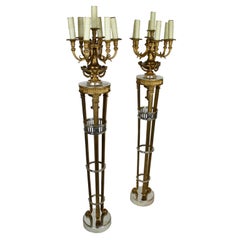
Caldwell Pair of Silvered and Doré Bronze Neoclassic Lamps
Located in New York, NY
Caldwell, a pair of doré and silvered bronze tripod form floor lamps on conforming marble bases. The seven-armed candelabra are carried on neoclassic urns decorated with rams' heads ...
Category

Early 20th Century American Neoclassical Furniture

Materials

Bronze

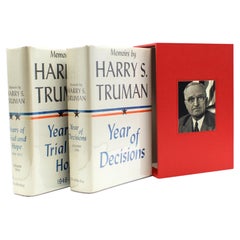
Memoirs Year of Decisions and Years of Trial and Hope, Signed and Inscribed
Located in Colorado Springs, CO
Truman, Harry. Memoirs by Harry S. Truman. New York: Doubleday Company, 1955-56. Both volumes signed and inscribed. Two-volume set. Octavos. Stated first editions. In later or ...
Category

Mid-20th Century American Mid-Century Modern Furniture

Materials

Paper

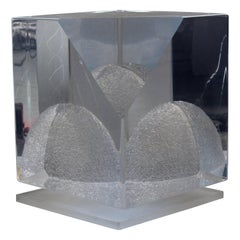
Bijan Bahar Lucite Sculpture
Located in Palm Springs, CA
A massive 450 pound Lucite sculpture by the noted artist Bijan Bahar. This piece is enormous and quite impressive. It looks great with the led light changing colors which will accompany the piece. It features an etched signature. This piece was hand-craved out by the artist and when viewed at the proper angle the hollowed out circle looks like multiple circles. Quite a stunning effect. it sits on a ring of Lucite and has an acrylic base plate. The sculpture is 22.75 inches tall but with the ring, which allows it to be rotated quite easily and base is 25.5 inches tall. This sculpture has a bit of cloudiness to it and some minor scuffs and marks. A truly monumental work by a talented artist. A bio of the artist follows: Museum Shows / Collections Some of Commissions / Collections Irvine Foundation, Los Angeles, CA Mr. R. Lichtenstein, Int. Riverside Museum of Art, Riverside, CA Mr. Ali Sobhani, CA Newport Harbor Art Museum, Newport Beach, CA 3700 Wilshire Blvd, LA, CA Museum of Science and Industry, Los Angeles, CA Mrs. Rose Freeman, CA Smithsonian Institute, Washington DC Mr. and Mrs. Wiernik, PA Las Vegas Museum of Art, Las Vegas, NV Mr. Sam Francis, Int. Baccarat Museum,cycling Paris, France Pat Sajak gift Laguna Beach Art Museum Metro Goldwyn-Mayer, CA The Walker Art Museum, KS Long Beach Children...
Category

1980s American Vintage Furniture

Materials

Acrylic

Bijan Bahar Lucite Sculpture
$28,000 Sale Price
20% Off
“Eye of the Pyramid” in Lucite by Bijan Bahar
Located in Palm Springs, CA
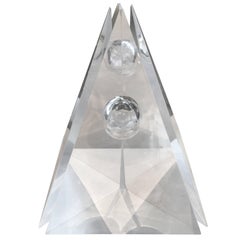
A monumental four-part sculpture that fits together to form a four-sided pyramid titled "Eye of the Pyramid" by the noted late artist Bijan Bahar. Mr Bahar sadly passed away a couple of years ago. We had the pleasure of getting to know him as he spent his last few years in Palm Springs. This was created in the late 1980s and is signed and numbered 5/6. It is in good age appropriate condition but has been recently re-polished. There are some minor marks from handling but nothing major. There is some cloudiness to the lucite from age. Note the bottom is sanded to a Frost finish by the artist. Each piece is signed and numbered. It was purchased directly from the artist and his team re-polished it. Please note that Bijan blunted the points of the tops for safety reasons when he created the sculpture. A bio af the artist follows: Museum Shows / Collections Some of Commissions / Collections Irvine Foundation, Los Angeles, CA Mr. R. Lichtenstein, Int. Riverside Museum of Art, Riverside, CA Mr. Ali Sobhani, CA Newport Harbor Art Museum, Newport Beach...
Category

1980s American Vintage Furniture

Materials

Acrylic

Bijan Bahar Lucite and Epoxy Resin Sculpture Yin Yang
Located in Palm Springs, CA
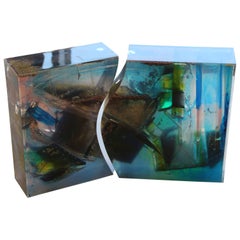
A beautiful colorful sculpture by the noted artist Bijan Bahar. Bijan created this incredible sculpture by first creating a lucite box and then filling it with epoxy resin. before the resin hardened he filled it with found objects of color. after it dried he cut the sculpture artfully into two pieces. it was created in the mid 1990's and is signed and numbered 1/1. It is in good age appropriate condition with some crazing to the seams where the glue has crazed. There are some surface scratches and minor nicks as well. Not the bottom is sanded to a Frost finish by the artist. A bio af the artist follows: Museum Shows / Collections Some of Commissions / Collections Irvine Foundation, Los Angeles, CA Mr. R. Lichtenstein, Int. Riverside Museum of Art, Riverside, CA Mr. Ali Sobhani, CA Newport Harbor Art Museum, Newport Beach, CA 3700 Wilshire Blvd, LA, CA Museum of Science and Industry, Los Angeles, CA Mrs. Rose Freeman, CA Smithsonian Institute, Washington DC Mr. and Mrs. Wiernik, PA Las Vegas Museum of Art, Las Vegas, NV Mr. Sam Francis, Int. Baccarat Museum,cycling Paris, France Pat Sajak gift Laguna Beach Art Museum Metro Goldwyn-Mayer, CA The Walker Art Museum, KS Long Beach Children...
Category

1990s American Furniture

Materials

Acrylic

Three Bijan Bahar Triangular Lucite Sculptures
Located in Palm Springs, CA
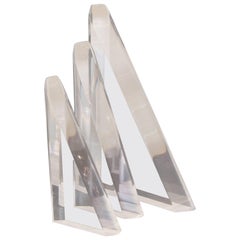
A nice group of three triangle shaped and faceted Lucite sculptures done and signed Bijan Bahar in the 1970s. The artist confirmed the timeframe himself. They are each signed and have been buffed out a bit by the artist himself. They still retain some surface scratches and imperfections with some edge roughness as the artist wanted them to retain some semblance of their true age. The tallest dimensions are given below, but the middles one is approx 15" tall, 6.5" W and 1.75" deep. The smallest is 13" tall, 6" wide and 1.5" deep. A bio of the artist: Museum Shows / Collections Some of Commissions / Collections Irvine Foundation, Los Angeles, CA Mr. R. Lichtenstein, Int. Riverside Museum of Art, Riverside, CA Mr. Ali Sobhani, CA Newport Harbor Art Museum, Newport Beach, CA 3700 Wilshire Blvd, LA, CA Museum of Science and Industry, Los Angeles, CA Mrs. Rose Freeman, CA Smithsonian Institute, Washington DC Mr. and Mrs. Wiernik, PA Las Vegas Museum of Art, Las Vegas, NV Mr. Sam Francis, Int. Baccarat Museum,cycling Paris, France Pat Sajak gift Laguna Beach Art Museum Metro Goldwyn-Mayer, CA The Walker Art Museum, KS Long Beach Children...
Category

1970s American Vintage Furniture

Materials

Lucite

John Miller Blue Plate Special Fries 2008 Hand Blown Pop Art Glass Sculptures
Located in Brooklyn, NY
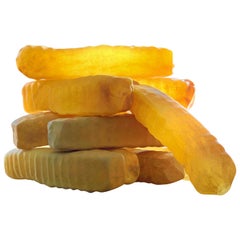
Inspired by Americana, Miller's work stands to bring new light and perspective to the often overlooked but ubiquitous cultural artifacts that form the American visual lexicon and lived experience. Maybe as impressive as the work itself, is the magnitude of which his creations come to life. At such an impressive scale, his process is truly spectacle to witness. Pieces from his famed ‘Blue Plate Special...
Category

Early 2000s American Post-Modern Furniture

Materials

Blown Glass

Pop Art Blue Plate Special Burger Fries Glass Sculpture Set John Miller, 2008
Located in Brooklyn, NY
Inspired by Americana, Miller's work stands to bring new light and perspective to the often overlooked but ubiquitous cultural artifacts that form the American visual lexicon and lived experience. Maybe as impressive as the work itself, is the magnitude of which his creations come to life. At such an impressive scale, his process is truly spectacle to witness. Pieces from his famed ‘Blue Plate Special...
Category

21st Century and Contemporary American Post-Modern Furniture

Materials

Art Glass, Blown Glass

Road Map Britannia 1675/6 No 5 Road London to Barwick, London Stilton Grey Frame
Located in BUNGAY, SUFFOLK
John Ogilby (British 1600-1676) cosmographer and geographick printer to Charles II. A road map from Britannia, 1675/6. No 5, The road from London to Barwick: London to Stilton In a grey painted and gilded frame. In a remarkable life John Ogilby pursued, several careers, each ending in misfortune, and yet he always emerged undeterred, to carry on. His modern reputation is based on his final career, started in his sixty-sixth year, as a publisher of maps and geographical accounts. Ogilby was born outside Dundee, in 1600, the son of a Scottish gentleman. While he was still a child, the family moved to London. When the elder Ogilby was imprisoned for debt, the young John invested his savings in a lottery, won a minor prize, and settled his father's debts. Unfortunately, not enough money was left to secure John a good apprenticeship; instead, he was apprenticed to a dance master. Ogilby was soon dancing in masques at court but, one day, while executing a particularly ambitious leap, he landed badly. The accident left him with a permanent limp, and ended his dancing career. However, he had come to the attention of Thomas Wentworth, later Earl of Strafford, Charles I's most senior minister. Ever one to exploit his contacts, Ogilby became a dance instructor in Strafford's household. When Strafford was sent to Ireland, Ogilby accompanied him as Deputy-Master of the Kings Revels, and then Master of Revels. In Dublin, he built the New Theatre, in St. Werburgh Street, which prospered at first, but the Irish Rebellion, in 1641, cost Ogilby his fortune, which he estimated at £2,000, and almost his life. After brief service as a soldier, he returned to England, survived shipwreck on the way, and arrived back penniless. On his return, Ogilby turned his attention to the Latin classics, as a translator and publisher. His first faltering attempt, in 1649, was a translation of the works of Virgil, but after his marriage to a wealthy widow the same year, his publishing activities received a considerable boost. One means by which Ogilby financed these volumes was by subscription, securing advance payments from his patrons, in return for including their name and coats-of-arms on the plates of illustrations. Another approach was to secure a patron, preferably in the court circle. Ogilby's first patron was Strafford, who found out too late that all leading ministers are dispensable when Charles I assented to his execution in 1641. As he re-established himself, Ogilby sought a new patron, the King himself. In 1661, Ogilby was approached to write poetry for Charles II's coronation procession; he later published 'The Relation of His Majesties Entertainment Passing Through the City of London', and a much enlarged edition the following year, which included a Fine set of plates depicting the procession. Royal favour was bestowed in 1674 when John Ogilby received the title of 'His Majesty's Cosmographer and Geographick Printer' with a salary of £13.6s.8d per annum. In 1665, Ogilby left London to avoid the Plague then ravaging the capital. The following year, in the Great Fire of London, Ogilby claimed that he lost his entire stock of books valued at some £3,000, as well as his shop and house, leaving him worth just £5. As he sought to restore his fortunes, Ogilby was already looking in new directions. The initial opportunity he seized on was the reconstruction of London's burnt-out centre. He secured appointment as a "sworn viewer", whose duty was to establish the property boundaries as they existed before the Fire. Ogilby was assisted in the project by his step-grandson, William Morgan, and by a number of professional surveyors. The result was an outstanding plan of London, on a scale of 100 feet to an inch, on 20 sheets, although it was not printed until after Ogilby's death. Ogilby then turned his attention to publishing geographical descriptions of the wider-world. In 1667, he issued 'An Embassy from the East India Company of the United Provinces to the Grand Tartar Cham, Emperor of China.' Buoyed by the response to this volume, Ogilby conceived an ambitious project, a multi-volume description of the world. The volumes were joint collaborations, in conjunction with the Dutch publisher Jacob van Meurs. 'Africa', published in 1670, was the least original of the three, both in terms of the text, maps and illustrations. In a similar vein, he issued the 'Atlas Japannensis' (1670), the 'Atlas Chinensis' (1671), and 'Asia' (1673). In 1671, Ogilby published the 'America', translated from Arnold Montanus' Dutch text. The 'America' is certainly the most original, and most important, of Ogilby's various geographical volumes, and its influence and popularity was immediate. With its completion, Ogilby turned to a project nearer his heart, the description of Britain. Ogilby originally intended to devote one volume to Britain, but as the project evolved, he became more ambitious, as revealed in a prospectus issued in about 1672: "This having oblig'd our Author to take new Measures ... to compleat within the space of two Years a Work ... considering the Actual survey of the Kingdom, the Delineation and Dimensuration of the Roads, the Prospects and Ground plots of Cities, with other Ornamentals ... into six fair volumes. The Four first comprehending the historical and geographical description of England, with the County-Maps truly and actually survey'd. ... The fifth containing an Ichnographical and Historical Description of all the Principal Road-ways in England and Wales, in two hundred copper sculptures, after a new and exquisite method. The sixth containing a New and Accurate Description of the famous City of London, with the perfect Ichnography thereof ..." In the proposals, Ogilby emphasised the scale of the undertaking; no-one before him had attempted such a vast project. He estimated the total costs would be £20,000, a staggering amount. The cost of the complete set of six volumes was to be £34. At that time, Wenceslas Hollar...
Category

Late 17th Century British Charles II Antique Furniture

Materials

Paper

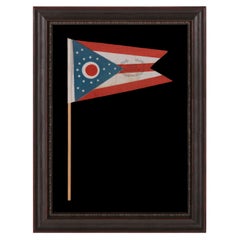
Ohio State Parade Flag with a Civil War Veterans Overprint
Located in York County, PA
OHIO STATE FLAG WITH CIVIL WAR VETERANS' OVERPRINT FROM THE GRAND ARMY OF THE REPUBLIC POST IN COLUMBUS, MADE IN MOURNING OF THE 1925 PASSING OF NATIONAL G.A.R. COMMANDER IN CHIEF DANIEL M. HALL, WHO ALSO SERVED AS COMMANDER OF THE OHIO DEPARTMENT OF THE G.A.R., AS WELL AS THE LOCAL CHAPTER Flag of the State of Ohio, printed on oilcloth-like cotton, affixed to its original wooden staff. Made for Civil War veteran's use, the flag bears a stamped overprint in the striped field that consists of an open wreath of laurel branches, inside which is the following text: “GAR [Grand Army of the Republic] Post, Dan Hall, Columbus, OH”. Born on October 20th, 1842, Daniel M. Hall enlisted with the Union Army as a Private at the age of 18 on August 25th, 1861. On October 8th of that year he mustered into the Co. H of the 2nd Ohio Cavalry. Discharged for disability on June 28th, 1862, he reenlisted approximately 17 months later, on November 11th, 1863, and mustered into Co. F of the 12th Ohio Cavalry at Camp Cleveland. He was at some point promoted to the rank of Sergeant, and, on February 21st, 1864, to the rank of Corporal. He mustered out at Nashville on November 14th, 1865. Hall mustered into the Hamlin Post of the Ohio G.A.R. on May 23rd, 1883. He would go on to serve not only as Commander of the Dept. of Ohio for the organization, but as National Commander of the entire Grand Army of the Republic. The Grand Army of the Republic was the primary veterans association for Union Civil War soldiers. Founded in 1866, its members dressed up in Civil War uniforms, attended parades and reunions, and the organization was somewhat more fraternal in nature than today’s VFW or American Foreign Legion. Flags overprinted for the purpose of advertising are a specialized form in American flag collecting. A flag with a basic G.A.R. overprint is the most common type. This might be accompanied by a post number and a date. More elaborate the overprints are more highly desired, such as this one, which is the only variation I know of that honors a particular person who was not the namesake of the chapter itself. It is of interest to note that a sister variety of 48 star parade flag is known, printed on the same fabric, that bears the same overprint, accompanied by the words: “We Mourn Our Comrade." From the additional text on the 48 star variety, one can extrapolate that the flags were made to mourn the passing of this important leader of Civil War veterans on October 19th, 1925, just one day before his 83rd birthday. The State Flag of Ohio was designed in 1901 by Cleveland architect John Eisenmann, who designed the Ohio building for the state's exhibition at the Pan American Exposition World's Fair in Buffalo, New York. It was officially adopted by the Ohio legislature on May 19th, 1902. It's elements are centered on a red disc, set against a circular white ground that forms a letter "O." This simultaneously represents a buckeye, the fruit of the state tree and an iconic Ohio symbol. The flag's 5 stripes are said to represent the state's waterways and roads, while the triangular shape of the union is said to illustrate hills and valleys. The presentation of 13 stars along the hoist end, arranged in a semi-circular medallion with two off-set stars above and below, reflects the original 13 colonies. The diamond of stars, towards the fly end. bring the overall count to 17 to reflect Ohio's admission. When the design was adopted by the state legislature, the position of these stars was changed slightly, moving them further around the circle to form a wreath. Flag expert Whitney Smith, who coined the term Vexillology in the late 1950's (the accepted term for the study of flags), pointed out that the format of the flag itself was reminiscent of Civil War cavalry guidons, carried by Ohio regiments throughout the state. These were of swallowtail form, though with 13 stripes, all horizontal and 90 degrees to the hoist. Most often these had circular star patterns around an open center, which makes them even more similar to the Ohio flag...
Category

1920s American Vintage Furniture

Materials

Cotton

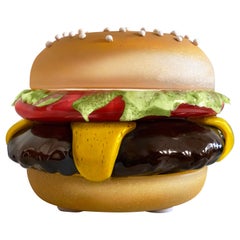
John Miller Blue Plate Special Hamburger 2008 Blown Pop Art Glass Sculpture
Located in Brooklyn, NY
Inspired by Americana, Miller's work stands to bring new light and perspective to the often overlooked but ubiquitous cultural artifacts that form the American visual lexicon and lived experience. Maybe as impressive as the work itself, is the magnitude of which his creations come to life. At such an impressive scale, his process is truly spectacle to witness. Pieces from his famed ‘Blue Plate Special...
Category

Early 2000s American Post-Modern Furniture

Materials

Blown Glass

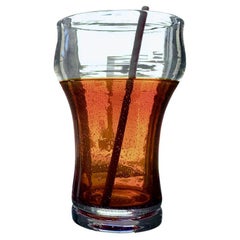
John Miller Blue Plate Special Cola Straw 2008 Blown Pop Art Glass Sculpture
Located in Brooklyn, NY
Inspired by Americana, Miller's work stands to bring new light and perspective to the often overlooked but ubiquitous cultural artifacts that form the American visual lexicon and lived experience. Maybe as impressive as the work itself, is the magnitude of which his creations come to life. At such an impressive scale, his process is truly spectacle to witness. Pieces from his famed ‘Blue Plate Special...
Category

Early 2000s American Post-Modern Furniture

Materials

Blown Glass, Art Glass

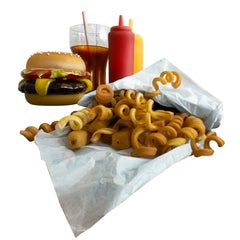
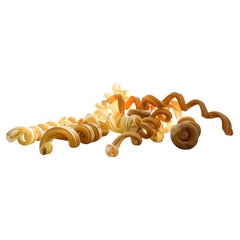
John Miller Blue Plate Special Curly Fries 2008 Blown Pop Art Glass Sculptures
Located in Brooklyn, NY
Inspired by Americana, Miller's work stands to bring new light and perspective to the often overlooked but ubiquitous cultural artifacts that form the American visual lexicon and lived experience. Maybe as impressive as the work itself, is the magnitude of which his creations come to life. At such an impressive scale, his process is truly spectacle to witness. Pieces from his famed ‘Blue Plate Special...
Category

Early 2000s American Post-Modern Furniture

Materials

Blown Glass

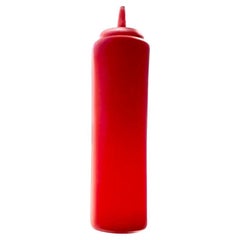
John Miller Blue Plate Special Ketchup Catsup 2008 Blown Pop Art Glass Sculpture
Located in Brooklyn, NY
Inspired by Americana, Miller's work stands to bring new light and perspective to the often overlooked but ubiquitous cultural artifacts that form the American visual lexicon and lived experience. Maybe as impressive as the work itself, is the magnitude of which his creations come to life. At such an impressive scale, his process is truly spectacle to witness. Pieces from his famed ‘Blue Plate Special...
Category

Early 2000s American Post-Modern Furniture

Materials

Blown Glass

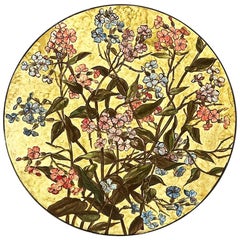
Earthenware John Bennett Plaque with Pink and Blue Phlox
Located in New York, NY
FAPG 20247D John Bennett (1840-1907), New York Plaque with pink and blue phlox, circa 1881-1882 Earthenware, painted and glazed Measures: 14 7/8 in. diameter, 1 13/16 in. high Signed and inscribed (on the back): J B[monogram] ENNETT / E 24 NY. / MC [or] CM If the Herter Brothers was the most distinguished and successful cabinet making and decorating firm in New York in the 1870s-1880s, the transplanted Englishman John Bennett was probably the most gifted ceramicist working in New York in the Aesthetic period. (Bennett was included in The Metropolitan Museum of Art’s landmark exhibition, In pursuit of beauty: Americans and the Aesthetic Movement, in 1986–87, and Alice Cooney Frelinghuysen’s chapter, “Aesthetic Forms in Ceramics and Glass,” pp. 216–19, significantly informs this essay). Born in England, the son of a potter who worked in the Staffordshire district, Bennett came under the influence of John Sparkes, head of London’s Lambeth School of Art. Soon thereafter, he was hired by Henry Doulton of the eponymous firm to teach artisans there the new art of underglaze faience decoration, which was part of a revival of the sixteenth-century interest in hand-painted ceramics. A number of Bennett’s works for Doulton were shown in the Doulton display at the Centennial Exposition in Philadelphia in 1876, and the considerable success enjoyed by Bennett and Doulton from an American audience undoubtedly played an important role in Bennett’s decision to leave Doulton and England and set up shop in New York in 1877. By the next year, he had already established a studio in New York, where he produced his own pottery in the tradition of the Arts & Crafts innovators, William Morris and William De Morgan, and also taught classes at the new Society of Decorative Art to the growing band of women who had taken up china painting, both professionally and avocationally. Bennett’s pottery developed a very serious following among students and collectors, and was offered for sale at such leading retail establishments as Tiffany & Company in New York. Typically, his work was brilliantly colored, with carefully drawn naturalistic flowers against a monochromatic background. Bennett’s fully developed American work, particularly pieces of larger scale, is exceedingly rare, as he worked in New York only from 1877 to 1883, in which year he withdrew to a farm in rural West Orange, New Jersey, where his production continued on a limited basis. He remained listed as a ceramicist there until 1889. While in New York City, Bennett maintained a studio at 412 East 24th Street. The present charger, boldly featuring pink and blue phlox, is signed by Bennett, and is inscribed “E 24 NY,” indicating its manufacture during Bennett’s time in New York. Although it is not dated, this piece is closely related stylistically to various dated pieces from 1881–82, which would place its production toward the end of Bennett’s New York years. Although we do not know whether Bennett worked out of this 24th Street studio from the outset, he was indeed working there by 1879 when he made (and signed, inscribed, and dated) a charger with white and red flowers now in the collection of the Art Institute of Chicago, which specifically points to “412 East 24 / NY” (acc. no. 1998.317). Additionally, the U.S. Census of 1880 lists Bennett as a ceramicist located at that same address, married to Mary Bennett with whom he had had six children. There are several other examples from Bennett’s time in New York City, which also give his studio address on East 24th Street, including a covered jar in cadmium yellow with indigo and green flowers made in 1881; an undated footed vase with lilac...
Category

1880s American Aesthetic Movement Antique Furniture

Materials

Earthenware

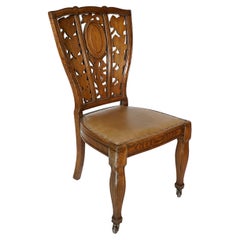
Arthur Heygate Mackmurdo for the Century Guild. An Important Art Nouveau Chair
Located in London, GB
Arthur Heygate Mackmurdo (1851-1942), a highly important oak chair, with an Art Nouveau floral back. Mackmurdo's influence in Europe is recognized as having produced the earliest examples of Art Nouveau, particularly in the styling of a chair-back designed in 1882 and the title page for Wren's City Churches a year later. The present chair was designed for the head of Rainhill hospital St Helen's south Lancashire/Merseyside (now demolished), an institute for the mentally ill, as part of an interior scheme for his study. It was almost certainly designed and made only for this interior, unlike the earlier chair which was designed in 1882 and made and sold until 1888. It was originally thought this interior was designed by the Liverpool architect Edmund Rathbone whose brother, Harold Rathbone, founded the Della Robbia Pottery factory in 1894. A picture is shown in Jeremy Cooper's Victorian and Edwardian Furniture and Interiors, p. 199, illus. 516, from the Bedford Lemere archive at the National Monuments Record, apparently credited as 'Rainhill, Edmund Rathbone'. But Edmund Rathbone was actually the Century Guild...
Category

1880s English Art Nouveau Antique Furniture

Materials

Oak

Shop Unique Furniture on 1stDibs

When it comes to shopping for vintage, new and antique furniture — whether you’re finally moving into that long-coveted loft apartment, ranch-style home, townhouse or furnishing your weekend house on the lake — you should think of your home as a stage for the seating, tables, lighting, storage cabinets and other pieces that best match your personality.

Coziness, comfort and creating a welcoming space are among the important things to consider when buying furniture, whether that means seeking strict cohesion or rooms characterized by a mix-and-match assembly of varying shapes, colors and materials. And for those who now work from home, exercise, eat and relax within the same four walls every day, they’ll also want to think about flexibility and an innovative approach.

Have you built your dream kitchen?

Is your current living-room furniture all that it could be?

Does your toast-worthy bar or vintage bar cart exude equal parts class and cheeriness?

And importantly, is your home officebackyard or otherwise — a happy one, regardless of the design style you happen to gravitate toward?

Although mid-century modern, rustic, minimalist, Art Deco and contemporary looks remain popular, they aren’t the only styles available to design connoisseurs.

Furniture styles are nothing if not fluid, meaning what’s popular one year may not be the next. That’s why it’s crucial to not only pay attention to interior-design trends but also focus on the styles that speak to you. That way, you (and your interior designer, if that is in the plans) can work to create a home that’s entirely your own, complete with impressively modern decor as well as an array of history’s universally renowned iconic designs.

It’s difficult to single out well-recognized designs from what is a crowded pantheon of celebrated and seminal furnishings. Certain outstanding designs have such stellar quality they’ve endured for decades as bona fide cultural treasures, still being manufactured, in many cases, by the same venerable companies that shepherded them into being (think Herman Miller, Knoll and Fritz Hansen). Some works come immediately to mind as contenders for any short list. When you’re discussing the most popular mid-century modern chairs, for example, no tally would be complete without citing designs by Arne Jacobsen, Charlotte Perriand, Charles and Ray Eames and Hans Wegner.

Good furniture, be it authentic vintage furniture or new custom furniture, allows you to comfortably sit and tell your favorite stories. Great furniture tells a story of its own.

On 1stDibs, find everything from sofas to serveware to credenzas to coffee tables, and every other type of antique, vintage and new furniture you need to create a singular space that you’ll be proud to call home.

Still Thinking About These?

All Recently Viewed