Furniture

to
16
366
106
293
183
6
286
37
20
6
6
6
5
4
4
2
2
1
1
1
8
53
122
299
40
58
9
2
5
14
16
6
5
8
3
1
1
287
171
118
78
75
273
271
271
156
68
482
198
199
271
8
6
6
4
Furniture For Sale
Search Within: Couper
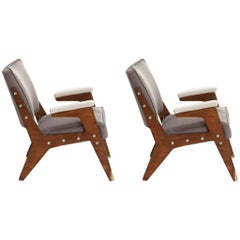
Jose Zanine Caldas Pair of Mid-century modern BrazilianArmchairs Model "H"
Located in Barcelona, ES
JOSE ZANINE DE CALDAS (1919-2001). Pair of armchairs model “H.” Manufactured by Moveis Artísticos Z. Brazil, 1949. Marine plywood, fabric upholstery. Measuremenents 58 cm x 50 cm x 80 H cm. Literature: Habitat, nº9, Sao Paulo 1952. José Zanine Caldas (Belmonte, Bahia, 1918 - Vitória, Espírito Santo, 2001) was an architect and designer. Caldas stands out on the national architecture in Brazil for his exploration of the constructive qualities of Brazilian woods, defining his work with a warm rustic ambience, working on both high-end residential projects and also popular constructions. Never actually training as an architect, he starting working in the 1940s as a designer at Severo & Villares and as a member of the National Artistic Historical Heritage Service (Sphan). He opens a maquet studio in Rio de Janeiro, where he worked between 1941 and 1948, and, at the suggestion of Oswaldo Bratke (1907-1997), moved the studio to São Paulo, from 1949 to 1955. The studio served important modern architects of the two cities, and was responsible for most of the models presented in the book Modern Architecture in Brazil, 1956, by Henrique E. Mindlin (1911-1971).. During the 1940s, he also began developing and researching at the Institute of Technological Research of the University of São Paulo (IPT/USP), and was first introduced to plywood. In 1949, he founded the Fábrica Móveis Artísticos Z, with the objective of producing large-scale industrialized furniture, good quaility and afforable, the furniture was to be materialized using plywood sheets. This method minimized material waste and the need for artisan skills, as the parts were mechanically produced and the use of labor was only needed for the assembling of the furniture. His time at Móveis Artísticos Z, in 1953 was rather short lived and left the company in 1953 and instead worked on landscape projects until 1958 in São Paulo, when he moved to Brasília, where he built his first house, also in 1958, and coordinated the construction of others until 1964. Appointed by Rocha Miranda to Darcy Ribeiro (1922-1997), he joined the University of Brasília (UnB) in 1962 and taught modeling classes until 1964, when he lost his position due to the military coup. He set off and travelled through Latin America and Africa, an experience that had a remarkable effect on his work. On return to Brazil he built his second house, the first of a series of projects in the Joatinga region of Rio de Janeiro. In 1968, he moved to Nova Viçosa, Bahia, and opened a workshop, which ran up until 1980. His experience in the Bahian city was shaped by his renewed love and contact with nature, and he began working closely with environmentalists. In one of these collaborations, he participated in the project of an environmental reserve with the artist Frans Krajcberg (1921-2017) for whom he also designed a studio in 1971. The furniture he designed during this period, is reflective of his ecological sensitivity, his works were constructed with crude logs of wood, whose twisted lines inspire his drawings. It is also in Nova Viçosa that the architect builds the Casa dos Triângulos (1970) and casa da Beira do Rio (1970), in which he adopted a very artisanal construction system with typical woods of the region. According to the historian and architecture critic Roberto Conduru, Caldas' performance was relevant for the diffusion of environmental values in architectural projects: a "taste for the alternative and the rustic was disseminated throughout the Brazilian territory [...], encouraged by environmental preservation campaigns, by the wear and tear of the current models in reinforced concrete and by the re-emergence of the regionalist ideal in the international panorama"1. Between 1970 and 1978, he kept an office in Rio de Janeiro, where he returned in 1982. In 1975, the filmmaker Antonio Carlos da Fontoura made the film Arquitetura de Morar, about the houses of Joatinga, with a soundtrack by Tom Jobim (1927-1993), for whom Caldas designed a house. Two years later, the architect's work was exhibited at the Museum of Modern Art of Rio de Janeiro (MAM/RJ), at the São Paulo Museum of Art Assis Chateaubriand (Masp) in Belo Horizonte, and the following year at Solar do Unhão, in Salvador. Between 1980 and 1982 The Helium House Olga Jr was designed and built in São Paulo. Caldas outlined the plans for the construction sourcing the all the wood, the actual assembly of the house was carried out by the owner. The house, is defined by wooden structure that stands out from the fence walls, the clay tile roof of wide eaves and the demolition materials that give the building the feeling of rusticity, warmth and nostalgia. The house was similar to those built in the 1970s for Eurico Ficher and Pedro Valente, in Joatinga. In 1983, Calders founded the Center for the Development of Applications of The Woods of Brazil (DAM), and gave it to UnB in 1985. During this period, he proposed the creation of the Escola do Fazer, a teaching center focused on the use of wood for the construction of houses, furniture and utilitarian objects for the low-income population. Despite the fact that much of Calders early work was centered around building houses for the elite, in the 1980s the designer dedicates himself the DAM where he rigorously researches popular housing based on artisan construction processes and whereby the users participate in the construction process. At the Brasília unit, he developed prototypes of popular houses with eucalyptus logs as a structure and sealing in soil-cement, betting on an ideal of self-construction already tested at Casa do Nilo, in São Gonçalo, Rio de Janeiro. From that moment on, as occurred with his the furniture designs, Caldas adopts the use of crude wood logs rolled...
Category

Mid-20th Century Brazilian Mid-Century Modern Furniture

Materials

Plywood, Velvet

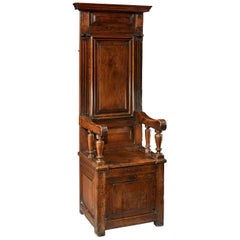
Cathedra or Throne Chair, Late 16th Century, French Second Renaissance, Walnut
Located in BUNGAY, SUFFOLK
A moulded cornice sits above the high, panelled back with fluting and applied roundels. The later, metal pin on the left edge releases the central, moulded panel in the back which retains its original hinges. When the pin is removed the panel can be lowered, revealing a large area behind. The scroll arms are supported by tapering turnings which can be compared with mid-16th century benches of the nave such as those in the churches in Gerberoy and Coivrel which are in Oise, the Piccardie region of Frances. The panelled, box seat has later 18th century hinges...
Category

16th Century French Renaissance Antique Furniture

Materials

Walnut

Shop Unique Furniture on 1stDibs

When it comes to shopping for vintage, new and antique furniture — whether you’re finally moving into that long-coveted loft apartment, ranch-style home, townhouse or furnishing your weekend house on the lake — you should think of your home as a stage for the seating, tables, lighting, storage cabinets and other pieces that best match your personality.

Coziness, comfort and creating a welcoming space are among the important things to consider when buying furniture, whether that means seeking strict cohesion or rooms characterized by a mix-and-match assembly of varying shapes, colors and materials. And for those who now work from home, exercise, eat and relax within the same four walls every day, they’ll also want to think about flexibility and an innovative approach.

Have you built your dream kitchen?

Is your current living-room furniture all that it could be?

Does your toast-worthy bar or vintage bar cart exude equal parts class and cheeriness?

And importantly, is your home officebackyard or otherwise — a happy one, regardless of the design style you happen to gravitate toward?

Although mid-century modern, rustic, minimalist, Art Deco and contemporary looks remain popular, they aren’t the only styles available to design connoisseurs.

Furniture styles are nothing if not fluid, meaning what’s popular one year may not be the next. That’s why it’s crucial to not only pay attention to interior-design trends but also focus on the styles that speak to you. That way, you (and your interior designer, if that is in the plans) can work to create a home that’s entirely your own, complete with impressively modern decor as well as an array of history’s universally renowned iconic designs.

It’s difficult to single out well-recognized designs from what is a crowded pantheon of celebrated and seminal furnishings. Certain outstanding designs have such stellar quality they’ve endured for decades as bona fide cultural treasures, still being manufactured, in many cases, by the same venerable companies that shepherded them into being (think Herman Miller, Knoll and Fritz Hansen). Some works come immediately to mind as contenders for any short list. When you’re discussing the most popular mid-century modern chairs, for example, no tally would be complete without citing designs by Arne Jacobsen, Charlotte Perriand, Charles and Ray Eames and Hans Wegner.

Good furniture, be it authentic vintage furniture or new custom furniture, allows you to comfortably sit and tell your favorite stories. Great furniture tells a story of its own.

On 1stDibs, find everything from sofas to serveware to credenzas to coffee tables, and every other type of antique, vintage and new furniture you need to create a singular space that you’ll be proud to call home.