Want more images or videos?
Request additional images or videos from the seller
1 of 18
Japanese Antique Hyakumanben Buddhist Prayer Beads 1830s-1844s / Zen Wabisabi
$2,500List Price
About the Item
- Dimensions:Height: 48.43 in (123 cm)Width: 9.85 in (25 cm)Depth: 7.49 in (19 cm)
- Style:Edo (Of the Period)
- Materials and Techniques:
- Place of Origin:
- Period:
- Date of Manufacture:1830s-1844s
- Condition:Wear consistent with age and use.
- Seller Location:Chōsei District Nagara, JP
- Reference Number:1stDibs: LU10403246208902
About the Seller
4.8
Platinum Seller
Premium sellers with a 4.7+ rating and 24-hour response times
Established in 2017
1stDibs seller since 2025
68 sales on 1stDibs
Typical response time: 2 hours
Authenticity Guarantee
In the unlikely event there’s an issue with an item’s authenticity, contact us within 1 year for a full refund. DetailsMoney-Back Guarantee
If your item is not as described, is damaged in transit, or does not arrive, contact us within 7 days for a full refund. Details24-Hour Cancellation
You have a 24-hour grace period in which to reconsider your purchase, with no questions asked.Vetted Professional Sellers
Our world-class sellers must adhere to strict standards for service and quality, maintaining the integrity of our listings.Price-Match Guarantee
If you find that a seller listed the same item for a lower price elsewhere, we’ll match it.Trusted Global Delivery
Our best-in-class carrier network provides specialized shipping options worldwide, including custom delivery.You May Also Like
Antique Tibetan Buddhist Handcrafted handheld Spinning Prayer wheel
Located in Pomona, CA
This is handcrafted Tibetan handheld spinning Prayer Wheel. This spinning prayer wheel was made from Sky Iron and has detailed handcrafted Tibetan traditional design with Copper wire...
Category
Early 20th Century Chinese Chinese Export Antiquities
Materials
Metal

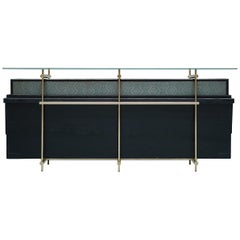
Contemporary Japanese Console with Folding Screen Zen Japanese Modern
By Ryosuke Harashima
Located in Shibuya-ku, Tokyo
Name: Early Dawn
Collection: STILLIFE
A console table that using a wooden box that stores two Japanese gold folding screens. It is a new histor...
Category
2010s Japanese Edo Console Tables
Materials
Brass
$16,000
H 31.7 in W 71.66 in D 15.75 in
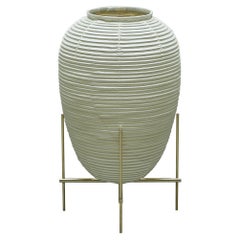
Contemporary Japanese Chochin Floor Lamp Zen Washi Japanese Paper Shade
By Ryosuke Harashima
Located in Shibuya-ku, Tokyo
Name: Under the Hazy Moon
Contemporary style Japanese Washi Japanese traditional paper shade floor lamp. Washi shade is famous as Isamu Noguchi Akari lightings.
Base is made of brass...
Category
2010s Japanese Edo Floor Lamps
Materials
Brass
$2,600 Sale Price / item
31% Off
H 30.32 in W 18.12 in D 18.12 in
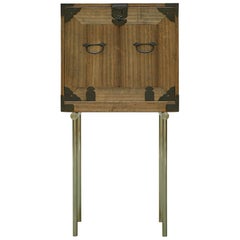
Cabinet Ryosuke Harashima Contemporary Zen Japanese Craft Mingei
By Ryosuke Harashima
Located in Shibuya-ku, Tokyo
Cabinet by Ryosuke Harashima.
Name: Casa Do Walk
Collection: STILLIFE
A chest for ship with a key door.
With four legs that imitate a stilt building structure, it looks like a house that going to walk.
STILLIFE
STILLIFE is not to redesign old Japanese folk tools but also to have a dialogue with the tools. Morphing "old folk tools" into a "more attractive still life" by giving it a modern interpretation. "Tsukumo God" which we Japanese...
Category
2010s Japanese Edo Cabinets
Materials
Brass
$4,500
H 37.6 in W 18.9 in D 13.98 in
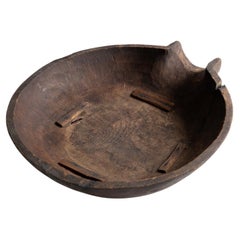
Japanese Katakuch Wood bowl / Mingei Wabisabi
Located in Sammu-shi, Chiba
If you are looking for something special, we recommend buying items selected by BROOD.
We sell a carefully selected range of old Japanese items.
We have seen tens of thousands of ite...
Category
Mid-20th Century Japanese Showa Antiquities
Materials
Wood
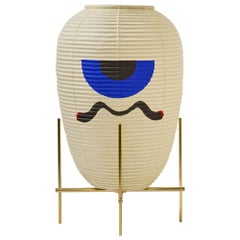
Contemporary Japanese Chochin Floor Lamp Limited Edition #2 Zen Washi
By Ryosuke Harashima
Located in Shibuya-ku, Tokyo
Name: OBAKE UN
Contemporary style Japanese Washi Japanese traditional paper shade floor lamp. Washi shade is famous as Isamu Noguchi Akari lightings.
Base is made of brass. Limited pattern painted model. Edition of 3+1AP
E26,27 light bulb.
Available to work with 100-250V.
Artist statement
In Japan, there is an animist belief that the soul dwells in old tools that have passed a long time and turns into spirits such as "Youkai" or "OBAKE." Its existence lurks in the darkness of everyday life, sometimes causing fear and sometimes entertaining.
This lantern is not an old tool, but it is made by the historic "Kojima Shoten", where the 10th generation are craftsmen in Kyoto. It's rare nowadays, and it's a style in which lanterns are made from bamboo bones to assembling papers and painting in one workshop and go. So, I decided to transform the polite crafted Japanese lanterns, which have been run through a traditional history, into a modern and pop style. It's not just OBAKE lurking in the darkness, but an existence who snuggles up to us as a more sophisticated being.
These one-eyed OBAKE have a meaningful look that originated in ancient Sanskrit culture. The red-eye "A [a]" is the facial expression that is the first pronunciation to make a sound in Sanskrit, which means "truth" and "spirit of inquiry" at the same time. The blue-eyed "UN [hu?]" expresses the pronunciation to close the sound, and at the same time means "wisdom" and "nirvana." There is also the idea that describing the beginning and end of the universe is represented by considering the "A" and "UN" as a pair. In Asia, it is a common sight to see a pair of guardian statues...
Category
2010s Japanese Edo Floor Lamps
Materials
Brass
$4,800 / item
H 30.32 in W 18.12 in D 18.12 in
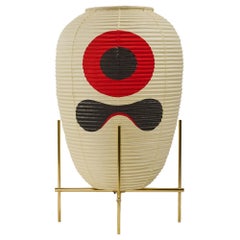
Contemporary Japanese Chochin Floor Lamp Limited Edition #1 Zen Washi
By Ryosuke Harashima
Located in Shibuya-ku, Tokyo
Name: OBAKE A
Contemporary style Japanese Washi Japanese traditional paper shade floor lamp. Washi shade is famous as Isamu Noguchi Akari lightings.
Base is made of brass. Limited pattern painted model. Edition of 3+1AP
E26,27 light bulb.
Available to work with 100-250V.
Artist statement
In Japan, there is an animist belief that the soul dwells in old tools that have passed a long time and turns into spirits such as "Youkai" or "OBAKE." Its existence lurks in the darkness of everyday life, sometimes causing fear and sometimes entertaining.
This lantern is not an old tool, but it is made by the historic "Kojima Shoten", where the 10th generation are craftsmen in Kyoto. It's rare nowadays, and it's a style in which lanterns are made from bamboo bones to assembling papers and painting in one workshop and go. So, I decided to transform the polite crafted Japanese lanterns, which have been run through a traditional history, into a modern and pop style. It's not just OBAKE lurking in the darkness, but an existence who snuggles up to us as a more sophisticated being.
These one-eyed OBAKE have a meaningful look that originated in ancient Sanskrit culture. The red-eye "A [a]" is the facial expression that is the first pronunciation to make a sound in Sanskrit, which means "truth" and "spirit of inquiry" at the same time. The blue-eyed "UN [hu?]" expresses the pronunciation to close the sound, and at the same time means "wisdom" and "nirvana." There is also the idea that describing the beginning and end of the universe is represented by considering the "A" and "UN" as a pair. In Asia, it is a common sight to see a pair of guardian statues...
Category
2010s Japanese Edo Floor Lamps
Materials
Brass
$4,800 / item
H 30.32 in W 18.12 in D 18.12 in
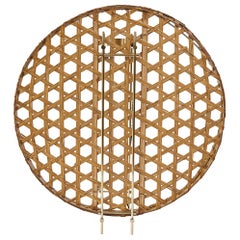
Bamboo Lattice Light Ryosuke Harashima Contemporary Zen Japanese Craft Mingei
By Ryosuke Harashima
Located in Shibuya-ku, Tokyo
Lamp designed by Ryosuke Harashima.
This work is made of antique Japanese bamboo basket and brass.
Artist creates new style lamp by comb...
Category
2010s Japanese Edo Floor Lamps
Materials
Brass
$3,500
H 35.44 in W 33.08 in D 11.23 in
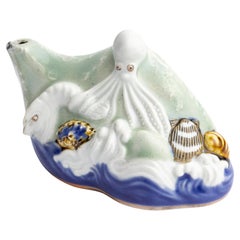
Japanese Octopus Water Dropper, c. 1830s
Located in Brisbane, QLD
A Japanese Hirado ware water dropper used in calligraphy dating to the Edo Period (1603-1868). The whimsical, molded design features an array of sea creatures and shells on the base ...
Category
Antique Early 19th Century Japanese Edo Ceramics
Materials
Ceramic
Japanese Antiques Natural wood stools, set of 2 Wabisabi Primitive Stool
Located in Niiza, JP
Natural wood stools, set of 2
Approx. φ330 x 420 (H) [mm]
7 kg each
Material: wood, iron base, cloth
Chairs that make use of the unusual shape of the wood
Intricately crafted, with ...
Category
20th Century Japanese Antiquities
Materials
Iron
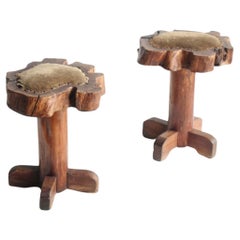
$1,400
H 16.54 in W 13 in D 13 in
More From This Seller
View AllJapanese Antique Edo period Drawer Chest 1830s-1844s / Sideboard Tansu Wabisabi
Located in Chōsei District Nagara, JP
This is a very old Japanese chest of drawers.
On the inner side of one drawer, a clearly handwritten inscription reading “天保(Tenpō)” remains intact, indicating that the piece was cra...
Category
Antique 1830s Japanese Edo Commodes and Chests of Drawers
Materials
Iron

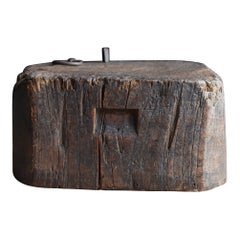
Japanese Antique Wooden Block Workbench 1900s-1940s / Display Stand Wabisabi
Located in Chōsei District Nagara, JP
This is an old Japanese wooden block workbench, believed to have been used in the early Showa period (1900s–1940s). The material is zelkova (keyaki) wood.
The countless scratches, dents, and the smoothness of its surface are proof of the many years of daily use and the touch of human hands that have polished it over time. The iron fittings remaining on the surface tell the story of the work once performed here, while also serving as a striking visual accent.
The inherent durability and beautiful grain of zelkova have gained even greater depth through the passage of time, creating a unique and irreplaceable texture. Left as it is, it stands as a powerful art piece; as a display stand, it functions beautifully to enhance the presence of whatever is placed upon it.
There is a slight tilt, but this too is part of its individuality, telling the tale of its long history. It is not in perfection, but in the imperfections shaped by time, that the Japanese aesthetic of wabi-sabi resides.
This wooden workbench is more than just an old tool — it is a sculptural object that reflects the era and the lives of the people who used it. Whether in a home interior, gallery, or as store display furniture...
Category
Mid-20th Century Japanese Primitive Antiquities
Materials
Wood
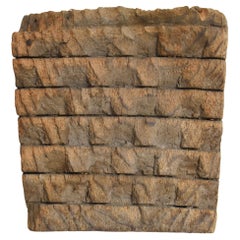
Japanese Antique Thatching Tools "Gangi" 1860s-1920s / Wall Decoration Wabisabi
Located in Chōsei District Nagara, JP
This is a traditional Japanese thatched roof tool known as a “Gangi.”
A Gangi is used to trim the cut ends of the thatch and smooth the roof’s surface, symbolizing the craftsmanship ...
Category
Early 20th Century Japanese Meiji Antiquities
Materials
Cedar
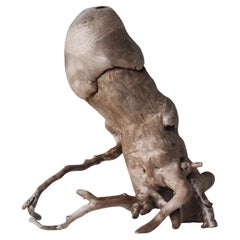
Japanese Antique Natural Wood Penis 1860s-1920s / Figurine Object Wabisabi
Located in Chōsei District Nagara, JP
This is a phallic statue made of natural wood produced in Japan.
It is estimated to have been created during the Meiji and Taisho periods (1860s-1920s), and is made of richly texture...
Category
Early 20th Century Japanese Meiji Antiquities
Materials
Pine
$800 Sale Price
20% Off
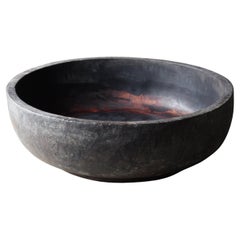
Japanese Antique Huge Wooden Bowl 1906s / Primitive Object Wabisabi Mingei
Located in Chōsei District Nagara, JP
This is a huge old Japanese lacquer wood bowl.
It was manufactured in 1906 (Meiji period), and its age can be read from the writing on the bottom. The material used is cedar wood, ma...
Category
Antique Early 1900s Japanese Meiji Antiquities
Materials
Cedar, Lacquer
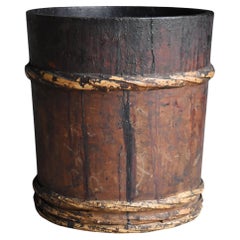
Japanese Antique Lacquer Bucket 1860s-1920s / Plant Pot Cover Wabisabi
By Axel Vervoordt
Located in Chōsei District Nagara, JP
This is an old Japanese lacquer tub, a rare piece that preserves the craftsmanship of artisans from the Meiji to Taishō period (1860s–1920s). The body is made of Japanese cedar, whil...
Category
Early 20th Century Japanese Taisho Antiquities
Materials
Bamboo, Cedar, Lacquer
Still Thinking About These?
All Recently ViewedMore Ways To Browse
Antique Rosaries
Prayer Beads
Japanese Zen Furniture
Antique Prayer Beads
Large Buddhist
Japanese Straw
Buddhist Beads
Chinese Terracotta Soldier
Geisha Pillow
Han Dynasty Chinese Cocoon Jar
Han Dynasty Cocoon Jars
Han Dynasty Cocoon
Han Dynasty Court Lady
Han Dynasty Pottery Heads
Hongshan Sculpture
Life Size Soldier Statue
Ming Dynasty Scroll
Ming Horse And Rider