1 of 12
Mid-Qing Blue and White Crane and Eight Buddhist Emblems Lid Jar
$1,480List Price
About the Item
- Dimensions:Height: 8.5 in (21.59 cm)Diameter: 6 in (15.24 cm)
- Materials and Techniques:Porcelain,Glazed
- Place of Origin:
- Period:
- Date of Manufacture:18th Century
- Condition:Wear consistent with age and use.
- Seller Location:San Gabriel, CA
- Reference Number:1stDibs: LU8312233339132
Authenticity Guarantee
In the unlikely event there’s an issue with an item’s authenticity, contact us within 1 year for a full refund. DetailsMoney-Back Guarantee
If your item is not as described, is damaged in transit, or does not arrive, contact us within 7 days for a full refund. Details24-Hour Cancellation
You have a 24-hour grace period in which to reconsider your purchase, with no questions asked.Vetted Professional Sellers
Our world-class sellers must adhere to strict standards for service and quality, maintaining the integrity of our listings.Price-Match Guarantee
If you find that a seller listed the same item for a lower price elsewhere, we’ll match it.Trusted Global Delivery
Our best-in-class carrier network provides specialized shipping options worldwide, including custom delivery.You May Also Like
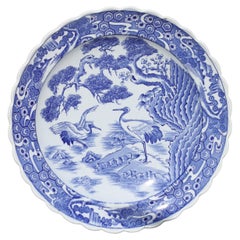
Chinese Export Blue and White "Cranes" Charger Qing Dynasty
Located in West Palm Beach, FL
A Chinese export blue and white "cranes" charger.
Qing dynasty, with a tightly scalloped edge, border of stylized motifs, the center recess representing two cranes in a stylized mar...
Category
20th Century Antiquities
Materials
Ceramic
Famille Rose/Verte
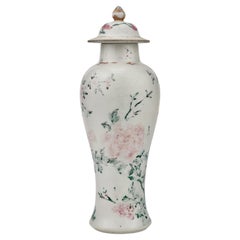
Crane and Flower
Baluster Vase, Qing Dynasty
Located in seoul, KR
The vase's form is elegant, with a tapered body and domed lid with long line of body, crowned with a delicate finial, embodying the sophistication and high aesthetic standards of Qin...
Category
Antique 17th Century Vietnamese Qing Antiquities
Materials
Ceramic
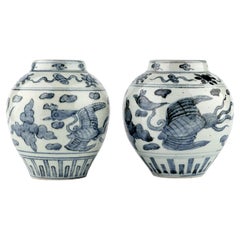
Blue and White Jars with Phoenix amid Clouds, Mid-Late Ming Dynasty
Located in seoul, KR
This blue and white porcelain jar was produced at a southern folk kiln (minyao) during the mid to late Ming dynasty. It features a well-balanced form with rounded shoulders, a short ...
Category
Antique 17th Century East Asian Ming Antiquities
Materials
Ceramic
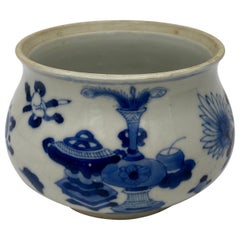
Antique Qing Dynasty Blue and White Chinese Porcelain Censer
Located in Brea, CA
Qing dynasty Kang XI blue and white Chinese porcelain censer with a design of "Antiques" and auspicious objects, the base in clear glaze and the mouth...
Category
Antique Early 18th Century Chinese Qing Antiquities
Materials
Porcelain
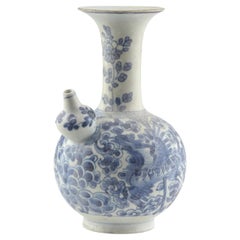
Kendi Blue And White, Qing Dynasty, Kangxi Period, C 1690
Located in seoul, KR
The Kendi is decorated with cobalt blue underglaze depicting flowers and a mythical bird, reflecting the artistic finesse and symbolic expressions of the era. These designs often carry symbolic meanings, with birds sometimes representing immortality or spiritual transcendence in Chinese mythology. The Kendi's form, with a bulbous body and spout for drinking, is a traditional vessel style in Asia, valued for both its functionality and aesthetic appeal.
Period : Qing Dynasty, Kangxi Period
Production Date : 1690-1699
Made in : Jingdezhen
Destination : Netherland
Found/Acquired : Southeast Asia , South China Sea, Vung Tau ship
Reference : Double checked with reference to the original catalogues
1) Christies Amsterdam 1992 - Vung Tau Cargo / Christies
2) Qing Dynasty Export...
Category
Antique 1690s East Asian Qing Antiquities
Materials
Ceramic
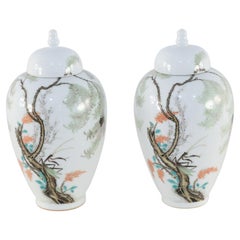
Pair of Chinese White Porcelain Famille Rose Lidded Jars
Located in Queens, NY
PAIR of Chinese white porcelain famille rose jars painted with verdant trees inhabitated by insects growing up and across the fronts and charac...
Category
20th Century Chinese Chinese Export Antiquities
Materials
Porcelain
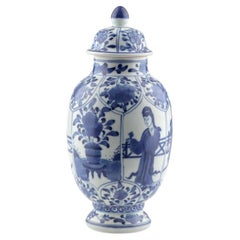
Blue And White Vase, Qing Dynasty, Kangxi Era, Circa 1690
Located in seoul, KR
Vung Tau Shipwreck Coralized Blue Underglazed Porcelain Lidded Vase. Almost perfectly Identical piece from Vietnamese Royal Family in United States provenance have been sold at other auction in California. This stunning porcelain lidded vase is elaborately decorated in a vivid blue underglaze with an ornate scene of concubines in a flower garden. The bottom of the vase bears a conch marking in underglazed blue, is a symbol of royalty, dignity and high rank, the 'Sacred Lungs of Buddha' and spiritual authority.
Period : Qing Dynasty, Kangxi reign
Production Date : 1690-1699
Made in : Jingdezhen
Destination : Amsterdam
Found/Acquired : Southeast Asia , South China Sea, Vung Tau Ship
Reference : Double checked with reference to the original catalogues
1) Christies Amsterdam 1992 - Vung Tau Cargo...
Category
Antique 1690s East Asian Qing Antiquities
Materials
Ceramic
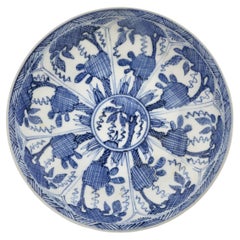
Blue and White Saucer, Qing Dynasty, Kangxi Era, Circa 1690
Located in seoul, KR
It features a complex design with a central circular motif surrounded by eight petal-like sections, each intricately adorned with various botanical and geometric patterns, creating a symmetrical arrangement.
The number 8 in Chinese culture is associated with prosperity and is considered very auspicious. This may reflect the traditional Chinese cosmological concept of the "Bagua," which are eight trigrams used in Taoist philosophy to represent fundamental principles of reality, seen in various aspects of Chinese culture, including the I Ching and Feng Shui.
The central circle with radiating petals is also a representation of perfect geometric harmony, reflecting the balance and unity which are key elements in Chinese aesthetics. The use of symmetry and balance is seen as a way to represent the harmony of the universe.
Period : Qing Dynasty, Kangxi Period
Production Date : 1690-1699
Made in : Jingdezhen
Destination : Netherland
Found/Acquired : Southeast Asia , South China Sea, Vung Tau ship
Size : 12.5cm (Diameter)
Condition : Excellent
Reference : Double checked with reference to the original catalogues
1) Christies Amsterdam 1992 - Vung Tau Cargo / Christies
2) Qing Dynasty Export Blue and White(淸代外销靑花瓷) - Vung Tau Cargo Catalogue / Guangxi Fine Art Publishing House
3) Asian Ceramic Found along Maritime Silk Route / National Maritime Museum of Korea
* Vung Tau Cargo Porcelain...
Category
Antique 1690s Vietnamese Qing Antiquities
Materials
Ceramic
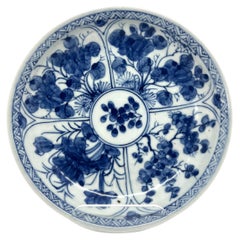
Blue and White Flower Saucer c. 1725, Qing Dynasty, Yongzheng Era
Located in seoul, KR
The central floral motif, possibly representing peonies or another culturally significant flora, is surrounded by intricate patterns and border designs typical of the period. Pieces ...
Category
Antique 1720s Vietnamese Chinoiserie Antiquities
Materials
Ceramic
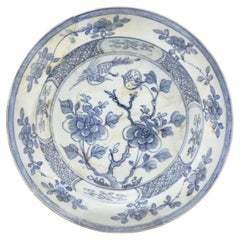
Blue and White Bowl Circa 1725, Qing Dynasty, Yongzheng Era
Located in seoul, KR
Bowl decorated with beautiful floral and bird pattern. Cracks on surface due to underwater excavation condition. Relatively rare piece among Ca Mau ship pieces.
Period : Qing Dynast...
Category
Antique 1720s Vietnamese Qing Antiquities
Materials
Ceramic, Porcelain
Still Thinking About These?
All Recently ViewedMore Ways To Browse
Chinese Crane
Chinese Porcelain Lidded Jar
Shoulder Vase
Crane Vase
Antique Chinese Lidded Jars
Blue Crane
Blue White Chinese Lidded
Porcelain Crane
Chinese Antique Blue Jar
Antique Furniture Emblems
Chinese Porcelain Cranes
Blue And White Qianlong Period Vase
Haori Kimono
Christies Catalogue
Seated Buddha Statue
Yuan Ming
Antique Chinese Furniture Hong Kong
Gilded Wood Buddha