1 of 10
Pair of Impressive Large Authentic Han Dynasty Terracotta Horses
$18,722.66List Priceper set
About the Item
- Dimensions:Height: 20.28 in (51.5 cm)Width: 22.45 in (57 cm)Depth: 8.27 in (21 cm)
- Sold As:Set of 2
- Style:Han (Of the Period)
- Materials and Techniques:
- Place of Origin:
- Period:
- Date of Manufacture:200 BC-206 AD
- Condition:We unconditionally certify the authenticity of all our antiquities, and we can provide thermoluminescence analysis report at additional costs. Excellent condition consistent with age.
- Seller Location:Oisterwijk, NL
- Reference Number:1stDibs: LU151523617402
Authenticity Guarantee
In the unlikely event there’s an issue with an item’s authenticity, contact us within 1 year for a full refund. DetailsMoney-Back Guarantee
If your item is not as described, is damaged in transit, or does not arrive, contact us within 7 days for a full refund. Details24-Hour Cancellation
You have a 24-hour grace period in which to reconsider your purchase, with no questions asked.Vetted Professional Sellers
Our world-class sellers must adhere to strict standards for service and quality, maintaining the integrity of our listings.Price-Match Guarantee
If you find that a seller listed the same item for a lower price elsewhere, we’ll match it.Trusted Global Delivery
Our best-in-class carrier network provides specialized shipping options worldwide, including custom delivery.You May Also Like
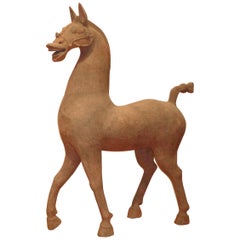
Massive Chinese Han Dynasty Sichuan Terracotta Pottery Horse, Oxford TL Tested
Located in Greenwich, CT
A massive Chinese Han dynasty Sichuan terracotta pottery figure of a horse
Han dynasty (206 BC-220 AD)
Powerfully modelled in a pose of alert attention, its strong neck and head pois...
Category
Antique 15th Century and Earlier Chinese Han Sculptures and Carvings
Materials
Terracotta
$58,000 Sale Price
31% Off
H 50 in W 36 in D 15 in
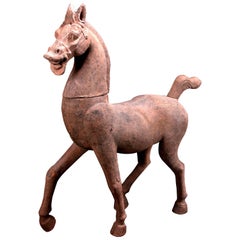
Monumental Han Dynasty Terracotta Horse - TL Tested - China,
206 BC–220 AD
Located in San Pedro Garza Garcia, Nuevo Leon
A massive pottery horse with separately made head and tail, standing on all fours and striding with its right hoof forward. Extended snout ends in parted lips showing teeth beneath i...
Category
Antique 15th Century and Earlier Chinese Han Antiquities
Materials
Terracotta
$118,750
H 43 in W 37 in D 12 in
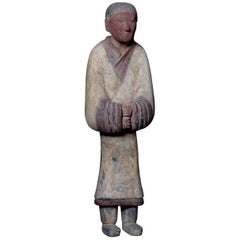
Elegant Han Dynasty Terracotta Warrior - China
206 BC - 220 AD
Located in San Pedro Garza Garcia, Nuevo Leon
Impressive terracotta warrior representing a banner bearer gripping a wooden staff with his hands (dematerialized through the ages); his gaze is ser...
Category
Antique 15th Century and Earlier Chinese Han Antiquities
Materials
Terracotta
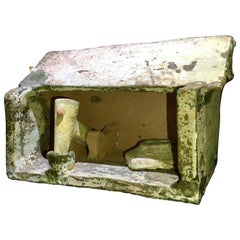
Eastern Han Dynasty Terracotta Model of a Paper Mill , China
206BC - 220AD
Located in San Pedro Garza Garcia, Nuevo Leon
Slab pottery constructed Model of a Paper Mill, in Green and Cream Color Glazed Terracotta having a peaked roof – open walled form with a mechanical pounder and a large round storage container. Light blue-green mottled glazed surface with some iridescence patina to the glaze. The Iridescence is a refraction of the layers on the glass that produces multicolor hues & metallic luster, and only develops after one thousand years of being buried in the ground. An unquestionable mark of antiquity, impossible to falsify.
Han Dynasty, dated 206 B.C-220 A.D.
Condition: Excellent, wear commensurate with age, an unusual example.
This fantastic piece is accompanied by a Certificate of Authenticity.
Sculptural effigies of domesticated animals were often interred in the tombs of nobility and elite members of the social hierarchy. Models like this one were made to represent everything from simple goat or pig pens to the most elaborate towers and palaces. Because very few ancient Chinese buildings have survived intact, these models, along with descriptions from ancient texts, give a good representation of what the buildings might have looked like.
Burial figurines of graceful dancers, mystical beasts, and everyday objects reveal both how people in early China approached death and how they lived. Since people viewed the afterlife as an extension of worldly life, these figurines, called mingqi, sometimes referred as “spirit utensils” or “vessels of ghosts” disclose details of routine existence and provide insights into belief systems over a thousand-year period. For the first time in Chinese history, we have images of rural and daily life during the Han in the form of contemporary records...
Category
Antique 15th Century and Earlier Chinese Han Antiquities
Materials
Terracotta
$5,625
H 7 in W 11.25 in D 6 in
Northern Wei Dynasty Terracotta Horses, TL Tested,
386 AD-535 AD
Located in Miami, FL
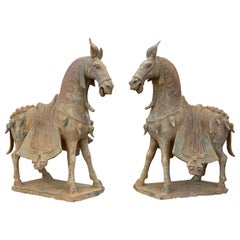
A massive pottery pair of horses standing on all fours and striding with its right hoof forward. Extended snout ends in parted lips showing teeth beneath in a braying attitude. Low relief bridle on face and well defined eyes. Raised mane down back of the neck
A fantastic example of the Wei dynasty horses.
Large, exquisite walking Ferghana horses with great attention paid to anatomical detail were the choice of the wealthy. The horse was second only in importance to the dragon. It was supposed to possess magical powers which the early Chinese were eager to explore. It would be the horse that would carry the deceased to the next life and it would be the amount of horses that an individual owned that would guarantee his ongoing status in the hereafter.
Thermoluminescence certificate from Madrid Labs included.
In southern China, people turned to Daoism, and mingqi, as well as above-ground sculptures, became ever more infused with animal iconography and energized with dynamic lines.
The north of China was eventually united by nomadic Tuoba invaders who founded the Northern Wei dynasty...
Category
Antique 15th Century and Earlier Chinese Han Antiquities
Materials
Terracotta
$185,000 / set
H 23.42 in W 11.81 in D 20.47 in
Eastern Han Dynasty Terracotta Barn Workshop, China
206BC - 220AD
Ex-Museum
Located in San Pedro Garza Garcia, Nuevo Leon
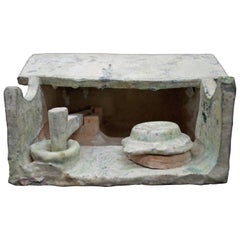
Slab pottery constructed barn workshop having a peaked roof – open walled form with a mechanical pounder and a large round covered storage container. Light blue-green mottled glazed surface with some iridescence patina to the glaze.
Condition: Intact, excellent condition, an unusual example.
Provenance: The Living Torah Museum, Brooklyn; ex. Sands of Time, 2002.
Sculptural effigies of domesticated animals were often interred in the tombs of nobility and elite members of the social hierarchy. Models like this one were made to represent everything from simple goat or pig pens to the most elaborate towers and palaces. Because very few ancient Chinese buildings have survived intact, these models, along with descriptions from ancient texts, give a good representation of what the buildings might have looked like.
This fantastic piece is accompanied by a Certificate of Authenticity.
Burial figurines of graceful dancers, mystical beasts, and everyday objects reveal both how people in early China approached death and how they lived. Since people viewed the afterlife as an extension of worldly life, these figurines, called mingqi, sometimes referred as “spirit utensils” or “vessels of ghosts” disclose details of routine existence and provide insights into belief systems over a thousand-year period. For the first time in Chinese history, we have images of rural and daily life during the Han in the form of contemporary...
Category
Antique 15th Century and Earlier Chinese Han Antiquities
Materials
Terracotta
$4,375
H 5 in W 9 in D 7.5 in
China Ancient Stone Entertainer, Han Dynasty 200 AD
Located in South Burlington, VT
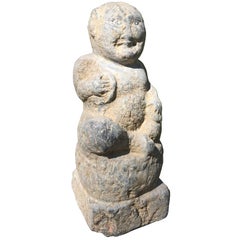
China an ancient limestone figure of an Entertainer replete with hands holding tambourines and a top a drum, -for the afterlife- , Han dynasty 206 BC...
Category
Antique 15th Century and Earlier Chinese Han Sculptures and Carvings
Materials
Limestone
Stunning Terracotta Standing Horse, Tang Dynasty, China
618-907 AD
, TL Test
Located in San Pedro Garza Garcia, Nuevo Leon
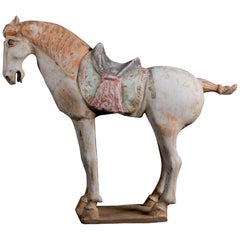
Magnificent standing horse in orange terracotta and traces of painting. With a finely decorated saddle and with the mane and tail hair braided. TL Test by Ralph Kotalla Lab NE: 09K12...
Category
Antique 15th Century and Earlier Chinese Tang Antiquities
Materials
Terracotta
$21,875
H 18.25 in W 19.66 in D 7 in
Ancient China Monumental Stone Ram Han Dynasty, 206BC-220AD
Located in South Burlington, VT
China, a large votive model of a stone ram, Han dynasty (206BC-220AD)
Dimensions: 45cm, 18 inches high and 65cm, 26 inches length and 25cm, 10 inches wi...
Category
Antique 15th Century and Earlier Chinese Han Sculptures and Carvings
Materials
Limestone
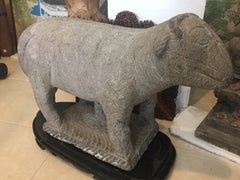
$17,600 Sale Price
54% Off
H 18 in W 26 in D 10 in
Han Dynasty, Antique Chinese Pottery Attendant Figurine
Located in Sampantawong, TH
Chinese pottery attendant figurine.
Age: China, Han Dynasty, 206 B.C. - A.D. 220
Size: Height 22 C.M. / Width 12 C.M.
Condition: Well-preserved old burial condition overall.
100% s...
Category
Antique 15th Century and Earlier Chinese Antiquities
Materials
Pottery
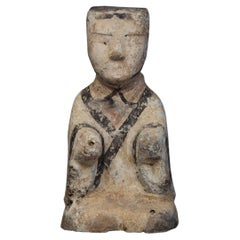
$1,800 Sale Price
20% Off
H 8.67 in W 4.73 in D 3.19 in
Still Thinking About These?
All Recently ViewedMore Ways To Browse
Terracotta Horse
Antique Terracotta Horse
Han Horse
Chinese Horse Terracotta
Han Dynasty Horse
Han Dynasty Terracotta Horse
Chinese Hand Fan
Wei Dynasty
Antique Preserve Stand
Dragon Horse
11th Century Furniture
Angkor Art
Antique Chinese Hand Fans
Asian Sword
Green Ming Dynasty
Khmer Bronze
Wooden Carved Monks
12th Century Bronze