Want more images or videos?
Request additional images or videos from the seller
1 of 5
Song Dynasty Stone Head of a Lohan Buddha, 960 AD
Price:$31,000
$37,500List Price
About the Item
- Dimensions:Height: 15 in (38.1 cm)Diameter: 6.25 in (15.88 cm)
- Period:
- Date of Manufacture:960 AD
- Condition:Overall an honest example in very good condition. Mounted on a removable ebonised wood base. Fragmentary as shown. Some minor visible chips. The end of the nose restored. Remains of green and black pigment (on the face and eyes respectively).
- Seller Location:London, GB
- Reference Number:1stDibs: LU105226696853
About the Seller
5.0
Recognized Seller
These prestigious sellers are industry leaders and represent the highest echelon for item quality and design.
Gold Seller
Premium sellers maintaining a 4.3+ rating and 24-hour response times
Established in 2007
1stDibs seller since 2014
106 sales on 1stDibs
Typical response time: 1 hour
Associations
LAPADA - The Association of Arts
Antiques DealersInternational Confederation of Art and Antique Dealers
AssociationsThe British Antique Dealers
Association
Authenticity Guarantee
In the unlikely event there’s an issue with an item’s authenticity, contact us within 1 year for a full refund. DetailsMoney-Back Guarantee
If your item is not as described, is damaged in transit, or does not arrive, contact us within 7 days for a full refund. Details24-Hour Cancellation
You have a 24-hour grace period in which to reconsider your purchase, with no questions asked.Vetted Professional Sellers
Our world-class sellers must adhere to strict standards for service and quality, maintaining the integrity of our listings.Price-Match Guarantee
If you find that a seller listed the same item for a lower price elsewhere, we’ll match it.Trusted Global Delivery
Our best-in-class carrier network provides specialized shipping options worldwide, including custom delivery.You May Also Like
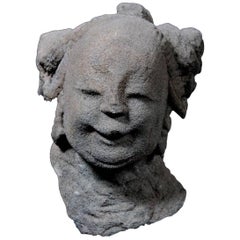
Ming Dynasty Celestial Deity Head Carved in Stone - China
1368-1644 AD
Located in San Pedro Garza Garcia, Nuevo Leon
Wonderful celestial deity head with a jovial expression in stone with a finely engraved cap. It is mounted on a custom lucite base.
This piece is accompanied by a Certificate of Authenticity, and Certificate of Expertise by Jean-Yves Nathan - Specialist in Asian Arts for the CEDEA (The European Confederation of Art Experts).
The Ming dynasty was the ruling dynasty of China – then known as the Empire of the Great Ming...
Category
Antique 15th Century and Earlier Chinese Ming Antiquities
Materials
Stone
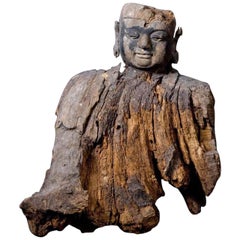
Ming Dynasty Very Rare Wooden Bust of Lohan
Located in San Pedro Garza Garcia, Nuevo Leon
Very serene depiction of a Lohan carved in wood, eroded with the pass of time. Lohan is the Chinese term, derived from the Sanskrit word Arhan, for a disciple or follower of Buddha w...
Category
Antique 15th Century and Earlier Ming Antiquities
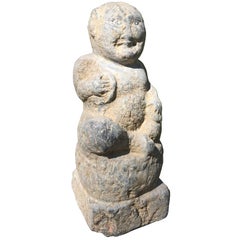
China Ancient Stone Entertainer, Han Dynasty 200 AD
Located in South Burlington, VT
China an ancient limestone figure of an Entertainer replete with hands holding tambourines and a top a drum, -for the afterlife- , Han dynasty 206 BC...
Category
Antique 15th Century and Earlier Chinese Han Sculptures and Carvings
Materials
Limestone
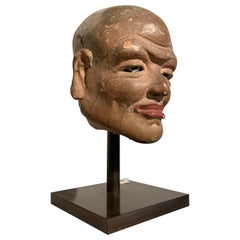
Chinese Painted Stucco Head of a Luohan, Song Dynasty, 11th Century, China
Located in Austin, TX
A remarkable Chinese life sized painted stucco head of a luohan, Song, Liao or Jin Dynasty, circa 11th century, China.
The amazingly life-like figure depicts a luohan (sometime spelled lohan), also known as an arhat, one of the original disciples of the Buddha. The elderly man has been molded in stucco with inset glass eyes and painted with idealized, if slightly exaggerated features.
The unidentified luohan sports a bald, or perhaps shaved, domed head above a bulging forehead, symbolizing his vast wisdom. The wrinkles in his furrowed brow, and creases around his eyes add to his realism. The learned man stares out wisely from deep set, heavily lidded inlaid glass eyes that catch the light.
The luohan has high cheekbones and a prominent jawline. His lips full and pursed as if about to speak. The corners of his mouth turned up ever so slightly in a faint smile, causing his gaunt cheeks to dimple charismatically. A series of dots above the upper lip indicate he may originally have sported a mustache of real hair.
This life sized head with extremely realistic features fits into a very narrow time frame of Chinese Buddhist art. Perhaps the most recognized group of large, finely molded Chinese luohan...
Category
Antique 15th Century and Earlier Chinese Sculptures and Carvings
Materials
Glass, Stucco
$48,000
H 14.5 in W 8 in D 8.25 in
Monumental Buddha Torso White Marble Sculpture - Tang Dynasty China 618-907 AD
Located in San Pedro Garza Garcia, Nuevo Leon
Beautiful and impressive early Tang white marble sculpture of headless Buddha, dressed in an elegant pleated toga. China. 618-907 AD. A true collectors piece.
This magnificent piece...
Category
Antique 15th Century and Earlier Chinese Tang Antiquities
Materials
Marble
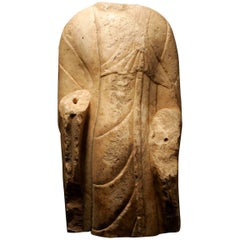
$43,750
H 28 in W 15 in D 8 in
Ancient China Monumental Stone Ram Han Dynasty, 206BC-220AD
Located in South Burlington, VT
China, a large votive model of a stone ram, Han dynasty (206BC-220AD)
Dimensions: 45cm, 18 inches high and 65cm, 26 inches length and 25cm, 10 inches wi...
Category
Antique 15th Century and Earlier Chinese Han Sculptures and Carvings
Materials
Limestone
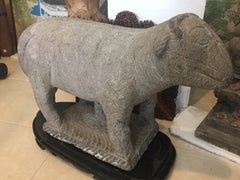
$17,600 Sale Price
54% Off
H 18 in W 26 in D 10 in
Northern Wei Dynasty Terracotta Horses, TL Tested,
386 AD-535 AD
Located in Miami, FL
A massive pottery pair of horses standing on all fours and striding with its right hoof forward. Extended snout ends in parted lips showing teeth beneath in a braying attitude. Low relief bridle on face and well defined eyes. Raised mane down back of the neck
A fantastic example of the Wei dynasty horses.
Large, exquisite walking Ferghana horses with great attention paid to anatomical detail were the choice of the wealthy. The horse was second only in importance to the dragon. It was supposed to possess magical powers which the early Chinese were eager to explore. It would be the horse that would carry the deceased to the next life and it would be the amount of horses that an individual owned that would guarantee his ongoing status in the hereafter.
Thermoluminescence certificate from Madrid Labs included.
In southern China, people turned to Daoism, and mingqi, as well as above-ground sculptures, became ever more infused with animal iconography and energized with dynamic lines.
The north of China was eventually united by nomadic Tuoba invaders who founded the Northern Wei dynasty...
Category
Antique 15th Century and Earlier Chinese Han Antiquities
Materials
Terracotta
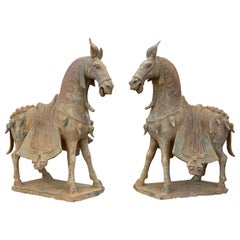
$185,000 / set
H 23.42 in W 11.81 in D 20.47 in
Dvaravati Stucco Buddha Head from Thailand
Located in Atlanta, GA
On offer is an early Buddha image from Dvaravati period (6-11th century) in Central Thailand. Made of stucco with an unfinished back suggesting its original use in architectural cont...
Category
Antique 15th Century and Earlier Thai Archaistic Antiquities
Materials
Stucco, Wood
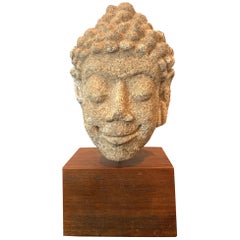
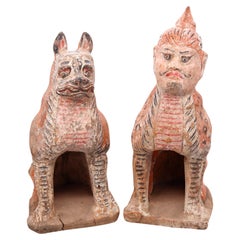
China 618-907 AD Tang Dynasty Pair Of Polychromate Earth Spirits Zhenmushou
Located in Miami, FL
Pair of Earths Spirits "Zhenmushou" from the China Tang Dynasty 618-907 AD.
A beautiful and rare pair of "Earths Spirits guardians" from the Yunnan province region in the ancient China. This was created in clay earthenware pottery during the Tang Dynasty period between 618 and 907 AD. Featuring the molded figures of two seated guardians with decorations with polychrome pigmentations. The figures are seated on their haunches with cloven hooves planted firmly on the base looking forward with their front legs in a straight position. Both with face and body alert expressions on a rectangular base.
Earth spirits usually appear in pairs, one with a human head and the other with a lion head. Their supernatural powers, indicated by antlers, spiky flanges and flames, enable them to confront evil spirits and protect any precincts within their gaze. Have been believed to protect the living by keeping the spirits of the dead from inappropriately roaming the world outside the tomb.
Zhenmushou or guardian deities, developed from a line of protective spirits found normally in pairs at the front of Tang dynasty tombs. They served both to protect the figure from untoward spirits, and the outside world from the roving spirit of the dead. Combining features from a number of animals to form the perfect mythic beast, these mythical creatures were perceived to be the ideal guardians of the dead
The semi human faced figure has a measures of 11.25 by 4.5 by 5.75 inches (28.57 x 11.43 x 14.60 Cm).
The mythological lion animal figure has a measures of 10 by 5 by 5.8 inches (24.5 x 12.7 x 14.73 Cm).
Tang dynasty or Tang Empire, was an imperial dynasty of China that ruled from 618 to 907, with an interregnum between 690 and 705. It was preceded by the Sui dynasty and followed by the Five Dynasties and Tend Kingdoms period. Historians generally regard the Tang as a high point in Chinese civilization, and a the golden age of cosmopolitan culture. Tang territory, acquired through the military campaigns of its early rulers, rivaled that of the Han dynasty.
The Li family founded the dynasty, seizing power during the decline and collapse of the Sui Empire and inaugurating a period of progress and stability in the first half of the dynasty's rule. The dynasty was formally interrupted during 690–705 when Empress Wu Zetian seized the throne, proclaiming the Wu Zhou dynasty...
Category
Antique 15th Century and Earlier Chinese Tang Antiquities
Materials
Earthenware, Pottery
$4,600 Sale Price / set
20% Off
H 11.25 in W 5.75 in D 4.25 in
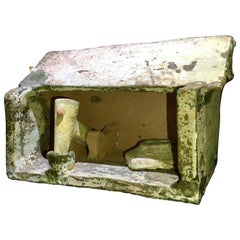
Eastern Han Dynasty Terracotta Model of a Paper Mill , China
206BC - 220AD
Located in San Pedro Garza Garcia, Nuevo Leon
Slab pottery constructed Model of a Paper Mill, in Green and Cream Color Glazed Terracotta having a peaked roof – open walled form with a mechanical pounder and a large round storage container. Light blue-green mottled glazed surface with some iridescence patina to the glaze. The Iridescence is a refraction of the layers on the glass that produces multicolor hues & metallic luster, and only develops after one thousand years of being buried in the ground. An unquestionable mark of antiquity, impossible to falsify.
Han Dynasty, dated 206 B.C-220 A.D.
Condition: Excellent, wear commensurate with age, an unusual example.
This fantastic piece is accompanied by a Certificate of Authenticity.
Sculptural effigies of domesticated animals were often interred in the tombs of nobility and elite members of the social hierarchy. Models like this one were made to represent everything from simple goat or pig pens to the most elaborate towers and palaces. Because very few ancient Chinese buildings have survived intact, these models, along with descriptions from ancient texts, give a good representation of what the buildings might have looked like.
Burial figurines of graceful dancers, mystical beasts, and everyday objects reveal both how people in early China approached death and how they lived. Since people viewed the afterlife as an extension of worldly life, these figurines, called mingqi, sometimes referred as “spirit utensils” or “vessels of ghosts” disclose details of routine existence and provide insights into belief systems over a thousand-year period. For the first time in Chinese history, we have images of rural and daily life during the Han in the form of contemporary records...
Category
Antique 15th Century and Earlier Chinese Han Antiquities
Materials
Terracotta
$5,625
H 7 in W 11.25 in D 6 in
More From This Seller
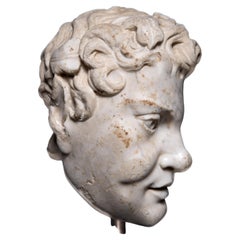
View AllPolished Roman Marble Head of a Satyr
Located in London, GB
This finely polished Roman marble head of a satyr is an impressive and characterful sculpture. Depicted with full, parted lips, with teeth visible in between, a pointed goat’s ear, t...
Category
Antique 15th Century and Earlier Classical Roman Busts
Materials
Marble
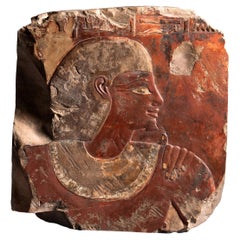
Egyptian Stone Relief of Man and Wife
Located in London, GB
This painted limestone relief is an exquisite example of New Kingdom relief carving from the apogee of Egyptian artistic production. Carved in raised relief - a labour-intensive tech...
Category
Antique 15th Century and Earlier Egyptian Egyptian Busts
Materials
Limestone
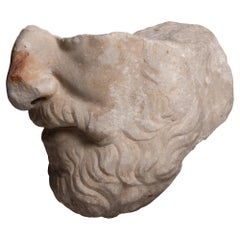
Roman Marble Head Fragment
Located in London, GB
This fine Roman marble head fragment, with broad nose, soft lips, and bearded chin, captures the likeness of one of the most important playwrights of...
Category
Antique 15th Century and Earlier Italian Classical Roman Busts
Materials
Marble
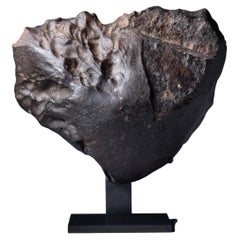
Oriented Stone Meteorite
Located in London, GB
Oriented Stone Meteorite
Chondrite
5.00 kg
Detached from its parent body by a mighty impact, this large, oriented Meteorite travelled over a hu...
Category
Antique 15th Century and Earlier North African Natural Specimens
Materials
Stone
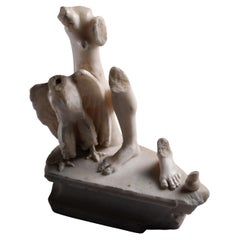
Roman Marble Statuette of Jupiter
Located in London, GB
Roman Marble Fragment of jupiter
Circa 2nd-3rd Century A.D.
Measure: Height: 19.7 cm
This beautiful Roman fragmentary statuette depicts Jupiter, the king of the gods, here recognisable from his two chief attributes, the eagle with outstretched wings - according the Pseudo-Hyginus, singled out by Jupiter because ''it alone, men say, strives to fly straight into the rays of the rising sun'' - and the base of the scepter, which remains at the side of the left foot, an aspect likely borrowed from the statue of Zeus at Olympia, once one of the Seven Wonders of the World. Though much of the original piece has been lost, the subtle anatomical detail in the feet mark this out as a piece of exceptional quality, and the work of an artist of particular talent and patience - as Johann Winckelmann once said of the famous Belvedere Torso, ''if you contemplate this with a quiet eye [...] the god will at once become visible in this stone.''
This fragment once caught the eye of Henry Howard, 4th Earl of Carlisle (1694-1758), a Knight of the Garter and among the most prolific collectors of his day. The piece, acquired during his travels to Rome, was proudly displayed on an alcove of the Western Staircase of Castle Howard...
Category
Antique 15th Century and Earlier Italian Classical Roman Figurative Scul...
Materials
Marble
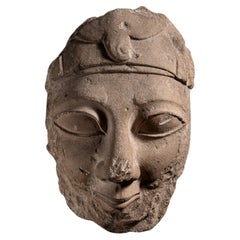
Monumental Ancient Cypriot Limestone Sculpture of a Man
Located in London, GB
This imposing and impressive head of a man would once have been part of a monumental votive statue dedicated in a temple in antiquity. Commissioned by a wealthy patron, it is an icon...
Category
Antique 15th Century and Earlier Busts
Materials
Limestone
Still Thinking About These?
All Recently ViewedMore Ways To Browse
Ship Tansu
Asian Silver Belt
Northern Qi Buddha
Russian Icon George Slaying
Wheat Thrasher
Chinese Pewter Plate
Kimekomi Dolls
Leather Rice Paddy Shoes
Luristan Dagger
Old Pottery Dog
Reuge Bird Box
Reuge Music Box Bird
Roman Antiquities Oil Lamp
Royal Presentation Frame
Tibetan Dzi Beads
Samurai Horse Riding
Sui Horse
Asprey China