Want more images or videos?
Request additional images or videos from the seller
1 of 17
Group of Nine Vintage Japanese Sake Bottle
Price:$3,325
$3,500List Price
About the Item
- Dimensions:Height: 11.5 in (29.21 cm)Diameter: 5 in (12.7 cm)
- Sold As:Set of 9
- Style:Japonisme (Of the Period)
- Materials and Techniques:
- Place of Origin:
- Period:
- Date of Manufacture:1900s-1930s
- Condition:Wear consistent with age and use. Surface wear, kiln glaze crackles and imperfection as made.
- Seller Location:Atlanta, GA
- Reference Number:1stDibs: LU945020820392
About the Seller
4.9
Platinum Seller
Premium sellers with a 4.7+ rating and 24-hour response times
Established in 2006
1stDibs seller since 2010
588 sales on 1stDibs
Typical response time: 1 hour
Authenticity Guarantee
In the unlikely event there’s an issue with an item’s authenticity, contact us within 1 year for a full refund. DetailsMoney-Back Guarantee
If your item is not as described, is damaged in transit, or does not arrive, contact us within 7 days for a full refund. Details24-Hour Cancellation
You have a 24-hour grace period in which to reconsider your purchase, with no questions asked.Vetted Professional Sellers
Our world-class sellers must adhere to strict standards for service and quality, maintaining the integrity of our listings.Price-Match Guarantee
If you find that a seller listed the same item for a lower price elsewhere, we’ll match it.Trusted Global Delivery
Our best-in-class carrier network provides specialized shipping options worldwide, including custom delivery.You May Also Like
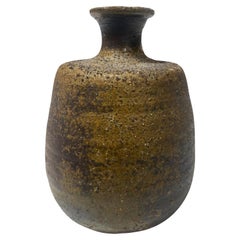
Kaneshige Toyo National Treasure Signed Japanese Bizen Pottery Sake Bottle Vase
Located in Studio City, CA
A beautiful, perfectly shaped and balanced antique Bizen ware shibui sake bottle (tokkuri) vase by renowned Japanese master potter/artist Kaneshige Toyo (1896-1967) featuring a unique natural, wonderfully textured organic forming ash glaze. Kaneshige is universally considered to be the founder of modern Bizen pottery.
In 1956, Kaneshige was certified as a Living National Treasure (Important Intangible Cultural Heritage) for his work in Bizen Ware pottery/ceramics. Bizen Ware is a type of Japanese pottery traditionally from the Bizen province, presently a part of the Okayama prefecture. It is considered one of the Six Ancient Japanese Kilns (along with Echizen ware, Seto ware, Shigaraki ware, Tamba ware, and Tokoname ware).
The piece is signed/ sealed on the base with one of Kaneshige's traditional incised marks.
A rather striking and engaging work. One of the best Kaneshige works we have come across. Scarce and hard to find in such an excellent condition. Would be a fantastic addition to any Japanese/Asian pottery or Bizen Ware collection or eye-catching stand-alone work in about any setting.
Kaneshige's work can be found in numerous prominent collections and museums including:
Aichi Prefectural Ceramic Museum, Seto, Japan
Brooklyn Museum, NY
Hagi Uragami Museum, Yamaguchi, Japan
Honolulu Art Museum, HI
Ibaraki Ceramic Art Museum, Kasama, Japan
Indiana Art...
Category
Mid-20th Century Japanese Showa Ceramics
Materials
Stoneware
$2,495
H 4.6 in Dm 4 in
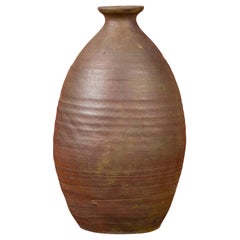
Japanese Meiji Period Early 20th Century Sake Bottle with Brown Patina
Located in Yonkers, NY
An antique Japanese Meiji period monochrome sake bottle from the early 20th century with concentric lines. Created in Japan during the Meiji period, this antique sake bottle captivat...
Category
Early 20th Century Japanese Meiji Bottles
Materials
Ceramic
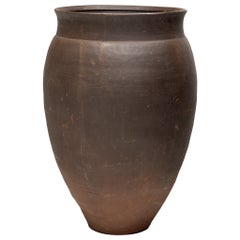
Monumental Japanese Sake Vessel, c. 1850
Located in Chicago, IL
This elegant, large-scale vessel is a Japanese widemouth stoneware jar (kame) traditionally used for storing water and other liquids. This 19th-century example continues traditional ...
Category
Antique Mid-19th Century Japanese Meiji Ceramics
Materials
Porcelain, Stoneware
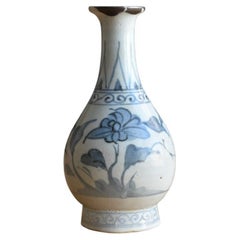
1610-1640/Japanese White Porcelain Blue and White Vase/"Imari Ware"/Sake Bottle
Located in Sammu-shi, Chiba
I bought a very nice vase with white porcelain and blue dye.
This is a sake bottle called Imari ware in Japan.
Imari ware is a kiln with a long history that began in the 17th cen...
Category
Antique Early 17th Century Japanese Edo Bottles
Materials
Porcelain
$1,000
H 5.99 in Dm 3.08 in
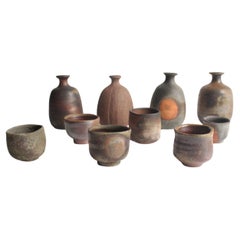
F13 Japanese Artist Design Bizen ware 4 Sake bottles
6 Sake cups
Located in Niiza, JP
Sake Bottle
W80-90mm, H130mm
Sake Cup
W50-60mm, H45-60mm
*Please note that measurements are approximate due to the handmade nature of the items.
This is a Bizen ware sake set made b...
Category
20th Century Japanese Ceramics
Materials
Pottery
$1,000 / set
H 5.12 in W 3.15 in D 3.15 in
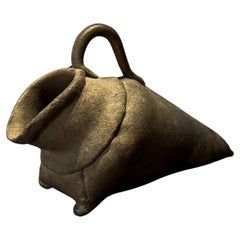
Antique Pigeon Sake Bottle, Edo Period from Japan
Located in Asheville, NC
This antique 'pigeon' sake bottle is from the Edo period (1603-1868). It is ceramic and in perfect condition with an incredible patina. Has a tan, slight olive color tone to it.
Category
Antique Early 19th Century Japanese Ceramics
Materials
Ceramic
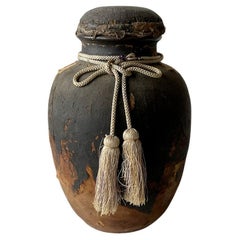
Early Showa-period Japanese Shuko Pottery Sake Jar
Located in Chiba, JP
Pottery sake jar with wooden lid, covered with old used papers, tied string, Early Showa period, Japan, H 26 x D 17 cm (10.23 x 6.69in).
Category
Mid-20th Century Japanese Japonisme Ceramics
Materials
Ceramic, String, Wood, Paper
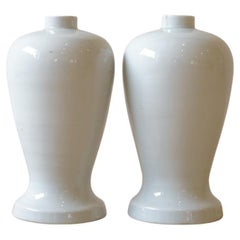
Japanese Antique White Porcelain Sake Bottles, 1930s–1950s - Japandi Wabi-Sabi
Located in Chiba, Chiba
A pair of Japanese antique white porcelain sake bottles, dating from the 1940s–1960s.
Originally used in ceremonial settings, these vessels have recently found new life as flower vas...
Category
Mid-20th Century Japanese Ceramics
Materials
Ceramic
$350 / set
H 9.26 in Dm 4.93 in
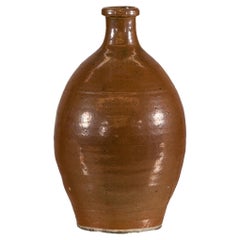
Antique Japanese Meiji Period Brown Monochrome Bottle, 19th Century Collectible
Located in Yonkers, NY
An antique Japanese Meiji period monochrome bottle from the 19th century. This antique Japanese bottle, created during the Meiji period of the...
Category
Antique 19th Century Japanese Meiji Ceramics
Materials
Ceramic
$980
H 13.25 in Dm 8 in
Japanese Satsuma Vase with Figures
Located in Antwerp, BE
A mid-20th century Japanese Satsuma vase with figures.
Satsuma ware is a style of Japanese earthenware originally from the Satsuma region of what is today southern Kyushu. There are two distinct categories of this ware: The original plain dark clay early Satsuma...
Category
Mid-20th Century Japanese Japonisme Vases
Materials
Ceramic

More From This Seller
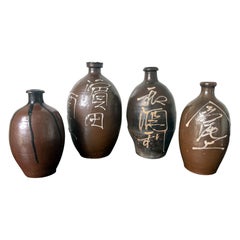
View AllCollection of Four Japanese Tanba Tokkuri Sake Bottles
Located in Atlanta, GA
A set of four Japanese Ceramic Tokkuri Sake storage bottles circa early 20th century (Meiji to Taisho period). The bottles were made in Tanba (or Tamba) ...
Category
Early 20th Century Japanese Japonisme Ceramics
Materials
Ceramic
Japanese Ceramic Sake Bottle Chosen Karatsu Ware
Located in Atlanta, GA
The long neck bottle of classic form was heavily potted with coarse clay with high iron content. The flask, circa 18th century Edo period, was purposed for sake storage but also substituted as a flower vase during tea ceremony. The surface is covered in glossy black glaze and contrasts strikingly with white ash glaze around the shoulder. The white, fired with straw, displays a splashing feather effect and fine crackles, blending in with the black artistically. This type of Karatsu ware...
Category
Antique 18th Century Japanese Japonisme Ceramics
Materials
Ceramic

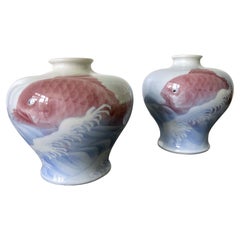
One of The Two Japanese Ceramic Vases Makuzu Kozan Meiji Period
By Makuzu Kozan
Located in Atlanta, GA
Two small nearly identical ceramic vases by Japanese Meiji imperial potter Makuzu Kozan (1842-1916), circa 1890-1900s. The vases were made in the form of jarlet with swelled shoulder...
Category
Antique Late 19th Century Japanese Japonisme Ceramics
Materials
Ceramic
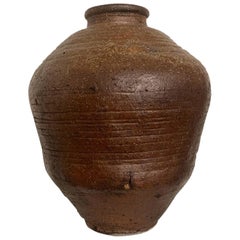
Large Japanese Antique Shigaraki Tsubo Jar
Located in Atlanta, GA
An antique Japanese stoneware storage jar, known as tsubo from Shigaraki kiln, circa 17th-18th century (early Edo possibly Momoyama period)....
Category
Antique 17th Century Japanese Japonisme Ceramics
Materials
Ceramic
Japanese Porcelain Dragon Glazed Vase Mazuku Kozan
By Makuzu Kozan
Located in Atlanta, GA
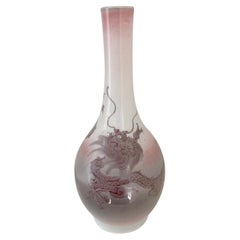
A porcelain vase with dragon motif by Japanese imperial potter Makuzu Kozan (1842-1916), circa 1900s. The vase is made in what is considered early phase of his underglaze period during late Meiji era. In a classic elongated baluster form, the surface of the vase was decorated in an unusual pink mist on a white and aubergine background (called Morotai, the Hazy style), on which a flying dragon is showcased on the center. The dragon was outlined in iron red and filled with the aubergine color and was artistically emphasized on its bulging eyes, claws, scales and a long tail. It was the sole focus of the design circumventing the entire body of the vase. The imagery calls in mind the dragon decoration found in Korean...
Category
Antique Early 1900s Japanese Japonisme Ceramics
Materials
Porcelain
Japanese Porcelain Vase Makuzu Kozan Meiji Period
By Makuzu Kozan
Located in Atlanta, GA
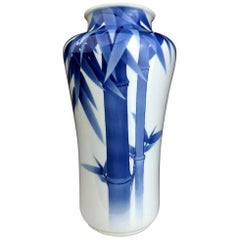
A striking blue and white vase from the studio of Japanese Potter Makuzu Kozan, also known as Miyagawa Kozan (1842–1916), one of the most established and collected ceramist from Meiji Period. Born as Miyagawa Toranosuke, Kozan established his pottery studio in Yokohama circa 1870s and later became one of the appointed artists to the Japanese Imperial household. His work was exhibited in many international fairs that the Meiji government participated at the turn of the century and won many grand prizes.
Of a relatively large size, this vase is decorated with underglaze cobalt blue using the novel technique developed by Kozan called Fuki-e (the blow painting). As a result, the bamboos appear took on a three-dimensional quality as if appearing in a mist. Known as one of the most creative ceramists, circa 1887, Kozan started experimenting with new chemical colors from the West in the format of his porcelain glaze. New colors allowed him to create underglaze design that appeared bright, smooth and glossy. He even invented his own receipt of cobalt blue to achieve a much brighter yet softer shade, as evident on this vase. To create landscape that is realistic and dimensional, more common in the western paintings, he was inspired by the native Japanese ink painting technique developed around 1900 by Yokoyama Taikan...
Category
Antique Early 1900s Japanese Japonisme Ceramics
Materials
Ceramic
Still Thinking About These?
All Recently ViewedMore Ways To Browse
Antique Japanese Stoneware
Japanese Sake Bottles
Vintage And Antique Bottles
Antique Sake Bottle
Antique Stoneware Bottles
Antique Japanese Sake Bottles
Japanese Kutani
Japanese Porcelain Edo
Chinese Ming Porcelain
Qing Dynasty Porcelain
Satsuma Meiji
Qianlong Period
Chinese Qing Plates
17th Century Chinese Ceramics
Ming Dynasty Furniture
Edo Period Japanese Art
Japanese Satsuma Meiji
17th Century Plate