Want more images or videos?
Request additional images or videos from the seller
1 of 7
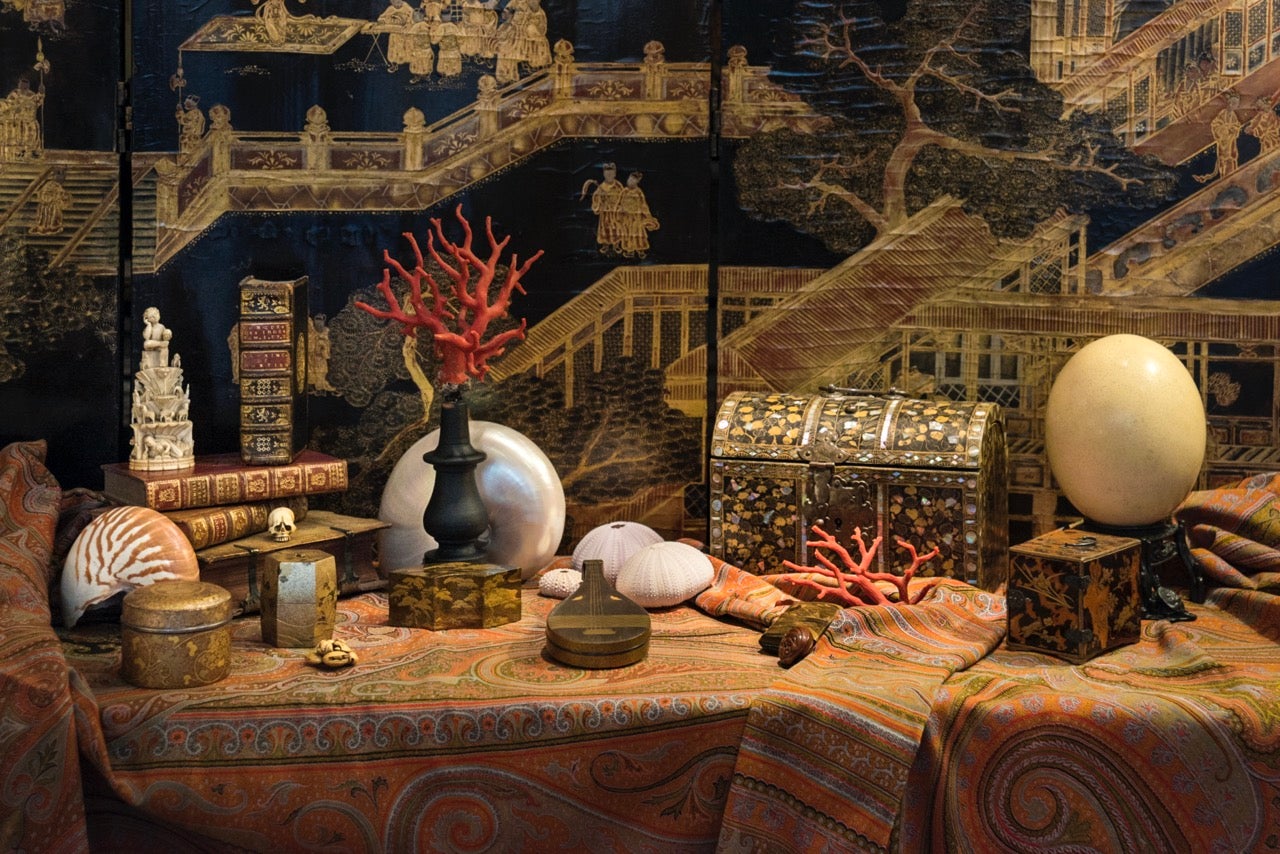
Japan hirado ware blue and white porcelain incense burner
Price:$1,436.61
About the Item
- Dimensions:Height: 2.76 in (7 cm)Diameter: 3.75 in (9.5 cm)
- Materials and Techniques:
- Place of Origin:
- Period:
- Date of Manufacture:circa 1900
- Condition:
- Seller Location:PARIS, FR
- Reference Number:Seller: 2023-11311stDibs: LU8311235339712
About the Seller
No Reviews Yet
Vetted Professional Seller
Every seller passes strict standards for authenticity and reliability
Established in 2013
1stDibs seller since 2023
Authenticity Guarantee
In the unlikely event there’s an issue with an item’s authenticity, contact us within 1 year for a full refund. DetailsMoney-Back Guarantee
If your item is not as described, is damaged in transit, or does not arrive, contact us within 7 days for a full refund. Details24-Hour Cancellation
You have a 24-hour grace period in which to reconsider your purchase, with no questions asked.Vetted Professional Sellers
Our world-class sellers must adhere to strict standards for service and quality, maintaining the integrity of our listings.Price-Match Guarantee
If you find that a seller listed the same item for a lower price elsewhere, we’ll match it.Trusted Global Delivery
Our best-in-class carrier network provides specialized shipping options worldwide, including custom delivery.You May Also Like
Japanese Porcelain Incense Burner 1970s Karabito
Located in Paris, FR
This is an incense burner which was made in Japan around 1970s in Showa era. This incense burner is made with ceramic.
Dimensions: 8 x 8 x H10 cm
Category
Vintage 1970s Japanese Showa Ceramics
Materials
Ceramic
Antique Japanese Porcelain Brazier
Incense Burner
, Signed
Located in Norton, MA
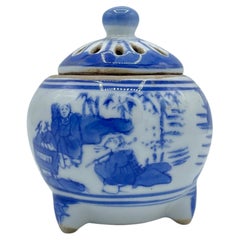
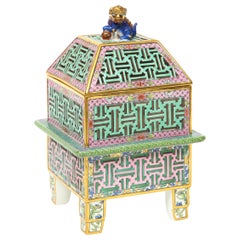
A very unusual Antique Japanese Porcelain Brazier (Incense Burner) with green checker pattern, Signed on the bottom.
Category
Early 20th Century Japanese Ceramics
Materials
Porcelain
Japanese Contemporary Ko-Imari Gold Blue Porcelain Koro Incense Burner
Located in Takarazuka, JP
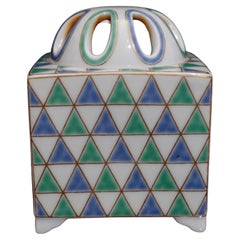
Stunning contemporary Japanese Ko-Imari style porcelain koro or incense burner or jewelry box, hand painted on a beautifully shaped round body in cobalt blue, red and green and gener...
Category
21st Century and Contemporary Japanese Meiji Jewelry Boxes
Materials
Gold
Japanese Contemporary Blue Gold Porcelain Incense Burner Jar by Master Artist, 2
Located in Takarazuka, JP
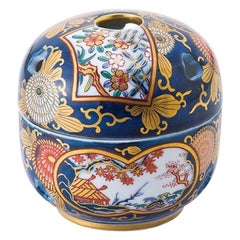
Exquisite contemporary Japanese Kutani decorative porcelain incense burner/jar, intricately hand painted with high purity gold on an elegantly...
Category
21st Century and Contemporary Japanese Meiji Jars
Materials
Gold
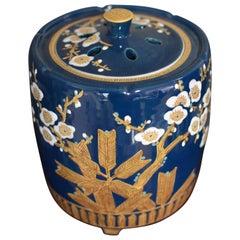
$1,150 Sale Price
23% Off
H 4.5 in Dm 4 in
Japanese Late Meiji Period Hirado Porcelain Incense Vessel, Ca. 1890-1910
Located in New York, NY
Japanese Late Meiji Period (1868-1912)
Hirado Porcelain
Incense Vessel
Ca. 1890-1910
DIMENSIONS
5.5” high x 4.5” across
Category
Antique 1890s Japanese Japonisme Ceramics
Materials
Porcelain
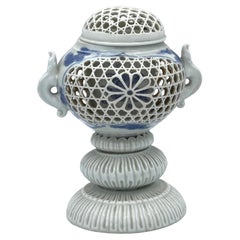
Rare Japanese Porcelain Incense Burner with Inlays Makuzu Kozan
By Makuzu Kozan
Located in Atlanta, GA
A porcelain incense burner (koro) made by Japanese potter Makuzu Kozan (also known as Miyagawa Kozan, 1842-1916) circa 1890s-1900s (end of Meiji Period). The koro features an elegant...
Category
Antique Late 19th Century Japanese Meiji Ceramics
Materials
Ceramic
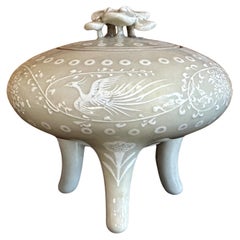
Old Japanese Porcelain Lidded Incense Burner in the Original Box
Located in Norton, MA
Old Japanese porcelain lidded incense burner in the original box
The lid with the lion, two pierced handles on each side, and four feet at the four corners to stand.
This is an old...
Category
Mid-20th Century Ceramics
Materials
Porcelain
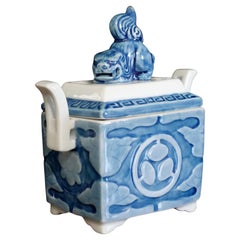
Satsuma Incense Burner
Located in New Orleans, LA
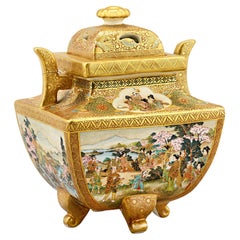
This Japanese Satsuma incense burner is a decorative work of art from the Meiji period, distinguished by its exquisite craftsmanship and intrica...
Category
Antique 19th Century Japanese Meiji Ceramics
Materials
Earthenware
Japanese Glazed Ceramic and Silver Koro Incense Burner Makuzu Kozan
By Makuzu Kozan
Located in Atlanta, GA
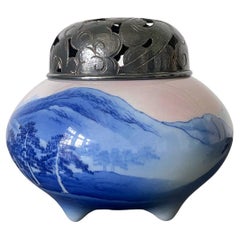
A tri-pod ceramic incense burner (koro) by Japanese Imperial potter Makuzu Kozan (1842-1916) circa late Meiji to the start of Taisho period (1890-1910s). A fine example of the artist's work belonging to the late part of his underglaze paint phase (started around 1887 until his death), the surface of the koro was painted in beautiful shades of blue to depict a continuous landscape not unlike a traditional ink and watercolor hand scroll. The rise and fall mountains recede and fade into the horizon and are dotted with groves of pines. The sky is painted with a beautiful subtle shade of pink, suggesting a time of sunrise or sunset. The koro is fitted with an ensuite reticulated sterling silver hoya (incense cover), pierced with swirling cloud and marked with "pure silver' in Kanji. The base is signed in underglaze blue "Makuzu Kozan Sei" within a double ring. The piece is beautifully potted in form and the decoration was done with expertise using the novel technique developed by Kozan called Fuki-e (the blow painting), in order to achieve the striking landscape known as "Mountain and Water" with sense of dimensions and gradient, the poetic effects normally conveyed only by sumi ink staining on paper. The piece comes with an unsigned tomobako (wood storage box) of a recent age.
Also known as Miyagawa Kozan (1842–1916), Makuzu Kozan was one of the most established and collected ceramist from Meiji Period. Born as Miyagawa Toranosuke, Kozan established his pottery studio in Yokohama around 1870s and later became one of the appointed artists to the Japanese Imperial household. His work was exhibited in many international fairs that the Meiji government participated at the turn of the century and won many grand prizes. Being one of the most creative ceramists, Kozan started experimenting with new chemical colors from the West in the format of his porcelain glaze around 1880s. New colors allowed him to create underglaze designs that appeared bright, smooth and glossy. He even invented his own receipt of cobalt blue to achieve a much brighter yet softer shade, as evident on this vase. To create landscape that is realistic and dimensional, more common in the western paintings, he was inspired by the native Japanese ink painting technique developed around 1900 by Yokoyama...
Category
Antique Early 1900s Japanese Japonisme Ceramics
Materials
Silver
Rare Meissen Marcolini Porcelain Chinoiserie Incense Burner Vase and Cover
By Meissen Porcelain
Located in Queens, NY
A rare Meissen Marcolini Porcelain Chinoiserie incense burner vase and cover, made for the Chinese market, circa 1800, blue cross swords and star mark, Pressnummer 58
A Museum Quality Piece.
Painted in the sought after famille rose palette with sprigs of indianische Blumen and enriched in gilding, the simulated pierced body supported by four feet painted with stylized dragons, the pierced cover with a Buddhist lion finial.
10" high x 6" wide x 6" deep
The shape of this piece, which appears to be unrecorded in the literature, is inspired by similar Chinese porcelain censers from the Qing Dynasty, Kangxi Period (1654-1722). An example in the Palace Museum, Beijing, is illustrated by Li Yi-hua in Qing Porcelain of Kangxi, Yongzheng and Qianlong Periods from the Palace Museum Collection, Hong Kong, 1989, pl. 65. Another in the British Museum, London (museum no. PDF, A.812) is catalogued as a perfume-holder.
These porcelain examples are in turn inspired by ancient Chinese bronzes from both the Shang (1600-1046 BC) and the Zhou (1046-246 BCE) dynasties, an example of which was sold anonymously by Christie's New York, 22 March 2019, lot 1601. This chain of inspiration tracking backwards from the 19th century to antiquity provides a clear example of how ceramics, and indeed other mediums, are able to influence and motivate the works of later generations.
For a Meissen porcelain snuff...
Category
Antique Late 18th Century German Chinoiserie Ceramics
Materials
Porcelain
$48,500
H 10 in W 6 in D 6 in
More From This Seller
View AllJapanese bronze incense burner in the form of an owl Signed Murata Seimin 村田製眠
Located in PARIS, FR
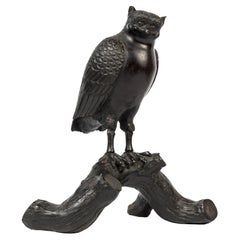
A bronze okimono of an owl, constructed in two sections, the short-eared owl (detachable) perched on a tree branch with its head cocked quizzically to the right and its wings folded ...
Category
Antique 18th Century Japanese Edo Metalwork
Materials
Bronze
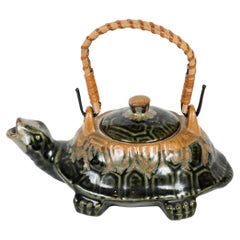
Japanese glazed Sandstone Teapot in the form of a Turtle
Located in PARIS, FR
Sandstone teapot in the shape of a turtle, the inside is enameled. The outside circumferences of the lid and the part in contact with the table are not enameled.
Japan – Taishô er...
Category
Early 20th Century Japanese Taisho Ceramics
Materials
Sandstone
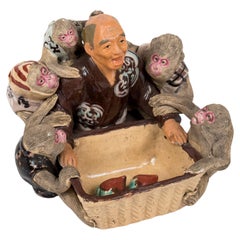
Japanese Sumida-Gawa sculpture of a man distributing peaches to its monkeys
Located in PARIS, FR
Polychrome sculpture in Sumida-gawa stoneware, also called Sumida-yaki, representing an old man surrounded by five monkeys in front of a basket containing two nuts. Glazed clothes an...
Category
Antique Late 19th Century Japanese Meiji Ceramics
Materials
Enamel
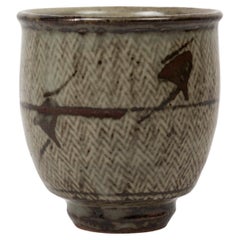
Japanese Shawan tea cup in celadon with corded pattern by to Tenzo Shimaoka
Located in PARIS, FR
Celadon tea cup with corded patterns glazed in the Jômon zogan style made by Tatsuzô Shimaoka (1919-2007, Mingei school). Developed by himself, this style ...
Category
20th Century Japanese Showa Ceramics
Materials
Ceramic, Celadon
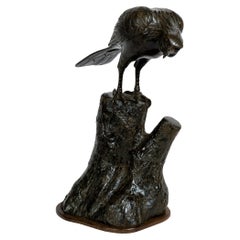
Bronze sculpture of an eagle on a tree stump, to be used as an incense burner
Located in PARIS, FR
This bronze sculpture represents a royal eagle standing on top of a tree stump. Its body and the stump were realized separately and mounted, the transition being right above the talo...
Category
Antique Early 19th Century Japanese Edo Metalwork
Materials
Bronze
Japanese Black and Gold Lacquer Kushibako
Located in PARIS, FR
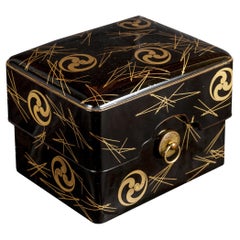
Kushibako (comb box) in black lacquer with gold lacquer decoration of arrows and my in the shape of three assembled commas " mitsudomoe " (Okabe; Itakura; Kuki; Hijikata; Arima famil...
Category
Antique Late 19th Century Japanese Lacquer
Materials
Lacquer
Still Thinking About These?
All Recently ViewedMore Ways To Browse
Koro Incense
Japanese Hirado
Hirado Porcelain
Blue And White Chinese Incense Burner
17th Century Chinese Incense Burner
Vintage Japanese Kutani
Antique Rose China Plates
Chinese Canton Rose Porcelain
Antique China Ware
Japanese Shoji
Signed Japanese Pottery
Porcelain Japanese 1900
Satsuma Pottery
Asian Tiles
Lotus Porcelain
17th Century Imari
Japanese Blue And White Porcelain Chargers
Qianlong Mark