Want more images or videos?
Request additional images or videos from the seller
1 of 16
Japanese Meiji Period Satsuma Koro Incense Burner Kinkozan
$2,196.43List Price
About the Item
- Creator:Kinkozan (Manufacturer)
- Dimensions:Height: 2.56 in (6.5 cm)Width: 4.14 in (10.5 cm)Depth: 2.29 in (5.8 cm)
- Style:Meiji (Of the Period)
- Materials and Techniques:
- Place of Origin:
- Period:
- Date of Manufacture:Circa 1890
- Condition:Wear consistent with age and use.
- Seller Location:Newark, GB
- Reference Number:Seller: KSHRD1stDibs: LU6971243759092
About the Seller
5.0
Vetted Professional Seller
Every seller passes strict standards for authenticity and reliability
Established in 2019
1stDibs seller since 2022
40 sales on 1stDibs
Typical response time: 3 hours
Authenticity Guarantee
In the unlikely event there’s an issue with an item’s authenticity, contact us within 1 year for a full refund. DetailsMoney-Back Guarantee
If your item is not as described, is damaged in transit, or does not arrive, contact us within 7 days for a full refund. Details24-Hour Cancellation
You have a 24-hour grace period in which to reconsider your purchase, with no questions asked.Vetted Professional Sellers
Our world-class sellers must adhere to strict standards for service and quality, maintaining the integrity of our listings.Price-Match Guarantee
If you find that a seller listed the same item for a lower price elsewhere, we’ll match it.Trusted Global Delivery
Our best-in-class carrier network provides specialized shipping options worldwide, including custom delivery.You May Also Like
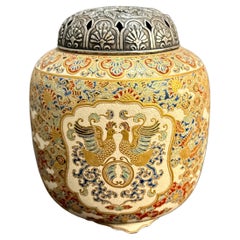
Japanese Satsuma Incense Burner, Koro, with Silver Lid, Meiji Period, Japan
Located in Austin, TX
A fantastic Japanese Satsuma incense burner, koro, with phoenix and brocade designs and a silver lid, Meiji Period, late 19th century, Japan.
The cens...
Category
Antique 1890s Japanese Meiji Ceramics
Materials
Silver
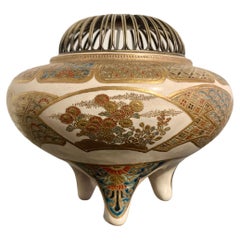
Japanese Satsuma Incense Burner, Koro, Meiji Period, Late 19th Century, Japan
Located in Austin, TX
A fine and elegant Japanese Satsuma tripod incense burner, koro, with pierced metal lid, signed Eizan (?) Meiji Period, late 19th century, Japan.
The koro, or censer, features a stoneware body of slightly compressed globular form, supported on three short and squat legs. The wide mouth with a recessed metal rim, and topped by an openwork metal lid topped with overlapping chrysanthemum blossoms of silver repousse.
The body of the koro finely painted with fan shaped cartouches. The fans in the foreground with sprays of blossoming chrysanthemum. The fans in the background with intricate geometric brocade designs.
The shoulder of the incense burner decorated with cartouches formed as stylized chrysanthemum petals, and intricately decorated with geometric and floral brocade designs.
The painting finely done in raised gilt and polychrome enamels, including the highly desirable gosu blue...
Category
Antique Late 19th Century Japanese Meiji Ceramics
Materials
Silver, Metal
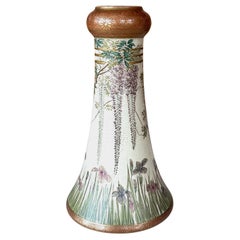
Fine Japanese Enameled Satsuma Vase by Kinkozan Meiji Period
By Kinkozan
Located in Atlanta, GA
A ceramic satsuma ware vase with very fine surface decoration made by Kinkozan circa 1880-1900s of late Meiji Period. The vase is of an elegant and relatively rare form with a trumpet shape body and the so-called garlic neck and opening. The surface is exquisitely decorated in a floral scheme with gilt and a light jewel-tone enamel. The top part showcases large bundles of wisteria blossom in white and purple, cascading down from a gilt wood trellis...
Category
Antique 1880s Japanese Meiji Ceramics
Materials
Ceramic
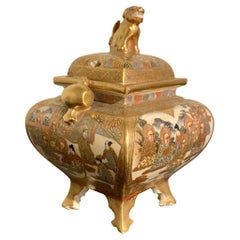
Small Japanese Satsuma Incense Burner, Koro, Meiji Period, Late 19th Century
Located in Austin, TX
A fine Japanese Satsuma stoneware incense burner, koro, Meiji Period, late 19th century, Japan.
The koro of square shape with curved sides,...
Category
Antique 1890s Ceramics
Materials
Enamel
$1,200
H 5.25 in W 4 in D 3.75 in
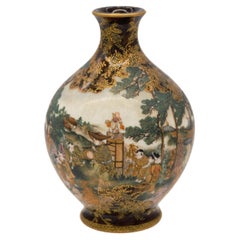
Satsuma earthenware vase by kinkozan, Meiji period
By Kinkozan
Located in Tel Aviv - Jaffa, IL
the body of this small marvelous vase is painted with a scene of a puppet show vendor with his wood backpack, on top of the backpack there are toys and dolls, he is surrounded with a group of 6 children, and on the background you can see a village.
on the other side of the vase there is an amazing painting of flowers and on the sides there are two amazing strong pine trees, the amorphous background is decorated in a "Tortoiseshell" color and design that gives it a real character and which is quite rare to see on satsuma pottery.
all the vase is over richly overpainted over the glaze with gold, which gives it its depth and realism.
signed Kyoto Kinkozan zo, and sealed Kinkozan zo
Kyoto’s Satsuma:
The painting technique used in Kyoto’s Satsuma-style ware is said to be the invention of the sixth generation Kinkōzan Sōbei (1824–1884). The Kinkōzan were a famous family of Kyoto Awataguchi potters who made ceramics that were used at Shōren'in, a temple closely tied to the imperial family, and by the shoguns of the Edo government. In fact the shogun is said to have granted them the name Kinkōzan. With the upheavals at the end of the Edo period, however, and the reforms of the subsequent Meiji government, the potters lost their traditional patrons and had to develop new markets.
Just at that time, the visit of a certain Westerner is said to have decided them to embark on overseas trade. By 1870, they had perfected Kyō Satsuma...
Category
Antique 1890s Japanese Meiji Ceramics
Materials
Gold
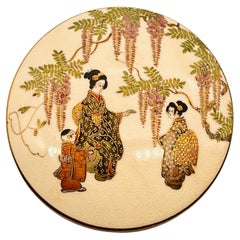
A Fine Japanese Satsuma kogo (incense box) Signed by Kinkozan. Meiji period
Located in London, GB
A Satsuma circular kogo (incense box) and cover signed by Kinkozan
19th century
Finely painted in enamels and gilt, the cover with wisteria and a scene of a woman and children ...
Category
Antique Late 19th Century Japanese Ceramics
Materials
Ceramic, Porcelain
$1,029
H 1.78 in Dm 3.75 in
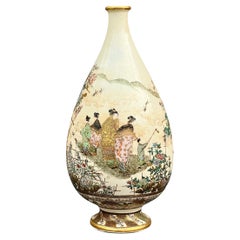
A Fine Japanese Satsuma Vase . Meiji Period. Kinkozan
Located in London, GB
A Fine Japanese Satsuma Vase with Bijin, Peacock, and Chrysanthemums.
Attributed to Kinkozan Workshop, Kyoto, Meiji period (late 19th century)
Of pear-shaped form with a flared f...
Category
Antique 19th Century Japanese Ceramics
Materials
Ceramic, Porcelain
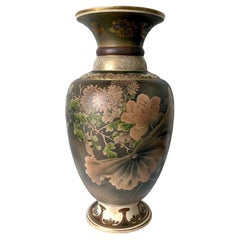
Large Japanese Satsuma Ceramic Vase Kinkozan
By Kinkozan
Located in Atlanta, GA
A large Japanese ceramic vase from the end of Meiji period circa 1890-1910s by Kinkozan (1645-1927). One of the largest studio manufacturers of the export ceramics at the time based in Kyoto. In the typical style of satsuma made at the turn of 20th century, the vase is elaborately decorated with a rather unusual kinran-de (gold paint) and green enamel highlight on a mottled brown background. The painterly decoration depicts a large seasonal floral arrangement in a circular fashion. Besides the obviously superb craftsmanship, what sets this particular vase apart from many lower quality and mass-produced pieces is its tone-on-tone color pallet that is visually somber and the small and sensitive details that heralds the change of the seasons. When the viewer goes beyond the first casual glimpse of the blossom and foliage, one would notice that on the edges of certain leaves as well as along the stalks, there accumulates a very thin layer of the white dust that represents the frost. The flower in bloom are chrysanthemums. Despite of being splendid, they are the messengers of the autumn. The large lotus leaf was subtly rendered in a bended and slightly withered manner, just past its prime. Although the lotus is still in bloom, the prominent seed pod indicates it may be the last for the season. The sentimental capture of the change of the seasons is not unusual in Japanese art. This vase poetically represents such a subtle transition from summer to fall, perhaps depicting the very first frost.
The neck of the vase is also slightly unusual with two rolled rings...
Category
Early 20th Century Japanese Meiji Ceramics
Materials
Ceramic
Satsuma Incense Burner
Located in New Orleans, LA
This Japanese Satsuma incense burner is a decorative work of art from the Meiji period, distinguished by its exquisite craftsmanship and intrica...
Category
Antique 19th Century Japanese Meiji Ceramics
Materials
Earthenware
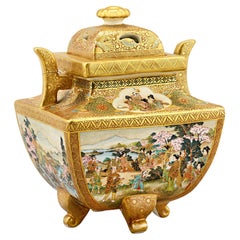
Fine Japanese Ceramic Satsuma Vase by Kinkozan
By Kinkozan
Located in Atlanta, GA
A miniature Japanese ceramic vase from the end of Meiji period circa 1880s- 1910s by Kinkozan (1645-1927). One of the largest studio manufacturers of the export ceramics at the time ...
Category
Early 20th Century Japanese Meiji Ceramics
Materials
Ceramic
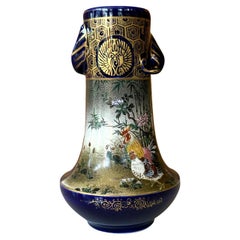
More From This Seller
View AllJapanese Meiji Period Satsuma Vase by Kinkozan
By Kinkozan
Located in Newark, England
FREE WORLDWIDE SHIPPING
FROM KYOTO’S FAMED KINKOZAN WORKSHOP, A MEIJI-PERIOD SATSUMA VASE OF EXCEPTIONAL ENAMEL AND GILT.
From our Japanese Satsuma collection, we are delighted to ...
Category
Antique Late 19th Century Meiji Ceramics
Materials
Ceramic, Earthenware, Pottery
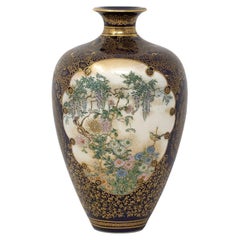
Japanese Antique Meiji Period Satsuma Vase by Kinkozan
By Kinkozan
Located in Newark, England
GLOBULAR FORM MINIATURE VASE
From our Japanese collection, we are delighted to offer this Japanese Satsuma Vase by Kinkozan. The Satsuma Vase made from earthenware pottery is potted...
Category
Antique Early 1900s Japanese Meiji Ceramics
Materials
Ceramic, Earthenware, Pottery

Japanese Antique Earthenware Satsuma Vase by Kinkozan Meiji Period
By Kinkozan
Located in Newark, England
FREE WORLDWIDE SHIPPING
MEIJI PERIOD (1868-1912)
From our Japanese Satsuma collection, we are delighted to present this exceptional Meiji period Satsuma vase by Kinkozan
This tal...
Category
Antique Late 19th Century Japanese Meiji Ceramics
Materials
Ceramic, Earthenware, Pottery
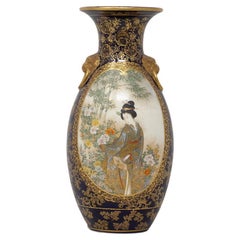
Japanese Meiji Period (1868-1912) Satsuma Vase by Kinkozan
By Kinkozan
Located in Newark, England
JAPANESE SATSUMA PROCESSIONAL VASE
From our Japanese collection, we are delighted to introduce to the market this Japanese Satsuma Vase by Kinkozan. The vase with a compressed body ...
Category
Antique Late 19th Century Japanese Meiji Ceramics
Materials
Ceramic, Earthenware, Pottery

Japanese Antique Earthenware Satsuma Vase by Kinkozan Meiji Period
By Kinkozan
Located in Newark, England
FREE WORLDWIDE SHIPPING
MEIJI PERIOD (1868-1912)
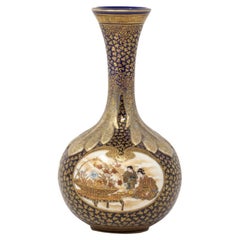
From our Japanese Satsuma collection, we’re pleased to offer this Meiji period bottle-form Satsuma vase by Kinkozan.
The vase is...
Category
Antique Early 1900s Japanese Meiji Ceramics
Materials
Ceramic, Earthenware, Pottery
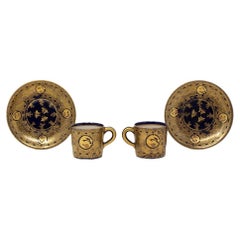
Japanese Meiji period (1868-1912) Satsuma Cup and Saucer Pair by Kinkozan
By Kinkozan
Located in Newark, England
PAIR OF CUP AND SAUCERS BY KINKOZAN
MEASUREMENTS
Saucer 10.8cm Diameter x 1.5cm High (4.25 x 0.6 Inches)
Cup 4.6cm High x 6.7cm Long x 5cm Wide (1.8 x 2.64 x 1.97 Inches)
From our ...
Category
Antique Late 19th Century Japanese Meiji Ceramics
Materials
Ceramic, Earthenware, Pottery
Still Thinking About These?
All Recently ViewedMore Ways To Browse
Japanese God
The God Of Wealth
Satsuma Koro
Japanese Satsuma Koro
Satsuma Incense
Satsuma Incense Burner
Antique Chawan
Dehua Porcelain
Korean Inlay
Asian Ceramic Pots
Calligraphy Ceramics
Chinese 14th Century
Chinese Antique Rose Mandarin Porcelain
Chinese Butterfly Porcelain
Chinese Qing Dog
Chinese Tea Bowl
Japanese Bizen
Vintage Green China