Want more images or videos?
Request additional images or videos from the seller
1 of 15
Large Japanese Satsuma Millefleur Covered Vase, Showa Period, Mid 20th Century
Price:$1,800
$2,700List Price
About the Item
- Dimensions:Height: 19 in (48.26 cm)Diameter: 12.5 in (31.75 cm)
- Style:Showa (Of the Period)
- Materials and Techniques:
- Place of Origin:
- Period:
- Date of Manufacture:Mid-20th Century
- Condition:Wear consistent with age and use. In fine condition, with no chips, cracks or repairs.
- Seller Location:Austin, TX
- Reference Number:1stDibs: LU894727549332
About the Seller
5.0
Platinum Seller
Premium sellers with a 4.7+ rating and 24-hour response times
Established in 2001
1stDibs seller since 2010
356 sales on 1stDibs
Authenticity Guarantee
In the unlikely event there’s an issue with an item’s authenticity, contact us within 1 year for a full refund. DetailsMoney-Back Guarantee
If your item is not as described, is damaged in transit, or does not arrive, contact us within 7 days for a full refund. Details24-Hour Cancellation
You have a 24-hour grace period in which to reconsider your purchase, with no questions asked.Vetted Professional Sellers
Our world-class sellers must adhere to strict standards for service and quality, maintaining the integrity of our listings.Price-Match Guarantee
If you find that a seller listed the same item for a lower price elsewhere, we’ll match it.Trusted Global Delivery
Our best-in-class carrier network provides specialized shipping options worldwide, including custom delivery.You May Also Like
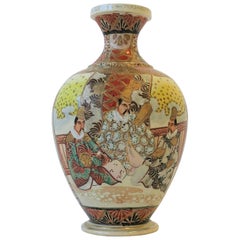
Japanese Satsuma Vase, Early 20th Century
Located in New York, NY
A beautiful Japanese Satsuma vase, circa early-20th century, late 1930s-1940s, Japan. Colors include red, black, gold, yellow, white, burgundy, green, and flesh tones. No chip noted....
Category
Vintage 1930s Japanese Ceramics
Materials
Ceramic, Earthenware, Pottery
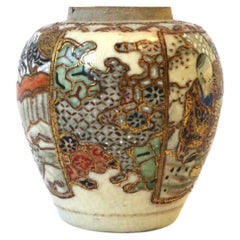
Japanese Satsuma Ginger Jar Vase, circa Early 20th Century
Located in New York, NY
A beautiful small Japanese Satsuma ginger jar vase, circa early-20th century, Japan. Colors include cream, copper, green, blue, white, black, orange...
Category
Early 20th Century Japanese Meiji Vases
Materials
Ceramic, Earthenware, Pottery
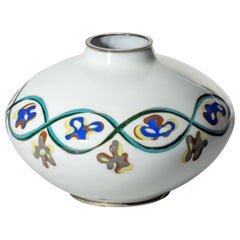
Unusual Showa Period Cloisonné Vase
Located in Lymington, Hampshire
An unusual Showa period cloisonné vase, of squat ovoid form with continuous guilloche in turquoise and green enamels enclosing abstract designs in blue, y...
Category
Vintage 1980s Japanese Showa Vases
Materials
Enamel
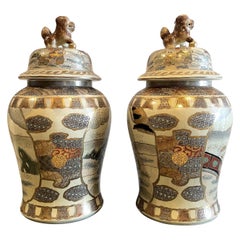
Pair of Taisho Period Japanese Satsuma Style Covered Jars
Located in Miami, FL
Pair of 19th century temple jars, lidded, Chinoiserie Foo Dog Finials, Exceptional quality and detail with raised hand painted work.
Category
Antique Late 19th Century Chinese Chinoiserie Urns
Materials
Ceramic
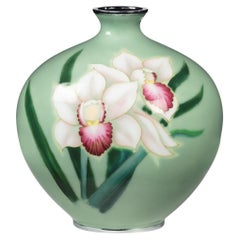
Showa Period Green Ground Cloisonne Vase
Located in Lymington, Hampshire
A Showa period green ground cloisonne vase, with two white and pink orchids, chrome mounts. Attributed to Ando. Japanese, circa 1950.
Category
Vintage 1950s Japanese Showa Ceramics
Materials
Ceramic
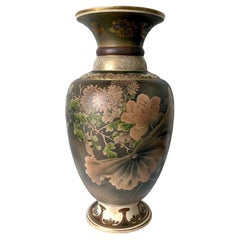
Large Japanese Satsuma Ceramic Vase Kinkozan
By Kinkozan
Located in Atlanta, GA
A large Japanese ceramic vase from the end of Meiji period circa 1890-1910s by Kinkozan (1645-1927). One of the largest studio manufacturers of the export ceramics at the time based in Kyoto. In the typical style of satsuma made at the turn of 20th century, the vase is elaborately decorated with a rather unusual kinran-de (gold paint) and green enamel highlight on a mottled brown background. The painterly decoration depicts a large seasonal floral arrangement in a circular fashion. Besides the obviously superb craftsmanship, what sets this particular vase apart from many lower quality and mass-produced pieces is its tone-on-tone color pallet that is visually somber and the small and sensitive details that heralds the change of the seasons. When the viewer goes beyond the first casual glimpse of the blossom and foliage, one would notice that on the edges of certain leaves as well as along the stalks, there accumulates a very thin layer of the white dust that represents the frost. The flower in bloom are chrysanthemums. Despite of being splendid, they are the messengers of the autumn. The large lotus leaf was subtly rendered in a bended and slightly withered manner, just past its prime. Although the lotus is still in bloom, the prominent seed pod indicates it may be the last for the season. The sentimental capture of the change of the seasons is not unusual in Japanese art. This vase poetically represents such a subtle transition from summer to fall, perhaps depicting the very first frost.
The neck of the vase is also slightly unusual with two rolled rings...
Category
Early 20th Century Japanese Meiji Ceramics
Materials
Ceramic
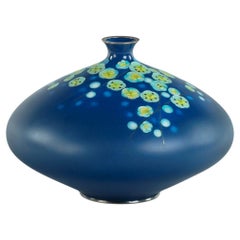
Showa Period Blue Cloisonne Vase by Tamura
By Tamura
Located in Lymington, Hampshire
A Showa period blue cloisonne vase by Tamura, of squat ovoid form with a band of gold, silver and white prunus blossom in gin-bari around the shoul...
Category
Antique 19th Century Japanese Showa Ceramics
Materials
Ceramic
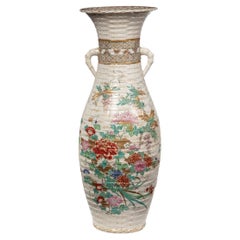
Large Meiji Period Satsuma Earthenware Floor Vase
Located in Lymington, Hampshire
A large Meiji period Satsuma earthenware floor vase, the of baluster form, painted in pastel overglaze enamels and gilding with two large sprays of flowers including prunus blossom, ...
Category
Antique 1870s Japanese Meiji Ceramics
Materials
Enamel
Large Meiji Period Satsuma Earthenware Floor Vase
Located in Lymington, Hampshire
A large Meiji period Satsuma earthenware floor vase, the skittle shaped body painted in pastel overglaze enamels and gilding with a continuous frieze of the Seven Gods...
Category
Antique 1870s Japanese Meiji Ceramics
Materials
Enamel
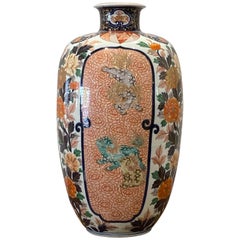
Large Japanese Meiji Period Imari Vase, 19th Century
Located in San Francisco, CA
A large and impressive fine quality 19th century Imari vase, with hand painted classical floral motif and inset panels painting of playful Foo Dogs.
Japan, Meiji period, late 19th c...
Category
Antique Late 19th Century Japanese Meiji Ceramics
Materials
Porcelain
More From This Seller
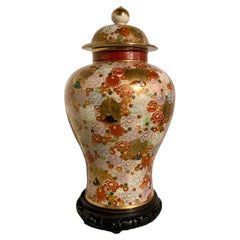
View AllLarge Japanese Satsuma Covered Vase, Showa Period, Mid 20th Century, Japan
Located in Austin, TX
A very large and exuberantly decorated Japanese Satsuma millefleur covered vase, marked Satsuma, Showa period, mid 20th century, Japan.
The large vase of attractive baluster form, with a slightly splayed foot, narrow waist, and tapered body with high shoulders and short neck. The vase topped by a domed cover with a large finial shaped like a hoju, the wish fulfilling jewel.
The vase decorated all over in a dense field of flowering blossoms - peony, lotus, and chrysanthemum - in a design known as millefleur, or a thousand flowers. The flowers freely and cheerfully painted in various colors of red, white, orange, green, blue and yellow, with raised white enamels...
Category
Mid-20th Century Japanese Showa Ceramics
Materials
Stoneware
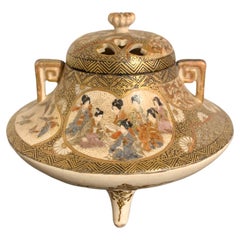
Japanese Satsuma Tripod Censer, Koro, Meiji period, Early 20th Century, Japan
Located in Austin, TX
A small and finely decorated Japanese Satsuma tripod incense burner (koro), signed Kyozan, Meiji period, circa 1900, Japan.
The censer, koro, with a compressed body supported by t...
Category
Antique Early 1900s Japanese Meiji Ceramics
Materials
Stoneware
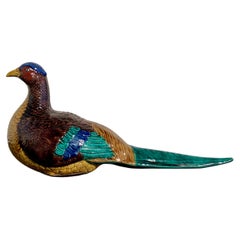
Japanese Kutani Pheasant Sculpture, Okimono, Showa Era, Early 20th Century
Located in Austin, TX
A spectacularly glazed Japanese Kutani model, okimono, of a pheasant, Showa era, early 20th century, Japan.
The okimono, or decorative sculpture, in the form of a magnificent phea...
Category
Vintage 1930s Japanese Showa Ceramics
Materials
Porcelain
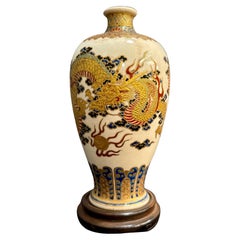
Japanese Satsuma Dragon Vase, Meiji Period, c 1900, Japan
By Satsuma
Located in Austin, TX
A fantastic small Japanese Satsuma vase with image of writhing dragons, Meiji Period, circa 1900, Japan.
The vase of elegant baluster form, with a slightly flared foot, slender body...
Category
Antique Early 1900s Japanese Meiji Ceramics
Materials
Ceramic, Porcelain, Pottery, Stoneware, Hardwood
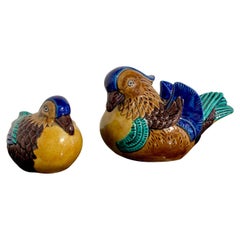
Pair Japanese Kutani Okimono of Mandarin Ducks, Showa Era, Early 20th Century
Located in Austin, TX
A charming and delightful pair of Kutani glazed porcelain models, okimono, of Mandarin ducks, oshidori, Showa Era, circa 1930's, Japan.
The two Mandarin ducks, called oshidori in ...
Category
Vintage 1930s Japanese Showa Ceramics
Materials
Porcelain
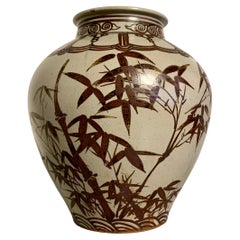
Large Korean Iron Red Glazed Bamboo and Plum Vase, 20th Century, Korea
Located in Austin, TX
A large and boldly painted Korean "Bamboo and Plum" underglaze iron brown porcelain vase, 20th century, Korea.
The large porcelain vase of baluster vase form with generous proportions. The bulbous body with high, wide shoulders, tapering down to a flat recessed foot. The body decorated in underglaze iron brown with large designs of tall, leafy bamboo stalks to one side. The opposite side with gnarled branches of blossoming plum.
Bamboo is revered in Korea, and Asia in general for its strength, flexibility and quick growing nature. Plum is invested with similar ideals, representing strength and resilience, as it flowers in the depth of winter.
The neck and shoulders featuring a design of stylized clouds. The base with a band of stylized waves. All in underglaze iron brown.
The vase with a transparent overglaze of bluish white.
The vase modeled after a 16th century Joseon vase...
Category
20th Century Korean Ceramics
Materials
Porcelain
Still Thinking About These?
All Recently ViewedMore Ways To Browse
Satsuma Large Vases
Japanese Satsuma Large Vase
Vintage Japanese Satsuma Vase Vases
Showa Stoneware
Millefleur Vase
Satsuma Shimazu
Meiji Charger
Japanese Meiji Plates
Blue Lotus
Antique Imari China
18th Century Famille Rose
Antique Rose Medallion China
Chinese Celadon Porcelain
Porcelain Yongzheng
Proc Period
Korean Joseon
Antique Chinese Blue And White Bowl
Chinese And Porcelain And Phoenix