1 of 5
Satsuma, Porcelain Incense Burner
$3,500List Price
About the Item
- Creator:Satsuma (Maker)
- Dimensions:Height: 13.39 in (34 cm)Diameter: 4.73 in (12 cm)
- Place of Origin:
- Period:
- Date of Manufacture:1864-1912
- Condition:
- Seller Location:Montreal, CA
- Reference Number:1stDibs: LU106822059512
Authenticity Guarantee
In the unlikely event there’s an issue with an item’s authenticity, contact us within 1 year for a full refund. DetailsMoney-Back Guarantee
If your item is not as described, is damaged in transit, or does not arrive, contact us within 7 days for a full refund. Details24-Hour Cancellation
You have a 24-hour grace period in which to reconsider your purchase, with no questions asked.Vetted Professional Sellers
Our world-class sellers must adhere to strict standards for service and quality, maintaining the integrity of our listings.Price-Match Guarantee
If you find that a seller listed the same item for a lower price elsewhere, we’ll match it.Trusted Global Delivery
Our best-in-class carrier network provides specialized shipping options worldwide, including custom delivery.You May Also Like
Satsuma Incense Burner
Located in New Orleans, LA
This Japanese Satsuma incense burner is a decorative work of art from the Meiji period, distinguished by its exquisite craftsmanship and intrica...
Category
Antique 19th Century Japanese Meiji Ceramics
Materials
Earthenware
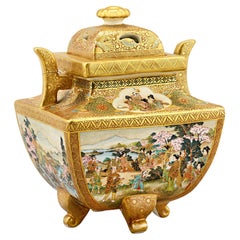
Japanese Porcelain Incense Burner 1970s Karabito
Located in Paris, FR
This is an incense burner which was made in Japan around 1970s in Showa era. This incense burner is made with ceramic.
Dimensions: 8 x 8 x H10 cm
Category
Vintage 1970s Japanese Showa Ceramics
Materials
Ceramic
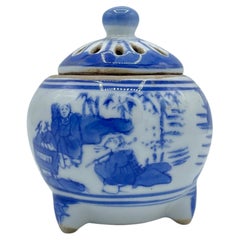
Antique Japanese Porcelain Brazier
Incense Burner
, Signed
Located in Norton, MA
A very unusual Antique Japanese Porcelain Brazier (Incense Burner) with green checker pattern, Signed on the bottom.
Category
Early 20th Century Japanese Ceramics
Materials
Porcelain
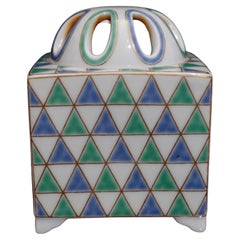
Japanese Satsuma Incense Burner, Koro, with Silver Lid, Meiji Period, Japan
Located in Austin, TX
A fantastic Japanese Satsuma incense burner, koro, with phoenix and brocade designs and a silver lid, Meiji Period, late 19th century, Japan.
The cens...
Category
Antique 1890s Japanese Meiji Ceramics
Materials
Silver
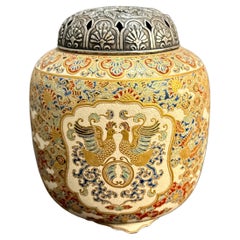
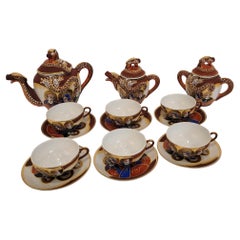
Satsuma Red Gold Blue Satsuma Porcelain Tea Set, Nakasima Japan
By Satsuma
Located in Valladolid, ES
Gorgous and very Delicate six-piece tea or coffee set made of Japanese Satsuma porcelain. Cherry, blue, and ochre colors predominate. The main motif features the goddess Kannon surro...
Category
Antique Early 1900s Japanese Japonisme Ceramics
Materials
Gold
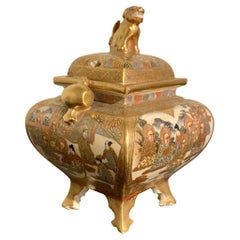
Small Japanese Satsuma Incense Burner, Koro, Meiji Period, Late 19th Century
Located in Austin, TX
A fine Japanese Satsuma stoneware incense burner, koro, Meiji Period, late 19th century, Japan.
The koro of square shape with curved sides,...
Category
Antique 1890s Ceramics
Materials
Enamel
$1,200
H 5.25 in W 4 in D 3.75 in
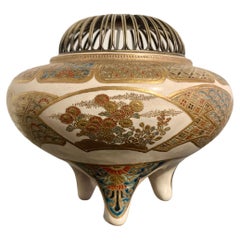
Japanese Satsuma Incense Burner, Koro, Meiji Period, Late 19th Century, Japan
Located in Austin, TX
A fine and elegant Japanese Satsuma tripod incense burner, koro, with pierced metal lid, signed Eizan (?) Meiji Period, late 19th century, Japan.
The koro, or censer, features a stoneware body of slightly compressed globular form, supported on three short and squat legs. The wide mouth with a recessed metal rim, and topped by an openwork metal lid topped with overlapping chrysanthemum blossoms of silver repousse.
The body of the koro finely painted with fan shaped cartouches. The fans in the foreground with sprays of blossoming chrysanthemum. The fans in the background with intricate geometric brocade designs.
The shoulder of the incense burner decorated with cartouches formed as stylized chrysanthemum petals, and intricately decorated with geometric and floral brocade designs.
The painting finely done in raised gilt and polychrome enamels, including the highly desirable gosu blue...
Category
Antique Late 19th Century Japanese Meiji Ceramics
Materials
Silver, Metal
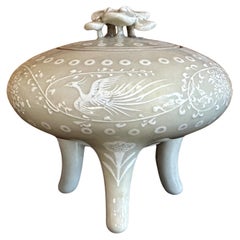
Rare Japanese Porcelain Incense Burner with Inlays Makuzu Kozan
By Makuzu Kozan
Located in Atlanta, GA
A porcelain incense burner (koro) made by Japanese potter Makuzu Kozan (also known as Miyagawa Kozan, 1842-1916) circa 1890s-1900s (end of Meiji Period). The koro features an elegant...
Category
Antique Late 19th Century Japanese Meiji Ceramics
Materials
Ceramic
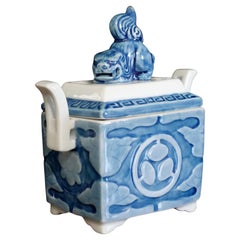
Old Japanese Porcelain Lidded Incense Burner in the Original Box
Located in Norton, MA
Old Japanese porcelain lidded incense burner in the original box
The lid with the lion, two pierced handles on each side, and four feet at the four corners to stand.
This is an old...
Category
Mid-20th Century Ceramics
Materials
Porcelain
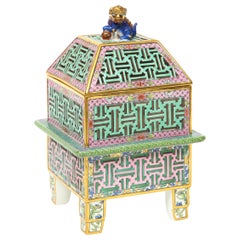
Rare Meissen Marcolini Porcelain Chinoiserie Incense Burner Vase and Cover
By Meissen Porcelain
Located in Queens, NY
A rare Meissen Marcolini Porcelain Chinoiserie incense burner vase and cover, made for the Chinese market, circa 1800, blue cross swords and star mark, Pressnummer 58
A Museum Quality Piece.
Painted in the sought after famille rose palette with sprigs of indianische Blumen and enriched in gilding, the simulated pierced body supported by four feet painted with stylized dragons, the pierced cover with a Buddhist lion finial.
10" high x 6" wide x 6" deep
The shape of this piece, which appears to be unrecorded in the literature, is inspired by similar Chinese porcelain censers from the Qing Dynasty, Kangxi Period (1654-1722). An example in the Palace Museum, Beijing, is illustrated by Li Yi-hua in Qing Porcelain of Kangxi, Yongzheng and Qianlong Periods from the Palace Museum Collection, Hong Kong, 1989, pl. 65. Another in the British Museum, London (museum no. PDF, A.812) is catalogued as a perfume-holder.
These porcelain examples are in turn inspired by ancient Chinese bronzes from both the Shang (1600-1046 BC) and the Zhou (1046-246 BCE) dynasties, an example of which was sold anonymously by Christie's New York, 22 March 2019, lot 1601. This chain of inspiration tracking backwards from the 19th century to antiquity provides a clear example of how ceramics, and indeed other mediums, are able to influence and motivate the works of later generations.
For a Meissen porcelain snuff...
Category
Antique Late 18th Century German Chinoiserie Ceramics
Materials
Porcelain
$48,500
H 10 in W 6 in D 6 in
Still Thinking About These?
All Recently ViewedMore Ways To Browse
Japanese Incense Burner Antique
Japanese Koro
Meiji Koro
Koro Incense
Satsuma Koro
Japanese Satsuma Koro
Satsuma Incense
Satsuma Incense Burner
Japanese Kutani
Japanese Porcelain Edo
Chinese Ming Porcelain
Qing Dynasty Porcelain
Satsuma Meiji
Qianlong Period
Chinese Qing Plates
17th Century Chinese Ceramics
Ming Dynasty Furniture
Edo Period Japanese Art