Want more images or videos?
Request additional images or videos from the seller
1 of 16
Japanese Table Cabinet with Cloisonne Panels in the style of Namikawa Sosuke
Price:$13,000
$16,000List Price
About the Item
- Similar to:Namikawa Sōsuke (Artist)
- Dimensions:Height: 23.25 in (59.06 cm)Width: 15 in (38.1 cm)Depth: 9 in (22.86 cm)
- Style:Japonisme (Of the Period)
- Materials and Techniques:
- Place of Origin:
- Period:
- Date of Manufacture:1900s-1910s
- Condition:Wear consistent with age and use. Warm patina and minor surface wear. Stable internal enamel hairlines on two panels as shown (last two photos, the top 1st and 3rd. The hairlines are discernible in the 1st and barely visible in the 3rd). A small old restored crack to the wood back.
- Seller Location:Atlanta, GA
- Reference Number:1stDibs: LU945013992352
About the Seller
4.9
Platinum Seller
Premium sellers with a 4.7+ rating and 24-hour response times
Established in 2006
1stDibs seller since 2010
586 sales on 1stDibs
Authenticity Guarantee
In the unlikely event there’s an issue with an item’s authenticity, contact us within 1 year for a full refund. DetailsMoney-Back Guarantee
If your item is not as described, is damaged in transit, or does not arrive, contact us within 7 days for a full refund. Details24-Hour Cancellation
You have a 24-hour grace period in which to reconsider your purchase, with no questions asked.Vetted Professional Sellers
Our world-class sellers must adhere to strict standards for service and quality, maintaining the integrity of our listings.Price-Match Guarantee
If you find that a seller listed the same item for a lower price elsewhere, we’ll match it.Trusted Global Delivery
Our best-in-class carrier network provides specialized shipping options worldwide, including custom delivery.You May Also Like
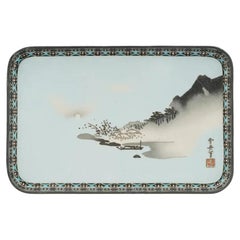
Japanese Wireless Cloisonné Serving Tray Meiji After Namikawa Sosuke
Located in Long Island City, NY
A rare 19th Century Japanese copper serving tray with cloisonne enamel design. The central part of the tray depicts a wireless cloisonne picture, a coastal landscape view with a full moon. The hieroglyphical signature of the artist is in the lower right. The rims and the backside are decorated with floral ornaments. Blue and black color palette. Collectible Oriental Decor And Applied Arts For Interior Design.
Namikawa Sosuke (1847–1910) was a Japanese cloisonné artist,[1] known for innovations that developed cloisonné enamel into an artistic medium sharing many features with paintings.[2][3] He and Namikawa Yasuyuki (no relation)[notes 1] were the most famous cloisonné artists of the 1890 to 1910 period, known as the "golden age" of Japanese enamels.[1] Around 1880 he set up and ran the Tokyo branch of the Nagoya Cloisonné Company.[1] He exhibited his artworks at national and international expositions, where he took an organising role.[2] He was recognised as an Imperial Household Artist and created art works for imperial residences. He sometimes signed his works with the character sakigake (Pioneer)
the art work is based off a art work done by Sesshu Toyo
Sesshu Toyo (?? ??, c. 1420 – August 26, 1506), also known simply as Sesshu (??), was a Japanese Zen monk and painter who is considered a great master of Japanese ink painting. Initially inspired by Chinese landscapes, Sesshu's work holds a distinctively Japanese style that reflects Zen Buddhist aesthetics.[1] His prominent work captured images of landscapes, portraits, and birds and flowers paintings, infused with Zen Buddhist beliefs, flattened perspective, and emphatic lines.[2]
Sesshu was born into the samurai Oda family (???) and trained at Shokoku-ji temple in Kyoto, Japan, as a Zen monk.[1] From his early childhood, Sesshu showed a talent for painting and eventually became widely revered throughout Japan as a wise, reputable Zen scholar, and the greatest painter priest of Zen-Shu.[3]
Sesshu worked in a painting atelier whilst training under Tensho Shubun (c. 1418–1463). But upon visiting China, his work betook a distinctive Chinese influence, merging Japanese and Chinese styles to develop his individualistic style of Zen paintings.[3] Sesshu's influence on painting was so wide that many schools of art appointed him their founder.[4] Sesshu's most acclaimed works are Winter Landscape (c. 1470s), Birds and Flowers (1420–1506) and Four Landscape Scrolls...
Category
Antique Late 19th Century Japanese Metalwork
Materials
Copper, Enamel
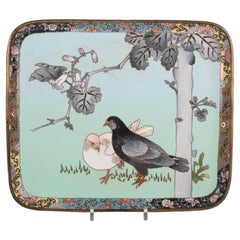
A Fine Japanese Meiji Period Cloisonné Enamel Tray Attributed to Namikawa Sösuke
Located in London, GB
A Japanese Meiji Period Cloisonné Enamel
Tray Attributed to Namikawa Sösuke, Late 19th Century
A refined rectangular cloisonné enamel tray with softly rounded corners and shallow...
Category
Antique 19th Century Japanese Metalwork
Materials
Enamel
$2,410
H 12.21 in W 12.21 in D 8.27 in
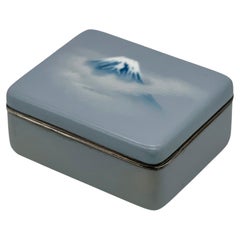
A Fine quality Japanese Cloisonne Enamel Box In Sosuke Style, Attr to Ando.
Located in London, GB
A high quality cloisonne enamel lidded box attributed to the highly regarded studios of Ando Jubei.
Meiji period
- the rounded rectangular lidded bo...
Category
Antique 19th Century Japanese Metalwork
Materials
Enamel
$1,790
H 1.97 in W 4.34 in D 3.55 in
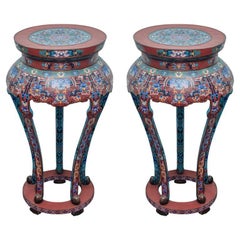
Antique Pair of Red, Blue and Multicoloured Cloisonné Tables
Located in Toronto, ON
These rare tables have a spectacular presence due to their grand size and intricate work. Cloisonné, derived from the French word “enclosed” is an ancient technique of decorating met...
Category
Early 20th Century Chinese Furniture
Materials
Metal
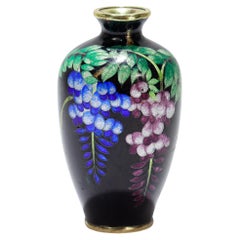
Antique Japanese Cloisonne Enamel Cabinet Vase with Wisteria
Located in Philadelphia, PA
A fine antique Japanese cloisonne enamel cabinet vase.
With polychrome enamel on a brass base.
Decorated with an enameled tree branches with blue & purple wisteria blossoms on a ...
Category
Antique 19th Century Japanese Meiji Metalwork
Materials
Enamel
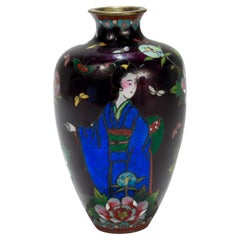
Antique Japanese Cloisonne Enamel Cabinet Vase with Geisha
Flowers
Located in Philadelphia, PA
A fine antique Japanese cloisonne enamel cabinet vase.
In brass with cloisonne enamel throughout.
Decorated with a geisha in blue kimono surrounded by numerous flowers and butterf...
Category
20th Century Japanese Showa Metalwork
Materials
Brass, Enamel
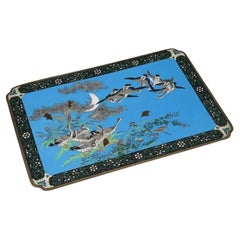
Large Rare Meiji Japanese Cloisonne Enamel Panel of Geese Flying over the Moon S
Located in Long Island City, NY
Large Meiji Japanese Cloisonne Enamel Panel of Geese Flying over the Moon Sky
A large antique Japanese, late Meiji era, enamel over brass wall panel. The panel is enameled with a p...
Category
Antique Late 19th Century Japanese Metalwork
Materials
Enamel, Brass
$12,000
H 19.75 in Dm 13.875 in
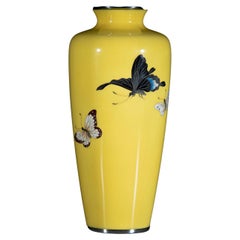
A Japanese cloisonné vase decorated with three flying butterflies
Located in Milano, IT
Vase in metal and cloisonné enamel with a yellow monochrome background, decorated with three flying butterflies with the Ando Company brand.
Period: Taisho 1920 ca.
Dimensions: 21 ...
Category
Early 20th Century Japanese Japonisme Metalwork
Materials
Enamel
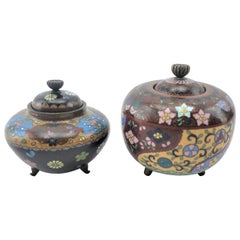
Pair of Antique Japanese Cloisonne Covered Jars with Floral Motif Decoration
Located in Hamilton, Ontario
This pair of antique cloisonne covered jars or urns are unsigned, but originate from Japan from approximately 1900 in a Japanese export style. The pair is done in muted tones and are...
Category
Early 20th Century Japanese Japonisme Metalwork
Materials
Metal
$1,295 / set
H 3.5 in Dm 3.25 in
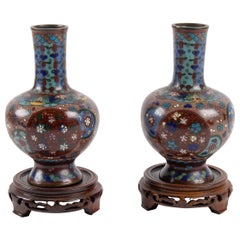
Pair of Cloisonné Bronze Vases, Japan, Circa 1900
Located in Saint-Ouen, FR
Pair of cloisonné bronze vases, Japan, circa 1900, accident on one, slight depression
Measures: H 19cm, D 10cm.
Category
20th Century Japanese Japonisme Metalwork
Materials
Bronze
More From This Seller
View AllJapanese Cloisonné Vase Ando Jubei with Storage Box
By Ando Jubei
Located in Atlanta, GA
A beautifully decorated cloisonné vase with silver rims by Ando Jubei (1876-1956), the celebrated Japanese Shippo studio. The piece is dated to late Meiji to early Showa period circa...
Category
Early 20th Century Japanese Japonisme Metalwork
Materials
Metal, Silver, Enamel
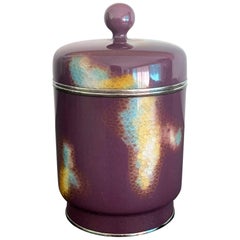
Japanese Cloisonné Covered Jar by Ando Jubei
By Ando Jubei
Located in Atlanta, GA
Japanese cloisonné enamels are known as shippo-yaki and the mid-19th century saw the production of very high quality wares in the early centers Nagoya. One of the most renowned works...
Category
Early 20th Century Japanese Japonisme Metalwork
Materials
Metal, Sterling Silver, Enamel
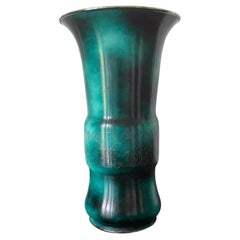
Japanese Cloisonne Vase with Silver Inlays by Ando Jubei
By Ando Jubei
Located in Atlanta, GA
A Japanese cloisonne vase by Ando Company circa 1910-30s, end of Meiji to Tasho period. The vase takes an archaic Chinese bronze vessel form know...
Category
Vintage 1920s Japanese Meiji Metalwork
Materials
Metal, Silver
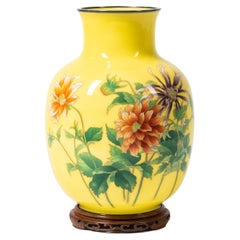
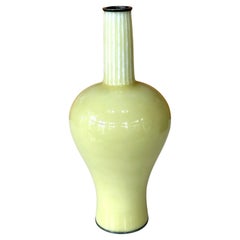
Japanese Wireless Musen Cloisonne Vase by Ando Jubei
By Ando Jubei
Located in Atlanta, GA
A Japanese cloisonne vase in bottle-form made by Ando Jubei (1876-1963) circa 1910-20s (late Meiji to Taisho period). The vase features a completely smooth surface without showing any wire. The technique is known as Musen (hidden wire) in Japanese and was notoriously difficult to perfect, especially with piece like this with a relatively large continuous surface. The beguiling effect is to use enamel to mimic porcelain or even jade. This vase, with its ultra smooth surface and soft yellow color (Yellow was often associated with Japanese imperial household...
Category
Early 20th Century Japanese Meiji Metalwork
Materials
Silver, Enamel
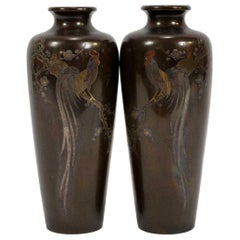
Pair of Japanese Bronze Vase with Metal Inlays by Mitsufune
Located in Atlanta, GA
A pair of elegant vases of solid oiled bronze from the Meiji era, Japan (1868-1912). In a Classic Meiping shape, the pair has a mirrored inlay with gold, silver and red enamel that d...
Category
Antique Late 19th Century Japanese Japonisme Metalwork
Materials
Bronze
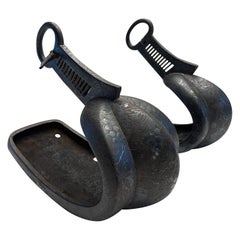
Antique Japanese Iron Stirrups with Silver Inlay Signed
Located in Atlanta, GA
A pair of antique Japanese Abumis, stirrup for horse-riding, in cast iron with elaborate silver inlay, circa 16th century Muramachi to Momoyama period. The prototype of Japanese abum...
Category
Antique 16th Century Japanese Japonisme Metalwork
Materials
Silver, Iron
Still Thinking About These?
All Recently ViewedMore Ways To Browse
Japanese Wood
Japanese Antique Wood
Japaned Table
Japanese Antique Tables
Imperial Japan
Large Cloisonne
Antique Metal Panel
Antique Four Panel Doors
Cloisonne Table
Meiji Period Cabinet
Cloisonne Namikawa
Small Cloisonne
Japanese Metal Cabinet
Namikawa Sosuke
Cloisonne Cabinet
Chinese Lacquer Red
Chinese Carved Lacquer
Chinese Red Lacquer Furniture