1 of 4
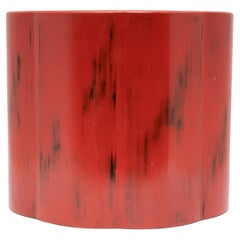
Contemporary Japanese Urushi Lacquer Sculpture
$2,367.73List Price
About the Item
- Creator:Natsuki Kurimoto (Author)
- Dimensions:Height: 9.06 in (23 cm)Width: 8.67 in (22 cm)Depth: 3.15 in (8 cm)
- Style:Other (In the Style Of)
- Materials and Techniques:
- Place of Origin:
- Period:
- Date of Manufacture:2016
- Production Type:New Custom(One of a Kind)
- Estimated Production Time:Available Now
- Condition:
- Seller Location:Milan, IT
- Reference Number:1stDibs: LU4569114535862
Authenticity Guarantee
In the unlikely event there’s an issue with an item’s authenticity, contact us within 1 year for a full refund. DetailsMoney-Back Guarantee
If your item is not as described, is damaged in transit, or does not arrive, contact us within 7 days for a full refund. Details24-Hour Cancellation
You have a 24-hour grace period in which to reconsider your purchase, with no questions asked.Vetted Professional Sellers
Our world-class sellers must adhere to strict standards for service and quality, maintaining the integrity of our listings.Price-Match Guarantee
If you find that a seller listed the same item for a lower price elsewhere, we’ll match it.Trusted Global Delivery
Our best-in-class carrier network provides specialized shipping options worldwide, including custom delivery.You May Also Like
Rhino Contemporary Japanese Lacquer Art by Someya Satoshi
Located in Atlanta, GA
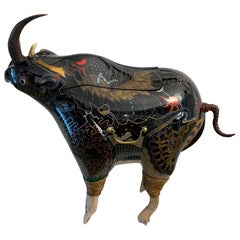
Japanese Lacquer Rhino Sculpture by Someya Satoshi (1983-). A hand-molded lacquer sculpture that depicts a fantasy beast "Rhino". The artist uses century-old traditional techniques and symbols but with an innovative contemporary energy that borders mysticism, shamanism and surrealism. Found objects were equally treated as part of the meticulous designs as the elaborate Maki-e and shell inlays.
According to the press of Honolulu Museum of Art: "Someya Satoshi has been described as “one of the most significant contemporary lacquer artists working in Japan today.” (Japan Times, 12 Dec. 2013) His work combines objects of daily use, such as bathing buckets, serving trays, and soup bowls, with a wide array of natural materials, including animal bones, horns and antlers, sand, stones, leaves and branches. In the process, he implements a range of traditional lacquer methods passed down from pre-modern eras, such as the kanshitsu or “dry lacquer” technique, the origins of which date to Japan’s Nara period (710–784). After creating his forms, he embellishes them with designs inspired by calligraphy, traditional Japanese textile patterns, and even contemporary manga or comic books. His work defies ordinary definitions of lacquer art and successfully challenges the perceived limits of this extremely difficult and, in some ways, most conservative of traditional Japanese art forms".
His work was exhibited in US such as Honolulu Museum of Art, Minneapolis Institute of Art, Morikami Museum etc. For a complete resume of the artist, see the artist's page in Imura Art Gallery.
Reference: For a very similar Bull Sculpture see Hard Bodies Contemporary Japanese Lacquer...
Category
Early 2000s Japanese Japonisme Lacquer
Materials
Rope, Wood, Lacquer
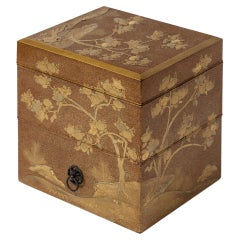
Japanese Lacquered Tebako
Box
Located in PARIS, FR
Tebako box with three compartments in golden and nashi-ji lacquer, decorated with golden, red, and kirigane lacquer, golden persimmon tree leaves, among rocks. The compartments are of increasing size from the top. The decoration is in continuity.
Persimmon has been cultivated in southern China for more than 2500 years and is believed to have been introduced to Japan in the 8th century. The veneer is a tree with very hard wood, similar to ebony. According to a legend, one specimen survived the atomic bombing of Nagasaki on August 9, 1945, close to the epicenter. It is therefore in Japan a symbol of strength and longevity. It is also the national fruit of the country. It is eaten as a traditional dish during New Year's Day celebrations.
Tebako literally means "portable box...
Category
Antique 1860s Japanese Lacquer
Materials
Lacquer
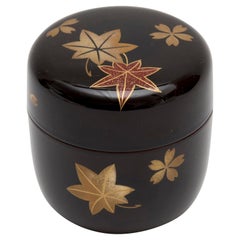
Japanese Lacquered Natsume
Tea Box
Located in PARIS, FR
Natsume in dark red lacquer, decorated with autumn leaves and cherry blossoms in hiramaki-e and nashiji. Interior in black lacquer.
Maple leaves (Momiji) are celebrated in literatur...
Category
Mid-20th Century Japanese Lacquer
Materials
Lacquer
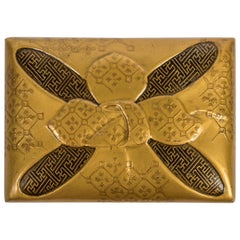
Japanese Lacquered Furoshiki Kobako
Box
Located in PARIS, FR
Rectangular and flat lacquer Kobako (small box) representing a furoshiki knot seen from above. Fundame background, furoshiki in takamaki-e with floral pattern, inside the folds of the fabric with black and gold sayagata pattern with togidashi maki-e technique. The saya (or sayagata) pattern is composed of Chinese swastikas...
Category
Antique Late 19th Century Japanese Lacquer
Materials
Lacquer
Japanese Red Lacquer Hibachi, c. 1900
Located in Chicago, IL
Designed to hold glowing embers, hibachi vessels were used for cooking or as a source of heat in Japanese homes. Placed under a low wood kotatsu table wi...
Category
Early 20th Century Japanese Meiji Lacquer
Materials
Copper
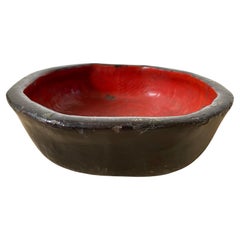
Japanese Red
Black Lacquer Bowl, Early 20th Century
Located in Jimbaran, Bali
A Japanese red & black lacquer bowl from the early 20th century. Its frame is crafted from woven rattan fibres and covered in multiple layers of lac...
Category
Early 20th Century Japanese Other Decorative Bowls
Materials
Rattan, Lacquer
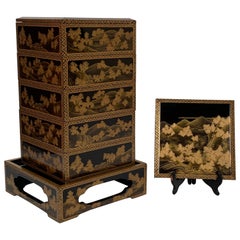
Japanese Maki-e Lacquer Stacking Box, Jubako, Meiji Period, Japan
Located in Austin, TX
A fine and impressive Japanese gold maki-e decorated black lacquer five-tier jubako with presentation tray, two lids, and the original tomobako storage box, Meiji period, late 19th c...
Category
Antique Late 19th Century Japanese Meiji Lacquer
Materials
Lacquer
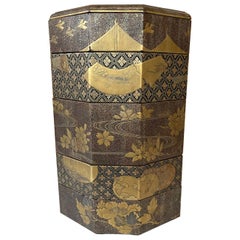
Japanese Maki-e Lacquer Stack Box Jubako
Located in Atlanta, GA
An antique jubako (stack boxes) with five tiers in an elongated octagon shape circa 19th century (end of Edo or beginning of Meiji period). jubako was traditionally used to store and...
Category
Antique 19th Century Japanese Japonisme Lacquer
Materials
Wood, Lacquer
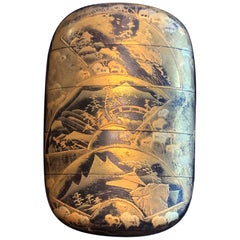
Fine Japanese Lacquered Inro by Yutokusai
Located in Atlanta, GA
A four-case lacquered Japanese inro by Yutokusai (Gyokkei), a lacquer artist active from 1845-1900 (end of Edo to Meiji period). The slightly round inro features a very intricate design with three unfolded fans on the front and two on the back: each reveals a vignette landscape scenery, likely real places in Japan. Using a combination of hiramaki-e and slight takamaki-e, the artist deftly created the pictures with fine details, rendering the inro as a miniature artwork...
Category
Antique 19th Century Japanese Japonisme Lacquer
Materials
Wood, Lacquer
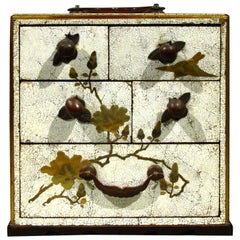
Signed Japanese White Lacquer and Maki-E Lacquer Tansu, Meiji Period
Located in Ottawa, Ontario
The case decorated overall in crackle-glaze white lacquer and fitted with a patinated metal carrying handle over three tiers of small drawers. The first two tiers are comprised of a ...
Category
Antique Late 19th Century Japanese Meiji Lacquer
Materials
Lacquer
Still Thinking About These?
All Recently ViewedMore Ways To Browse
Red Lacquer Ware
Indian Wood Angels
Jade Netsuke
Japanese Lacquer Letter Box
Raj Papier Mache
Stacking Lunch Box
Straits Altar
Tomizo Saratani
Antique Japanese Food Box
Sofu Teshigahara
Tsugaru Nuri
18 Luohan
Asian Plate Display
Japanese Eggshell Lacquer
Japanese Hat Box
Japanese Hokkai Box
Japanese Inkstone
Japanese Lacquer Picnic Set