Want more images or videos?
Request additional images or videos from the seller
1 of 21
Exceptional Japanese Gold Lacquer Tebako 手箱
Box for Personal Accessories
$5,243.02List Price
About the Item
- Dimensions:Height: 4.73 in (12 cm)Width: 8.08 in (20.5 cm)Depth: 10.48 in (26.6 cm)
- Materials and Techniques:
- Place of Origin:
- Period:
- Date of Manufacture:Late Edo period
- Condition:Wear consistent with age and use. Minor losses. The box is in a very good condition with minor traces of age and wear. Some tiny chips from the supports on the interior. Please look at the photos for a clear condition reference.
- Seller Location:Amsterdam, NL
- Reference Number:Seller: N25111stDibs: LU7165230747852
About the Seller
4.8
Vetted Professional Seller
Every seller passes strict standards for authenticity and reliability
Established in 1996
1stDibs seller since 2022
22 sales on 1stDibs
Authenticity Guarantee
In the unlikely event there’s an issue with an item’s authenticity, contact us within 1 year for a full refund. DetailsMoney-Back Guarantee
If your item is not as described, is damaged in transit, or does not arrive, contact us within 7 days for a full refund. Details24-Hour Cancellation
You have a 24-hour grace period in which to reconsider your purchase, with no questions asked.Vetted Professional Sellers
Our world-class sellers must adhere to strict standards for service and quality, maintaining the integrity of our listings.Price-Match Guarantee
If you find that a seller listed the same item for a lower price elsewhere, we’ll match it.Trusted Global Delivery
Our best-in-class carrier network provides specialized shipping options worldwide, including custom delivery.You May Also Like
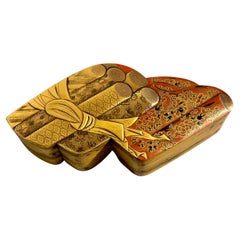
Japanese Lacquer Accessories Box, Tebako, Brocade Design, Meiji Period, Japan
Located in Austin, TX
A very fine Japanese lacquer tebako, box for personal accessories, in the form of rolled bolts of brocade fabric, Meiji Period, late 19th century, Japan.
The box is whimsically shap...
Category
Antique Late 19th Century Japanese Meiji Lacquer
Materials
Softwood, Lacquer
$4,800
H 1.6 in W 6.25 in D 3 in
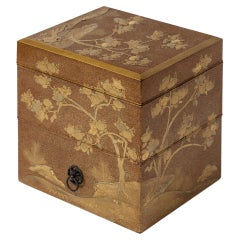
Japanese Lacquered Tebako
Box
Located in PARIS, FR
Tebako box with three compartments in golden and nashi-ji lacquer, decorated with golden, red, and kirigane lacquer, golden persimmon tree leaves, among rocks. The compartments are of increasing size from the top. The decoration is in continuity.
Persimmon has been cultivated in southern China for more than 2500 years and is believed to have been introduced to Japan in the 8th century. The veneer is a tree with very hard wood, similar to ebony. According to a legend, one specimen survived the atomic bombing of Nagasaki on August 9, 1945, close to the epicenter. It is therefore in Japan a symbol of strength and longevity. It is also the national fruit of the country. It is eaten as a traditional dish during New Year's Day celebrations.
Tebako literally means "portable box...
Category
Antique 1860s Japanese Lacquer
Materials
Lacquer
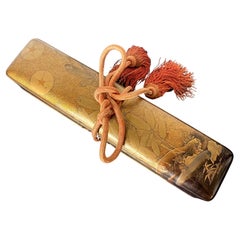
Japanese Lacquered Gold Maki-E Naga Fubako Meiji Period
Located in Atlanta, GA
A Japanese lacquered wood Naga Fubako (a long box used to store document or large scroll painting), circa 19th century Meiji period. The rectangular box features an unusually deep lipped lid with slightly rounded corners, a conforming lower box with bronze medallion rings with tasseled...
Category
Antique 19th Century Japanese Meiji Lacquer
Materials
Wood, Lacquer
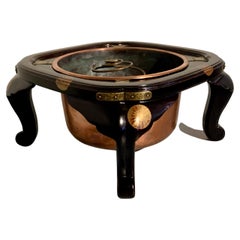
Japanese Lacquer Hibachi with Imperial Chrysanthemum, Meiji Period, Japan
Located in Austin, TX
A simple and elegant Japanese lacquer hibachi stand with imperial chrysanthemum mon and copper liner, now modified as an usubata, late Meiji Period, ci...
Category
Antique Early 1900s Lacquer
Materials
Copper
$975
H 5.5 in W 10 in D 10 in
Japanese Lacquered Maki-e Fubako Edo Period
Located in Atlanta, GA
A Japanese lacquered wood fubako (a box used to store document or small scroll painting), circa second half of 19th century late Edo period. The rectangular box features an unusually deep lipped lid with slightly rounded corners, a conforming lower box that is almost entirely covered by the lid which has two bronze medallion rings with tasseled...
Category
Antique 19th Century Japanese Edo Lacquer
Materials
Wood, Lacquer
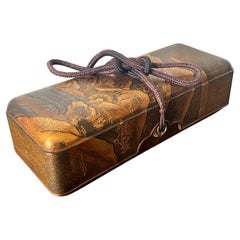
Japanese Lacquered Maki-E Fubako in Kodaiji Style
Located in Atlanta, GA
A rare Japanese lacquered wood fubako decorated in Kodaiji maki-e style circa early 17th century the beginning of the Edo period, possibly early toward the end of the Azuchi-Momoyama period. The rectangular, long and slim box features a deep lipped lid with slightly rounded corners, a conforming lower box with two bronze medallion rings with tasseled...
Category
Antique Early 17th Century Japanese Edo Lacquer
Materials
Wood, Lacquer
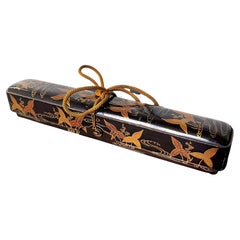
Japanese Lacquered Maki-E Natsume in Kodaiji Style
Located in Atlanta, GA
A Japanese lacquered tea caddy (known as Natsume) with fine Maki-e decoration circa 18-19th century Edo to Meiji period. The large-sized nat...
Category
Antique 19th Century Japanese Meiji Lacquer
Materials
Wood, Lacquer
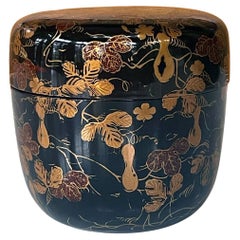
Japanese Meiji Han Koto with Maki-e Lacquer Decoration
Located in Atlanta, GA
A rare Japanese Koto made from carved Paulownia wood and lavishly decorated with lacquer Maki-e circa late 19th century of Meiji Period (1868-1912). The ...
Category
Antique Late 19th Century Japanese Japonisme Lacquer
Materials
Wood
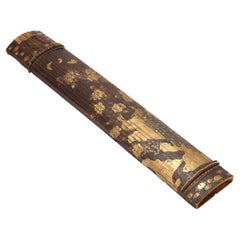
Exquisite Japanese Lacquer Maki-e Suzuribako by Koma Kyūhaku Edo Period
Located in Atlanta, GA
One of the finest Japanese Maki-e Suzuribakos (ink box) we have on offer, the roiro color box showcases an ambient nocturnal scene in which two shakudo inlaid crows perched on the ha...
Category
Antique Early 19th Century Japanese Edo Lacquer
Materials
Stone, Metal
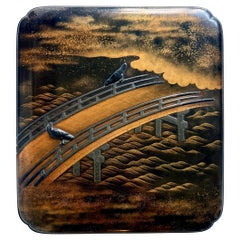
$18,000
H 2 in W 9.25 in D 10.125 in
Japanese Lacquer Tray with Maki-e and Inlay Hara Yoyusai Edo Period
Located in Atlanta, GA
A lovely Japanese lacquer rectangular lacquer tray with a slightly scalloped corner and four L shape supporting feet by one of the most celebrated lacquer artist active in Edo period Hara Yoyusai (1772-1845). Yoyusai lived in Edo (Tokyo) and worked under the patronage of Lord Matsudaira. He operated a large workshop and had a very prolific output of lacquer objects. Most survived pieces being inro...
Category
Antique 19th Century Japanese Japonisme Lacquer
Materials
Wood, Lacquer
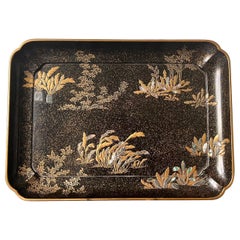
$8,000
H 1.5 in W 11.5 in D 8.25 in
More From This Seller
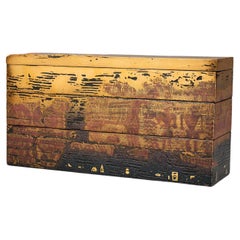
View AllJapanese lacquer oblong storage box by Hiroshi Hayashi 林宏 (1967)
By Hiroshi Hayashi
Located in Amsterdam, NL
An exceptional, oblong lacquer 3-tiered storage box with cover, reminiscent of a bento box, by Hiroshi Hayashi (1967). Covered in shiny gold and black l...
Category
21st Century and Contemporary Japanese Lacquer
Materials
Silk, Wood, Lacquer
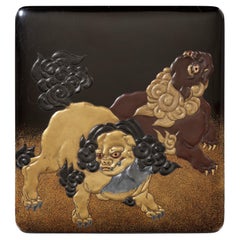
Japanese lacquer suzuri’bako 硯箱 (writing box) with shishi
Hotei design
Located in Amsterdam, NL
A captivating lacquer suzuri’bako (writing box) of rounded rectangular form depicting a pair of shishi (temple lions) and the lucky god Hotei 布袋 on a rôiro...
Category
Antique Early 19th Century Japanese Lacquer
Materials
Gold Leaf, Silver Leaf
Japanese lacquer suzuri’bako 硯箱 (writing box) with ‘Rinpa School’-style design
Located in Amsterdam, NL
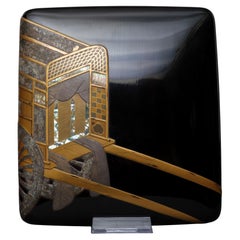
Superb rectangular ‘Rinpa School’-style black lacquer suzuri’bako (writing box) with a slightly arched well-fitted overhanging cover with rounded corners.
The lid with a design of a gosho’guruma (ox-drawn carriage for Heian-era nobles) featuring golden hiramaki-e (low-relief lacquer design) and takamaki-e (high-relief lacquer design), inlays of lead and shiny mother-of-pearl (raden). The design continues along the sides.
The reverse of the lid decorated with two large curving pine trees (matsu) executed in the same way, but also with intricate dots of tiny pieces of inlaid blue mother-of-pearl along the golden trunk.
The interior shaped to hold various scholar’s accessories, including a partially gold lacquered inkstone (suzuri) and a bronze waterdropper (suiteki) shaped like a mythical minogame.
The interior inscribed ‘Hokkyô Kôrin zô’ (Made by Hokkyô Kôrin). Referring to the design being in style of the master Ogata Kôrin, but the actual lacquer artist is unknown. It is a homage to Kôrin by an artist that followed the school of Rinpa.
Including black lacquer wooden tomobako (tomobako).
The Rinpa School was a key part of the Edo period revival of indigenous Japanese artistic interests described by the term yamato-e. Paintings, textiles, ceramics, and lacquerwares were decorated by Rinpa artists with vibrant colours applied in a highly decorative and patterned manner. Favoured themes, which often contained evocative references to nature and the seasons, were drawn from Japanese literature, notably The Tale of Genji, The Tales of Ise...
Category
Antique 19th Century Japanese Lacquer
Materials
Brass, Lead
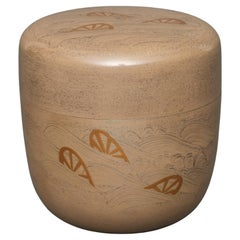
Japanese Ecru Lacquered Natsume 棗
Tea Caddy
with Maki-E of Carriage Wheels
Located in Amsterdam, NL
Uncommon ecru lacquer tea caddy (natsume) with a nice golden hiramaki-e (low-relief design) of cart wheels submerged in a wild swirling stream.
The design ...
Category
20th Century Japanese Lacquer
Materials
Giltwood, Lacquer
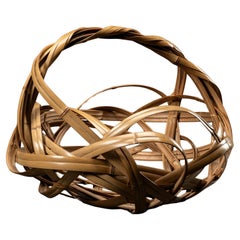
Massive and exceptional Japanese bamboo hanakago 花籠 (ikebana flower basket)
Located in Amsterdam, NL
A massive and exceptional bamboo hanakago (ikebana flower basket). The unusual and modernist basket with a loop handle and showing fine wickerwork in thick strips of bamboo of a ligh...
Category
20th Century Japanese Decorative Baskets
Materials
Bamboo
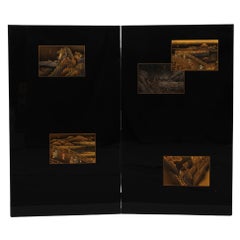
Tall, Japanese lacquer byôbu 屏風 (folding screen) by Mitsuo Takana 高名光夫 (1956)
By Mitsuo Takana
Located in Amsterdam, NL
Refined, tall two-panel byôbu (folding screen) completely adorned with ‘Wajima Ryûsaku’ lacquer by the Nitten award winning artist Mitsuo Takana (1956).
Featuring five refined images inspired by woodblock prints from the famous series ‘Tôkaidô gojûsan tsugi’ (The fifty-three stations of the Tokaido road), like the 1st station Nihonbashi, the 10th station Hakone, and the 21st station Okabe.
The design is executed in hiramaki-e (low-relief lacquer design) in shades of gold, silver, heightened by some multi-coloured details. Set on a shiny black lacquer substrate.
Signed in red lacquer in the lower right corner.
Including original signed & sealed wooden tomobako (storage box). The front with an inscription about the contents as described above. The inside:
‘Friend of the Nitten Exhibition Takana Mitsuo’ - Seal: ‘Hikari’.
‘Lacquer artist Wajima Ryûsaku’ - Seal: ‘Ryûsaku’.
Mitsuo Takana was born 1956 in Wajima, Ishikawa prefecture. He won several awards during exhibitions like: Ishikawa Contemporary Art Exhibition, Japan Artisans' Association Exhibition and the well-known Nitten Exhibition.
Dimensions:
Height 57.48 in/146 cm, Total width 66.92 in/170 cm (2 x 33.46 in/85 cm), Depth 1.10 in/2.8 cm.
Weight 56.21 lb/25.5 kg.
Wajima lacquerware...
Category
Late 20th Century Japanese Paintings and Screens
Materials
Wood, Giltwood, Lacquer
Still Thinking About These?
All Recently ViewedMore Ways To Browse
Japanese Lacquer Boxes
Silver Antique Japanese Boxes Silver Boxes
Japanese Gold Lacquer Box
Chinese Export Black Lacquer Gilt
Japanese Mother Of Pearl Art
Red Cinnabar
Chinese Cinnabar
Vintage Lacquer
Antique Japanese Tray
Asian Black Lacquer Pearl Furniture
Chinese Cinnabar Furniture
Carved Cinnabar
Cinnabar Lacquer Furniture
Antique Chinese Cinnabar
Japanese Lacquered Tray
Chinese Carved Cinnabar
Japanese Lacquerware
Red Lacquer Cinnabar