Want more images or videos?
Request additional images or videos from the seller
1 of 19
Japanese
double gourd
lacquer suzuri’bako (writing box) by Hara Yôyûsai 原羊遊斎
$7,744.05List Price
About the Item
- Creator:Hara Yôyûsai (Artist)
- Dimensions:Height: 9.45 in (24 cm)Width: 8.67 in (22 cm)Depth: 1.78 in (4.5 cm)
- Materials and Techniques:
- Place of Origin:
- Period:
- Date of Manufacture:Late Edo period (Early 19th century)
- Condition:Wear consistent with age and use. Minor losses. Condition: In a good condition with wear and extensive crackling to the lacquer, with small associated losses. Please look at the photos for a condition reference.
- Seller Location:Amsterdam, NL
- Reference Number:Seller: 832201stDibs: LU7165237062792
About the Seller
4.8
Vetted Professional Seller
Every seller passes strict standards for authenticity and reliability
Established in 1996
1stDibs seller since 2022
22 sales on 1stDibs
Authenticity Guarantee
In the unlikely event there’s an issue with an item’s authenticity, contact us within 1 year for a full refund. DetailsMoney-Back Guarantee
If your item is not as described, is damaged in transit, or does not arrive, contact us within 7 days for a full refund. Details24-Hour Cancellation
You have a 24-hour grace period in which to reconsider your purchase, with no questions asked.Vetted Professional Sellers
Our world-class sellers must adhere to strict standards for service and quality, maintaining the integrity of our listings.Price-Match Guarantee
If you find that a seller listed the same item for a lower price elsewhere, we’ll match it.Trusted Global Delivery
Our best-in-class carrier network provides specialized shipping options worldwide, including custom delivery.You May Also Like
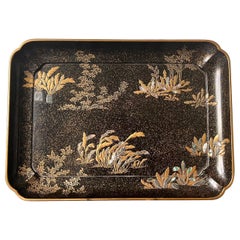
Japanese Lacquer Tray with Maki-e and Inlay Hara Yoyusai Edo Period
Located in Atlanta, GA
A lovely Japanese lacquer rectangular lacquer tray with a slightly scalloped corner and four L shape supporting feet by one of the most celebrated lacquer artist active in Edo period Hara Yoyusai (1772-1845). Yoyusai lived in Edo (Tokyo) and worked under the patronage of Lord Matsudaira. He operated a large workshop and had a very prolific output of lacquer objects. Most survived pieces being inro...
Category
Antique 19th Century Japanese Japonisme Lacquer
Materials
Wood, Lacquer
$8,000
H 1.5 in W 11.5 in D 8.25 in
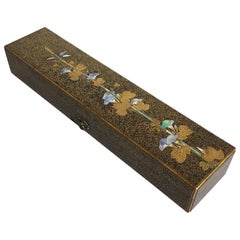
Japanese Edo Period Igarashi School Long Lacquer Box, Tanzaku-Bako
Located in Austin, TX
A stunning Japanese Edo period lacquer tanzakubako, box for poem cards, late 18th-early 19th century, Edo Period, Japan.
Attributed to the Igarashi School, this box is masterfully ...
Category
Antique Early 19th Century Japanese Edo Lacquer
Materials
Mother-of-Pearl, Lacquer
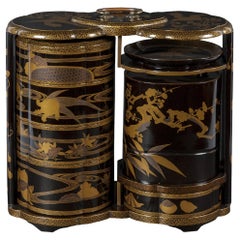
Fine Japanese Black and Gold Lacquer Sageju-Bako - Picnic Box
Located in PARIS, FR
Black and gold lacquer sageju-bako (picnic box) decorated with floral motifs in hiramaki-e. It includes a sake bottle, a four-compartment box with nashi-ji lacquer inside, a simple tray and a hollow tray. At the top, there is a bronze handle for transport.
The sageju-bako is divided into four superimposed boxes for food on the left; a simple tray, a sake bottle and a hollow tray on the right. They are in the shape of a plum blossom.
On the top, on both sides a phoenix. The phoenix (hôo) has an imperial and solar symbolism. This auspicious bird also embodies virtues taken from the teachings of Confucius (such as goodness, righteousness and wisdom).
The left boxes are patterned with turtles, plum tree, bamboo, cherry blossoms, water plantains near rivers. The two trays on the right have a shell and seaweed pattern. The sake bottle is decorated with a plum tree and bamboo.
On the sides, calabash decoration. Borders in saya (or sayagata) pattern, composed of Chinese swastikas...
Category
Antique Early 19th Century Japanese Lacquer
Materials
Lacquer
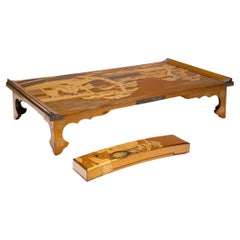
Japanese Meiji Gilt Lacquer Writing Desk
Poem Box
Located in Chicago, IL
With intricate construction and exquisite decoration, this fine tabletop writing set is a masterpiece of Japanese lacquerware. The matching set includes a writing table (bundai) and poem box (tanzaku bako), both decorated with gilt lacquer in the style of takamaki-e and hiramaki-e urushi lacquer.
Framed by everted ends, the lacquered table top is masterfully worked, depicting a robed man seated on a veranda within an idyllic mountain-and-water landscape. Swirling clouds drift overhead and pine trees bend towards the sky, formed of raised lacquer (takamaki-e) and mother of pearl inlay (raden). Dark lacquer at the corners imitate metal hardware and the sculptural corner legs are decorated with raised motifs of maple leaves.
The writing table includes a matching poem box (tanzaku bako), used for storing paper cards of painted calligraphy and poetry. The lid is similarly decorated in shimmering gilt lacquer with a raised design of a fine carriage beneath a pine tree, draped in cloths and shaded by bamboo blinds...
Category
Early 20th Century Japanese Meiji Lacquer
Materials
Mother-of-Pearl, Wood
Rare Japanese Lacquer Writing Box Suzuribako Meiji Period
Located in Atlanta, GA
A Japanese Lacquer writing box Suzuribako Meiji Period (1868-1912), likely circa late 19th century. This suzuribako is one of the most unusual boxe...
Category
Antique 19th Century Japanese Japonisme Lacquer
Materials
Lacquer
Japanese Antique Lacquer Maki-E Miniature Hasami-Bako with Copper Mounts
Located in Atlanta, GA
A Japanese lacquered box with lid in the shape of a miniature Hasami-Bako (traveling chest) circa late 18 to early 19th century of the Edo period....
Category
Antique Early 19th Century Japanese Japonisme Lacquer
Materials
Copper
$3,800
H 3.5 in W 8 in D 3.25 in
Japanese Lacquer Writing Box, Suzuribako, Edo Period, 18th Century, Japan
Located in Austin, TX
An exceptionally fine and unusual Japanese lacquer writing implements box, suzuribako, in the form of a zither, koto, Edo Period, 18th century, Japan. With a modern wood storage box,...
Category
Antique 18th Century Japanese Edo Lacquer
Materials
Gold, Silver, Copper
$18,000
H 1.5 in W 8 in D 3 in
Japanese Lacquer Box
Located in New Orleans, LA
This exquisite Meiji-period lacquer document box known as a ryoshibako showcases the meticulous artistry of maki-e, a technique of raised lacquer decoration. Adorned with gold and vi...
Category
Antique 19th Century Asian Meiji Lacquer
Materials
Gold
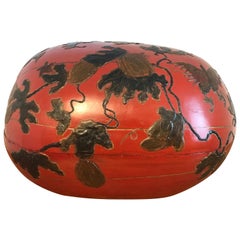
Huge Japanese Red Lacquerware Gourd Motif Box
Located in West Palm Beach, FL
Huge Japanese red lacquerware gourd motif box, decorated in relief with Japanese gourds suspended from leafy branches and scrolling vines.
Category
Early 20th Century Japanese Meiji Lacquer
Materials
Lacquer
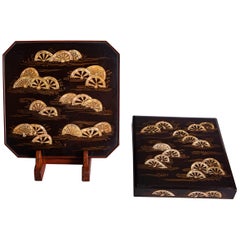
18th Century Japanese Lacquer Writing Box and Tray Set
Located in Hudson, NY
Wheels Submerged in flowing water motif, believed to be a subject popular in samurai families. Example of the same subject matter in Tokyo National Museum.
Category
Antique 18th Century Japanese Lacquer
More From This Seller
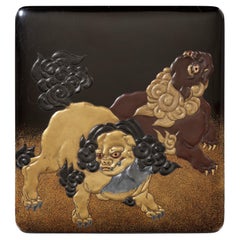
View AllJapanese lacquer suzuri’bako 硯箱 (writing box) with shishi
Hotei design
Located in Amsterdam, NL
A captivating lacquer suzuri’bako (writing box) of rounded rectangular form depicting a pair of shishi (temple lions) and the lucky god Hotei 布袋 on a rôiro...
Category
Antique Early 19th Century Japanese Lacquer
Materials
Gold Leaf, Silver Leaf
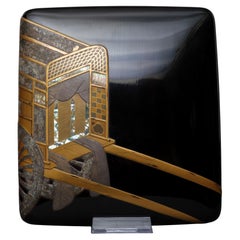
Japanese lacquer suzuri’bako 硯箱 (writing box) with ‘Rinpa School’-style design
Located in Amsterdam, NL
Superb rectangular ‘Rinpa School’-style black lacquer suzuri’bako (writing box) with a slightly arched well-fitted overhanging cover with rounded corners.
The lid with a design of a gosho’guruma (ox-drawn carriage for Heian-era nobles) featuring golden hiramaki-e (low-relief lacquer design) and takamaki-e (high-relief lacquer design), inlays of lead and shiny mother-of-pearl (raden). The design continues along the sides.
The reverse of the lid decorated with two large curving pine trees (matsu) executed in the same way, but also with intricate dots of tiny pieces of inlaid blue mother-of-pearl along the golden trunk.
The interior shaped to hold various scholar’s accessories, including a partially gold lacquered inkstone (suzuri) and a bronze waterdropper (suiteki) shaped like a mythical minogame.
The interior inscribed ‘Hokkyô Kôrin zô’ (Made by Hokkyô Kôrin). Referring to the design being in style of the master Ogata Kôrin, but the actual lacquer artist is unknown. It is a homage to Kôrin by an artist that followed the school of Rinpa.
Including black lacquer wooden tomobako (tomobako).
The Rinpa School was a key part of the Edo period revival of indigenous Japanese artistic interests described by the term yamato-e. Paintings, textiles, ceramics, and lacquerwares were decorated by Rinpa artists with vibrant colours applied in a highly decorative and patterned manner. Favoured themes, which often contained evocative references to nature and the seasons, were drawn from Japanese literature, notably The Tale of Genji, The Tales of Ise...
Category
Antique 19th Century Japanese Lacquer
Materials
Brass, Lead
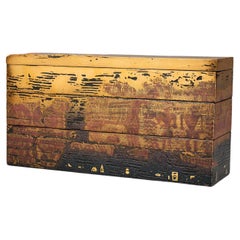
Japanese lacquer oblong storage box by Hiroshi Hayashi 林宏 (1967)
By Hiroshi Hayashi
Located in Amsterdam, NL
An exceptional, oblong lacquer 3-tiered storage box with cover, reminiscent of a bento box, by Hiroshi Hayashi (1967). Covered in shiny gold and black l...
Category
21st Century and Contemporary Japanese Lacquer
Materials
Silk, Wood, Lacquer
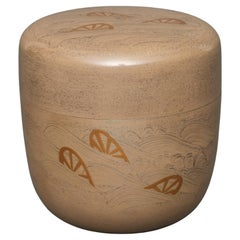
Japanese Ecru Lacquered Natsume 棗
Tea Caddy
with Maki-E of Carriage Wheels
Located in Amsterdam, NL
Uncommon ecru lacquer tea caddy (natsume) with a nice golden hiramaki-e (low-relief design) of cart wheels submerged in a wild swirling stream.
The design ...
Category
20th Century Japanese Lacquer
Materials
Giltwood, Lacquer
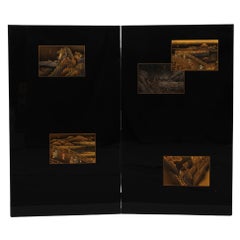
Tall, Japanese lacquer byôbu 屏風 (folding screen) by Mitsuo Takana 高名光夫 (1956)
By Mitsuo Takana
Located in Amsterdam, NL
Refined, tall two-panel byôbu (folding screen) completely adorned with ‘Wajima Ryûsaku’ lacquer by the Nitten award winning artist Mitsuo Takana (1956).
Featuring five refined images inspired by woodblock prints from the famous series ‘Tôkaidô gojûsan tsugi’ (The fifty-three stations of the Tokaido road), like the 1st station Nihonbashi, the 10th station Hakone, and the 21st station Okabe.
The design is executed in hiramaki-e (low-relief lacquer design) in shades of gold, silver, heightened by some multi-coloured details. Set on a shiny black lacquer substrate.
Signed in red lacquer in the lower right corner.
Including original signed & sealed wooden tomobako (storage box). The front with an inscription about the contents as described above. The inside:
‘Friend of the Nitten Exhibition Takana Mitsuo’ - Seal: ‘Hikari’.
‘Lacquer artist Wajima Ryûsaku’ - Seal: ‘Ryûsaku’.
Mitsuo Takana was born 1956 in Wajima, Ishikawa prefecture. He won several awards during exhibitions like: Ishikawa Contemporary Art Exhibition, Japan Artisans' Association Exhibition and the well-known Nitten Exhibition.
Dimensions:
Height 57.48 in/146 cm, Total width 66.92 in/170 cm (2 x 33.46 in/85 cm), Depth 1.10 in/2.8 cm.
Weight 56.21 lb/25.5 kg.
Wajima lacquerware...
Category
Late 20th Century Japanese Paintings and Screens
Materials
Wood, Giltwood, Lacquer
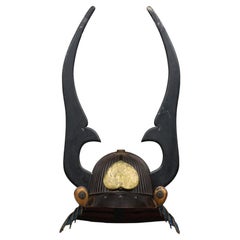
Japanese Edo-Period 62-Plate Kabuto 兜
Helmet
with Long Lacquer Wakidate
Located in Amsterdam, NL
An old and exceptional completely lacquered akoda-nari suji’bachi kabuto (helmet with raised ridges) with a bronze maedate (decorative front piece) shaped like a spade, and mounted b...
Category
Antique 18th Century Japanese Antiquities
Materials
Bronze, Copper, Iron
Still Thinking About These?
All Recently ViewedMore Ways To Browse
Japanese Lacquer Boxes
Antique Writing Box
Double Gourd
Silver Antique Japanese Boxes Silver Boxes
Gourd Art
Flying Cranes
Japanese Gold Lacquer Box
Japanese Gourd
Water Dropper
Antique Water Dropper
Lacquer Writing Box
Japanese Writing Box
Antique Hara
Ogata Korin
Antique Japanese Writing Box
Japanese Bako
Cinnabar Lacquer Furniture
Antique Chinese Cinnabar