1 of 8
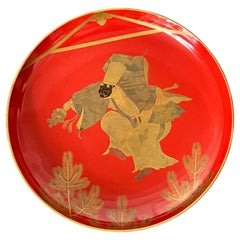
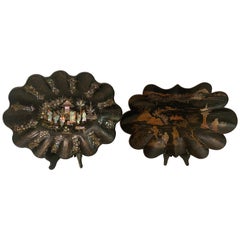
Japanese Gold Lacquer Wall Plate Onlaid Ivory Mother-of-Pearl
$6,846.96List Price
About the Item
- Dimensions:Height: 5.12 in (13 cm)Diameter: 23.23 in (59 cm)
- Style:Other (Of the Period)
- Materials and Techniques:
- Place of Origin:
- Period:
- Date of Manufacture:1860-1880
- Condition:Minor structural damages. There have been several minor repairs to the rim and one slightly bigger please see photos.
- Seller Location:Brighton, GB
- Reference Number:1stDibs: LU262737041673
Authenticity Guarantee
In the unlikely event there’s an issue with an item’s authenticity, contact us within 1 year for a full refund. DetailsMoney-Back Guarantee
If your item is not as described, is damaged in transit, or does not arrive, contact us within 7 days for a full refund. Details24-Hour Cancellation
You have a 24-hour grace period in which to reconsider your purchase, with no questions asked.Vetted Professional Sellers
Our world-class sellers must adhere to strict standards for service and quality, maintaining the integrity of our listings.Price-Match Guarantee
If you find that a seller listed the same item for a lower price elsewhere, we’ll match it.Trusted Global Delivery
Our best-in-class carrier network provides specialized shipping options worldwide, including custom delivery.You May Also Like
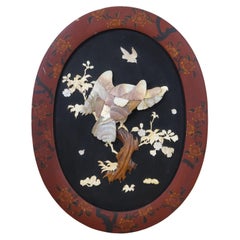
Antique Japanese Meiji Shibayama Lacquered Mother of Pearl Eagle Wall Plaque 21"
Located in Dayton, OH
Early 20th century, Meiji period shibayama wall plaque depicting a mother of pearl eagle perched on a flowering tree, set on a black lacquer background, with a reddish brown oval frame painted...
Category
Early 20th Century Japanese Meiji Lacquer
Materials
Mother-of-Pearl, Hardwood, Lacquer
$175 Sale Price
30% Off
H 21 in W 16.5 in D 1 in
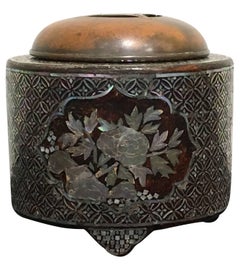
Japanese Edo Period Lacquer and Mother-of-Pearl Embellished Stoneware Koro
Located in Austin, TX
A highly unusual Japanese crackle glazed koro (incense burner or censer), lacquered and inlaid with mother-of-pearl embellishment, signed Gyokusen, Ed...
Category
Antique 19th Century Japanese Edo Scholar s Objects
Materials
Copper
17th Century Pair of Chinese Silver Lacquer Plates with Mother of Pearl
Located in Brea, CA
Pair of Chinese silver, lacquer, and mother of pearl plates from the 17th century. A matching pair of ornamental antique Chinese plates, the faces ...
Category
Antique 17th Century Chinese Qing Lacquer
Materials
Lacquer
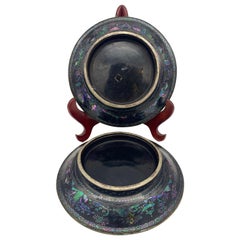
Two Japanese Mother of Pearl Wood Dishes
Located in Brea, CA
Two Japanese mother of pearl wood dishes, very beautiful pieces. Measures: Large one H 2” x L 13.5” x W 10”.
Category
Early 20th Century Japanese Japonisme Antiquities
Materials
Lacquer
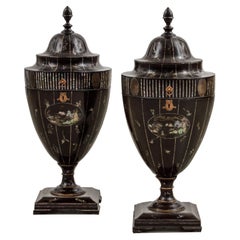
Pair of Japanese Lacquer and Mother-of-Pearl Inlaid Knife Urns, circa 1800-1815
Located in Amsterdam, NL
A rare pair of Kyoto-Nagasaki style lacquer and mother-of-pearl inlaid knife urns
Edo period, early 19th century
Measures: Height 71 x diameter 30 cm
?Formed as urns with vertically lifting covers and elongated finials, revealing fitted green velvet lined interiors for knives, decorated overall with birds, flowering stems, faux-fluting and oval panels with landscapes. The square plinth is raised on four bracket feet. Inside the lifting cover of one of the urns are Japanese characters, supposedly indications of some code by the craftsman.
A closely related knife urn, now in the collection of the Peabody Essex Museum, Salem (inv. E 73115), was acquired in Nagasaki by Captain Samuel Gardner Derby of the Margareth of Salem in 1801. Captain Gardner Derby traded in Nagasaki under charter from the VOC (Vereenigde Oostindische Compagnie), the Dutch East India Company. Between 1797 and 1814 Holland was occupied by the French and from 1811 until 1816 Java by
the English. During these periods practically no Dutch shipping was possible between Holland and Batavia (Jakarta) or between Batavia (Jakarta) and Nagasaki. To maintain a minimum amount of shipping between Batavia (Jakarta) and Nagasaki, between 1797 and 1807, the VOC chartered mainly American ships. American captains and officers ordered and bought mainly lacquered furniture in an American-English style, completely different from what the Dutch up till then had ordered. The present knife urns were possibly also ordered and acquired by Captain Gardner Derby during his stay in Deshima/Nagasaki in 1801.
Another similarly neoclassical shaped knife urn in the collection of the Ashmolean Museum Oxford (inv. 1996.17) appears to be signed by woodworker Kiyotomo koreo tsukuru (Kiyomoto made this). The same name, together with an address in the Sanjo-Teramachi District of Kyoto, has been found inside a fragmentary urn in a private collection. This is an indication that European-style furniture was not only lacquered in Japan but made there as well. This undoubtedly is not only true for knife-urns, but all European- style furniture lacquered in Japan after circa 1800 was made by Japanese furniture makers...
Category
Antique Early 19th Century Japanese Anglo-Japanese Lacquer
Materials
Brass
$57,196 / set
Free Shipping
H 27.96 in Dm 11.82 in
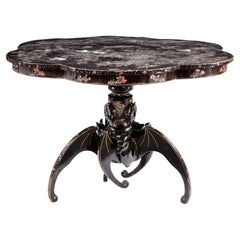
Mother-of-Pearl Black Lacquer Japanese Export Table with Feet Shaped as Bats
Located in Amsterdam, NL
A Japanese export lacquer tripod table with feet shaped as bats
Nagasaki, 1850-1860
H. 73 x diam. 108 cm
The six-lobbed top is decorated with reverse-painted mother-of-pearl in a sprawling motif of plum blossom, bamboo, and peonies, surrounded by fluttering sparrows enhanced by details in maki-e.
The table, made to appeal to a foreign audience, incorporates a curious mixture of seasonal references. In addition to the decoration of foliage from late winter and spring, the column is decorated with grapes and a rabbit pounding rice, both Japanese motifs for autumn and the month of September. The feet, shaped like bats that almost appear to wake up from hibernation, symbolise luck and happiness in Japan.
The present flamboyant Nagasaki-style table is depicted in the Asada workshop drawings of 1856. These drawings, titled Aogai makie hiinagata hikae (memorandum of designs for lacquer with inlaid pearl...
Category
Antique 19th Century Japanese Lacquer
Materials
Lacquer
$53,621
H 28.75 in Dm 42.52 in
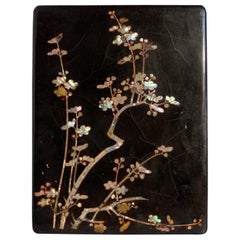
Japanese Momoyama Period Black Lacquer and Mother of Pearl Box, 16th Century
Located in Austin, TX
A fine and unusual Japanese black lacquer and mother of pearl inlaid box, Momoyama Period, 16th century, Japan.
The large box and cover featu...
Category
Antique 16th Century Japanese Edo Lacquer
Materials
Lacquer, Abalone
$9,800
H 4 in W 11 in D 15 in
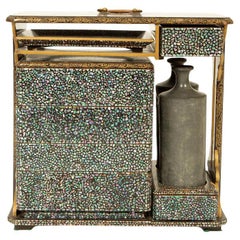
Antique 20th Century Japanese Mother-of-Pearl Bento Box
Located in LOS ANGELES, CA
Beautiful and antique Japanese Mother-of-Pearl Bento Box with full array of components included. Unique iridescent lacquer finish throughout, with black & gold hand painted details a...
Category
20th Century Japanese Other Furniture
Materials
Mother-of-Pearl
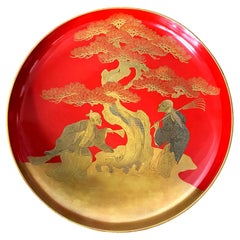
Japanese Lacquer Maki-e Plate of Takasago Story
Located in Atlanta, GA
A large circular plate with a short stem base in Vermillion lacquer color from Late Meiji Period circa end of 19th century to early 20th century. ...
Category
Antique 19th Century Japanese Meiji Lacquer
Materials
Lacquer
Japanese Lacquer Maki-e Plate of Masked Dancer
Located in Atlanta, GA
A large circular plate with a short stem base in Vermillion lacquer color from Late Meiji Period circa end of 19th century to early 20th century. ...
Category
Antique 19th Century Japanese Meiji Lacquer
Materials
Lacquer