Cord Lacquer
to
2
2
2
2
3,250
434
252
114
45
2
2
2
2
2
2
Material: Cord
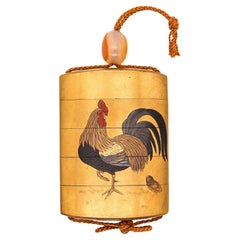
Japan 1810 Kajikawa Edo Period Five Drawer Inro Lacquered Gilt Wood With Rooster
Located in Miami, FL
Japanese Inro from the Edo period (1615-1868) created by Kajikawa.
Beautiful Inro, created in Japan by one of the Kajikawa family during the Edo period (1615-1868), circa 1810. Has been carefully crafted in carved precious wood with applications of gilding maki-e and decorated with Japonism patterns. All dan trays are attached together with a himo cord. The detailed craftsmanship was a true pleasure to behold.
Period: Edo period (1615-1868). Shogunate.
Approximate Date: 1790-1810
Motif: A family of birds consisting of a cockerel, the hen and three chicks.
Drawers: Five.
Shape: Rectangular navette.
Technique: Carved wood, lacquer and decorated in iroe-hiramaki-e on a gold ground.
Ojime: 15mm 20mm, oval carved from natural translucent agate.
Netsuke: None
Weight: 47.70 Grams.
Measurements: Inro is 78 mm by 55 mm by 18 mm (3.07 x 2.17 x 0.71 Inches).
Signatures: Kajikawa Saku, in the underside with the signature KAJIKAWA. By a member of the Kajikawa family, signed Kajikawa 梶川 Japan, late 18th century to early 19th century, Edo period (1615-1868).
The Kajikawa family
Kajikawa family, flourished in the 19th century, they was Japanese lacquerware artists whose school in Edo (now Tokyo) flourished for more than 200 years. This family is perhaps the most famous of all the dynasties of Japanese lacquer artists, and certainly the name most often found on inro. The family is said to have been founded by Hikobei at Edo in the early 17th century, although some claim that the family’s great reputation really stemmed from his son and pupil Kyujiro. In any event, Hikobei worked for the shogunate, as did his successors until well into the 19th century. Kijirō excelled in designing particularly delicate lacquer inrō, portable medicine cases...
Category
1810s Japanese Edo Antique Cord Lacquer
Materials
Agate, Gold

$3,337 Sale Price
25% Off
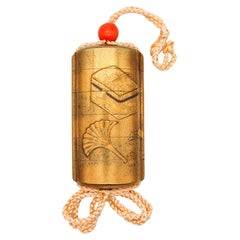
Japan 1800 Edo Period Six Drawer Inro In Lacquered Gilt Wood With Utensils
Located in Miami, FL
Japanese Inro from the Edo Period (1603-1867).
Beautiful Inro, created in Japan during the Edo period (Shogunate), circa 1800. It was carefully crafted in carved precious wood with ...
Category
Early 1800s Japanese Edo Antique Cord Lacquer
Materials
Coral
$2,437 Sale Price
25% Off
Related Items
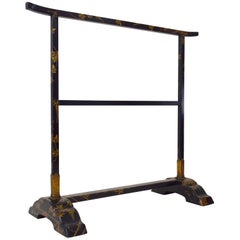
Elegant Japanese Edo Period Rack
Located in New York, NY
This refined object dates to the first half of the 19th century, and was probably used for obi, kimono sashes, which were hung over it. The gold decorations on the black-lacquered g...
Category
1830s Japanese Edo Antique Cord Lacquer
Materials
Lacquer
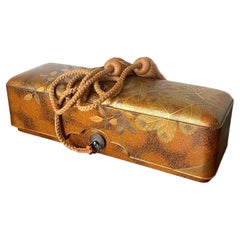
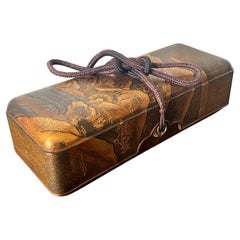
Japanese Lacquer Maki-E Scroll Box Fubako by Kansonsai Edo Period
Located in Atlanta, GA
A Japanese lacquered wood fubako (a box to store document or small scroll painting) circa late 18th century of Edo period. The rectangular box features a deep lid with rounded corners and recessed mid-edge and a lower box with two bronze medallion rings and tasseled silk ties. The surface of the fubako was elaborately decorated with hiramaki-e and a low takamaki-e on a mottled Mura-nashiji background. The motifs on the lid depict branches of Japanese pine with finely rendered needles on the lower part; on the upper part, it showcases fruited persimmon branches. Two different shades of gold fundame were used to contrast the design and augmented by scattered gold kirigane to highlight some of the leaves. The design continues and cascades down to all sides of the lid as well as the walls of the box. The two bronze medallions appear original to the box and the silk ties show significant fading from the age. This Fine fubako is signed on the lower wall "Kanshosai" in Kanji with a kao mark. All the trims were finished in gold fundame and the interiors a dense nashiji in gold.
Kanshosai is the mark of the distinguished lacquer artist Lizuka Toyo I who also signed his work "Toyosai". He was active in the second half of the 18th century during Edo period, employed by Hachisuka Shigeyoshi (1738-1801), daimyo of Awa on Shikoku Island. Although most survived work bearing his marks are inros, he was also known to decorated trays and other larger objects...
Category
Late 18th Century Japanese Edo Antique Cord Lacquer
Materials
Wood, Lacquer
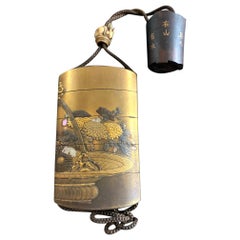
Antique Japanese Inro by Shigehide Edo Period
Located in Atlanta, GA
This exquisite four-case lacquered inro was dated to the latter part of 18th century to early 19th century (Edo period) and made by Shigehide. The opposite sides of the inro together features a lavish flower arrangement in a bamboo basket (ikebana). The detailed craftmanship was a true pleasure to behold. Mostly Takamaki-e (high relief) were used to texturize the delicate petals of the chrysanthemums, on which different shades of gold were used to create contrast. Raden (mother of pearl) shells were also used to highlight some leaves, rendering the piece an interesting balance of color and material. The interior was completed in a mottled gold finish. It was signed Shigehide on the bottom with a Kao. There is a small carved rabbit ojime bead...
Category
Late 18th Century Japanese Japonisme Antique Cord Lacquer
Materials
Wood, Lacquer
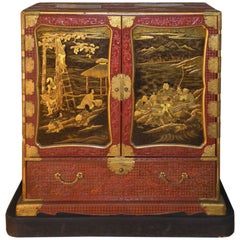
Japanese Lacquer and Cinnabar "Samurai" Cabinet, Inaba Family, Edo Period
Located in Troy, NY
Exceptionally large and rare lacquer cabinet. According to the heraldry, visible on the headgear in one of the panels, it was made for the Inaba family, a high ranking Daimyo family,...
Category
Late 19th Century Japanese Edo Antique Cord Lacquer
Materials
Bronze
$385,000
H 38 in W 36 in D 21 in
Japanese Lacquered Maki-e Fubako Edo Period
Located in Atlanta, GA
A Japanese lacquered wood fubako (a box used to store document or small scroll painting), circa second half of 19th century late Edo period. The rectangular box features an unusually deep lipped lid with slightly rounded corners, a conforming lower box that is almost entirely covered by the lid which has two bronze medallion rings with tasseled...
Category
19th Century Japanese Edo Antique Cord Lacquer
Materials
Wood, Lacquer
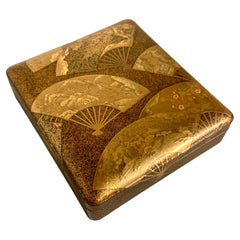
Japanese Maki-e Lacquer Document Box, Edo Period, early 19th Century, Japan
Located in Austin, TX
A spectacular Japanese maki-e lacquer lidded box, possibly a writing box, suzuribako, decorated with images of folding fans, ogi, Edo Period, earl...
Category
Early 19th Century Japanese Edo Antique Cord Lacquer
Materials
Coral
$12,000
H 2.5 in W 9 in D 10 in
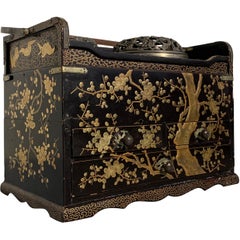
Japanese Lacquer Smoking Box, Tabako Bon, Edo Period, 19th Century
Located in Austin, TX
A very fine Japanese maki-e lacquer decorated tabako bon, or smoking box, late Edo Period, mid-19th century, Japan.
The elegant smoking box of black lacquer decorated with a wonderful gold lacquer takamaki-e design of a gnarled and elegantly twisted plum tree with branches in full bloom. A border of golden cranes in flight to the top.
The smoking box, called a tabako bon, is comprised of an open section at the top with inset with two cylindrical metal canisters...
Category
Mid-19th Century Japanese Edo Antique Cord Lacquer
Materials
Lacquer
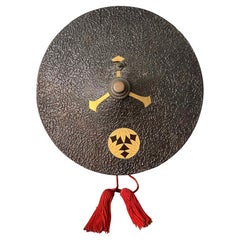
Japanese Lacquered Samurai Jingasa Hat Edo Period
Located in Atlanta, GA
A bespoken Japanese historical hat known as Jinggasa (militant hat) that was worn by samurai in Edo period (1603-1868) circa 18-19th century. There were several subtypes of Jingasa a...
Category
19th Century Japanese Japonisme Antique Cord Lacquer
Materials
Wood, Lacquer
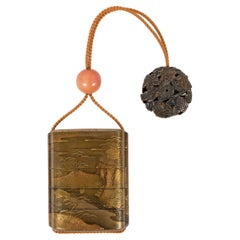
Japanese inro of the edo period adorned with a landscape houses near a lake
Located in PARIS, FR
Inrō with four gold lacquer compartments, decorated with a lake landscape. Accompanied by a bronze ryusa manju.
Small boxes formed of compartments that fit one on top of the other, i...
Category
Late 18th Century Japanese Edo Antique Cord Lacquer
Materials
Gold
$6,652
H 2.6 in W 2.17 in D 0.79 in
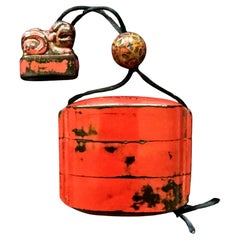
Rare Japanese Inro Netsuke and Omije with Negoro Red Lacquer Edo Period
Located in Atlanta, GA
A Japanese three-case inro with stringed carved netsuke and bead ojime from early Edo period circa 17th century. The trio accoutrement is covered in red Negoro lacquer and displays w...
Category
17th Century Japanese Edo Antique Cord Lacquer
Materials
Wood, Lacquer
$4,800
H 2.5 in W 2.8 in D 0.8 in
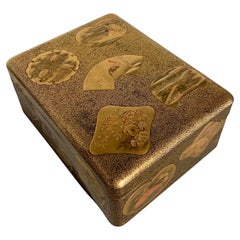
Large Japanese Lacquer Document Box, Ryoshibako, Edo/Meiji period, Japan
Located in Austin, TX
A large and magnificently decorated Japanese lacquer document box, ryoshibako, signed Umeboshi/Baikyo, late Edo or early Meiji Period, mid 19th century, Japan.
The large document box, ryoshibako, of tall, rectangular shape with rounded corners, and fitted with an inrobuta (flush-fitting) cover with beveled edges. The exterior of this exquisite box is decorated all over with fifteen different raised reserves shaped as uchiwa (paddle) fans against a lush and intricate krikane ground imitating shagreen.
The uchiwa shaped reserves all of takamaki-e, and exquisitely painted with designs of animals, flowers, and landscapes in silver, gold, maki-e, hiramaki-e, and takamaki-e, with kirikane, nashiji, and polychrome embellishments, upon gold lacquer fudame grounds.
The interior of the lid is nothing short of spectacular, featuring a large design of a magnificent and beautifully detailed rooster and hen with chicks gathered around a lazy stream. Large stalks of chrysanthemum bloom behind them. All against an ethereal nashiji ground.
The cover of the box features five reserves:
1. Three minogame (turtles with long tails), symbolizing longevity
2. "Narihira Crossing the Sumida" from The Tales of Ise...
Category
1860s Japanese Meiji Antique Cord Lacquer
Materials
Softwood, Lacquer
$27,500
H 5.75 in W 10 in D 13.25 in
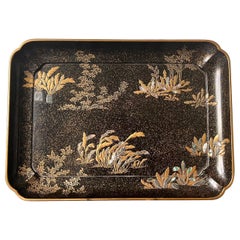
Japanese Lacquer Tray with Maki-e and Inlay Hara Yoyusai Edo Period
Located in Atlanta, GA
A lovely Japanese lacquer rectangular lacquer tray with a slightly scalloped corner and four L shape supporting feet by one of the most celebrated lacquer artist active in Edo period Hara Yoyusai (1772-1845). Yoyusai lived in Edo (Tokyo) and worked under the patronage of Lord Matsudaira. He operated a large workshop and had a very prolific output of lacquer objects. Most survived pieces being inro...
Category
19th Century Japanese Japonisme Antique Cord Lacquer
Materials
Wood, Lacquer
$8,000
H 1.5 in W 11.5 in D 8.25 in
Previously Available Items
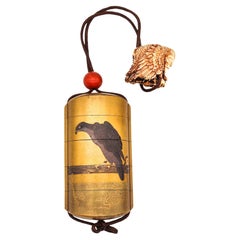
Japan 1810 Edo Period Takamaki-e Five Drawer Inro In Lacquered Wood With A Hawk
Located in Miami, FL
Japanese Inro with a Hawk from the Edo Period (1603-1867).
Beautiful Inro, created in Japan during the Edo period (Shogunate), circa 1810. It was carefully crafted in carved preciou...
Category
1810s Japanese Edo Antique Cord Lacquer
Materials
Coral, Silver
H 3.5 in W 1.62 in D 1.5 in
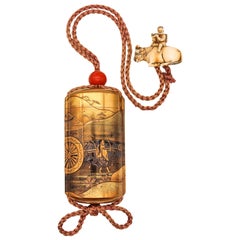
Japan 1830 Edo Period Six Drawer Inro In Lacquered Gilt Wood With A Carriage
Located in Miami, FL
Japanese Inro from the Edo Period (1603-1867).
Beautiful Inro, created in Japan during the Edo period (Shogunate), circa 1830. It was carefully crafted in carved precious wood with applications of lacquer and decorated with orientalism patterns. All dan trays are attached together with a himo cord. The detailed craftsmanship was a true pleasure to behold.
Period: Edo 1606-1867, Shogunate.
Approximate Date: 1830
Motif: An elaborated three-dimensional royal carriage with a silvered bull and a richly dressed court companion. All surrounded by a road and sinuous mountainous landscape with trees and plants.
Drawers: Six.
Shape: Oval
Technique: Carved wood, Lacquer, hiramaki-e, takamaki-e, Gilding, Silvered.
Ojime: 15mm, round sphere carved from natural translucent carnelian
Netsuke: Patinated carved seated child playing a shakuhachi (flute) in a resting bull, signed.
Weight: 67.60 Grams.
Measurements: Inro is 92 mm by 27 mm by 38 mm (3.60 x 1.06 x 1.50 Inches).
The Edo Period
The Edo period or Tokugawa period is the period between 1603 and 1867 in the history of Japan, when Japan was under the rule of the Tokugawa shogunate and the country's 300 regional daimyo. Emerging from the chaos of the Sengoku period, the Edo period was characterized by economic growth, strict social order, isolationist foreign policies, a stable population, perpetual peace, and popular enjoyment of arts and culture. The period derives its name from Edo (now Tokyo), where on March 24, 1603, the shogunate was officially established by Tokugawa Ieyasu. The period came to an end with the Meiji Restoration and the Boshin War, which restored imperial rule to Japan. The Tokugawa (or Edo) period brought 250 years of stability to Japan. The political system evolved into what historians call bakuhan, a combination of the terms bakufu and han (domains) to describe the government and society of the period.[3] In the bakuhan, the shōgun had national authority and the daimyo had regional authority. This represented a new unity in the feudal structure, which featured an increasingly large bureaucracy to administer the mixture of centralized and decentralized authorities. The Tokugawa became more powerful during their first century of rule: land redistribution gave them nearly seven million koku, control of the most important cities, and a land assessment system reaping great revenue
Inro
Is a traditional Japanese case for holding small objects, suspended from the obi (sash) worn around the waist when wearing a kimono. They are often highly decorated with various materials such as lacquer and various techniques such as maki-e, and are more decorative than other Japanese lacquerware. Because traditional Japanese dress...
Category
1830s Japanese Edo Antique Cord Lacquer
Materials
Gold, Silver
H 3.6 in W 1.5 in D 1.06 in
More Ways To Browse
Korean Mother Of Pearl
Antique Chinese Cinnabar Lacquer
Lacquer Hibachi
Chinese Lacquer Fan
Copper Hibachi
Antique Japanese Lacquer Kobako
Chinese Lacquer Board
Namban Lacquer
Antique Black Lacquer Inlay
Burmese Lacquer Trays
Japanese Laquered
Japanese Negoro Lacquer
Japanese Suzuribako
Japanese Lacquered Plates
Jubako Box
Shibayama Lacquer
Hsun Ok
Japanese Black Lacquer Abalone Inlay