Want more images or videos?
Request additional images or videos from the seller
1 of 12
Vintage Japanese Lacquered Trinket Box
$420List Price
About the Item
- Dimensions:Height: 12 in (30.48 cm)Width: 9.2 in (23.37 cm)Length: 12 in (30.48 cm)
- Style:Chinoiserie (Of the Period)
- Materials and Techniques:
- Place of Origin:
- Period:
- Date of Manufacture:1920-1930
- Condition:Repaired: Good for it s age and use. Signs of some minor repairs to the pagoda handles on the top and missing the copper handle on the red drawer. Otherwise very good. Wear consistent with age and use. Minor losses. Good for it s age and use. Signs of some minor repairs to the pagoda handles on the top and missing the copper handle on the red drawer. Otherwise very good.
- Seller Location:Dallas, TX
- Reference Number:1stDibs: LU3978120685942
About the Seller
4.8
Gold Seller
Premium sellers maintaining a 4.3+ rating and 24-hour response times
Established in 2015
1stDibs seller since 2018
400 sales on 1stDibs
Typical response time: 1 hour
Authenticity Guarantee
In the unlikely event there’s an issue with an item’s authenticity, contact us within 1 year for a full refund. DetailsMoney-Back Guarantee
If your item is not as described, is damaged in transit, or does not arrive, contact us within 7 days for a full refund. Details24-Hour Cancellation
You have a 24-hour grace period in which to reconsider your purchase, with no questions asked.Vetted Professional Sellers
Our world-class sellers must adhere to strict standards for service and quality, maintaining the integrity of our listings.Price-Match Guarantee
If you find that a seller listed the same item for a lower price elsewhere, we’ll match it.Trusted Global Delivery
Our best-in-class carrier network provides specialized shipping options worldwide, including custom delivery.You May Also Like
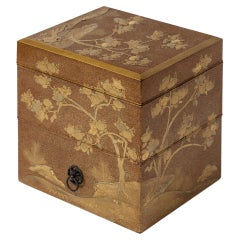
Japanese Lacquered Tebako
Box
Located in PARIS, FR
Tebako box with three compartments in golden and nashi-ji lacquer, decorated with golden, red, and kirigane lacquer, golden persimmon tree leaves, among rocks. The compartments are of increasing size from the top. The decoration is in continuity.
Persimmon has been cultivated in southern China for more than 2500 years and is believed to have been introduced to Japan in the 8th century. The veneer is a tree with very hard wood, similar to ebony. According to a legend, one specimen survived the atomic bombing of Nagasaki on August 9, 1945, close to the epicenter. It is therefore in Japan a symbol of strength and longevity. It is also the national fruit of the country. It is eaten as a traditional dish during New Year's Day celebrations.
Tebako literally means "portable box...
Category
Antique 1860s Japanese Lacquer
Materials
Lacquer
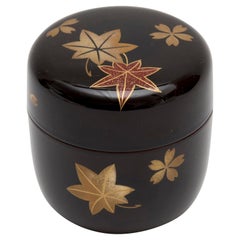
Japanese Lacquered Natsume
Tea Box
Located in PARIS, FR
Natsume in dark red lacquer, decorated with autumn leaves and cherry blossoms in hiramaki-e and nashiji. Interior in black lacquer.
Maple leaves (Momiji) are celebrated in literatur...
Category
Mid-20th Century Japanese Lacquer
Materials
Lacquer
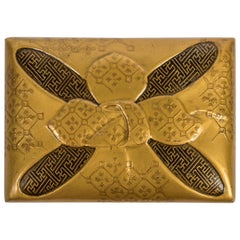
Japanese Lacquered Furoshiki Kobako
Box
Located in PARIS, FR
Rectangular and flat lacquer Kobako (small box) representing a furoshiki knot seen from above. Fundame background, furoshiki in takamaki-e with floral pattern, inside the folds of the fabric with black and gold sayagata pattern with togidashi maki-e technique. The saya (or sayagata) pattern is composed of Chinese swastikas...
Category
Antique Late 19th Century Japanese Lacquer
Materials
Lacquer
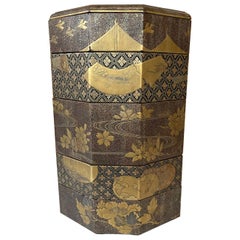
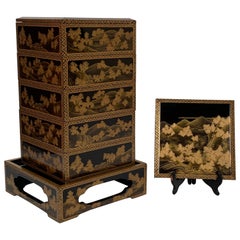
Japanese Maki-e Lacquer Stack Box Jubako
Located in Atlanta, GA
An antique jubako (stack boxes) with five tiers in an elongated octagon shape circa 19th century (end of Edo or beginning of Meiji period). jubako was traditionally used to store and...
Category
Antique 19th Century Japanese Japonisme Lacquer
Materials
Wood, Lacquer
Japanese Maki-e Lacquer Stacking Box, Jubako, Meiji Period, Japan
Located in Austin, TX
A fine and impressive Japanese gold maki-e decorated black lacquer five-tier jubako with presentation tray, two lids, and the original tomobako storage box, Meiji period, late 19th c...
Category
Antique Late 19th Century Japanese Meiji Lacquer
Materials
Lacquer
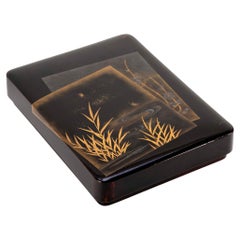
Black and Gold Lacquer Japanese Suzuribako Box
Located in Stamford, CT
19th century Japanese black and gold lacquer Suzuribako box with firefly and plum blossom design.
Category
Antique Late 19th Century Japanese Decorative Boxes
Materials
Lacquer
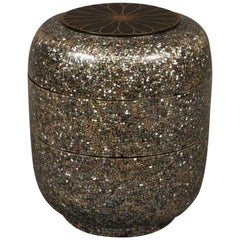
Antique Japanese Lacquer Stacking Food Box
Jubako
Located in Hudson, NY
With all-over mother of pearl inlay and mon design of chrysanthemum in gold and black lacquer on top. The chrysanthemum is a national symbol of Japan and the Imperial family.
Category
Antique 19th Century Japanese Lacquer
Materials
Gold
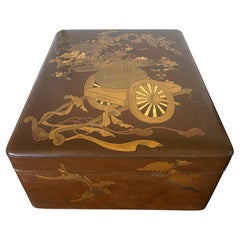
Japanese Lacquer Ryoshibako Document Box Meiji Period
Located in Atlanta, GA
A large Japanese lacquer box with elaborate Maki-e design from Meiji period, (mid-late 19th century). The generous size of the box was reser...
Category
Antique 19th Century Japanese Japonisme Lacquer
Materials
Wood, Lacquer
Japanese Rinpa Style Lacquer Box Meiji Period
Located in Atlanta, GA
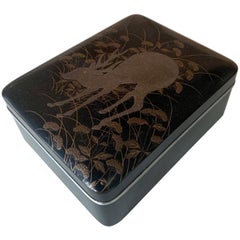
A black lacquer tebako (hand box) with maki-e decoration and silver trim, circa late 19th century, Meiji period. The surface of the lid features a Rinpa style maki-e paint depicting ...
Category
Antique 1890s Japanese Japonisme Lacquer
Materials
Wood, Lacquer
Japan Red Lacquered Box 19th Century
Located in Beuzevillette, FR
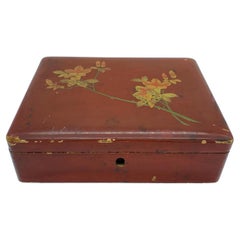
Beautiful Japanese box in red lacquered wood. The lid is decorated with flowering magnolia branches and signed by the artist. The inside of the box is covered with a paint loaded wit...
Category
Antique Late 19th Century Jewelry Boxes
Materials
Wood
More From This Seller
View AllVintage Japanese Temple Style Box
Located in Dallas, TX
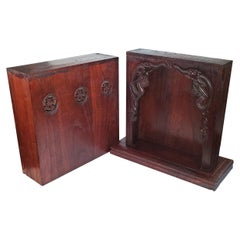
PRESENTING A LOVELY Vintage Japanese Temple Style Box.
Made of rosewood, this box has a cover featuring ‘Buddhist Swastikas’ on the front.
The cover lifts off to reveal a tabernacle with 2 carved dragons on wither side.
Probably made in the first quarter of the 20th Century, circa 1920-30.
Rectangular shaped for the storage of deities statues...
Category
Early 20th Century Japanese Japonisme Decorative Boxes
Materials
Wood
19C Anglo Ceylonese Specimen Wood Trinket Box
Located in Dallas, TX
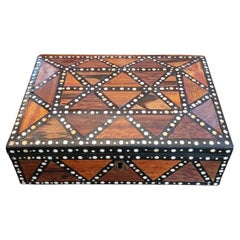
PRESENTING A BEAUTIFUL and RARE 19C Anglo Ceylonese Specimen Wood Trinket Box.
Made in ‘Galle’, Ceylon (now Sri Lanka) circa 1860-80.
Made for the ex...
Category
Antique 19th Century Sri Lankan Anglo-Indian Jewelry Boxes
Materials
Bone, Hardwood, Ebony, Sandalwood
19th Century Samson Paris Porcelain Trinket Box
By Samson
Cie
Located in Dallas, TX
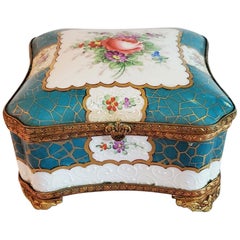
Presenting a gorgeous French 19th century Samson Paris Porcelain Trinket Box probably by Edme Samson.
Marked on the base with “Made in France” and unmistakably in the style and manner of Samson.
The lid features hand painted floral bouquets on an ivory porcelain background with gold edging, surrounded by a sky blue lid with gold web or crackling effect.. The lid is hinged and the lid and base are edged in floral gilt metal mounts with Fleur De Lis clasp. It sits on 4 gilt metal or ormolu feet. The sides are likewise hand decorated.
This wonderful antique hand painted box is just bursting with History. Inspired by Edme Samson of Samson & Co., Paris. we believe (based upon the markings and natural aging) that it was made between 1880– 1890 in France and was meant to resemble an antique of a much earlier period. It is very similar to Sevres pieces with it’s color, decoration and design.
Samson specialized in reproducing antiques from the 1600 and 1700s. One of his most interesting works was his Heraldic or Armorial pieces. With this medium sized box, he was not only copying the larger porcelain caskets or coffin boxes...
Category
Antique Late 19th Century French Louis XVI Jewelry Boxes
Materials
Ormolu
19C Anglo Indian Bombay MOP Sadeli Mosaic Trinket Box
Located in Dallas, TX
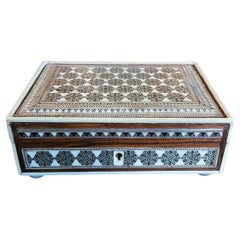
PRESENTING a LOVELY 19C Anglo Indian Bombay MOP (Mother of Pearl) Sadeli Mosaic Trinket Box from circa 1875-85.
Gorgeously detailed and hand-crafted ‘sadeli mosaic’ inlay, from the Bombay Area, with deep greens with silver, pewter, mother of pearl, bone and ebony in geometric patterns.
The box case, is made of sandalwood but completely covered in MOP, bone, faux ivory, ebony and mosaic inlay.
Edged with faux ivory and banded with a different pattern of sadeli mosaic.
Some minor damage to the top (repair is obvious in pics) and ivorine replacements to some edging, but it still a BEAUTIFUL BOX and of real QUALITY!
The mosaic work is FABULOUS!
Box opens to reveal its original blue velvet lining.
It sits on 4 (recently added) silvered button feet.
SADELI MOSAIC: “Anglo Indian boxes were made in India for the English residents from the early part of the 18th century. They were brought back or sent back to England usually by the people who had commissioned them. From the beginning of the nineteenth century they were imported more commercially, although not in any significant numbers until the middle decades. They were very highly valued, especially the early ones, to the extent that the designs were copied on late 19th and early 20th century tins.
The ancient art of Sadeli Mosaic is said to have been introduced from Shiraz in Persia via Sind to Bombay, a long time before the Anglo Indian boxes were made. It was a technique, which required a high degree of skill and patience. It was executed very lavishly, in that the frequent cuts wasted a great amount of the precious materials used. The workmanship was however more than commensurable to the value of the materials.
Ivory, silver, pewter (or other metals), wood and horn were cut into faceted rods which were bound together to form geometric patterns. When the glue has set, the rods were sliced in transverse sections. This gave the maker a number of angled circular pieces in the original pattern. Several variations of patterns could be achieved by combining the materials in different ways. The ivory was sometimes dyed green to give an extra color.
The mosaic pieces in a combination of patterns, often separated by ivory, ebony, horn or silver stringing were used to veneer sandalwood boxes. In the early boxes, which date from the turn of the 18th to the 19th century, there are large panels of mosaic covering tops and sides of boxes. It took incredible skill to cover such large areas without any shakes or wavering of the pattern. The corners and joins on these boxes are impeccably matched.
The makers (reputed to be Persian) of Sadeli mosaic made in the first two decades of the 19th century displayed a total understanding of the qualities of the different materials they used. They combined substances, which can expand and contract according to atmospheric conditions with others, which are hard and unyielding. The result was a sharp definition of the lines and patterns, which made up the whole design.
On the early boxes the designs look deceptively simple. The fact is, they emerged from a culture, which had mastered geometry and understood how to generate a pattern from a set number of points. The patterns are so harmoniously combined that their incredible complexity is not immediately apparent.
The earliest Sadeli boxes...
Category
Antique Late 19th Century Indian Anglo-Indian Jewelry Boxes
Materials
Silver
19C Anglo Indian Vizigapatam Stamp Box
Located in Dallas, TX
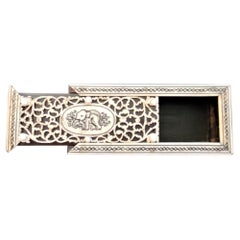
Presenting an absolutely gorgeous and very rare 19C Anglo Indian Vizigapatam stamp box.
Made in Colonial India (the Time of the Raj) circa 1860.
Prob...
Category
Antique Mid-19th Century Indian Anglo-Indian Decorative Boxes
Materials
Bone, Shell
Set of 6 Mindanao Brass Silver Betel Boxes, Philippines
Located in Dallas, TX
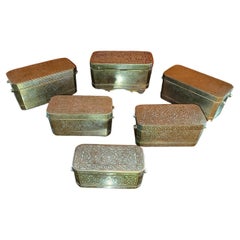
Presenting an amazing set of 6 Mindanao brass silver betel boxes, Philippines.
Betel chewing was prevalent in the southern Philippines as in much o...
Category
Antique Late 19th Century Philippine Islamic Tea Caddies
Materials
Silver, Brass, Copper
Still Thinking About These?
All Recently ViewedMore Ways To Browse
Antique Anthropology
Black Trinket Boxes
Arts And Crafts Copper Box
W Z
Japanese Lacquer Box With Drawers
Japanese Applique
Black Lacquer Chinoiserie Boxes
Japanese Trinket Box
Asian Trinket Boxes
Pagoda Drawers
Chinoiserie Trinket Box
Swedish Chinoiserie
Black Lacquer With Gold Art
Japanese Lacquered Art
Japanese 19th Century Lacquer
Asian Black Lacquer Furniture
Vintage Japanese Lacquer
Japanese Lacquer Meiji