Want more images or videos?
Request additional images or videos from the seller
1 of 18
Antique Bronze Buddha Head on Wood Stand
Price:$850
About the Item
- Dimensions:Height: 13 in (33.02 cm)Width: 5 in (12.7 cm)Depth: 4.5 in (11.43 cm)
- Style:Tibetan (Of the Period)
- Materials and Techniques:
- Place of Origin:
- Period:
- Date of Manufacture:circa 1800s or earlier
- Condition:Wear consistent with age and use. Well preserved, with original beautifully aged warm dark green patina. Wear consistent with age, handling exposure. Minor pinhole pitting around neck, oxidation, scattered verdigris. Saw marks to bottom, indicative of being removed from body.
- Seller Location:Forney, TX
- Reference Number:1stDibs: LU5977240087192
About the Seller
4.8
Platinum Seller
Premium sellers with a 4.7+ rating and 24-hour response times
Established in 2013
1stDibs seller since 2021
316 sales on 1stDibs
Typical response time: 1 hour
Authenticity Guarantee
In the unlikely event there’s an issue with an item’s authenticity, contact us within 1 year for a full refund. DetailsMoney-Back Guarantee
If your item is not as described, is damaged in transit, or does not arrive, contact us within 7 days for a full refund. Details24-Hour Cancellation
You have a 24-hour grace period in which to reconsider your purchase, with no questions asked.Vetted Professional Sellers
Our world-class sellers must adhere to strict standards for service and quality, maintaining the integrity of our listings.Price-Match Guarantee
If you find that a seller listed the same item for a lower price elsewhere, we’ll match it.Trusted Global Delivery
Our best-in-class carrier network provides specialized shipping options worldwide, including custom delivery.You May Also Like
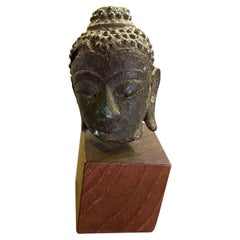
Bronze Thai Siam Temple Shrine Kamphaeng Phet Style Buddha Head on Wood Stand
Located in Studio City, CA
A wonderful, little gem of a piece. Thai/ Siam meditating buddha with serenely closed eyes in the Kamphaeng Phet style. The piece has a beautiful patina acquired over time.
From a collection of Asian antiques. Would make for a nice addition to any South-East Asian artifacts...
Category
Antique 19th Century Thai Sculptures and Carvings
Materials
Bronze
$395
H 3.5 in W 1.5 in D 1.5 in
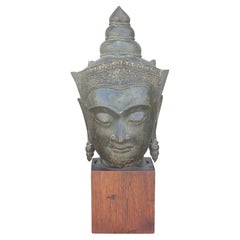
Early Bronze Thai Buddha Head Mounted on Block
Located in Kilmarnock, VA
A remarkable Buddha’s head dating from the 17th to 18th century, originating from the historic Ayutthaya Kingdom in Thailand. This larger-sized sculpture exhibits a terrific aged pat...
Category
Antique 18th Century Thai Metalwork
Materials
Bronze
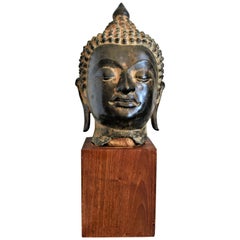
Antique Asian Cast Bronze Buddha Head Fragment Bust Sculpture Thai, 18th Century
Located in Hamilton, Ontario
Antique Asian and extremely detailed cast bronze fragment of the head of Buddha, dating from the 18 century and presumably having Thai or Tibetan origins. The sculpture fragment is s...
Category
Antique 18th Century Thai Tibetan Metalwork
Materials
Bronze
$1,750
H 13.6 in W 5 in D 6 in
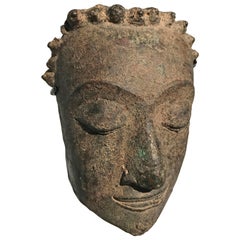
Fragment of Bronze Head of Buddha, Thailand
Located in Schellebelle, BE
Fragment of Bronze Head of Buddha
Thailand
16th Century
Category
Antique 16th Century Thai Metalwork
Materials
Bronze
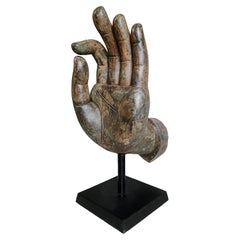
Mid 20th Century Cast Bronze Buddha Hand Sculpture, On Stand
Located in New York, NY
A large cast bronze sculpture of a Buddha's left hand, circa 1960. Mounted on a trapezoid-shaped wood and metal stand.
The gesture is known as Dharmachakra Mudra, the traditional B...
Category
Vintage 1960s Thai Other Sculptures
Materials
Bronze
$1,320 Sale Price
20% Off
H 27 in W 11 in D 12 in
Antique Bronze Buddha Figure C1920
Located in Big Flats, NY
Antique Bronze Buddha Figure C1920
Measures - 5 1/2" x 3 7/8" x 2 3/4"
An antique bronze Buddha figure from circa 1920. The figure is seated in a meditative pose on a lotus base. T...
Category
Early 20th Century Metalwork
Materials
Bronze
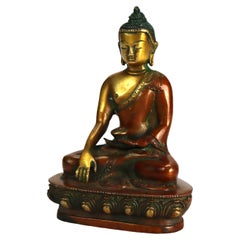
Small Antique Bronze Buddha Head Sculpture with Verdigris on Stand
Located in Moreno Valley, CA
Small antique Southeast Asian cast bronze buddha head sculpture with verdigris patina mounted on a black base wood stand.
Bronze Sukhothai style Buddha bronze head with green patina,...
Category
Antique Late 19th Century Thai Tibetan Sculptures and Carvings
Materials
Bronze

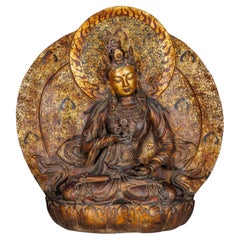
A Monumental Gilt-Lacquered Bronze Ornamental Buddha Sculpture of Vajravidarana
Located in Queens, NY
A Monumental Gilt-Lacquered Bronze Ornamental Buddha Sculpture of Vajravidarana:
A Masterpiece of Sino-Tibetan Craftsmanship, Late 19th Century, Qing Dynasty
This monumental gilt-lacquered bronze ornamental sculpture of Vajravidarana is an extraordinary and commanding piece of art, showcasing the pinnacle of Sino-Tibetan craftsmanship from the late 19th century. The figure of Vajravidarana, a powerful purification deity in Tibetan Buddhism, is meticulously sculpted to embody both spiritual authority and artistic excellence.
Vajravidarana is primarily known for his role in removing spiritual impurities and negativities. Unlike other deities associated with wisdom or compassion, Vajravidarana’s function is centered on purification and healing. He is typically depicted holding a vajra and a bell, symbolizing the cutting away of delusions and the resonance of divine truth. In this striking sculpture, Vajravidarana is shown holding a vishva vajra (the double vajra), a unique and powerful variation of the traditional iconography, which signifies ultimate protection and the dispelling of negative karma.
Vajravidarana: The Supreme Purifier and Protector
Vajravidarana is revered in Tibetan Buddhism as the deity of spiritual purification, called upon to cleanse practitioners of defilements and negative influences. His vajra represents the indestructibility of truth, while his bell signifies the wisdom that resonates through purification rituals. In this sculpture, the presence of the vishva vajra, or double vajra, enhances his association with supreme protection, ensuring the destruction of all spiritual obstacles and afflictions.
The figure’s powerful yet composed expression conveys a sense of unwavering resolve and divine authority. His posture, along with the carefully sculpted details of his robes and ornaments, highlights his function as a guardian against impurity. The inclusion of the vishva vajra rather than the usual single vajra reinforces his role as a supreme protector, capable of dispelling all forms of negativity and restoring balance.
Symbolism of the Mantras and Aureole:
Unlike deities that embody wisdom through duality, Vajravidarana’s iconography is centered on purification and exorcism. The aureole surrounding him is inscribed with sacred purification mantras rather than depictions of a consort. These mantras emphasize his function as a remover of obstacles and impurities, reinforcing his role in Buddhist healing rituals.
The presence of the sacred inscriptions elevates the sculpture’s spiritual significance, making it a focal point for meditation and ritual purification. Practitioners often visualize Vajravidarana radiating purifying light, dissolving afflictions and negative karma. This theme is mirrored in the sculptural repetition of the purification symbols on the aureole, reinforcing the deity’s role as a divine cleanser.
Gilt-Lacquered Bronze: The Artistry of Sino-Tibetan Metalwork:
The craftsmanship of this monumental figure reflects the expertise of late 19th-century Sino-Tibetan metalwork, where traditional Tibetan themes were infused with Chinese artistic sensibilities. Cast in bronze and finished with a rich gilt lacquer, the statue has an otherworldly glow, giving it an ethereal, almost divine presence. The gilding process—applied with exceptional skill—gives the sculpture a striking luminosity that enhances the fine details of the facial features, flowing robes, jewelry, and other elements of the deity’s attire.
The technique employed to create this figure speaks to the high level of craftsmanship that flourished during the late Qing Dynasty and early modern Tibetan art. The ornate details of the robes and the fine texture of the sculpture highlight the exceptional skill of the artisans who brought this work to life. The use of gold and lacquer not only reflects the preciousness of the sculpture but also its spiritual significance as an object meant to inspire reverence and meditation.
An Ornamental Sculpture of Monumental Scale:
Unlike smaller devotional objects, this sculpture is designed as an ornamental masterpiece, intended to make a grand visual and spiritual statement. Its monumental size allows it to dominate any space, offering a commanding presence that is both physically and symbolically impressive. In Buddhist practice, large sculptures of this nature are often placed in temples or meditation halls, where their imposing size and serene presence would encourage contemplation and devotion.
The grand scale of the statue further amplifies the spiritual power it is meant to convey. As a representation of Vajravidarana, it is not only a physical object of beauty but also a conduit for meditation, purification, and enlightenment. The scale of the sculpture also emphasizes the divine stature of the deity, highlighting his importance in the Buddhist tradition as the ultimate force for spiritual cleansing and protection.
Provenance:
Acquired in China in circa 1900
1905 Private Buddhist Temple, Northeast, USA
Private Sale
Solomon Treasure...
Category
Antique Late 19th Century Chinese Tibetan Metalwork
Materials
Bronze
$173,500
H 43 in W 43 in D 12 in
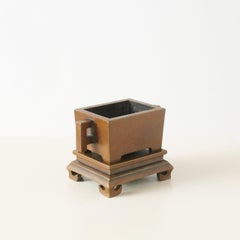
Bronze Rectangular Censer on Footed Stand
Located in San Francisco, CA
Bronze Rectangular Censer with Base, Marked “Qin Shu Lu”
A bronze rectangular censer with single side handle, resting on a tiered bronze base with small corner feet. The piece has a...
Category
20th Century Chinese Metalwork
Materials
Bronze
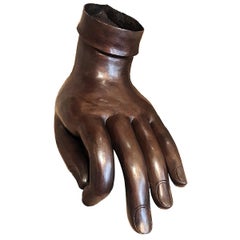
Polished Bronze Buddha Hand
Located in New York, NY
A polished dark bronze Buddha hand sculpture, contemporary. Dharmchakra Mudra, the traditional gesture of Teaching. Suitable for placing on the flo...
Category
2010s Thai Other Figurative Sculptures
Materials
Bronze
More From This Seller
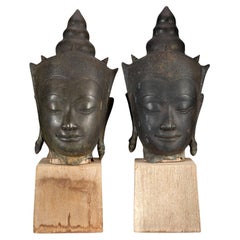
View AllPair of Antique Thai Ayutthaya Period Bronze Crowned Buddha Head on Wood Stand
Located in Forney, TX
A remarkable pair of Thai Ayutthaya period bronze crowned Buddha mounted on wood display stands. Thailand. 17th/18th Century
Dimensions: (approx)
Head: 15" High, 7.75" Wide, 6" Deep (tallest)
Overall: tbd
Provenance / Acquisition:
Acquired from the highly reputable auction house Heritage Auctions, Dallas, Texas.
2024 March Fine & Decorative Asian Art Signature Catalog Auction #8155 Lot #78357
Condition Report:
Attractive pair with beautifully aged patina, condition commensurate of age, use, and exposure. Scattered areas of desirable verdigris green patina and oxidation throughout to each. Minor loss to front shell point of one example. Small holes scattered throughout and scews/nails through each fixing both examples to wooden bases. Both well preserved and present superbly
History:
The first Crowned Buddha images or Jambupati Buddha statues are known to have been originated from the Pyu, where the Indian influence of Buddhist arts and non-Theravada Buddhism was extremely felt in those days. There may have been various background stories behind the crowned Buddha statues in the course of history but one of the most popular stories goes by the legend of Jambupati. This particular legend is not known in the home of Buddhism India, however the crowned Buddha statues have been attached to the name Jambupati as the Buddha is believed to have humbled a boastful and arrogant king Jambupati. The story goes on about how the Buddha transformed himself into a mighty king with a crown and jewelry and set himself a majestic yet incomparable palace. Seeing this, the king accepted the great ability of the Buddha and submitted himself to the Dharma and became a Buddhist monk. This particular story has gained a lot of popularity and stood the test of time in Burma as the number of Crowned Buddha statues in Burma is considerably great in amount.
There are also other versions of the background story of crowned statues...
Category
Antique 17th Century Thai Folk Art Metalwork
Materials
Bronze
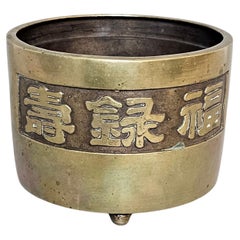
Antique Chinese Qing Bronze Censer Incense Burner Cachepot
Located in Forney, TX
A high quality Qing Dynasty (1636-1912) Chinese bronze brazier censer (today use as an incense burner - cachepot planter - decorative table box) encircled with traditional characters, rising on three ball feet, nicely patinated. Functional and decorative, it's a superb example of antique Asian...
Category
Antique 19th Century Chinese Qing Metalwork
Materials
Bronze
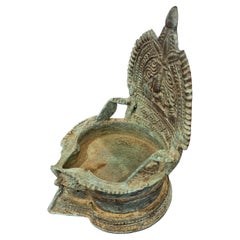
Antique Indian Patinated Bronze Oil Lamp 19th Century South India
Located in Forney, TX
A charming early patinated metal oil lamp, India, 19th century or earlier.
Most likely originating in the South Indian state of Tamil Nadu, richly cast using the renowned ancient b...
Category
Antique 19th Century Indian Anglo-Indian Metalwork
Materials
Bronze
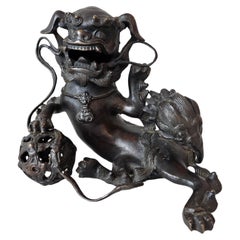
Antique Japanese Patinated Bronze Buddhistic Lion Censer 17th/18th Century
Located in Forney, TX
A remarkable Edo Period (1603-1868) Japanese patinated bronze Buddhistic lion censer, exceptionally executed sculptural shishi foo dog form, finely detailed, retaining the original r...
Category
Antique 18th Century Japanese Edo Metalwork
Materials
Bronze
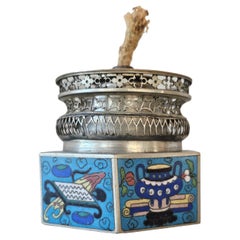
Antique Chinese Cloisonne Enamel Opium Oil Lamp
Located in Forney, TX
A rare and a bit unusual Qing Dynasty (1636-1912) cloisonne enameled opium lamp. Originating in China in the 19th century, the silver-tone oil lamp features a six sided base with uni...
Category
Antique 19th Century Chinese Qing Metalwork
Materials
Metal, Enamel
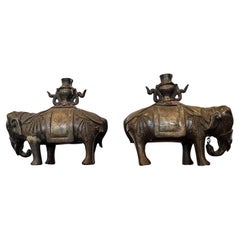
Pair 18th/19th Century Chinese Bronze Elephant Figure Candle Holder Sculptures
Located in Forney, TX
A pair of finely cast and incised burnished bronze candlestick elephants, Chinese school, 18th-19th Century, Qing Dynasty (1636-1912).
Each elephant is standing foursquare with head...
Category
Antique Early 19th Century Chinese Qing Metalwork
Materials
Bronze